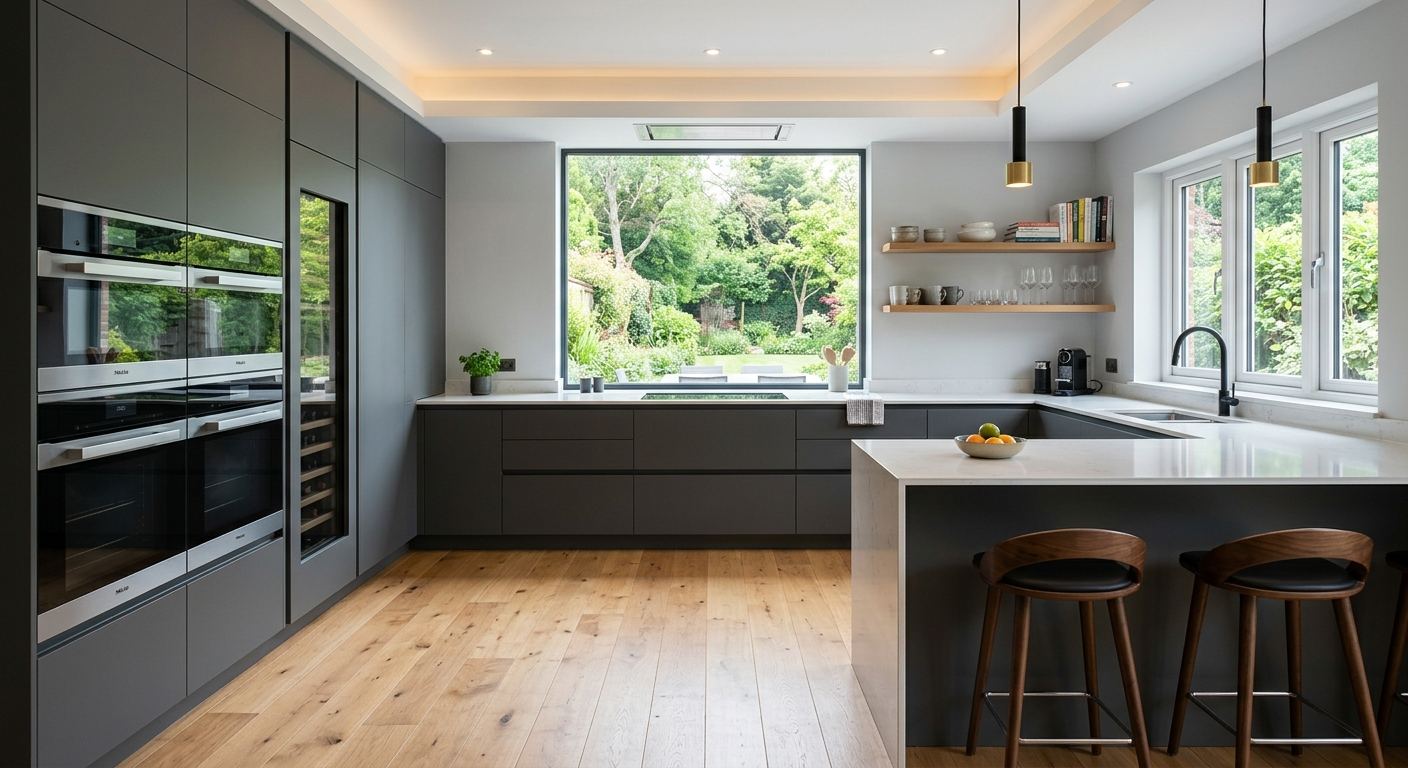
Kitchen renovation options and costs in Trail
Trail, British Columbia is a practical place to renovate kitchens: most homeowners balance style with durability because houses are often older and daily life is hard on surfaces. With a median household income of about $68,000 (Statistics Canada, 2021 Census), many renovations in the Kootenay area land in the refresh-to-mid-range tier—new cabinets and counters, but not full structural reworks. That said, Trail’s housing mix is weighted toward single-detached homes, with 70.4% of dwellings being detached, and 87.4% of homes built before 1981 (Statistics Canada, 2021 Census). Older framing and dated electrical/plumbing runs are common, so even “standard” projects often need thoughtful planning for what’s behind the walls.
Local costs in the Kootenay region are also influenced by market expectations: when homeowners plan for resale, the finishing choices (laminate vs. quartz vs. natural stone) usually track what buyers will recognize as good value. Contractor availability can add variation too—if your scope needs coordinated trades (cabinet install plus electrical, plumbing, and tile), lead times and scheduling can tighten. In Trail’s popular areas such as the north end (around Columbia Avenue and neighbourhood streets near local schools and shopping), kitchen upgrades are especially in demand as homeowners update older homes with more functional layouts and modern finishes.
Below are common renovation tiers and what you can typically expect for duration and budget, to help you compare quotes apples-to-apples before you sign anything.
| Renovation Tier |
What's Included |
Typical Duration |
Price Range |
| Cosmetic refresh (paint, hardware, new appliances only) |
Cabinet paint or touch-ups, new hardware, appliance swap (no plumbing/gas changes), basic cleaning/deep prep |
3–7 days |
$5,000–$12,000 |
| Mid-range full renovation (new cabinets, counters, sink, tile) |
New semi-custom or stock cabinets, countertop (laminate or entry quartz), sink + faucet, backsplash tile, new flooring transitions as needed |
2–4 weeks |
$30,000–$55,000 |
| High-end full renovation (custom cabinets, stone counters, island) |
Fully custom cabinets, quartz or natural stone (granite/stone), island with upgraded lighting, upgraded tile/backsplash (including higher-end selections), coordinated electrical/plumbing |
4–8 weeks |
$55,000–$80,000 |
| Cabinet refacing only (new doors + drawer fronts, same boxes) |
Refacing to match or improve layout, new doors/drawers, new hardware, optional paint on cabinet interiors, backsplash refresh if scope allows |
1–2 weeks |
$8,000–$25,000 |
| Countertop swap only (laminate to quartz or stone) |
Removal and install of new countertops, new sink cut-outs as required, basic sealants and finishing for edges |
3–8 days |
$5,000–$12,000 |
| Backsplash tile installation only |
Tile supply and install, surface prep, caulking and grouting, trim/edge finishing around outlets and corners |
3–6 days |
$1,200–$5,000 |
Prices are estimates only and vary by project scope, site access and material selection.
What affects the price of kitchen renovation in Trail
In Trail and across British Columbia, it’s common to see quotes for the “same” kitchen differ by 30–50%. The biggest driver usually isn’t climate—it’s the mix of materials and trade coordination that homeowners choose based on local housing values and household income. In Kootenay, many projects are priced to remain sellable and defensible at resale, so finish tiers tend to follow what buyers will pay attention to: cabinet quality, countertop appearance, and the overall layout. In higher-value neighbourhoods and higher-income situations, homeowners more often justify quartz or stone counters and semi-custom cabinetry because the renovation cost is easier to recover on resale. In more modest setups, laminate and stock cabinets are popular because they deliver a visible update without pushing the total beyond the typical mid-range bands.
Layout changes are where your budget can swing, regardless of finish. Removing a wall, adding an island, or moving a gas line/plumbing run can add unpredictable costs because contractors must open walls, confirm framing/structural details, and coordinate permits and inspections. For example, a cabinet-and-counter refresh that might land near $30,000–$55,000 can climb quickly if you also relocate plumbing for a new sink or change venting for a range hood. Likewise, if your home built before 1981 has older supply lines, the price to replace or access them can push a “countertop swap” above $5,000–$12,000.
Two Trail-specific examples that commonly move the needle: (1) older homes often have out-of-square walls, which increases labour for cabinet installation and may require more shims and filler materials; (2) if the kitchen connects to exterior doors or entryways, seasonal condensation and temperature swings can highlight weak seals—so contractors may recommend better caulking, backsplash detailing, and sometimes flooring transitions. Availability of skilled tile and stone installers can also affect schedule, which influences labour pricing when multiple trades are overlapping.
| Price Factor |
Why It Matters |
Cost Impact |
| Cabinet tier — stock vs. semi-custom vs. fully custom millwork |
Material quality, door thickness, internal hardware, and how well the unit fits older Trail walls |
Can add roughly $10,000–$25,000 between tiers on full renovations |
| Countertop material — laminate vs. quartz vs. granite vs. stone |
Durability, edge profiles, heat resistance, and seam layout complexity |
Typical countertop line-item can vary by $2,500–$10,000+ |
| Layout change — wall removal, island add, plumbing/gas move |
Trade coordination, permit requirements, and hidden structural/plumbing constraints |
Often the single biggest swing: +$5,000 to $20,000+ depending on scope |
| Appliance package tier — builder vs. mid-range vs. pro-grade |
Electrical/gas requirements, venting needs, and fitting complexity |
Can shift budget by several thousand dollars |
| Flooring — refinish existing vs. full replacement |
Subfloor condition and whether old materials must be removed for underlayment and transitions |
Replacements commonly add $2,000–$8,000 |
| Backsplash — ceramic tile vs. marble vs. full-height slab |
Prep difficulty, cutting around outlets, grout/finishing complexity and material cost |
Often $1,200–$5,000+ with full-height finishes at the high end |
| Electrical — new circuits for island, under-cabinet lighting |
Code-compliant wiring runs and fixture installation |
Typically +$1,000–$5,000+ depending on new circuits and lighting layout |
| Permit fees and licensed trade requirements |
Permits, inspections and licensed trades add both cost and scheduling time |
Often adds a few hundred to several thousand dollars depending on work |
Permits & regulations in British Columbia
In British Columbia, a simple cabinet or countertop swap is usually straightforward from a permitting standpoint. Typically, replacing cabinets and installing new countertops (without changing plumbing, gas lines, or electrical circuits) generally does not require a permit. However, when your kitchen renovation starts to alter the “systems” of the home, permits and licensed trades become part of the job.
Work that commonly does require a permit and licensed trades includes moving plumbing supply or drain lines (for example, relocating a sink or adding a dishwasher where plumbing isn’t already there), relocating gas lines (including changes to a stove/range setup or venting), removing a load-bearing wall, and adding electrical circuits (such as for an island receptacle count, under-cabinet lighting tied into new wiring, or new dedicated circuits for appliances). Gas work must be completed by a licensed gas fitter, and electrical work must be done by a licensed electrician—both require inspections after installation.
To verify a contractor in Trail, start with licensing and proof of responsibility in writing. Ask for:
- A valid contractor licence/registration information appropriate to the trades performing work (and the trades’ own licences for gas and electrical).
- Certificate of Insurance for liability coverage (request the COI and confirm it’s current).
- Proof of worker protection coverage (WSIB/WCB coverage as applicable) and ask how subcontractors are handled.
- A clearance letter or equivalent documentation when provided by the province for eligible trades/employers.
Make sure the contract clearly states who is pulling permits and paying permit fees. Don’t assume—confirm before work starts.
Cabinets, countertops and layout decisions in Trail
When planning a Trail kitchen renovation, three decisions determine most of your cost and how happy you’ll be with the finished space: (1) cabinet tier, (2) countertop material, and (3) whether you change the layout. For cabinets, stock options are the fastest and cheapest, semi-custom is the most popular mid-range choice, and fully custom millwork is for the best fit and highest flexibility. For countertops, laminate is budget-friendly, quartz offers strong everyday performance with minimal maintenance, granite/stone provides a premium look, and butcher block or marble can be beautiful but require more intentional care.
Trail’s real-world wear and tear matters. In older homes (87.4% built before 1981), walls and base elevations can be uneven, so cabinet fit and installation technique become more important than in newer builds. If your project budget is closer to a mid-range full renovation at $30,000–$55,000, semi-custom cabinets paired with quartz are often the sweet spot for a clean, resale-friendly finish. If you push into the high-end range around $55,000–$80,000, adding an island and upgrading to full-height backsplash details can justify custom cabinetry because you’re changing function and presenting more visible surface area.
Layout-wise, an open-concept wall removal or island addition is most cost-justified when it improves workflow and storage—not just for aesthetics. Plumbing/gas relocation is where budgets rise fastest because it can involve hidden work and coordination. For a concrete example: if upgrading to quartz versus laminate is roughly a few thousand dollars in material and install, it’s usually worth it for busy kitchens. But if choosing quartz requires delaying the island because the plumbing move is uncovered, you may be better off stabilizing the layout first and upgrading surfaces in phase two.
| Option |
Durability |
Maintenance |
Best For |
Price Range |
| Stock cabinets (big-box) |
Good daily durability, but fit can be more variable in older homes |
Low maintenance; hinges/hardware may need adjustment over time |
Budget-focused refresh with fewer custom requirements |
$10,000–$20,000 |
| Semi-custom cabinets (local dealer) |
Strong build quality with more door/drawer and layout options |
Low maintenance; better component consistency |
Most Trail renovations targeting mid-range resale value |
$16,000–$30,000 |
| Custom cabinets (local millwork shop) |
Excellent durability with tailored fit and built-in solutions |
Low maintenance; hinges/hardware quality is often higher |
Complex layouts, imperfect walls, and premium storage needs |
$25,000–$45,000 |
| Laminate countertop |
Moderate durability; seams and edges are the weak points |
Wipe clean; avoid cutting directly and protect edges from impacts |
Cost control when doing a full cabinet/counter refresh |
$2,500–$6,000 |
| Quartz engineered countertop |
High durability and resistant to everyday staining and abrasion |
Low maintenance; no sealing required for typical quartz |
Busy kitchens needing a modern look with less upkeep |
$6,000–$11,000 |
| Granite / natural stone countertop |
Very durable and heat-tolerant; unique patterns and veining |
May require periodic sealing; clean carefully for long life |
Premium look when budget allows higher material and install |
$8,000–$14,000 |
| Butcher block countertop |
Durable but susceptible to water staining and knife marks if abused |
Regular oiling and prompt drying; best with good habits |
Warm, traditional style for kitchens that get attentive care |
$5,000–$10,000 |
| Marble countertop |
Visually premium but more vulnerable to etching and staining |
Requires careful cleaning; sealing and ongoing protection matter |
Low-to-moderate kitchen wear and a high design focus |
$9,000–$16,000 |
How to choose a kitchen renovation contractor in Trail
Choosing the right contractor is especially important in Trail because many kitchens sit in older homes where unexpected issues are common—out-of-square framing, older wiring, and plumbing that’s harder to access. Start by verifying British Columbia compliance for the trades involved. Ask for proof of liability insurance (certificate of insurance showing active coverage), and confirm worker protection coverage (WSIB/WCB as applicable) so you’re not exposed if something goes wrong on site. For gas and electrical changes, require the contractor to show the relevant licensed trade documentation for those scopes. Then verify the licence status using the appropriate online registries for the trades and licence numbers provided.
Next, request 2–3 itemised written quotes—not just a lump sum. You want a breakdown of labour and materials for cabinets, countertops, tile/backsplash, electrical/plumbing allowances, disposal, and any site-prep. Confirm what’s excluded: for example, is drywall repair included after cabinet removal, is permit pulling included, and is waste disposal/haul-away included? Make sure the quote clearly states whether finishes are allowance-based (and how overages are handled).
Warranty matters too. Ask for (1) the workmanship warranty length (how long they cover installation issues), (2) the product/manufacturer warranty details for cabinets/counters, and (3) whether those warranties transfer to you if you sell the home. For payment scheduling, avoid heavy deposits: never pay more than 10–15% upfront, and use a holdback until the job is fully complete and any deficiencies are corrected. Finally, require a written timeline with a start date and estimated completion—kitchen timelines often hinge on cabinet fabrication and scheduling of tile/stone and licensed trades.
- Confirm the scope includes site measurements, layout verification, and cabinet/counter templates.
- Check that permits (if needed) are explicitly assigned and included in the plan.
- Require an itemised labour/material breakdown, not only a “materials allowance.”
- Ask who handles disposal/haul-away and whether it’s included.
- Verify liability insurance is active and covers renovation work.
- Confirm WSIB/WCB coverage (or equivalent worker protection documentation) for workers.
- Ensure gas work is by a licensed gas fitter and electrical by a licensed electrician.
- Get the workmanship warranty in writing, including what triggers service calls.
- Ask whether manufacturer warranties are included and if they’re transferable.
- Review the payment schedule and keep a holdback until punch list completion.
- Confirm the project schedule accounts for cabinet lead times and inspection windows.
- Ask how they handle unforeseen issues in older Trail homes (change orders process).
Red flags to watch for in Trail: (1) quotes that don’t specify whether plumbing/gas/electrical changes are included or excluded; (2) “we’ll figure permits out later” language; (3) vague warranties or no written workmanship coverage; (4) large upfront payments beyond 10–15%; and (5) no proof of insurance or worker protection coverage when you ask.
Frequently asked questions — kitchen renovation in Trail
What's the best countertop material for a busy Trail kitchen?
For a busy Trail kitchen, quartz is often the best balance of durability and low maintenance. It holds up well to day-to-day cooking, wiping, and busy households, and it avoids the ongoing sealing that some natural stones need. If you’re keeping the renovation in the mid-range, a kitchen that lands around $30,000–$55,000 commonly pairs semi-custom cabinets with quartz to hit a “looks premium, works hard” result buyers recognize. Laminate can also work if you’re doing a tighter scope and want to redirect funds to cabinet quality or an improved layout. In older homes, good installation and careful sealing around the sink and edges is what really protects your investment—no matter which surface you pick.
How do I add an island to my Trail kitchen?
Adding an island starts with layout and services. If your island is purely cosmetic (seating only, no sink or cooktop), the work is usually more straightforward and often cheaper because you’re not moving plumbing or gas. If you want a sink, dishwasher, or a cooktop/hood, plan for moving drain/supply lines and possibly gas venting—these items typically trigger permits and licensed trades in British Columbia. In Trail’s older housing stock, you may also need extra carpentry adjustments for floor level and wall alignment. Budget-wise, an island can push a mid-range project upward; many homeowners who stay around $30,000–$55,000 choose quartz and keep the island simple. Higher-end island builds with service relocations more often land nearer $55,000–$80,000.
How much does a kitchen renovation cost in Trail?
In Trail, kitchen renovation cost commonly depends on whether you’re refreshing, doing a mid-range full renovation, or moving into a high-end layout and finish package. A cosmetic refresh (paint, hardware, and appliances only) often starts around $5,000–$12,000. A mid-range full renovation typically lands around $30,000–$55,000, especially when replacing cabinets and counters and adding backsplash tile. If you’re choosing custom cabinetry, stone counters, and adding an island with coordinated electrical/plumbing, higher-end jobs often fall in the $55,000–$80,000 range. Because many homes in Trail were built before 1981, expect that some hidden conditions (electrical updates, older plumbing access, wall inconsistencies) can affect the final cost even with a well-planned budget.
How long does a kitchen renovation take in Trail?
Timelines vary by scope and material lead times, but a good rule of thumb is: cosmetic refreshes take about 3–7 days, while mid-range full renovations often take 2–4 weeks. High-end full renovations are commonly 4–8 weeks, largely because custom cabinetry and premium countertop fabrication can add time, and because inspections must be scheduled for any permitted electrical/gas/plumbing work. In Trail, weather matters less than trade scheduling and cabinet/counter lead times, but indoor acclimation for materials is still important. If your renovation changes layout—especially moving plumbing or adding circuits—add buffer time for discovery work (opening walls) and inspection windows. A contractor who gives you only “a range” without a start date and completion estimate in writing should be questioned.
Quartz vs granite countertops — which is better?
“Better” depends on your priorities. Quartz is usually the better choice for a busy Trail household because it’s engineered for consistent performance: it resists staining and scratches better for everyday use and generally doesn’t require sealing like some natural stones. Granite is also very durable and heat-tolerant and offers unique natural patterns that many homeowners love for appearance. The trade-off is typically maintenance—granite may need periodic sealing and more careful cleaning to protect the surface. Cost is another factor: countertop installs often fall around $6,000–$11,000 for quartz, while granite/natural stone can trend higher depending on slabs and edge profiles. Many clients choose quartz to keep the project in the mid-range while still achieving a premium, clean look.
Should I reface or replace my cabinets?
Refacing can be the better option when the existing cabinet boxes are solid, straight, and able to support new doors and drawer fronts—especially if you’re trying to keep costs and dust/time down. Replace is usually the smarter move when boxes are damaged, too out-of-level, or when the layout needs significant upgrades (functional changes, new storage configurations, or improved base/corner solutions). In older Trail homes built before 1981, uneven walls can reduce the benefits of refacing if the underlying frames aren’t true. If you’re weighing cost, cabinet refacing often fits a budget near $8,000–$25,000, while a full cabinet replacement can push a renovation toward the $30,000–$55,000 mid-range totals once counters, tile, and finishing are included. The best way to decide is a site assessment of your current boxes and installation conditions.