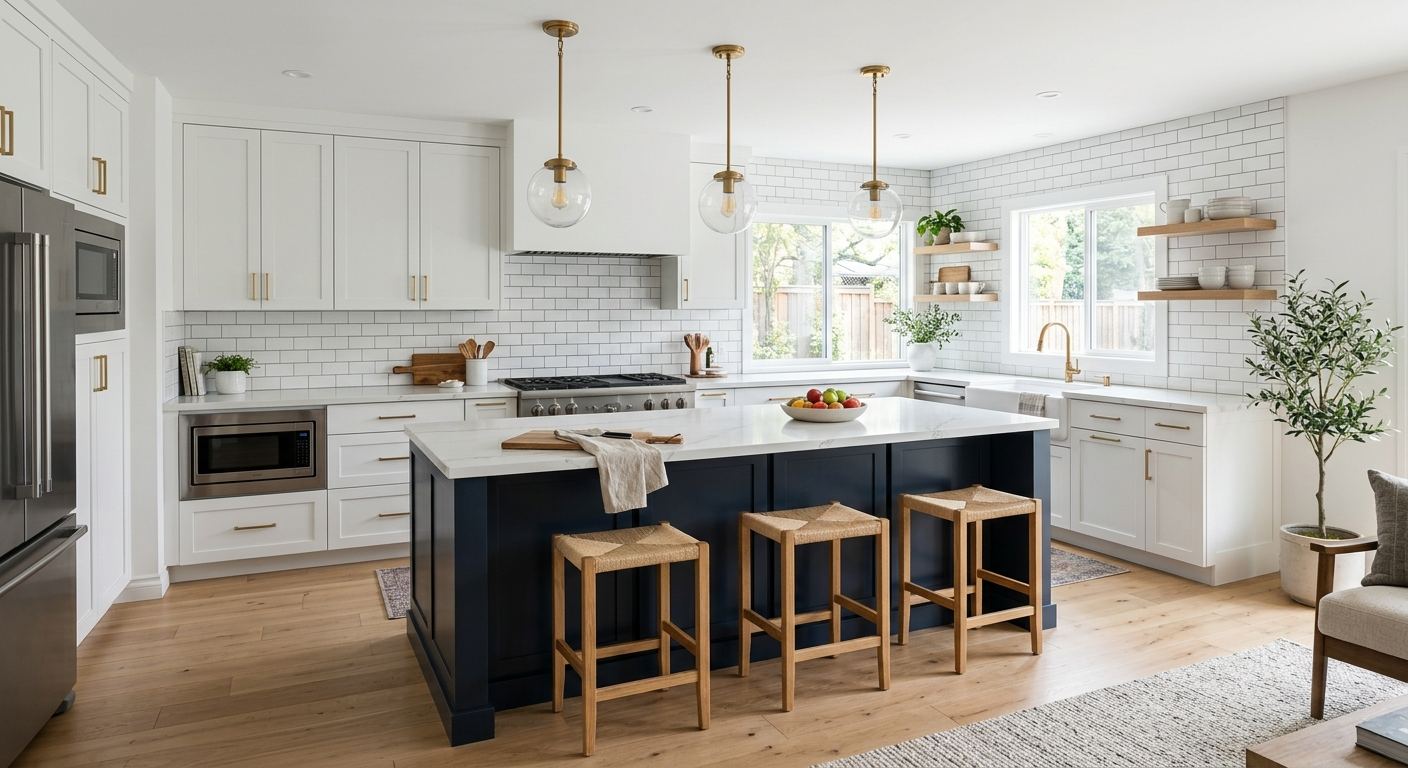
Kitchen renovation options and costs in Maplewood
Maplewood kitchen renovations are shaped less by weather and more by what homeowners expect to pay for resale-ready finishes in the Lower Mainland–Southwest. With a small population of 1,090 (Statistics Canada, 2021 Census), projects here tend to be concentrated around a few active contractors and supply partners, so lead times are often driven by cabinet shop schedules rather than permitting queues. Even in smaller markets, the broader region’s economics matter: many buyers anchor their upgrade decisions to what the Lower Mainland–Southwest supports financially, and that’s why higher finish tiers tend to move faster toward quartz, stone, and semi-custom cabinetry when budgets allow. In a practical sense, the region’s mid-range projects are where you’ll see the strongest value trade-off—especially when the footprint is already functional and plumbing stays in the same zone.
Climate does still play a role, but mostly indirectly. British Columbia’s wet winters and indoor humidity swings can be harder on softer materials and poorly sealed edges, so contractors often recommend better countertop sealing details and reliable ventilation when cooking vapours rise. Because Maplewood is in the Lower Mainland–Southwest, you can usually source materials year-round, but contractor availability can tighten during peak renovation months when Vancouver and Surrey demand pulls crews across the corridor. In Maplewood proper and nearby Surrey-area delivery routes, cabinetry installers are especially in demand when a job includes full cabinet replacement or a custom hood surround.
Below is a clear side-by-side comparison of common renovation tiers, so you can connect your goals to realistic pricing.
| Renovation Tier |
What's Included |
Typical Duration |
Price Range |
| Cosmetic refresh (paint, hardware, new appliances only) |
Cabinet repaint or touch-ups, new pulls/knobs, appliance swap (no layout change), minor patching, basic appliance install |
3–7 days |
$40,000–$65,000 |
| Mid-range full renovation (new cabinets, counters, sink, tile) |
New semi-custom or stock cabinetry, countertop replacement, sink/faucet, backsplash tile, under-cabinet lighting prep as needed, flooring refresh or selective replacement |
3–6 weeks |
$70,000–$95,000 |
| High-end full renovation (custom cabinets, stone counters, island) |
Fully custom millwork, stone/quartz counters with premium edge profiles, island with electrical, upgraded backsplash (e.g., full-height), more complex layout and detailing |
6–10 weeks |
$95,000–$120,000 |
| Cabinet refacing only (new doors + drawer fronts, same boxes) |
Refacing with new doors/drawer fronts, new hardware, fit/finish upgrades, optional new crown/trim, typically no cabinet box replacement |
2–4 weeks |
$8,000–$30,000 |
| Countertop swap only (laminate to quartz or stone) |
Removal and replacement of counters, seal/edge finishing, basic countertop install only (no cabinet tear-out beyond what’s required) |
2–5 days |
$3,000–$12,000 |
| Backsplash tile installation only |
Surface prep, tile supply/installation as scoped, grout/seal, clean-up; may include minor wall patching |
3–6 days |
$1,500–$6,000 |
Prices are estimates only and vary by project scope, site access and material selection.
What affects the price of kitchen renovation in Maplewood
In Maplewood and across the Lower Mainland–Southwest, the same kitchen can land 30–50% apart depending on how the scope is packaged. The biggest drivers aren’t climate—they’re local home value expectations and the finish tier homeowners choose. In higher-value parts of Metro Vancouver, buyers often default to quartz or stone counters, semi-custom cabinetry, upgraded hardware, and design-led layouts; those choices can push the project into a full-renovation range rather than a refresh. In more modest markets or when homeowners prioritise practicality, laminate and stock cabinets dominate because the upgrade cost is easier to recover on resale. Across British Columbia, a basic refresh stays relatively restrained, while a full remodel rises quickly once cabinetry, trades, layout changes, and premium finishes are included.
For Maplewood, two local cost-shifters show up again and again. First, cabinet tier: moving from stock to semi-custom usually changes both material cost and install time—often nudging a job toward the mid-range full renovation band rather than staying in refacing territory. Second, countertop and edge details: swapping laminate for quartz can be a relatively efficient upgrade, typically sitting in the countertop swap band, but stepping up to stone (plus an island) can quickly add up inside the high-end full renovation bracket. Third, layout changes are the wild card regardless of finish: removing a wall, adding an island, or moving a gas line or plumbing is labour-heavy, requires trades coordination, and adds inspection steps.
As for climate and housing age: many Lower Mainland homes built decades ago have older subflooring and moisture-prone details near exterior walls. That can require extra prep and moisture mitigation before new cabinets and tile go in, which is why contractors sometimes add dollars not because the kitchen is “bigger,” but because the substrate needs correction before finishes can last.
| Price Factor |
Why It Matters |
Cost Impact |
| Cabinet tier — stock vs. semi-custom vs. fully custom millwork |
Pricing changes with fit quality, internal storage options, and how much is made-to-measure |
Can shift a full renovation by roughly $15,000–$40,000 depending on scope |
| Countertop material — laminate vs. quartz vs. granite vs. stone |
Material + fabrication + edge profile cost rises sharply from laminate to engineered stone and natural stone |
Often $3,000–$12,000 for swaps; stone/island upgrades can increase full-project totals |
| Layout change — wall removal, island add, plumbing/gas move |
Triggers additional framing, venting/vent rework, and trade scheduling plus inspections |
Typically the largest unpredictable component; can add thousands even on “same finishes” jobs |
| Appliance package tier — builder vs. mid-range vs. pro-grade |
Pro-grade models can require electrical/gas hookups and more precise cabinetry clearances |
May add $2,000–$10,000 depending on appliance set and install complexity |
| Flooring — refinish existing vs. full replacement |
Some demo reveals subfloor issues; replacement also affects tile transitions and edge details |
Small refresh stays lower; full replacement increases labour and material costs |
| Backsplash — ceramic tile vs. marble vs. full-height slab |
Premium materials need better substrate prep, layout, and installation skill |
Ceramic tile can start around the backsplash-only band; premium full-height can exceed it |
| Electrical — new circuits for island, under-cabinet lighting |
Island outlets and lighting increase wiring, boxes, and inspection requirements |
Often a few thousand; can rise if walls must be opened up |
| Permit fees and licensed trade requirements |
Some work must be permitted and done by licensed trades; admin time and inspections add cost |
Varies by scope; generally noticeable when plumbing/gas/electrical is modified |
Permits & regulations in British Columbia
In British Columbia, many straightforward finish-only updates do not require permits. A cabinet and countertop swap (i.e., replacing existing cabinets/soap, counters, and surfaces without altering services) typically doesn’t need a permit. The work that usually does require permits and licensed trades is the work that changes the “systems” in your home: moving or altering plumbing supply/drain lines, relocating gas appliances or gas lines (including stove changes and any gas range/hood alterations), removing a load-bearing wall, adding structural openings, and adding new electrical circuits for items like an island outlet or new under-cabinet lighting runs that require circuit work.
Here’s the practical step-by-step homeowners in Maplewood can follow. First, ask your contractor which permits are required for your exact scope and get that list in writing in the contract. Next, verify the trades: confirm a licensed gas fitter for gas work and a licensed electrician for electrical work. Then check liability insurance: request a current certificate of insurance for the contractor and subcontractors. Finally, look for proof of workers’ coverage (commonly referred to as WCB/clearance) and keep clearance documentation in your renovation folder.
Where to look: rely on the province’s online licence verification for credentials, request certificate of insurance directly from the contractor, and ask for the insurance clearance letter/WCB proof before work starts. This protects you if something goes wrong, and it prevents last-minute delays when a trade realises the scope was mis-scoped.
Cabinets, countertops and layout decisions in Maplewood
If you want the biggest “decision impact per dollar,” focus on three choices in your Maplewood kitchen renovation: (1) cabinet tier, (2) countertop material, and (3) layout changes. Cabinet tier is where cost and timeline start to diverge. Stock cabinets are typically the fastest and cheapest; semi-custom is the most popular mid-range balance because you get better sizing options and storage layouts without the full custom price. Custom cabinets deliver the best fit for awkward corners and ceilings, but they’re the priciest and usually add schedule time.
Countertops follow a similar logic. Laminate is budget-friendly and resists many day-to-day issues, but in British Columbia’s indoor humidity swings, the longevity depends heavily on edge sealing and how well the countertop is installed. Quartz engineered countertops are a common sweet spot: they’re durable for busy kitchens and require minimal maintenance compared with many natural stone options. Granite and natural stone can be stunning and durable, but they’re less forgiving if sealing maintenance gets missed. Butcher block adds warmth, yet it needs more regular care to prevent staining or swelling near sink splash zones—especially in kitchens where moisture is frequent.
Layout changes are the justification test. Adding an island can be worth it when you gain usable prep and seating—however, if it requires moving plumbing or gas, costs rise quickly. For example, if you keep plumbing in the same location and choose a quartz swap, you may stay closer to the countertop-only band. If you’re moving plumbing/gas plus adding electrical for island outlets, the project can shift toward the high-end full renovation range even with similar materials.
Because the Lower Mainland–Southwest resale market rewards modern storage and surfaces, homeowners who plan for buyer expectations at each price point tend to get the best long-term value.
| Option |
Durability |
Maintenance |
Best For |
Price Range |
| Stock cabinets (big-box) |
Good everyday durability with limited flexibility around sizing |
Low; keep hinges adjusted and clean spills promptly |
Quick refreshes and straightforward layouts |
$8,000–$25,000 |
| Semi-custom cabinets (local dealer) |
Very durable with more options for storage and finishes |
Low to moderate; better hardware and alignment reduce wear issues |
Best-value remodels in Maplewood |
$25,000–$60,000 |
| Custom cabinets (local millwork shop) |
Excellent fit and finish; strong for complex spaces |
Low; longevity depends on finish quality and install details |
Homes with unusual dimensions or high design expectations |
$60,000–$95,000 |
| Laminate countertop |
Moderate; seam and edge quality matter most |
Low; avoid prolonged standing water and sharp impacts |
Budget upgrades where the base cabinets are staying |
$3,000–$6,000 |
| Quartz engineered countertop |
High; consistent performance for busy kitchens |
Very low; typical cleaners only, periodic sealing usually not required |
Maplewood homeowners wanting a durable, low-maintenance surface |
$6,000–$10,000 |
| Granite / natural stone countertop |
High; durable with proper installation |
Moderate; sealing and stain prevention matter |
Premium look without going fully to marble |
$8,000–$12,000 |
| Butcher block countertop |
Medium to high; can be affected by moisture at seams |
Higher; regular oiling and careful cleaning around the sink |
Warm, casual kitchens and homeowners who maintain materials |
$4,000–$8,000 |
| Marble countertop |
High beauty, but can be more stain/etch sensitive |
Higher; requires diligent sealing and stain/acid control |
Showpiece kitchens with lighter daily wear |
$10,000–$16,000 |
How to choose a kitchen renovation contractor in Maplewood
Choosing the right contractor in Maplewood comes down to verifying credentials, getting apples-to-apples quotes, and reading the scope like a contract—because kitchen renovations are where small omissions turn into expensive change orders. In British Columbia, start by confirming licensing for any electrical or gas work through the province’s licence verification tools. Ask each contractor to provide proof of liability insurance and the relevant workers’ coverage (WCB/WCB clearance information). Get the certificate of insurance and clearance documentation before demo begins, not after you’ve already moved into the “waiting for parts” phase.
Next, request 2–3 itemised written quotes. You want labour and materials broken out (cabinet supply, install labour, countertop fabrication/installs, tile labour, electrical allowance, disposal, and any permitting costs). Avoid “lump sum” only estimates without line items—those make it hard to compare. Read the scope carefully: what’s excluded (subfloor repairs, drywall patching, vent relocation, additional electrical circuits), is permit pulling included, and is waste disposal included? Kitchen projects often balloon when demolition reveals hidden water damage or when cabinet locations need additional blocking and shimming.
Warranty matters. Ask for the workmanship warranty length and whether it’s transferable if you sell. Then confirm the product/manufacturer warranty on cabinets and countertops. For payment, never pay more than 10–15% upfront; hold back until key milestones are complete (final install, caulking/grouting, and a punch list). Finally, get the start date and completion estimate in writing, including a realistic cabinet lead-time buffer so you’re not stuck mid-renovation.
- Check British Columbia contractor licence/registration status before signing.
- Request certificates of liability insurance for the contractor and major subcontractors.
- Ask for WCB/WCB clearance proof and keep it with your contract documents.
- Get 2–3 itemised quotes with clear labour/material breakdowns (not only totals).
- Confirm permit responsibility in writing (who pulls permits, who pays, who schedules inspections).
- Verify disposal/waste haul-away is included or priced separately.
- Ask what’s included in drywall patching, caulking, and final paint touch-ups.
- Confirm countertop templating timing and who covers remake charges for fabrication errors.
- Demand a clear cabinet installation plan (leveling, shimming, filler details, toe-kick specs).
- Review warranty terms for workmanship and product—length, exclusions, and transferability.
- Use a milestone-based payment schedule with a holdback until punch list completion.
- Get start date, lead times (cabinet fabrication), and estimated completion in writing.
Red flags in Maplewood include: quotes that won’t list line items; missing clarity on whether permits and licensed trades are included; a payment request beyond 15% upfront; vague timelines that ignore cabinet lead times; and warranties that only cover “materials” but not workmanship.
Frequently asked questions — kitchen renovation in Maplewood
What's the best countertop material for a busy Maplewood kitchen?
For most busy kitchens in Maplewood and the wider Lower Mainland–Southwest, quartz is the most practical “set-and-forget” option. It handles daily use well, resists many common stains, and typically doesn’t require the same ongoing sealing routine you’d plan for with natural stone. If your goal is a targeted upgrade without major rework, a countertop swap budget often fits within the countertop installation band of $3,000–$12,000, depending on thickness, edge profile, and whether any sink/cooktop cut-outs change. Laminate can work on a tighter budget, but in British Columbia’s humidity swings, installation quality—especially at seams and edges—matters a lot for long-term appearance.
How do I add an island to my Maplewood kitchen?
Adding an island is usually a “layout + trades coordination” project. Start by confirming clearances for walkways and traffic flow, then decide where your plumbing or gas will (and won’t) move. If the island is purely for prep/storage with no sink, costs often stay more predictable than projects that relocate plumbing. If you do want an island sink or a gas cooktop, you’ll be looking at permits and licensed trades in British Columbia, plus more complex routing for supply/drain lines and electrical. In pricing terms, island work can push you from a simple refresh into mid-range full renovation territory, especially once electrical circuits and detailed millwork are included. Make sure your contractor itemises electrical scope (outlets/lighting) and includes disposal and any permit admin in the written contract.
How much does a kitchen renovation cost in Maplewood?
In Maplewood, a typical full kitchen renovation commonly lands in the broader regional band of $40,000–$120,000, with mid-range jobs often clustering toward the middle when you keep the footprint practical and use semi-custom cabinetry and quartz. Smaller scopes can be much lower: cabinet refacing can start in the $8,000–$50,000 range depending on material and coverage, and a countertop swap alone is commonly $3,000–$12,000. Backsplash tile installation is often $1,500–$6,000 when scoped to the wall surface. Because Maplewood sits in the Lower Mainland–Southwest market, finish expectations can be influenced by resale priorities, and quotes for the “same size” kitchen can vary by 30–50% based on cabinet tier, countertop selection, and how much plumbing/electrical you modify.
How long does a kitchen renovation take in Maplewood?
Timelines depend mainly on cabinet lead times and how much demolition involves services changes. Cosmetic refresh work can be as short as 3–7 days if you’re only painting, swapping hardware, and installing appliances. A mid-range full renovation typically takes about 3–6 weeks in Maplewood-area projects, while high-end full renovations with custom millwork and an island are often 6–10 weeks. Countertop swaps can be just a few days once templating and fabrication are complete. The best way to protect your schedule is to get a written plan that includes cabinet fabrication dates, countertop templating timing, and when electrical/plumbing rough-ins will occur. British Columbia permitting and licensed-trade scheduling can also add time when you’re moving plumbing supply/drain lines or relocating gas/electrical circuits.
Quartz vs granite countertops — which is better?
“Better” depends on how you cook and maintain your surfaces. Quartz is often the best choice for busy Maplewood households because it’s engineered for consistent performance and generally needs less maintenance—typically no regular sealing routine like many natural stones. Granite is very durable and can look premium, but it’s more maintenance-oriented: sealing and stain prevention matter, and some homeowners prefer that extra upkeep while others want lower maintenance. If you’re comparing costs for a swap-only scope, countertop installation in the $3,000–$12,000 band can work for either material depending on thickness, edge, and the number of cut-outs. If the project scope is moving into a full renovation, the countertop choice is only one line item—cabinet tier and whether you add an island or electrical can drive the real difference.
Should I reface or replace my cabinets?
Refacing is usually the best option when the cabinet boxes are solid, your layout still works, and you want a faster, less invasive update. It can also be a good choice if you’re trying to stay closer to a cabinet refacing budget in the $8,000–$50,000 range. Replacing cabinets is typically smarter when boxes are damaged, uneven, poorly aligned, or when you want major storage and layout changes (like deeper drawers, different corner solutions, or updated heights). For Maplewood kitchens, check moisture exposure around sink and exterior-wall runs—British Columbia’s humidity and wet winters can magnify early cabinet wear. Ask your contractor to assess box condition before deciding; a good refacing quote should include what happens if hidden water damage is discovered after hardware removal.