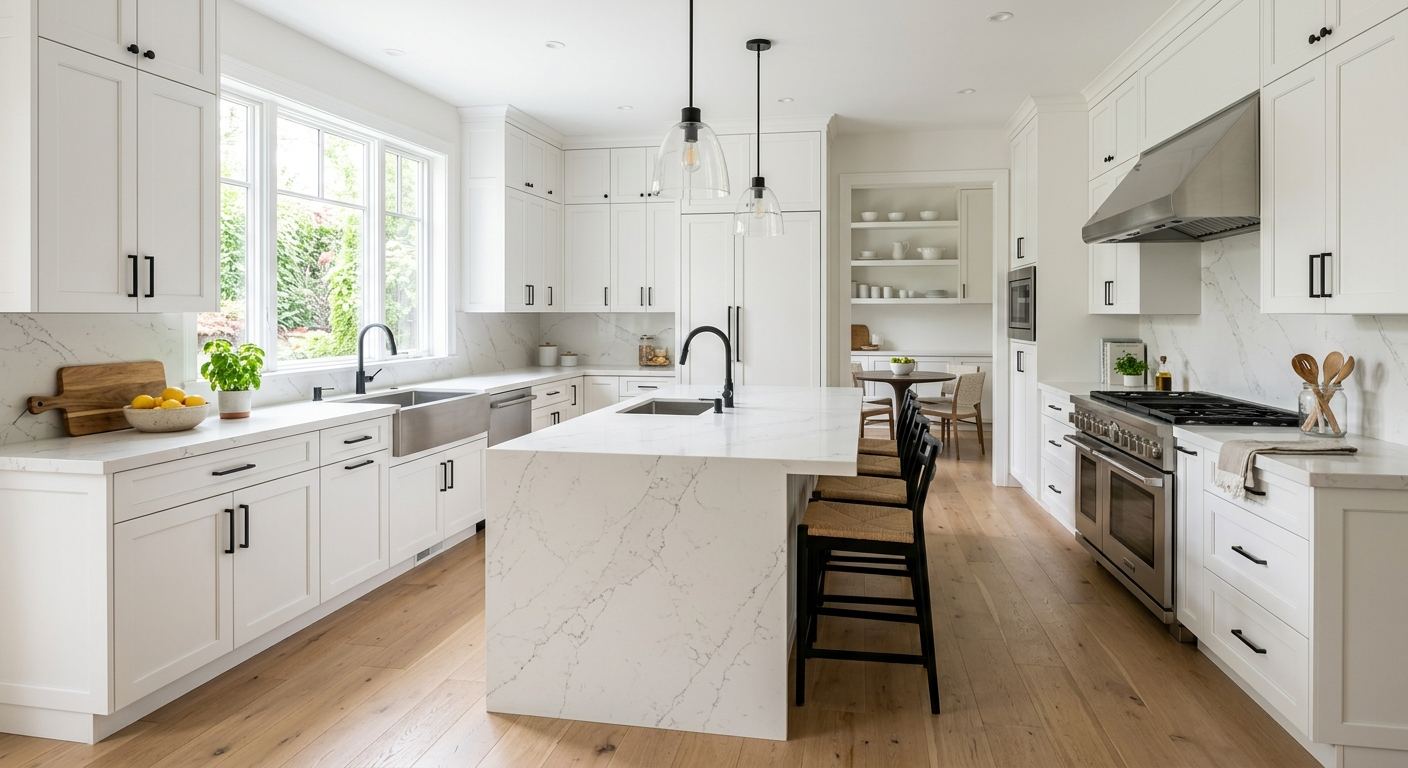
Kitchen renovation options and costs in Blueridge
Kitchen renovations in Blueridge tend to follow a pretty consistent pattern: most homeowners start with a “refresh” budget, then climb toward a full rebuild once they price out cabinetry, counters, and any layout changes. With a small local population of 2,245 (Statistics Canada, 2021 Census), contractors often plan schedules around a steady rotation of Greater Vancouver clients rather than one-off isolated jobs. In the Lower Mainland–Southwest, renovation choices are also strongly tied to what the market expects—especially in higher-value resale pockets—where buyers typically favour upgraded materials like quartz and semi-custom cabinetry. That finish-driven expectation is one reason the same kitchen size can swing meaningfully in price across the region, even before we consider site conditions.
Climate isn’t usually the main driver of cost here, but it affects durability requirements and how carefully installers handle moisture-prone areas like sinks, dishwashers, and exterior-facing exterior walls. Coastal weather means humidity cycling and occasional dampness in older homes can expose subfloor and cabinet base issues sooner, which is why many “mid-range” quotes in Blueridge can drift toward full renovation once we open walls. Labour availability in the Lower Mainland–Southwest can also shift timelines and labour pricing, particularly during spring and summer when renovation demand peaks.
If you’re seeing growing interest in your area, it’s commonly noticeable around Burnaby Heights–style neighbourhood pockets where family homes are turning over and owners want kitchens that read modern at resale. From there, it’s easiest to compare your likely scope and budget in the table below.
| Renovation Tier |
What's Included |
Typical Duration |
Price Range |
| Cosmetic refresh (paint, hardware, new appliances only) |
Cabinet repaint/paint, new pulls/handles, new sink tap, replace appliances (no plumbing/gas relocation), minor caulking and trim touch-ups |
3–7 days |
$15,000 – $28,000 |
| Mid-range full renovation (new cabinets, counters, sink, tile) |
New semi-custom or stock cabinets, countertop (quartz/stone/laminate), sink + tap, backsplash tile, flooring patching as needed, labour for basic plumbing connections |
3–6 weeks |
$40,000 – $85,000 |
| High-end full renovation (custom cabinets, stone counters, island) |
Fully custom millwork, stone counters (granite/stone/quartz premium slab), island with deeper cabinetry, upgraded hardware, upgraded backsplash (tile or slab feature), more detailed millwork installation |
6–12 weeks |
$85,000 – $120,000 |
| Cabinet refacing only (new doors + drawer fronts, same boxes) |
Door/drawer front replacement, new veneer/laminate faces where applicable, new hardware, touch-up paint to match, existing box preservation |
1–3 weeks |
$8,000 – $30,000 |
| Countertop swap only (laminate to quartz or stone) |
Removal of existing countertop, install new countertop, new sink cut-out as required, standard sealing and caulking, basic backsplash touch-up |
3–10 days |
$3,000 – $12,000 |
| Backsplash tile installation only |
Tile supply/installation (ceramic or similar), surface prep, waterproofing where required, grout/caulking at edges |
3–7 days |
$1,500 – $6,000 |
Prices are estimates only and vary by project scope, site access and material selection.
What affects the price of kitchen renovation in Blueridge
In Blueridge and across the Lower Mainland–Southwest, it’s common to see the “same” kitchen renovation come in 30–50% apart between bids. That spread usually isn’t about the weather—it’s about how closely the scope matches the buyer’s expectations for finish level, and how much cabinetry and trade work is included. Across British Columbia, higher-end homes and resale targets nudge homeowners toward quartz or stone counters, upgraded hardware, and semi-custom cabinetry, which raises material and installation costs. Meanwhile, more cost-conscious renovations often stay in the $40,000–$85,000 mid-range by using stock/laminate combinations and keeping the layout mostly intact.
Local home values and household income typically shape which tier makes sense more than any climate factor. In higher-value pockets of the Lower Mainland–Southwest, owners often recover more of their spend on resale because the kitchen reads “move-in ready” with premium-looking surfaces—so a jump from mid-range to high-end is easier to justify. In more modest scenarios, owners choose laminate or stock cabinets because the ROI is steadier and budgets don’t get swallowed by custom millwork lead times.
Layout change is the biggest wildcard regardless of finish tier. Examples from Blueridge-area projects: (1) removing a load-bearing wall or opening up into a living space often adds structural engineering and rework to soffits or ceilings; (2) adding an island can trigger extra electrical work for under-cabinet lighting and pendants, plus ducting considerations if you add/relocate a hood; (3) moving plumbing supply or drain lines can uncover subfloor issues in older housing stock and require more framing repairs. Even within the $40,000–$120,000 full renovation bands, a plumbing/gas move can push labour and materials upward fast.
| Price Factor |
Why It Matters |
Cost Impact |
| Cabinet tier — stock vs. semi-custom vs. fully custom millwork |
Cabinet complexity affects sizing, install time, and how many components need fabrication |
Can shift most of the project budget; typically +$15,000 to +$40,000 |
| Countertop material — laminate vs. quartz vs. granite vs. stone |
Material price, fabrication method, and seam/edge complexity change labour and waste |
Often +$3,000 to +$15,000 moving up tiers |
| Layout change — wall removal, island add, plumbing/gas move |
Triggers structural, framing, re-routing, and coordination across trades |
Commonly +$8,000 to +$30,000 depending on scope |
| Appliance package tier — builder vs. mid-range vs. pro-grade |
Installation requirements and dimensions affect cabinet/counter adjustments |
Typically +$2,000 to +$10,000 |
| Flooring — refinish existing vs. full replacement |
Demo dust, subfloor damage and matching new materials to old finishes can add time |
Often +$1,500 to +$12,000 |
| Backsplash — ceramic tile vs. marble vs. full-height slab |
Premium materials increase cutting time, accuracy needs, and waste |
Usually +$1,000 to +$6,000 |
| Electrical — new circuits for island, under-cabinet lighting |
More fixtures and power points increase electrician time and materials |
Often +$1,200 to +$6,000 |
| Permit fees and licensed trade requirements |
Permits and inspections add administrative time and require specific licensed contractors |
Commonly +$500 to +$5,000 |
Permits & regulations in British Columbia
In British Columbia, cabinet and countertop swaps usually do not require a permit because you’re keeping existing services and opening up no new structural or service routes. Replacing cabinet faces, swapping countertops, and updating backsplash finishes are generally treated as non-structural, non-service work. However, once you move plumbing supply or drain lines, relocate gas for a stove/range/any gas-fired equipment, remove a load-bearing wall, or add electrical circuits (for example, new outlets for an island, under-cabinet lighting, or additional pendant wiring), permits and inspections typically come into play.
Gas work must be completed by a licensed gas fitter, and electrical work must be done by a licensed electrician—both require inspections before you can proceed safely. Always confirm permit responsibility with your contractor before signing so it’s clearly assigned in the contract. If you’re not sure whether something triggers a permit, ask for the contractor’s written rationale based on the specific changes to your kitchen’s plumbing, gas, and electrical layout.
For your own verification in Blueridge: (1) request the contractor’s licence details and proof of liability insurance and confirm coverage amounts; (2) ask for a certificate of insurance (COI) and check the policy period; (3) verify the contractor’s status on the appropriate online registry for licences (and the individual trades if applicable); (4) request clearance/coverage proof for workers under the relevant workers’ compensation system; and (5) keep copies with your signed contract, drawings, and change orders.
Cabinets, countertops and layout decisions in Blueridge
When you renovate in Blueridge, three decisions drive the cost—and they also shape how your kitchen will photograph and perform for years: (1) cabinet tier, (2) countertop material, and (3) whether you change the layout (open-concept wall removal, island addition, or plumbing/gas relocation). In the Lower Mainland–Southwest resale market, buyers often expect a contemporary look: clean hardware lines, bright surfaces, and counters that handle daily wear without constant upkeep. That expectation is why semi-custom cabinets and quartz are such a common mid-range “sweet spot.”
Cabinet tier: Stock cabinets are fastest and cheapest, but they’re less forgiving of unusual wall lengths. Semi-custom cabinets (most popular for mid-range full renovations) balance budget and fit. Custom cabinets cost more and take longer, but they can maximize storage with better sightlines—especially if you’re building an island.
Countertops: In a coastal climate like ours, the main risk isn’t the countertop material failing due to “weather,” it’s maintenance habits and edge sealing around sinks. Laminate can be a budget win, but seams and heat exposure can show faster. Quartz is the practical daily-driver choice. Granite/natural stone offers character, but requires thoughtful sealing and realistic cleaning routines.
Layout: Adding an island can be justified when it meaningfully improves traffic flow and seating. But moving plumbing or gas can add the most unpredictable dollars. For example, a kitchen that stays within a mid-range renovation budget of about $40,000–$85,000 can become much harder to control if you also relocate plumbing and electrical for an island. If the layout change is limited to repositioning appliances without service moves, the cost uplift is usually more manageable.
These choices work differently depending on how much cabinetry and service work you’ll do—and on what local buyers expect at your price point.
| Option |
Durability |
Maintenance |
Best For |
Price Range |
| Stock cabinets (big-box) |
Good durability; tolerances can be tighter on older walls |
Minimal; focus on proper shimming and sealing |
Fast refresh and tighter budgets |
$8,000 – $25,000 |
| Semi-custom cabinets (local dealer) |
Very durable; better fit for common BC room dimensions |
Low; keep hinges adjusted and wipe spills promptly |
Most mid-range full renovations |
$25,000 – $55,000 |
| Custom cabinets (local millwork shop) |
Highest durability potential; can be built for your exact layout |
Low; premium hardware and finished interiors are easier to maintain |
Islands, unique layouts, and high-end resale goals |
$55,000 – $85,000+ |
| Laminate countertop |
Decent for everyday use; watch for impact/heat at seams |
Wipe clean; avoid prolonged heat and standing water at edges |
Budget-focused refreshes |
$3,000 – $7,000 |
| Quartz engineered countertop |
High durability; resists staining and daily scratches |
Low; standard cleaners are usually fine |
Busy kitchens with a practical, resale-friendly finish |
$7,000 – $12,000 |
| Granite / natural stone countertop |
Very durable; variation can hide everyday wear |
Requires periodic sealing depending on stone |
Homeowners wanting unique natural character |
$8,000 – $15,000 |
| Butcher block countertop |
Strong but can scratch; sensitive to moisture edges |
Oiling and prompt drying are important |
Warm, family-oriented kitchens |
$6,000 – $12,000 |
| Marble countertop |
Beautiful but softer; can etch with acids |
More careful cleaning and protection needed |
Design-led high-end renovations |
$10,000 – $18,000+ |
How to choose a kitchen renovation contractor in Blueridge
Choosing a kitchen contractor in Blueridge comes down to proof, process, and clarity. Start by verifying British Columbia licensing for the trades involved: electricians and gas fitters must be licensed for any related work. For the contractor, confirm liability insurance coverage (request a current certificate of insurance) and ensure workers are covered under the appropriate workers’ compensation system. How to check each: (1) ask for licence numbers and trade categories, then look them up on the relevant online registry; (2) review the COI for effective dates, listed insured parties, and the coverage limits; and (3) request a clearance letter or coverage proof that matches the contract’s timeframe.
Next, get 2–3 itemised written quotes, not lump sums. You want a labour + materials breakdown that shows cabinet supply, countertop fabrication/installation, plumbing/electrical allowances, tile scope, and disposal/cleanup. Read the scope carefully: what’s excluded (drywall patching, subfloor repair, appliance install, disposal)? Is a permit pull included if your design requires it? Are there line items for electrical circuits, under-cabinet lighting, and any gas relocation? Finally, review warranties: workmanship warranty length, product/manufacturer warranty terms, and whether they are transferable if you sell the home.
For payment, avoid paying more than 10–15% upfront. Use a staged schedule tied to milestones, and hold back a portion until completion and punch-list items are addressed. Ask for a start date and a completion estimate in writing, including lead times for cabinets and counters.
- Confirm the electrician and gas fitter are licensed for any electrical circuits or gas appliance work.
- Ask for licence numbers, COI, and coverage proof before signing.
- Get an itemised quote: cabinets, counters, tile, labour, disposal, and allowances.
- Require a written scope that lists inclusions and exclusions.
- Check whether permits and inspection fees are included or quoted separately.
- Ask who coordinates trade scheduling (you or the contractor).
- Confirm cabinet and countertop lead times in writing.
- Clarify warranty terms: workmanship length and product warranty responsibility.
- Use a milestone-based payment schedule with a holdback for final completion.
- Request a detailed start date and target completion date.
- Ensure the quote includes demolition, patching, and site cleanup responsibilities.
- Verify the contractor will protect floors/walls during demo and install.
Red flags we see in Blueridge: (1) a quote that’s “one number” without itemised labour/materials; (2) vague answers about permits and who pays for them; (3) no written warranty details or only verbal promises; (4) requesting large deposits beyond 10–15% without milestones; and (5) refusing to provide COI/licence proof when asked.
Frequently asked questions — kitchen renovation in Blueridge
How do I know if I need to update my kitchen plumbing in Blueridge?
In Blueridge, you usually only need full plumbing updates if you’re moving fixtures or if the existing lines are nearing end-of-life. If you’re keeping the same sink location and not changing supply/drain routing, many renos simply reconnect the new sink, tap, and dishwasher—so you may not need to replace every line. But if you’re adding an island, relocating a sink, or moving a gas range (where venting/hood changes often happen too), permits and licensed trade work become more likely. During demo, signs like corrosion, slow draining, leaking under the cabinet base, or water staining around toe-kicks are strong indicators. It’s also a good idea to ask the contractor to inspect accessible shutoffs and run a basic pressure/leak check before final cabinetry is installed.
What is the difference between a galley and open-concept kitchen?
A galley kitchen has two parallel runs of cabinets with a corridor between them, typically optimizing workflow but limiting seating. An open-concept kitchen removes barriers between the kitchen and living/dining areas, changing traffic flow and often increasing the need for thoughtful ventilation, lighting layout, and sound control. In Blueridge and across the Lower Mainland–Southwest, open-concept layouts are popular because they read modern at resale, but they can increase scope—especially if you’re removing a wall or adjusting electrical circuits and lighting. If you’re staying within a refresh budget (for example, a cosmetic refresh typically lands around $15,000 – $28,000), a galley update with new hardware and appliances is usually achievable without major service moves. For open-concept remodels, plan budgets closer to the mid-range full renovation band (commonly $40,000 – $85,000).
How do I get accurate kitchen renovation quotes in Blueridge?
To get accurate quotes in British Columbia (including Blueridge), you need comparable scope between bidders. Start by sharing your measurements, your desired cabinet tier (stock, semi-custom, or custom), and countertop material preference (laminate vs. quartz). Then ask for 2–3 itemised written quotes showing labour and materials, not just a total. Confirm what’s included for demolition, disposal, drywall patching, plumbing/electrical allowances, permit pull (if required), and installation details. Also ask for line items for any layout change you want—like an island add or plumbing/gas relocation—because that’s where costs typically swing. A good contractor will include lead-time assumptions for cabinets and countertops and will note exclusions so you don’t get hit with surprise change orders after walls open.
What's the best countertop material for a busy Blueridge kitchen?
For most busy households in Blueridge, quartz engineered countertops are the best balance of durability, stain resistance, and low maintenance. They’re a practical fit for everyday cooking, quick wipe-downs, and resale-friendly finishes without the ongoing sealing responsibilities of many natural stones. Laminate can work well for budget-focused refreshes, but it’s more sensitive to heat and seam wear over time. Butcher block can be great for families who love prep space, provided you oil and keep edges protected from moisture—especially important in our coastal humidity swings. Granite/natural stone offers unique character and strong durability, but it may require periodic sealing. If you’re budgeting around the mid-to-upgrade range, quartz typically aligns with common countertop swap pricing within $7,000 – $12,000, while laminate is usually lower inside $3,000 – $7,000.
How do I add an island to my Blueridge kitchen?
Adding an island starts with clear traffic-flow planning and the decision of whether it’s purely functional storage/surface or whether it includes sink and/or appliances. If your island includes a sink, dishwasher, or gas cooktop, you’re likely triggering plumbing/gas relocation and electrical circuit additions—each may require permits and licensed trades in British Columbia. If you keep the island to a prep/storage role (no service moves), the scope stays more predictable and often lands easier within a mid-range renovation budget. In Blueridge, many homeowners justify the cost because island seating and expanded work surfaces improve daily usability and modern resale appeal. Expect additional labour and coordination even when the island is “simple,” including cabinet layout for overhangs and proper base framing to handle countertop weight.
How much does a kitchen renovation cost in Blueridge?
Kitchen renovation costs in Blueridge generally follow the Lower Mainland–Southwest bands, with final numbers driven more by finish tier and layout changes than by climate. For a cosmetic refresh (paint, hardware, and new appliances only), many projects land around $15,000 – $28,000. A mid-range full renovation—new cabinets, counters, sink, and backsplash tile—commonly falls in the $40,000 – $85,000 range. If you’re moving into custom cabinetry, stone counters, and an island with more complex details, budgets often range toward the high-end band of $85,000 – $120,000. If you’re seeing a quote far outside these ranges, ask what changed: cabinet tier, countertop material, whether plumbing/gas/electrical were moved, and whether disposal, patching, and permits are included. For context, Blueridge’s population is 2,245 (Statistics Canada, 2021 Census), so many contractors rely on broader Metro Vancouver demand patterns when scheduling.