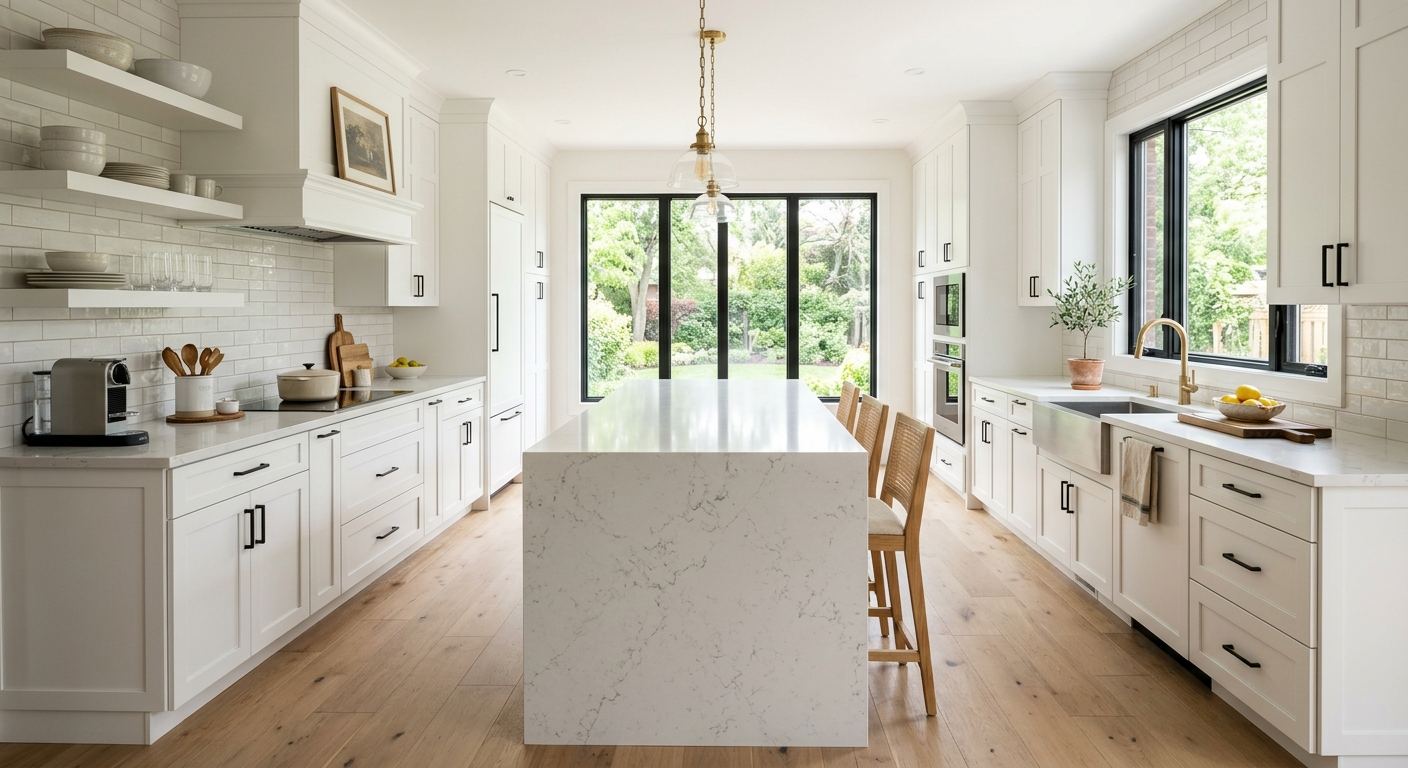
Kitchen renovation options and costs in Chineside
In Chineside, British Columbia, kitchen renovations can range from a quick refresh to a full rebuild—often with very different price outcomes for the same kitchen size. With a local population of 2,929 (Statistics Canada, 2021 Census), most projects are sized around practical family layouts, but expectations still track Metro Vancouver’s higher-end buyer preferences. Many households also earn at a level where durability and resale-ready finishes matter, and that typically pushes homeowners toward semi-custom cabinetry and stone-looking surfaces rather than purely budget options (Statistics Canada, 2021 Census). In the Lower Mainland–Southwest, pricing is driven more by home value, income, and expected finish level than by weather; you’ll still pay attention to humidity and temperature swings, but labour and material demand tend to be the cost drivers. Availability can also vary because cabinet and stone installers are busiest when multiple local trades coordinate simultaneous renovations—especially in the nearby Burnaby and Surrey corridors that feed the same supply chains. If you’re targeting a neighbourhood feel that matches modern builds in nearby Metrotown-style retail areas, you’ll often see higher demand for design-led layouts and updated hardware.
Because of that, the same kitchen can land anywhere from a restrained refresh to a full high-end renovation once you add cabinet customization, quartz or stone counters, and layout changes. Use the tiers below as a budgeting starting point, then we’ll narrow it to your scope and finish level.
| Renovation Tier |
What's Included |
Typical Duration |
Price Range |
| Cosmetic refresh (paint, hardware, new appliances only) |
Cabinet paint or refinishing (no box changes), new hardware, new appliances, touch-up drywall/trim, basic cleaning and minor caulking |
1–2 weeks |
$8,000–$25,000 |
| Mid-range full renovation (new cabinets, counters, sink, tile) |
New semi-custom or stock cabinets, countertops, sink and faucet, backsplash tile, flooring patching/partial replacement, electrical/light fixture swap where needed |
3–6 weeks |
$40,000–$85,000 |
| High-end full renovation (custom cabinets, stone counters, island) |
Fully custom cabinetry, quartz or natural stone countertops, island build/feature lighting, premium backsplash (including larger format tile or slab), upgraded sink/faucet package, coordinated electrical and plumbing changes |
6–10+ weeks |
$85,000–$120,000 |
| Cabinet refacing only (new doors + drawer fronts, same boxes) |
Refacing panels, new doors/drawer fronts, hardware upgrade, matching trim, optional interior add-ons (pull-out shelves/organizers) if your boxes are in good shape |
2–4 weeks |
$8,000–$50,000 |
| Countertop swap only (laminate to quartz or stone) |
Remove old surface, measure and template (as needed), install new quartz/stone, new undermount sink cutouts if required, basic edge and caulking, reseal joints for natural stone where applicable |
3–7 days |
$3,000–$12,000 |
| Backsplash tile installation only |
Tile supply install, surface prep, waterproofing where needed, grout/seal (for relevant materials), caulking at edges, clean-up and final touch-ups |
3–10 days |
$1,500–$6,000 |
Prices are estimates only and vary by project scope, site access and material selection.
What affects the price of kitchen renovation in Chineside
In the Lower Mainland–Southwest, it’s common to see the same kitchen renovation quote differ by 30–50% across British Columbia and even within the broader Metro Vancouver market. The main reason isn’t climate; it’s local pricing pressure from home value, household income, and the finish tier buyers expect. In higher-value neighbourhood pockets, owners often default to quartz or stone counters and semi-custom cabinetry because the renovation cost is easier to justify at resale. In more modest areas, laminate and stock cabinets dominate because they deliver a visible upgrade at a lower total spend and still read clean and modern to buyers. Across British Columbia, layout changes are the real wildcard: removing a wall, adding an island, moving a gas line, or relocating plumbing can add work regardless of whether you choose laminate or granite.
Here are a few concrete Chineside examples that move the needle. First, if your kitchen currently has older plumbing runs, changing the sink location or adding a dishwasher can push labour and material up quickly, even if cabinets stay put. Second, upgrading from laminate to quartz isn’t just a material swap—better edges, firmer cutouts, and thicker profiles often come with more templating time; a countertop-only budget can start around $3,000–$12,000, while a full mid-range renovation that includes cabinets and tile commonly lands in the $40,000–$85,000 band. Third, in homes with older electrical panels or limited capacity, adding under-cabinet lighting or relocating outlets for an island can trigger additional electrical labour and component costs.
Finally, housing stock matters: many older Lower Mainland homes have different wall construction and subfloor conditions, so “hidden prep” can add thousands once the existing surfaces are opened—especially before stone or custom cabinet installations. Plan for that uncertainty when comparing quotes, because it’s where the biggest gaps appear.
| Price Factor |
Why It Matters |
Cost Impact |
| Cabinet tier — stock vs. semi-custom vs. fully custom millwork |
Custom sizing, internal organizers, and build quality change both material cost and install time |
Often the largest swing item; can shift a project by tens of thousands |
| Countertop material — laminate vs. quartz vs. granite vs. stone |
Material pricing and fabrication complexity (edges, thickness, seam layout) drive total cost |
Countertops can move from “swap-only” to full remodel tier depending on material |
| Layout change — wall removal, island add, plumbing/gas move |
Demolition, structural work, new connections, and additional trades increase unpredictability |
Frequently adds the most variance between quotes |
| Appliance package tier — builder vs. mid-range vs. pro-grade |
Dimensions, ventilation requirements, and installation complexity change labour and cabinetry planning |
Can add several thousand; more if ventilation or gas details change |
| Flooring — refinish existing vs. full replacement |
If floors are uneven or damaged, new flooring and subfloor repairs become necessary |
Small scope may be limited; full replacement adds cost quickly |
| Backsplash — ceramic tile vs. marble vs. full-height slab |
Surface prep, cut accuracy, and material weight affect labour and substrate prep |
Can range from a “few days” install to a premium finish package |
| Electrical — new circuits for island, under-cabinet lighting |
New circuits require licensed work and may trigger permit/inspection steps |
Often moderate in a refresh; major if you’re adding an island and outlets |
| Permit fees and licensed trade requirements |
Some work requires permits and inspections; scheduling also affects labour costs |
Can add both direct fees and delays if not planned early |
Permits & regulations in British Columbia
In British Columbia, many kitchen “surface” changes are straightforward from a permitting standpoint, but anything that changes building services or structure can trigger permit requirements and licensed trade work. Typically, cabinet and countertop swaps themselves do not require permits—because you’re replacing finishes in place. However, moving plumbing supply or drain lines, relocating gas appliances or work involving gas lines, removing a load-bearing wall (or otherwise changing structural support), and adding new electrical circuits generally require permits and licensed trades. Gas work must be completed by a licensed gas fitter, and electrical work must be done by a licensed electrician, with inspections required as part of the process.
For a Chineside homeowner, the best verification is step-by-step and should be done before signing. First, confirm the contractor’s British Columbia licence information (and any relevant trade credentials) through the appropriate online registry. Second, request a current certificate of insurance (liability coverage) and ensure the coverage is active for the project dates. Third, ask whether workers are covered under WCB/WSIB-equivalent coverage (and that the contractor can provide proof). Fourth, if permits are required for your scope, ask who will pull the permits and provide the permit number(s) in writing.
Always make permit responsibility explicit in the contract—“the contractor handles permits” is not the same as “you pay for permits and the contractor submits drawings.” Get it clear up front so cost and timeline don’t drift.
Cabinets, countertops and layout decisions in Chineside
The three most consequential decisions in a Chineside kitchen renovation are (1) cabinet tier, (2) countertop material, and (3) layout changes that affect plumbing/gas and traffic flow. Start with cabinets: stock units are the fastest and cheapest, semi-custom is the most popular mid-range because it balances lead times, fit, and price, and custom cabinets give the best fit for awkward corners and ceiling heights (common in older Lower Mainland homes). Next, choose countertops based on durability and maintenance: laminate is budget-friendly and quick to install, quartz is a strong “daily driver” in busy homes, natural stone adds premium character but may require more care depending on the specific stone. Finally, layout: open-concept wall removal and island additions can be worth it, but plumbing/gas relocation is where the cost justification becomes a square-metre value question. In resale-focused Metro Vancouver buyer expectations, a functional island with seating and clear sightlines can be a major selling point; the same island with poor circulation won’t recover its cost as well.
Because the Lower Mainland–Southwest market often rewards modern finishes, moving up from laminate to quartz is frequently where homeowners feel they’re buying back daily convenience and “clean look” longevity. For example, a countertop-only upgrade may sit around $3,000–$12,000, while pairing quartz with new cabinets, sink, and tile is more typical in the $40,000–$85,000 mid-range renovation band. In Chineside’s housing stock, older plumbing runs and electrical placement can add cost when you move sink locations or add an island; if your goal is to keep budget, consider changing countertop and backsplash first and delay plumbing moves until you’re ready.
For climate practicality, focus on installation quality and sealing details. In coastal BC humidity, poorly sealed joints and poorly flashed backsplashes can cause issues over time, so invest in good prep and correct caulking rather than chasing the cheapest surface.
| Option |
Durability |
Maintenance |
Best For |
Price Range |
| Stock cabinets (big-box) |
Good for standard layouts; depends on build quality and finish |
Routine cleaning; less flexibility for custom spacing |
Quick refreshes and tight budgets |
$8,000–$25,000 |
| Semi-custom cabinets (local dealer) |
Very solid; improved sizing options and options for organizers |
Low day-to-day effort; keep hardware maintained |
Most Chineside mid-range renovations |
$25,000–$65,000 |
| Custom cabinets (local millwork shop) |
Highest fit and finish; best for unusual walls and ceilings |
Easy to maintain; higher-end materials require proper care |
Premium builds and design-led layouts with islands |
$65,000–$120,000 |
| Laminate countertop |
Decent for daily use; edges and seam quality matter |
Wipe clean; avoid heat and standing water at seams |
Cost-controlled refreshes |
$3,000–$6,000 |
| Quartz engineered countertop |
High durability and consistent surface performance |
Low maintenance; simple cleaners are typically fine |
Busy households wanting a “stone look” |
$6,000–$12,000 |
| Granite / natural stone countertop |
Very durable; pattern and hardness vary by stone type |
Periodic sealing and careful stain management |
Premium appearance and long-term use |
$8,000–$16,000 |
| Butcher block countertop |
Durable but susceptible to cuts and moisture if neglected |
Oil regularly; keep it dry at seams and edges |
Warm, casual style kitchens |
$5,000–$12,000 |
| Marble countertop |
Elegant but can scratch or etch; sealing quality is key |
More maintenance (sealing and gentle cleaning) |
Low-to-moderate cooking households prioritizing luxury |
$10,000–$18,000 |
How to choose a kitchen renovation contractor in Chineside
When you hire a contractor in Chineside, confirm British Columbia licensing, liability insurance, and worker coverage before they start. Start with licensing: ask for their relevant BC trade licences/registrations and verify them using the applicable online registry. Next, request a certificate of insurance and check the policy is active for the project period and covers the scope (not just general business coverage). For worker coverage, ask for proof of WCB/WSIB-equivalent coverage—so you’re not exposed if there’s an incident on site.
Then get 2–3 itemised written quotes. You want a labour and materials breakdown, not a single “lump sum” number—especially for cabinetry install, countertop fabrication/placement, electrical scope, plumbing scope, and tile prep. Read exclusions carefully: confirm whether permit pulling is included (if required), whether disposal/dump fees are included, and whether patching, paint touch-ups, and caulking are in the scope. Ask about timeline assumptions and what happens if materials arrive late.
For warranty, separate workmanship warranty (how long the installer backs the job) from product/manufacturer warranty (what the cabinet or countertop maker covers). Also ask whether warranties are transferable if you sell the home. For payment schedule, never pay more than 10–15% upfront; hold back until key milestones are complete (cabinet installation and countertop templating/installation are common holdback points). Finally, request a start date and completion estimate in writing so your renovation doesn’t stall midstream.
- Ask for licence numbers and verify them online in British Columbia.
- Collect current certificate of insurance and confirm coverage dates.
- Request proof of worker coverage (WCB/WSIB-equivalent).
- Require an itemised quote: cabinets, countertops, tile, labour, demo, and site prep.
- Confirm who pulls permits and whether they’re included in the price.
- Clarify disposal: demolition hauling and dump fees included or extra?
- Ask who provides templates for countertops and how changes are handled.
- Check that plumbing/gas and electrical scopes are itemised separately.
- Get warranty details in writing (workmanship and product coverage).
- Use a milestone-based payment plan with a clear holdback.
- Request a written schedule with lead times for cabinets and stone.
- Confirm protection on floors and cabinets during demolition and installation.
Concrete red flags we commonly see in Chineside include: quoting with no line-item scope (no plumbing/electrical/tile breakdown), refusing to provide proof of insurance or licences, promising “all-in” timelines without acknowledging cabinet/stone lead times, changing scope verbally without written change orders, and requesting large upfront payments beyond 10–15%.
Frequently asked questions — kitchen renovation in Chineside
Should I renovate my kitchen before selling in Chineside?
In Chineside and across British Columbia, it often makes sense to renovate before listing only if your kitchen is functionally outdated or visually off-trend for today’s buyers. For many homes, a targeted refresh (paint, hardware, and updated appliances) can improve photos and showings without risking a full budget spend. If you’re looking at a mid-range upgrade, projects commonly land in the $40,000–$85,000 band—especially when you’re adding new cabinets, counters, and tile. If your layout is awkward, buyers may look past finishes, so consider whether layout changes are truly needed before you sell. Also, plan around lead times: if cabinets or stone are delayed, your listing timeline can slip, and that’s often more costly than the renovation itself.
What's the most popular kitchen style in Chineside right now?
In Chineside, the most requested look is typically modern transitional: clean lines, shaker-style or flat-panel cabinetry, warm neutrals, and a practical island layout. Homeowners frequently choose semi-custom cabinets because they match ceiling heights and awkward corners better than stock, while still keeping cost controlled compared to fully custom millwork. Quartz counters remain a common choice because they fit busy lifestyles and generally require less ongoing maintenance than many natural stones. Backsplash trends often include large-format ceramic tile or a tidy stacked herringbone in select areas—something that photographs well in daylight and doesn’t fight the rest of the finish palette. Because Lower Mainland–Southwest buyers often expect “resale-ready” finishes, the style you pick should align with the finish tier your budget supports.
How do I know if I need to update my kitchen plumbing in Chineside?
In British Columbia kitchens, you usually don’t need to replace plumbing pipes just because you’re renovating—but you should update plumbing when you see performance issues or when the renovation requires moving fixture locations. Common triggers in Chineside include slow draining, leaks under the sink, water hammer, corroded shutoff valves, and persistent odours that suggest a drain issue. If you’re moving the sink, adding a dishwasher, or changing the island configuration, expect that plumbing supply and drain runs may need adjustments, which is where labour cost rises. Even a countertop-only project can require minor plumbing coordination if you’re changing an undermount sink. If you’re considering gas for the stove or range hood, any relocation must be handled by a licensed gas fitter, and permits may be required depending on the work.
What's the difference between a galley and open-concept kitchen?
A galley kitchen is a narrow layout with counters on two parallel walls—efficient for cooking but often limited for social space. In an open-concept kitchen, the kitchen blends into the living/dining area, typically by removing a wall or redefining the space with an island or peninsula. In Chineside, homeowners often weigh the resale impact: open-concept layouts can feel more spacious and align with common buyer expectations, but they can also raise costs if you need structural changes or you must relocate plumbing/gas and electrical for the island. If you keep the galley configuration, you can still modernize finishes and appliances with lower risk. Choose based on whether your goal is improving daily workflow (galley) or maximizing sightlines and entertaining space (open-concept).
How do I get accurate kitchen renovation quotes in Chineside?
To get accurate quotes in Chineside, start by preparing the same information for each contractor: your target finish tier, whether you want to change layout, and a list of appliances you plan to keep or replace. Ask for itemised quotes that break labour and materials into categories like cabinetry installation, countertop fabrication and install, tile/backsplash prep, and plumbing/electrical work. Make sure the quote specifies whether permits are included if your scope involves moving plumbing supply or drain lines, relocating gas, removing a load-bearing wall, or adding electrical circuits. Request written timelines and confirm how they handle material lead times (especially cabinets and stone). A detailed site visit matters too—site access and the condition behind existing cabinets can change prep work, and that’s often where “cheap quotes” stop being cheap.
What's the best countertop material for a busy Chineside kitchen?
For a busy kitchen in Chineside and across the Lower Mainland–Southwest, quartz is often the best balance of durability and low maintenance. Quartz typically performs well against daily wear and looks consistent, which matters for resale photographs and everyday cleaning. If you’re considering quartz, plan your budget in the typical $6,000–$12,000 range for many swap projects, depending on edges, seam layout, and thickness. Natural stone like granite can be excellent too, but many homeowners find they need more care (such as sealing schedules) to stay stain-protected. Laminate can be a practical choice for tighter budgets, but it’s more sensitive to heat and seam moisture. Butcher block can work beautifully if you’re willing to oil and maintain it, while marble is best when you’re okay with extra sealing and gentler use due to etching risk.