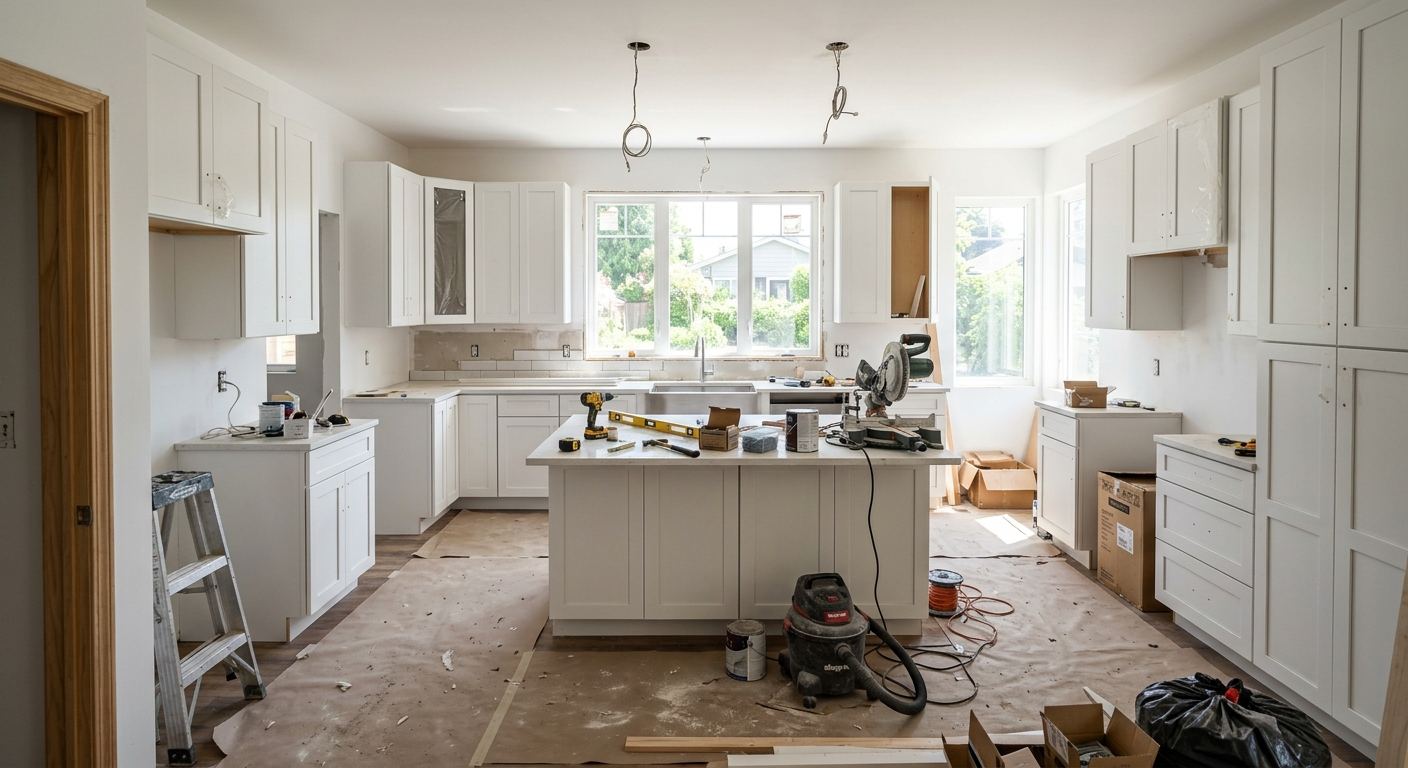
Kitchen renovation options and costs in Lumby
Kitchen renovation in Lumby is a little different than in larger centres because you’re often working with older housing stock, tighter room dimensions, and customers who want a finish that fits the Thompson–Okanagan lifestyle. With a population of 2,063 and about 700 homeowner households (Statistics Canada, 2021 Census), many projects are owner-occupied and planned for long-term use rather than purely for resale timing. That aligns with the region’s median household income of about $77,000 (Statistics Canada, 2021 Census): homeowners typically fund renovations with realistic, mid-range comfort in mind, and they’re willing to pay for cabinetry and countertops that look “right” for the home. Single-detached dwellings make up 66.7% of local housing, and that often means basements, exterior access, and slab/floor conditions can affect installation logistics.
In the Thompson–Okanagan, labour availability and material pricing through 2026 tend to keep overall totals elevated, and homeowners commonly request semi-custom or custom cabinetry paired with quartz or natural stone counters. Climate plays a secondary role: Lumby’s heating season drives dryer indoor air and temperature swings, which makes proper ventilation, countertop sealing where needed, and solid cabinet installation more important than choosing a different finish category. Where you’ll notice demand most is the North Okanagan Valley corridor and the areas along the highway approaches—those are the jobs that keep cabinet installers, plumbers, electricians, and tile crews booked.
Below are practical renovation tiers you can use to compare quotes, starting with a cosmetic refresh and moving up to custom millwork and stone.
| Renovation Tier |
What's Included |
Typical Duration |
Price Range |
| Cosmetic refresh (paint, hardware, new appliances only) |
Cabinet painting or touch-up, new pulls/handles, fresh wall paint, new appliances (dishwasher/range/hood/hood fan as applicable), minor trim/caulk, basic countertop cleaning/spot repair only (no swap) |
3–7 working days |
$5,000–$12,000 |
| Mid-range full renovation (new cabinets, counters, sink, tile) |
New semi-custom or quality-stock cabinets, new quartz or laminate counters, sink swap and standard plumbing tie-ins, backsplash tile, new flooring repair/partial replacement as needed, install of mid-range appliances |
3–6 weeks |
$40,000–$75,000 |
| High-end full renovation (custom cabinets, stone counters, island) |
Fully custom millwork, stone counters (granite or higher-end natural stone), island with upgraded base/counter supports, upgraded backsplash (tile feature or slab look), upgraded lighting/electrical, sink upgrade and concealed plumbing where possible |
6–12+ weeks |
$80,000–$110,000 |
| Cabinet refacing only (new doors + drawer fronts, same boxes) |
Door/drawer-front replacement, new end panels and trims, hardware, repaint or surface work to existing cabinet boxes if required, alignment adjustments, optional new countertop requires separate quote |
1–3 weeks |
$8,000–$22,000 |
| Countertop swap only (laminate to quartz or stone) |
Remove old laminate, measure/template, fabricate and install quartz/stone, seal/silicone finishes, standard cut-outs (sink/faucet, cooktop), backsplash patching where necessary |
3–10 working days |
$3,500–$18,000 |
| Backsplash tile installation only |
Remove existing backsplash (if needed), prep/flatten wall surfaces, install ceramic or porcelain tile, grout/seal, waterproofing at wet zones, trim transitions |
4–8 working days |
$3,000–$15,000 |
Prices are estimates only and vary by project scope, site access and material selection.
What affects the price of kitchen renovation in Lumby
In Lumby, you can see the same “kitchen refresh” land 30–50% apart across Thompson–Okanagan contractors and broader British Columbia because quotes often assume different standards for cabinetry quality, countertop fabrication, and what’s included in the labour line items. A builder-grade install with partial teardown costs differently than a managed renovation where we address subfloor dips, behind-cabinet drywall repairs, electrical bring-up, and proper venting clearances. In higher-value Thompson–Okanagan pockets, homeowners default to quartz or stone counters and semi-custom cabinetry because the finish gap is easier to justify on resale—your renovation cost is more likely to be recovered in buyer expectations. In more modest markets, laminate and stock cabinet lines can offer better ROI, but only if the layout and workmanship are solid.
Concrete Lumby examples that move price up or down: (1) older homes built before 1981 often have uneven plaster/drywall and older electrical runs, so prep labour and electrical updates can add costs even before cabinets arrive; (2) if you’re swapping laminate to quartz, the “countertop-only” pricing can rise quickly when sink or faucet cut-outs need rework and the wall behind the stove requires additional tile backer and waterproofing; (3) adding an island or removing a wall for open-concept flow typically triggers plumbing/gas/electrical coordination—so even with the same $40,000–$75,000 mid-range cabinet-and-counter target, layout changes can push you toward the upper bands.
Finally, climate matters mostly indirectly: the long heating season means more attention to ventilation and moisture management. If your range hood ducting is undersized or routed poorly, we often recommend upgrading the system during renovation—small in material cost, but it protects cabinets and tile long-term.
| Price Factor |
Why It Matters |
Cost Impact |
| Cabinet tier — stock vs. semi-custom vs. fully custom millwork |
Cabinet quality affects door/drawer construction, fit/finish, and how easily they adapt to uneven walls and special storage. |
Can shift a full kitchen job by roughly $12,000–$40,000, depending on tier and scope. |
| Countertop material — laminate vs. quartz vs. granite vs. stone |
Materials change fabrication complexity, edge profiles, and installation tolerances; stone also varies by slab and pattern. |
Often the next biggest swing factor after cabinetry; countertop installs can range about $3,500–$18,000+. |
| Layout change — wall removal, island add, plumbing/gas move |
Layout edits can require engineering/permit work, rerouting drains/supply, and structural or venting adjustments. |
Commonly adds $8,000–$30,000+ versus “like-for-like” installs. |
| Appliance package tier — builder vs. mid-range vs. pro-grade |
Higher tiers add better electronics, fit, and ventilation; they can also require electrical circuit changes. |
Typically $1,500–$6,000+ difference in appliances, plus potential electrical labour. |
| Flooring — refinish existing vs. full replacement |
Demo and subfloor correction costs vary based on current condition and what must be removed to install cabinets. |
May add $2,000–$12,000 depending on whether flooring is kept, repaired, or replaced throughout. |
| Backsplash — ceramic tile vs. marble vs. full-height slab |
Tile complexity depends on layout, trim details, and whether surfaces need flattening and waterproofing. |
Backsplash-only can range about $3,000–$15,000; full-height features push higher. |
| Electrical — new circuits for island, under-cabinet lighting |
Lighting, outlets, and hood/range power often require additional runs and better planning for cabinet lighting. |
Commonly adds $800–$5,000+ depending on circuit count and access. |
| Permit fees and licensed trade requirements |
When required, permits and inspections add admin time and licensed labour; scope definitions matter in quotes. |
Can add $300–$3,500+ depending on work complexity and inspection requirements. |
Permits & regulations in British Columbia
In British Columbia, straightforward cabinet and countertop swaps typically do not require a permit: replacing cabinets in the same locations, installing new counters, and updating a backsplash usually fall under standard renovation work. However, permits and licensed trades come into play when you change the “services” or the structure. Moving plumbing supply or drain lines (including relocating a sink), relocating a gas appliance (including work related to a range/range hood with gas), removing a load-bearing wall, or adding new electrical circuits for an island or new lighting all require permits and work by the appropriate licensed professional. Gas work must be completed by a licensed gas fitter, and electrical work must be done by a licensed electrician, with inspections where required.
For a homeowner in Lumby, the verification process should be done before you sign. Step one: ask for the contractor’s licence details and confirm they are current; you can cross-check credentials through the province’s public online sources for the relevant trade categories. Step two: request a current certificate of liability insurance (and ask that it matches your job site address and dates). Step three: confirm worker coverage documentation (WSIB/WCB) where applicable for the crews involved; your contract should specify who is providing coverage. Step four: ensure responsibilities are clear—permit pulling, inspection scheduling, and the final sign-off belong in writing.
Always confirm who is responsible for permits before work starts—if the contractor assumes permits are “you only,” stop and get it corrected in the contract.
Cabinets, countertops and layout decisions in Lumby
In a Lumby kitchen renovation, the three decisions that most affect both cost and satisfaction are cabinet tier, countertop material, and whether you’ll change the layout. Cabinet tier drives the fit-to-your-home story: stock cabinets go up fastest and are usually the lowest cost, but they may not hide older-wall irregularities as well. Semi-custom cabinets are the most popular mid-range choice because they balance lead times, customization, and installation forgiveness for uneven surfaces—an important consideration in homes built before 1981, where you’ll often see out-of-square walls. Fully custom cabinets are the best fit and can add features like pull-outs, integrated charging, and tailored storage, but they’re where budgets most easily drift.
Countertops should match your lifestyle and maintenance comfort. Laminate is affordable and practical, but it’s more susceptible to chipping at seams and needs careful care around heat and cutting. Quartz is a strong middle ground: it resists stains well, comes in many looks, and typically lands in a “mid-range” band. Granite/natural stone offers durability and visual variety, but you may need sealing depending on the specific stone. In the Thompson–Okanagan resale market, buyers at higher price points often expect a stone or quartz look, which is why fully-managed renovations tend to cluster around the $40,000–$75,000 range for mid-range full installs and can move into $80,000–$110,000 when islands and premium stone/custom millwork are included.
Layout is where justification matters. Adding an island or removing a wall can be worth it when it improves work flow, creates seating, and supports everyday traffic patterns. But if it requires plumbing or gas relocation, the cost can rise quickly. For example: if you’re considering a countertop-only swap (often $3,500–$18,000), that’s usually a safer upgrade than combining it with sink relocation—moving plumbing can push you into renovation-tier pricing even if finishes stay “mid-range.”
| Option |
Durability |
Maintenance |
Best For |
Price Range |
| Stock cabinets (big-box) |
Good for daily use; durability depends on door construction and hardware quality. |
Low; wipe-clean surfaces, but ensure proper alignment to avoid moisture gaps. |
Fast timelines and tighter budgets; simpler layouts. |
$8,000–$18,000 |
| Semi-custom cabinets (local dealer) |
Very good; better adjustments for uneven walls and more storage options. |
Low; typical care with mild cleaners, keep water away from seams. |
Most owner-occupied renovations in Lumby looking for “upgrade” value. |
$18,000–$30,000 |
| Custom cabinets (local millwork shop) |
Excellent; tailored joinery and optimized internal storage. |
Low to moderate depending on finishes; avoid abrasive cleaners on matte. |
Complex layouts, premium finishes, and maximum storage/fit. |
$30,000–$55,000 |
| Laminate countertop |
Moderate; can chip if hit at edges and needs careful use around heat. |
Low; avoid soaking seams and use trivets for hot pans. |
Budget-conscious upgrades where appearance matters more than stone feel. |
$3,500–$7,500 |
| Quartz engineered countertop |
High; resistant to stains and everyday impacts. |
Low; usually no sealing, but still use cutting boards. |
Busy households and buyers expecting a “stone-like” premium look. |
$7,500–$14,000 |
| Granite / natural stone countertop |
High; strong and heat resistant, with natural variation in pattern and hardness. |
Moderate; sealing may be needed depending on the stone type. |
Higher-end kitchens and homeowners who want distinctive natural character. |
$10,000–$18,000 |
| Butcher block countertop |
Moderate to high when maintained; can dent but can be refinished. |
Moderate; needs oiling/conditioning and careful moisture control. |
Cooks who want warmth and refinish-ability. |
$6,000–$12,000 |
| Marble countertop |
Moderate; elegant but softer than quartz/most granites. |
Moderate to high; requires sealing and careful stain/etch prevention. |
Low-to-moderate use homes prioritizing luxury look. |
$12,000–$22,000 |
How to choose a kitchen renovation contractor in Lumby
Choosing the right contractor in Lumby starts with verification of British Columbia trade credentials and insurance. Before anyone begins, ask for proof of a valid licence for the trades they’re coordinating (and confirm who does gas and electrical work—these must be handled by licensed professionals). Then request a certificate of liability insurance with active coverage and job-site dates. For worker coverage, confirm WSIB/WCB documentation where applicable; don’t rely on verbal assurances—ask for the paper trail so you’re protected if something goes wrong. A reputable contractor in the Thompson–Okanagan will also provide references for kitchens similar in scope and finish level.
Next, get 2–3 itemised written quotes. You want labour and materials broken out, not one lump-sum number, so you can compare whether the quote includes demo, drywall patching, disposal, electrical allowances, and countertop template/fabrication. Read the scope line-by-line: what’s excluded (subfloor repairs, fridge panel kits, backsplash waterproofing, or lighting fixtures), who pulls permits, and whether disposal/recycling is included. Warranty is another differentiator: ask for workmanship warranty length (how long they stand behind installation), manufacturer warranty for cabinetry/counters, and whether warranties are transferable if you sell your home.
On payment scheduling, don’t accept more than 10–15% upfront. Hold back a portion until key milestones are complete. Finally, require a timeline in writing with a start date and estimated completion window—cabinet and stone lead times should be stated clearly.
- Confirm trade licensing for gas/electrical and document who performs the work.
- Verify liability insurance and the certificate dates match your project period.
- Ask for WSIB/WCB coverage proof for applicable trades/crew.
- Require 2–3 itemised quotes (labour vs materials) rather than “estimate ranges” only.
- Ensure permit pull responsibility is written in the contract (if required for your scope).
- Check whether disposal/hauling and dumpster costs are included.
- Confirm demolition scope: what’s protected, what’s removed, and who repairs what.
- Ask who handles electrical rough-in and when inspections are scheduled.
- Confirm cabinet install plan includes shimming/levelling and securing to correct structure.
- Review backsplash details: waterproofing at wet zones, tile layout, and trim edges.
- Get warranty details in writing: workmanship term, manufacturer terms, and transferability.
- Use milestone payments: small deposit, then pay at measurable completion stages.
Concrete red flags I see in Lumby: (1) contractors who won’t provide insurance or WSIB/WCB documentation; (2) quotes that omit electrical/permit details and assume “it’ll be fine” later; (3) requesting large upfront deposits beyond 10–15%; (4) vague scopes (“supply and install kitchen” with no breakdown of cabinets/counters/backsplash); (5) no written timeline or cabinet/stone lead-time plan despite ordering custom or semi-custom millwork.
Frequently asked questions — kitchen renovation in Lumby
How do I budget for a kitchen renovation?
Budgeting in Lumby usually starts with deciding how much of the kitchen you’re truly changing. If you’re keeping the layout and doing a cosmetic refresh, you might stay in the lower end of the bands (for example, a refresh around $5,000–$12,000, depending on appliances). If you want a noticeable upgrade—new cabinets, counters, sink, and backsplash—plan for a full renovation tier (mid-range often lines up with $40,000–$75,000, and higher-end projects commonly reach $80,000–$110,000). In the Thompson–Okanagan, finishes like quartz or stone and semi-custom cabinetry are common because homeowners expect a more durable, resale-friendly look. Also budget for hidden labour in older homes (many in the area were built before 1981), such as drywall prep and electrical bring-up.
Can I move my kitchen sink or stove?
Yes, you can move a sink or stove in British Columbia, but it’s usually the most expensive part of a renovation because it involves plumbing and sometimes gas-related decisions. Moving a sink typically requires relocating supply and drain lines, which usually means permits and licensed plumbing work. Moving a gas stove or adjusting gas connections requires a licensed gas fitter, with inspections where required. The timeline can also change because trades need access when walls are open. If you’re in Lumby and your goal is “upgrade without surprise costs,” consider keeping the sink in roughly the same location and doing cabinetry/countertop/backsplash upgrades first, then revisit layout changes only if you’re comfortable with the added labour and permit steps.
What's the most cost-effective kitchen upgrade?
Most homeowners in Lumby find the best cost-effectiveness is one of these: (1) upgrading countertops and hardware while keeping the layout, or (2) doing a targeted backsplash that ties the new counters to the rest of the kitchen. A countertop swap alone can often be within the $3,500–$18,000 band, and it delivers a big visual change even when cabinets stay in place. Another option is cabinet refacing—new doors and drawer fronts—often falls into the $8,000–$22,000 range, so you get the look of a new cabinet without the full demolition expense. If you’re working with older surfaces, we’ll also check what needs flattening behind tile or under countertops so the “cheap” upgrade doesn’t turn into rework later.
Custom vs stock cabinets — is custom worth it?
Custom cabinets are worth it when you have an irregular layout, want maximum storage efficiency, or need the best fit on older walls. For many Lumby homeowners, semi-custom is the sweet spot: it’s usually a faster and more predictable path than fully custom, while still offering upgrades like better internal organization and improved appearance compared with basic stock lines. Stock cabinets can be a great value if your measurements are straightforward and you’re aiming for a faster, lower-cost renovation tier. The Thompson–Okanagan market also influences expectations—buyers at higher price points often notice cabinetry finish quality and hardware, so if you’re planning a full renovation that lands in the $40,000–$110,000 range, investing in cabinet quality can be a smarter spend than chasing a very expensive countertop alone.
How do I choose a kitchen contractor in Lumby?
Choose a contractor by verifying credentials and comparing written scopes, not by price alone. In British Columbia, confirm gas and electrical work is done by properly licensed trades, and ask for documentation: liability insurance and worker coverage (WSIB/WCB where applicable). Then request 2–3 itemised quotes with a labour and materials breakdown—ensure you can see whether demo, disposal, permits (if required), electrical allowances, and backsplash prep are included. A strong contractor will also provide a written timeline and warranty details (workmanship duration plus manufacturer warranty terms, including whether warranties are transferable). Finally, be cautious of contractors requesting more than 10–15% upfront or who won’t put responsibilities in the contract—those are common predictors of frustration in kitchen projects.
What order do kitchen renovation steps happen in?
In Lumby projects, the typical order is designed to protect the site while trades work efficiently. First, final measurements and approvals happen, especially for cabinets and countertops. Next is demolition and site protection (covering floors/adjacent spaces), followed by rough-ins—electrical rough-in, plumbing/gas rough work, and any framing adjustments if the layout changes. After that comes inspection steps (where permits apply), then drywall/patching and paint/texture. Cabinets install next, followed by countertop templating and installation, and then backsplash tile. Flooring repairs or full replacement generally happen around cabinets in a way that preserves transitions and base alignment. Finally, appliances, trim, caulking, and finishing details are completed. If you’re doing a countertop-only swap, the order tightens, but the principle remains: rough work and approvals first, then install surfaces for best alignment.