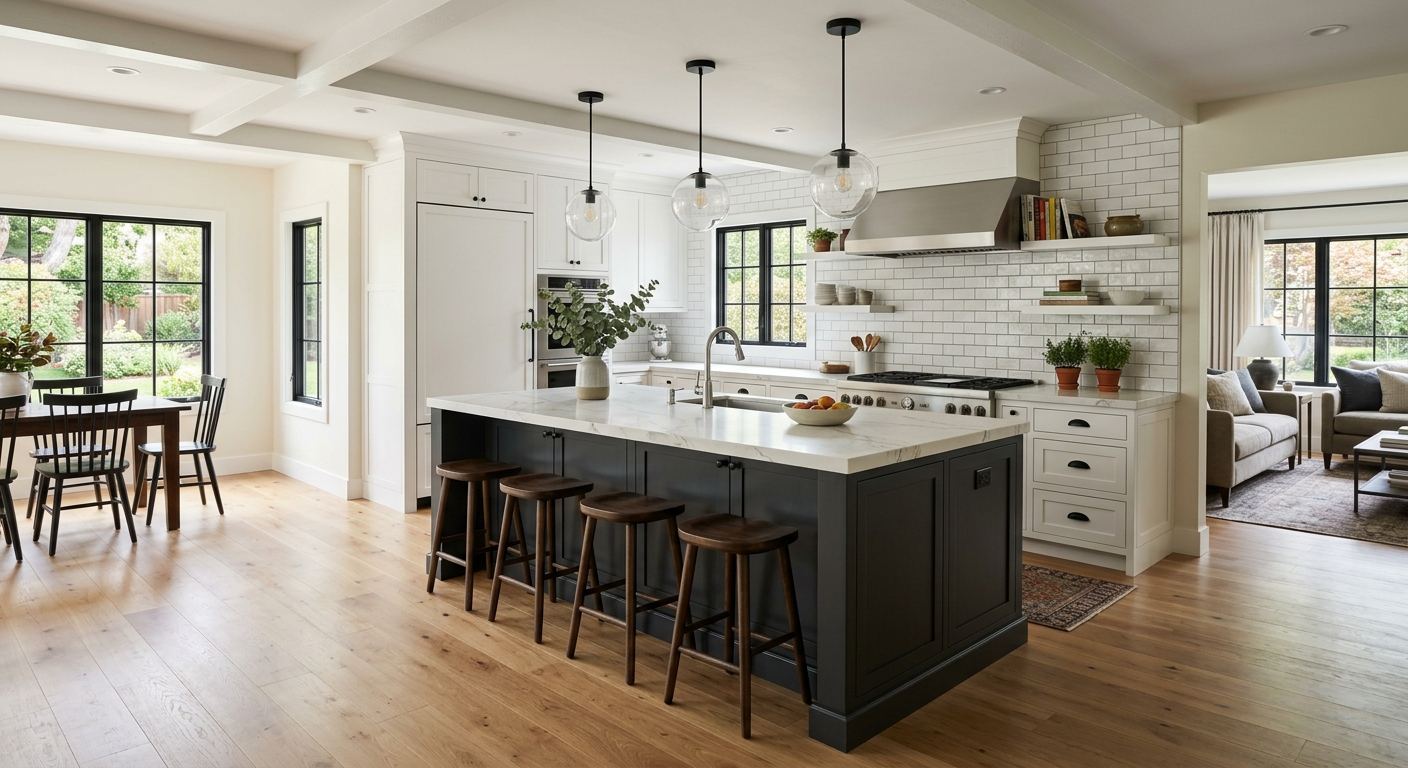
Kitchen renovation options and costs in Strawberry Hill
In Strawberry Hill, kitchen renovation costs tend to track how homeowners want the finished look to feel—not just how many square feet are being updated. With a population of about 41,000 people (Statistics Canada, 2021 Census), the local demand is steady, and most kitchens are influenced by the broader Lower Mainland–Southwest market where buyers often pay more for clean lines, modern storage, and durable surfaces. In these higher-value neighbourhood pockets around Surrey and Burnaby-style commuter corridors (including many homes that sit close to newer shopping and transit), it’s common to see renovation expectations rise toward semi-custom cabinetry and quartz/stone counters, because the cost is easier to recover on resale in the Lower Mainland–Southwest. In practical terms, that means many jobs land in the “mid-range full renovation” lane rather than a strictly basic refresh.
Climate is also a factor, but in the Lower Mainland–Southwest it usually shows up indirectly. Humid coastal conditions and wet-season driveway/entry access can slow drying and affect installation timing for finishes and flooring adhesives, yet pricing is driven more by material and labour availability than by temperature swings. Contractor availability is strongest where larger housing turnover drives repeat demand; trade partners are especially busy in the Strawberry Hill and nearby Guildford/Whalley corridor, where homeowners often renovate during spring and early fall to align with move-in schedules. The table below breaks down the main renovation tiers so you can compare bids apples-to-apples.
| Renovation Tier |
What's Included |
Typical Duration |
Price Range |
| Cosmetic refresh (paint, hardware, new appliances only) |
Cabinet hardware swap, paint/stain touch-ups, appliance replacements (no plumbing/gas moves), minor caulking, basic deep clean and countertop/millwork wipe-down |
3–7 days |
$8,000–$20,000 |
| Mid-range full renovation (new cabinets, counters, sink, tile) |
New semi-custom or quality stock cabinetry, new countertop, sink + faucet replacement, backsplash tile, under-cabinet lighting (if added), flooring refresh/replacement depending on scope |
3–6 weeks |
$40,000–$85,000 |
| High-end full renovation (custom cabinets, stone counters, island) |
Fully custom millwork, quartz or premium natural stone, island build-out, upgraded hardware, upgraded lighting package, comprehensive backsplash (including full-height options), often layout changes and more electrical |
6–10 weeks |
$85,000–$120,000 |
| Cabinet refacing only (new doors + drawer fronts, same boxes) |
Door/drawer front replacement, new hinges/soft-close hardware, resurfacing existing cabinet boxes (where condition allows), simple paint touch-ups, updated trim where needed |
1–3 weeks |
$8,000–$35,000 |
| Countertop swap only (laminate to quartz or stone) |
Removal and install of new countertop, sink cut-out handling, new edge profile, standard backsplash caulking interface (no full tile rebuild) |
2–5 days |
$3,000–$12,000 |
| Backsplash tile installation only |
Tile supply/installation, substrate prep, waterproofing and grout sealing as needed, removal of existing backsplash (where included) |
2–6 days |
$1,500–$6,000 |
Prices are estimates only and vary by project scope, site access and material selection.
What affects the price of kitchen renovation in Strawberry Hill
For the same kitchen, you can see quotes in the Lower Mainland–Southwest that swing by about 30–50% compared with other parts of British Columbia. The biggest driver isn’t usually the coastal climate—it’s how local home values and income expectations shape the finish tier. In higher-value Metro Vancouver-adjacent markets (including areas where Strawberry Hill homeowners often plan for resale), many people default to quartz or natural stone counters and semi-custom cabinetry because the upgrade reads well at showings. In lower-cost markets, laminate and stock cabinets dominate because they deliver a better ROI for the money. In both cases, layout changes are the wild card: removing a wall, adding an island, or moving a gas line can reshape labour, trades coordination, and permit scope regardless of whether you choose laminate or stone.
In Strawberry Hill specifically, a few common conditions push costs up or down. First, older cabinet boxes and uneven wall framing can require extra prep—sometimes adding $1,500–$4,000 in patching, blocking, or re-leveling before new tile goes in. Second, kitchens with long runs of plumbing can increase rough-in time; even a “minor” sink move can trigger additional plumbing hours and new shutoffs, often adding $800–$2,500 depending on access. Third, if you’re aiming for a mid-range full renovation (often $40,000–$85,000 in this tier), choosing a quartz countertop helps stabilize the total: you get a premium surface without the same labour intensity as full custom stone templates. By contrast, a high-end full renovation (often $85,000–$120,000) can jump quickly once custom cabinetry and island wiring are included.
| Price Factor |
Why It Matters |
Cost Impact |
| Cabinet tier — stock vs. semi-custom vs. fully custom millwork |
Custom boxes, drawer configurations, and door styles require more measuring, fabrication time, and finishing |
~$10,000–$45,000 difference within the same kitchen footprint |
| Countertop material — laminate vs. quartz vs. granite vs. stone |
Material price, edge profiles, and templating complexity change both material and install time |
~$2,000–$12,000 swing depending on choice and seam/edge requirements |
| Layout change — wall removal, island add, plumbing/gas move |
Triggers structural work, new rough-in paths, and more trade coordination |
~$5,000–$25,000 added cost even when finishes stay “mid-range” |
| Appliance package tier — builder vs. mid-range vs. pro-grade |
Higher-end units cost more and may require different electrical/gas readiness and ventilation |
~$1,500–$10,000 difference |
| Flooring — refinish existing vs. full replacement |
Floor repairs are often limited by moisture exposure and subfloor condition; replacement is the safer path |
~$1,000–$8,000 depending on scope and underlayment prep |
| Backsplash — ceramic tile vs. marble vs. full-height slab |
Premium materials add fabrication and more careful setting, especially with vertical runs |
~$500–$5,000+ depending on coverage and material |
| Electrical — new circuits for island, under-cabinet lighting |
Additional circuits and lighting require licensed labour and longer scheduling |
~$800–$6,000 added cost |
| Permit fees and licensed trade requirements |
Work that touches plumbing/gas/electrical or structure often requires permitting and inspections |
~$300–$3,000+ in added admin and trade coordination |
Permits & regulations in British Columbia
In British Columbia, not every kitchen update needs a permit. A simple countertop swap or a basic cabinet door/drawer refacing generally does not require a permit. However, when you move plumbing supply or drain lines, relocate a gas range or change a gas range hood connection, remove a load-bearing wall, or add new electrical circuits (for example, for an island and under-cabinet lighting), permits typically come into play and licensed trades must perform the work. Gas work must be completed by a licensed gas fitter, and electrical work must be done by a licensed electrician, with inspections arranged as required. Always confirm who pulls permits in your written contract—permit responsibility can’t be left as “the contractor will handle it” without details.
To verify a contractor in Strawberry Hill, I recommend this step-by-step process before you sign:
- Ask for a copy of their licence/scope details for relevant trades (gas and electrical only if they’re doing that work directly).
- Request certificate(s) of insurance showing liability coverage.
- Confirm WSBC coverage (commonly referred to as WCB/WSIB in conversation). If they’re subcontracting, ensure subcontractors also carry coverage.
- When you get a quote, require the permit notes: which items require permits, and whether the contractor includes or excludes permit fees.
- After work starts, keep an eye on inspection milestones for anything involving plumbing/electrical/gas.
If you’re ever unsure, ask for their insurance certificate and any clearance documentation up front. It’s much easier to sort before materials arrive.
Cabinets, countertops and layout decisions in Strawberry Hill
The three most consequential decisions in a Strawberry Hill kitchen renovation are cabinet tier, countertop material, and whether you change layout. Start with cabinet tier: stock is fastest and typically the cheapest, semi-custom is usually the sweet spot for mid-range budgets because you can tailor storage and some dimensions, and custom delivers the best fit for awkward corners and unique wall lines—at the highest cost. Next, choose countertop material. In Lower Mainland–Southwest kitchens, quartz is a common “default premium” because it balances durability and low day-to-day maintenance. Natural stone can be gorgeous, but budgeting for sealing/maintenance and careful templating matters. Finally, layout changes: opening up with a wall removal, adding an island, or moving plumbing/gas is where cost and disruption can spike.
In a resale-minded market like Strawberry Hill, the best ROI often comes from visible storage and clean finishes. For example, moving from laminate to quartz may add roughly $2,000–$5,000 in many projects, but it can be justified if your cabinet tier and backsplash are already in the mid-range. That’s a common path within a $40,000–$85,000 renovation: you upgrade the surfaces without overhauling plumbing. Conversely, skipping a layout change can keep you away from the biggest unpredictable costs—especially if you’re not ready for island wiring or gas line coordination—helping you stay closer to the plan even when you choose a higher-end countertop.
Because the Lower Mainland’s damp season can affect cure times for flooring and certain adhesives, schedule matters. A well-planned contractor will protect work areas and sequencing so cabinet install and counter templating don’t get delayed by humidity or wet subfloors.
| Option |
Durability |
Maintenance |
Best For |
Price Range |
| Stock cabinets (big-box) |
Good durability with standard construction; limited for unusual dimensions |
Low; wipe clean, manage hinges/hardware over time |
Budget-conscious refreshes where layout is staying the same |
$8,000–$25,000 |
| Semi-custom cabinets (local dealer) |
Very strong for daily use; better storage options and door/drawer upgrades |
Low to moderate; keep hardware adjusted |
Most common Strawberry Hill mid-range remodels |
$18,000–$45,000 |
| Custom cabinets (local millwork shop) |
Highest fit and finish; tailored to corner geometry and unique wall conditions |
Low; depends on finish system (paint vs. stain) |
Homes with tight layouts, slanted walls, or a long-term “designer” goal |
$35,000–$70,000+ |
| Laminate countertop |
Decent for light wear; edges can be more vulnerable to water infiltration if seams fail |
Easy daily cleaning; avoid standing water at seams and sinks |
Fast upgrades when budget control is the top priority |
$3,000–$7,000 |
| Quartz engineered countertop |
High durability; consistent surface with good stain resistance |
Low; no sealing for most quartz brands |
Premium look with practical upkeep for busy households |
$6,000–$12,000 |
| Granite / natural stone countertop |
Very durable; unique veining and heat tolerance |
Moderate; typically requires periodic sealing |
Premium builds where appearance is the priority |
$7,000–$15,000 |
| Butcher block countertop |
Durable but softer than stone; benefits from proper cutting practices |
Moderate; oiling and conditioning needed |
Cozy, warm styles and households that maintain surfaces |
$4,000–$10,000 |
| Marble countertop |
Premium feel but more sensitive to etching; needs careful care |
Higher maintenance; sealing and acid/heat management |
Designer-forward kitchens where appearance outweighs “worktop abuse” |
$10,000–$22,000+ |
How to choose a kitchen renovation contractor in Strawberry Hill
When you’re choosing a kitchen renovation contractor in Strawberry Hill, verify credentials in three buckets: licence/scope (where applicable), insurance, and work coverage. For insurance, request a certificate of liability showing enough coverage for construction activities. For coverage, ask for proof of WSBC coverage (often referenced as WCB/WSIB). Then, for trade work that involves gas or electrical, confirm the contractor’s capacity to perform those scopes safely and legally by having the right licensed trades on the job.
Next, get 2–3 itemised quotes. You want a labour + materials breakdown instead of a single lump sum so you can compare like-for-like—especially for cabinetry installation, countertop templating, electrical allowances, tile prep, and disposal. Read the scope section carefully: what’s excluded (for example, drywall patching beyond a reasonable allowance), who handles permits, and whether demolition disposal is included in the price or billed separately. Warranty matters too: ask for the workmanship warranty length, the manufacturer warranty on cabinets/counters/appliances, and whether warranties are transferable if you sell the home.
Payment schedule should be conservative. Avoid paying more than 10–15% upfront; hold back a portion until key milestones are complete and the punch list is addressed. Finally, protect your time: require a start date and a completion estimate in writing, plus an explanation of what triggers delays (counter templating lead times, weather impacts for flooring, or electrical scheduling).
- Confirm they’re insured and can provide a current certificate of insurance on request.
- Verify WSBC coverage documentation before demolition starts.
- Request proof of licences for any gas/electrical scopes they will perform.
- Get itemised labour/materials quotes (no “mystery allowances”).
- Ask who pulls permits, and whether permit fees are included or excluded.
- Confirm disposal: dumpster fees and hauling—what’s included?
- Check flooring and subfloor allowances: what happens if moisture damage is found?
- Demand countertop templating details and seam/edge decisions in writing.
- Ask about cabinet install method and wall straightness requirements.
- Review warranty terms: workmanship length and what voids coverage.
- Agree on a realistic timeline with lead-time buffers for cabinets/counters.
- Keep milestone-based payments tied to inspection/punch-list completion.
Red flags I see in Strawberry Hill include: vague scopes with missing line items, avoiding insurance/coverage documentation, “permit will be handled later” language, overly large upfront deposits, and warranties that are only provided verbally or don’t separate labour vs. product coverage.
Frequently asked questions — kitchen renovation in Strawberry Hill
How do I choose a kitchen contractor in Strawberry Hill?
Start by comparing like-for-like bids. In Strawberry Hill and the wider Lower Mainland–Southwest, a contractor’s total price can swing based on finish tier and how much of the work they coordinate (cabinet install, countertop templating, electrical, and tile prep). Request 2–3 itemised quotes that separate labour and materials, including disposal and whether permits are included. Verify insurance (liability certificate), WSBC coverage for workers, and ensure any gas or electrical work is performed by properly licensed trades. When you review their warranty, confirm workmanship duration and whether manufacturer warranties carry over to you if you sell. If a quote only lists a lump sum without allowances or exclusions, treat that as a decision you can’t confidently price-check.
What order do kitchen renovation steps happen in?
A typical kitchen renovation sequence in British Columbia looks like this: (1) confirm layout and finalize measurements; (2) schedule demolition and protect floors/doorways; (3) complete rough-in work (electrical, plumbing, and any gas changes) after the walls/floor are opened; (4) close up and complete drywall/patching; (5) prep and install flooring (or reinstall as needed); (6) install cabinets (after walls are straight and sealed); (7) template and fabricate countertops (quartz/stone templating usually happens once cabinets are set); (8) set countertops and connect plumbing; (9) install backsplash and under-cabinet lighting; (10) final connections, caulking, paint touch-ups, and punch list. This sequencing matters—quartz and stone lead times can delay close-out if templating is rushed.
Can I live at home during a kitchen renovation in Strawberry Hill?
Often, yes—especially for cosmetic refreshes or staged mid-range renos. If you’re only doing cabinet refacing, new hardware, and appliance swaps, most homeowners can remain in the home with a functional kitchen for light use. For fuller work (new cabinets/counters/tile), you’ll usually have a period where the sink and main prep surface are out of service. I recommend planning for a “temporary cooking zone” (microwave, kettle, and a small plug-in burner if approved) and protecting the rest of the home from dust. Humid coastal conditions can slow certain drying steps, so ask your contractor how they manage ventilation and containment. A higher-end full renovation with an island can take longer, so plan your living arrangements accordingly.
Should I renovate my kitchen before selling in Strawberry Hill?
If you’re preparing to sell, prioritize upgrades that buyers can instantly see and that hold up to daily wear. In Strawberry Hill’s Lower Mainland–Southwest market, that often means clean cabinet lines, durable countertops, and good lighting. A mid-range full renovation is commonly budgeted around $40,000–$85,000, and it tends to align with what many buyers expect visually when they tour. If you’re not ready for a full rebuild, a countertop swap or cabinet refacing can still deliver a refreshed look without the full disruption—though you should only proceed if the existing cabinet boxes and layout are structurally sound. The key is timing and schedule: unfinished work can reduce perceived value, so choose finishes and materials with predictable lead times (especially for quartz/stone).
What's the most popular kitchen style in Strawberry Hill right now?
Right now, many homeowners in Strawberry Hill are leaning toward bright, modern “transitional” kitchens: shaker-style cabinet doors, warm neutrals, matte hardware, and durable countertops that look like stone. The practical driver is resale expectations—buyers in the Lower Mainland–Southwest often look for quartz/stone surfaces and a layout that supports everyday flow. That’s why semi-custom cabinetry is a frequent choice: it offers better storage planning than basic stock while staying closer to $40,000–$85,000 mid-range renovations than custom millwork. Islands are common, but whether they’re worth it depends on electrical and plumbing coordination. If you’re changing a wall or adding an island, build in time for permits and licensed trades scheduling.
How do I know if I need to update my kitchen plumbing in Strawberry Hill?
You may need plumbing updates if you notice leaks, low water pressure, corrosion at shutoffs, slow draining, or if you’re moving the sink/dishwasher or adding an island. In many Strawberry Hill homes, plumbing can be older than the finish—so the visible kitchen may be outdated while pipes are already near end-of-life. A good contractor will camera-check or inspect at the start once walls are opened, then suggest replacements where access is easiest (shutoffs, supply lines, and any drain changes). If you’re keeping the sink in the same location and making only countertop/appliance changes, plumbing work may be minimal. But if you’re changing drain/supply routes, you should expect permitting and licensed trade involvement. Even small changes can affect schedule and cost, typically adding more than most homeowners expect.