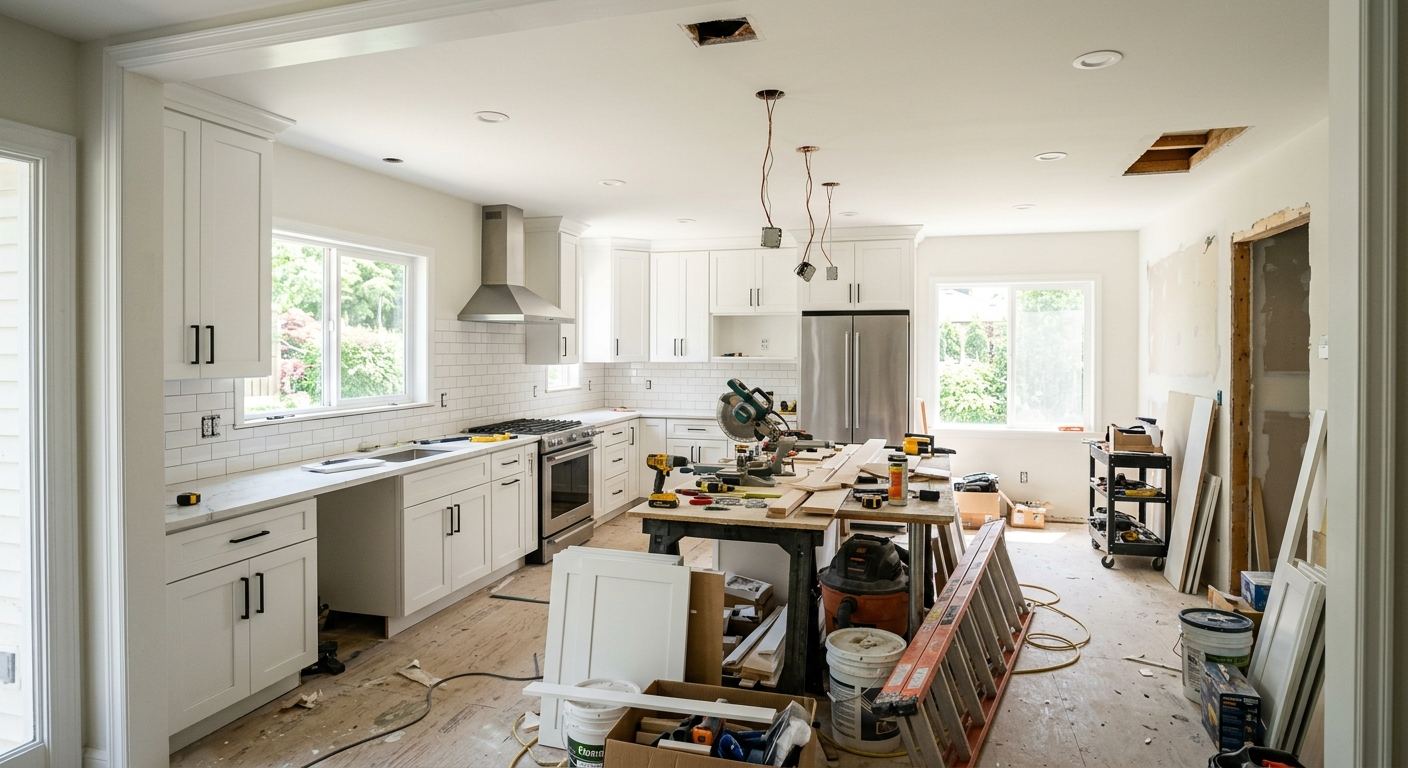
Kitchen renovation options and costs in Chinatown
Kitchen renovations in Chinatown, British Columbia tend to price faster than many homeowners expect because the finish level is strongly shaped by local market expectations. With a population of about 24,000 in the area (Statistics Canada, 2021 Census), the demand you’ll see around the Lower Mainland–Southwest is concentrated in practical, everyday upgrades—yet Vancouver-adjacent buyers still push owners toward durable surfaces and clean, modern lines. On top of that, Lower Mainland–Southwest projects often reflect the region’s higher home-value resale logic: owners choose cabinetry and countertops that “hold their value” visually, especially in higher-visibility blocks where show-ready kitchens matter.
Climate plays a secondary role compared with budgeting and contractor availability. In the Lower Mainland–Southwest you don’t typically get the extreme freeze-thaw that drives structural movement elsewhere in Canada, so costs are less about winter damage and more about material lead times, indoor humidity control during install, and the complexity of custom cabinetry. In Chinatown specifically, work is often in older strata buildings and older houses where access and coordination can affect scheduling—especially around narrow entries and shared service paths. That’s why trades with established routing and dust-control routines are in demand, particularly near the core retail streets where customers still need storefront traffic managed.
Below is a clear comparison of common renovation tiers you’ll see in Chinatown quotes, so you can benchmark whether a proposal is a refresh, a true mid-range remodel, or a premium rebuild with stone and design-led millwork.
| Renovation Tier |
What's Included |
Typical Duration |
Price Range |
| Cosmetic refresh (paint, hardware, new appliances only) |
Paint, new cabinet hardware, appliance swap, minor caulking, basic countertop polish (no surface replacement), housekeeping-level backsplash touch-ups if existing tile is retained |
2–5 weeks |
$8,000–$25,000 |
| Mid-range full renovation (new cabinets, counters, sink, tile) |
Semi-custom or quality stock cabinets, new counters, sink and faucet, backsplash tile, full flooring replacement or upgrade (as needed), plumbing reconnection, electrical add-ons like under-cabinet lighting |
6–12 weeks |
$40,000–$85,000 |
| High-end full renovation (custom cabinets, stone counters, island) |
Fully custom cabinetry, stone counters, island build with upgraded electrical, higher-end fixtures, full-height backsplash where requested, often includes layout optimization and more extensive flooring/trim refinishing |
10–18 weeks |
$85,000–$120,000 |
| Cabinet refacing only (new doors + drawer fronts, same boxes) |
New door/drawer fronts, updated hardware, new trim, refinished or relaminated box interiors where needed, often paired with countertop and backsplash decisions |
4–8 weeks |
$8,000–$40,000 |
| Countertop swap only (laminate to quartz or stone) |
Remove existing top, install new quartz/stone, new sink cut-outs if needed, edge detail upgrade, silicone and final sealing |
1–3 weeks |
$3,000–$12,000 |
| Backsplash tile installation only |
Remove/revive existing surface as required, tile supply and install, grout/seal, finish detailing up to cabinets/hood, clean-up and caulking |
1–2 weeks |
$1,500–$6,000 |
Prices are estimates only and vary by project scope, site access and material selection.
What affects the price of kitchen renovation in Chinatown
In Chinatown and throughout the Lower Mainland–Southwest, the same “kitchen size” can land 30–50% apart from quote to quote because pricing tracks local home-value expectations and the finish tier homeowners choose—more than it tracks climate. Across British Columbia, contractors also price differently based on overhead, how premium they need to be to cover labour shortages, and how quickly they can source cabinetry and stone. In higher-value Metro Vancouver-oriented pockets, it’s common for homeowners to default to quartz or stone counters and semi-custom cabinetry, because the renovation cost is easier to justify at resale when the kitchen reads “updated” to buyers. In more modest markets, laminate and stock cabinets still dominate because the ROI goal is often “fresh and functional” rather than “premium materials.”
In Chinatown specifically, older housing stock and denser site conditions can raise or lower costs in very practical ways. If your kitchen is in an older home, you may run into dated plumbing runs or less-modern electrical capacity; bringing wiring up for an island or adding under-cabinet lighting can add labour even before you touch finishes. Conversely, if the existing cabinet boxes are in good shape, refacing can hold costs down versus full replacement; you might redirect that budget into a higher-end countertop. Another example: if your renovation includes moving a sink or relocating a gas range, the plumbing/gas changes become the “driver” of cost regardless of whether you choose laminate or quartz.
To ground it in price bands, a mid-range renovation often starts around $40,000–$85,000, while a high-end full renovation with custom millwork can push into $85,000–$120,000. In this region, layout changes—wall removal, island addition, or moving a gas line—are the most unpredictable component, typically outweighing countertop material choices in cost volatility.
| Price Factor |
Why It Matters |
Cost Impact |
| Cabinet tier — stock vs. semi-custom vs. fully custom millwork |
Custom fit, door styles, soft-close/upgrade packages, and build-to-wall measurements change labour and material complexity |
Often shifts a full renovation by tens of thousands (e.g., $40,000–$85,000 vs $85,000–$120,000) |
| Countertop material — laminate vs. quartz vs. granite vs. stone |
Material cost, edge profiles, and install requirements vary; stone also affects scheduling and handling |
Countertop installation commonly ranges $3,000–$12,000 depending on material and complexity |
| Layout change — wall removal, island add, plumbing/gas move |
Structural work, new framing, and trades coordination drive both labour and permit steps |
Can add the largest unpredictability regardless of finish tier |
| Appliance package tier — builder vs. mid-range vs. pro-grade |
Pro-grade units can require electrical/gas readiness and different cut-out tolerances |
May add several thousand dollars and can increase coordination time |
| Flooring — refinish existing vs. full replacement |
Demo conditions and substrate repair can expand scope quickly in older homes |
Partial savings if you can refinish; full replacement adds labour and waste handling |
| Backsplash — ceramic tile vs. marble vs. full-height slab |
Higher-end stone increases cutting complexity; full-height adds height detailing and more material |
Backsplash & tile typically ranges $1,500–$6,000 |
| Electrical — new circuits for island, under-cabinet lighting |
New circuits and fixture locations change electrician time and inspection needs |
Often a meaningful add-on when island power or code updates are required |
| Permit fees and licensed trade requirements |
Permits add administrative steps and scheduling, especially when multiple trades are involved |
Can add cost and timeline; exact amount depends on what work triggers permits |
Permits & regulations in British Columbia
In British Columbia, many “like-for-like” kitchen upgrades can proceed without a permit. Generally, swapping cabinets and replacing countertops is typically treated as a non-permitted finishing scope. That said, the moment you change plumbing routing, electrical circuits, or gas equipment locations, you move into permit-and-inspection territory—especially in Chinatown where older home wiring and plumbing layouts can be less ready for modern add-ons.
Work that typically requires permits and licensed trades includes: moving or modifying plumbing supply/drain lines (for example, relocating a sink), relocating a gas stove or doing work tied to gas connections, removing a load-bearing wall (or any structural change), and adding new electrical circuits (commonly for an island outlets and new under-cabinet lighting on updated circuits). Gas work must be done by a licensed gas fitter, and electrical work by a licensed electrician; both require inspections after installation.
Step-by-step, here’s how a homeowner in Chinatown should verify credentials before signing: first, ask for the contractor’s licence number and confirm it through the relevant online registry; second, request a current certificate of insurance and verify the coverage limits; third, confirm workers’ compensation coverage (WCB) where applicable and ask for documentation—your contract should reflect it. Finally, request a clear statement of who is pulling permits and who pays the inspection-related costs. If responsibility isn’t written down, that’s when surprises happen.
Cabinets, countertops and layout decisions in Chinatown
In a Chinatown kitchen renovation, three decisions usually determine 70% of your long-term satisfaction: (1) cabinet tier, (2) countertop material, and (3) whether you change layout. Start with cabinet tier. Stock cabinets are the fastest and often the cheapest, but they may not fit older, uneven walls without more fillers and trim. Semi-custom cabinets are the most common “sweet spot” in the Lower Mainland–Southwest because they offer better fit and popular storage options without jumping all the way to custom. Fully custom cabinets cost more, but they let you follow the room’s geometry closely—especially helpful in older Chinatown homes where corners aren’t always perfectly square.
Next, countertop material. Laminate is budget-friendly and forgiving, but it’s less ideal if you expect heavy daily use or want a long “no-thinking” surface. Quartz is the go-to for many renovations because it handles everyday heat and spills well and looks consistent. Granite/natural stone brings premium appearance, while butcher block can work beautifully in heritage-style kitchens but needs more maintenance. In terms of realistic pricing, countertop installation generally sits in $3,000–$12,000, and your material choice is what moves you within that band.
Finally, layout changes: open-concept wall removal, island addition, and plumbing/gas relocation are only “worth it” when the space gain improves how you live—traffic flow, cooking triangle, and where outlets and lighting land. A specific example: if you’re considering a full island with relocated plumbing, the project can quickly shift from a mid-range total around $40,000–$85,000 toward the high-end band ($85,000–$120,000) because electrical/plumbing coordination and finishing all expand scope. If your island can be added without moving gas lines and with a short electrical run, the upgrade is much easier to justify.
| Option |
Durability |
Maintenance |
Best For |
Price Range |
| Stock cabinets (big-box) |
Good daily durability; fit depends on your wall straightness |
Low—standard cleaning and tightening of hardware as needed |
Fast refreshes, straightforward layouts, budget-conscious owners |
$8,000–$25,000 |
| Semi-custom cabinets (local dealer) |
Very good; better storage customization and door style options |
Low to moderate—occasional hardware adjustments |
Most Chinatown renovations aiming for resale-ready finishes |
$20,000–$60,000 |
| Custom cabinets (local millwork shop) |
Excellent; built-to-fit for irregular or heritage details |
Low—treat like quality cabinetry; minor repairs handled by maker |
Challenging rooms, premium design, maximum fit and storage |
$40,000–$90,000 |
| Laminate countertop |
Moderate; can be sensitive to seams and heat if not installed/managed well |
Low—avoid standing water at seams and use trivets |
Budget refreshes and rental-friendly updates |
$3,000–$6,000 |
| Quartz engineered countertop |
High; resistant to staining and good everyday resilience |
Low—routine cleaning; avoid extreme heat exposure |
Most mid-range and high-value updates in Lower Mainland–Southwest |
$6,000–$10,000 |
| Granite / natural stone countertop |
High; very durable with natural character |
Moderate—sealing/maintenance depending on the stone |
Owners wanting a premium, unique look |
$8,000–$12,000 |
| Butcher block countertop |
Moderate to high; susceptible to dents/scratches but repairable |
Moderate—oil and keep dry near sinks |
Warm, heritage styles; families who maintain surfaces regularly |
$5,000–$9,000 |
| Marble countertop |
Moderate; gorgeous but can etch/stain without careful use |
Moderate to high—more sealing and prompt cleaning |
Statement kitchens where aesthetics matter more than heavy-duty abuse |
$9,000–$12,000 |
How to choose a kitchen renovation contractor in Chinatown
Choosing the right contractor in Chinatown, British Columbia starts with proof, not promises. Verify licensing by asking for their licence details and confirming them through the applicable BC online registry; don’t accept “we’re covered” without numbers you can check. For liability insurance, request a certificate of insurance and confirm it’s active and includes general liability suitable for renovation work. For workers’ compensation coverage, ask how they handle WCB/WCB clearance for their trades and request documentation—your contract should show it clearly. If a contractor won’t provide documentation promptly, that’s a major warning sign.
Next, get 2–3 itemised written quotes. You want a breakdown that separates labour from materials, with line items for cabinetry install, countertop install, electrical/plumbing allowances, tile/backsplash, demo, disposal, and any permit-related costs. A lump-sum quote without scope detail makes it hard to compare fairness. Read the scope carefully for exclusions: what’s the demolition limit, who handles site protection/dust control, and is permit pulling included or billed separately? Confirm disposal and garbage handling—kitchen builds in older Chinatown units can create unexpected waste if it isn’t spelled out.
Warranty should be written down: workmanship warranty length, product manufacturer warranty terms, and whether the warranty transfers if you sell your home. For payment schedule, never pay more than 10–15% upfront; hold back a final portion until the job is complete and punch-list items are corrected. Finally, insist on a written start date and completion estimate so you can plan around material lead times.
- Ask for BC licence numbers and confirm them online before work begins.
- Request current certificate of insurance (liability) and keep it on file.
- Confirm WCB/WCB coverage documentation and that trades are properly covered.
- Use itemised quotes (labour vs materials) with allowances clearly marked.
- Check whether permits are included, who pulls them, and who pays permit fees.
- Confirm disposal and protection (dust control, floor covering) is included.
- Verify countertop template, sink/cut-out responsibility, and seam/edge details.
- Ask who handles electrical/plumbing changes and whether licensed trades are booked.
- Review the warranty: workmanship length, product warranty terms, and transferability.
- Set a payment schedule with 10–15% maximum upfront and progress milestones.
- Get a written start/completion timeline and expected lead times for cabinets/stone.
- Ask for references from similar Lower Mainland–Southwest kitchen scopes.
Concrete red flags to watch for in Chinatown contractors: vague scopes that don’t name materials or allowances; refusal to provide insurance/WCB documentation; “lowball” pricing that later adds essential items like demo, disposal, or permit handling; no written timeline (only “soon”); and pressure to pay large upfront deposits before templates or trade scheduling are confirmed.
Frequently asked questions — kitchen renovation in Chinatown
How do I add an island to my Chinatown kitchen?
Adding an island in Chinatown, British Columbia is usually less about the cabinet itself and more about what must be brought to the island. If you want island lighting or outlets, you’ll typically need new electrical planning (and often a permit). If you also want a sink or cooktop on the island, expect plumbing or gas routing that can add time and cost beyond typical refresh pricing. In many projects, homeowners start with a mid-range scope around $40,000–$85,000 and then decide whether the island stays “power-only” (cheaper) or becomes “sink/cook” (costly). Your contractor should propose options that minimize moving plumbing/gas and confirm clearances, venting requirements, and cabinet layout before ordering cabinetry.
How much does a kitchen renovation cost in Chinatown?
Kitchen renovation costs in Chinatown commonly fall into the broader Lower Mainland–Southwest bands, with wide variation based on cabinet tier, stone vs laminate, and whether layout changes are included. A cosmetic refresh with appliances and hardware only may start around $8,000–$25,000, while a mid-range full renovation with new cabinets, counters, a sink, and tile often lands in the $40,000–$85,000 range. If you’re moving toward custom cabinetry, stone counters, and an island—plus broader layout and trade coordination—some builds move into $85,000–$120,000. In Chinatown’s older housing stock, access limits and dated electrical/plumbing can also influence labour allowances, so itemised quotes are essential for realistic benchmarking.
How long does a kitchen renovation take in Chinatown?
Timelines in Chinatown depend on whether you’re doing a surface refresh or a full rebuild, plus cabinet and stone lead times. Cosmetic refreshes are often 2–5 weeks because they avoid major trade rerouting. Mid-range renovations typically take about 6–12 weeks, assuming cabinets are ready and trades are scheduled without gaps. High-end custom projects can run 10–18 weeks, especially when stone templating and custom millwork are involved. The Lower Mainland–Southwest market is competitive, so scheduling windows for electricians, plumbers, and gas fitters can affect start dates. Also factor in older-unit site conditions—narrow access and dust control needs can extend the demo and finishing steps. A reliable contractor will provide a written timeline with milestones, not just a single end date.
Quartz vs granite countertops — which is better?
In a Chinatown kitchen, quartz is often the “best practical” choice for busy households because it’s low maintenance and delivers consistent appearance. Granite is naturally variable and can look stunning, but it may require sealing and more careful handling based on the specific stone. Both are durable for daily cooking, but quartz is typically more predictable in installation and upkeep. Cost-wise, countertop installation commonly ranges $3,000–$12,000 depending on material and complexity; in many projects, quartz lands in the mid-to-upper part of that band, while granite often trends higher once you factor edges, thickness, and any special cut-outs. For many Lower Mainland–Southwest homeowners, the resale-friendly look and straightforward maintenance of quartz is why it’s selected so frequently.
Should I reface or replace my cabinets?
Refacing versus replacing is primarily a condition-and-goal decision. If your cabinet boxes are solid (doors/drawers are just dated) and the layout is working, refacing can be cost-effective and reduce demolition time. Cabinet refacing only often falls around $8,000–$50,000, while a full cabinet replacement is typically a larger portion of your overall renovation budget (often aligning with mid-range totals around $40,000–$85,000 for full kitchen work). In older Chinatown homes, replacing may be smarter if boxes are sagging, water-damaged, or not square, or if you need significant storage redesign. If you’re planning to change layout or add significant new plumbing/electrical features, replacement may simplify the rebuild around the new systems. Ask for measurements and a stability check before choosing.
Do I need a permit for a kitchen renovation in British Columbia?
In British Columbia, cabinet and countertop swaps are commonly done without a permit. You generally do need permits when your renovation changes the services: moving plumbing supply or drain lines, relocating gas equipment (such as a range) or making gas connections, removing a load-bearing wall, and adding new electrical circuits (common when you add an island with outlets or new lighting). All gas work must be done by a licensed gas fitter, and electrical by a licensed electrician, with inspections. The best approach in Chinatown is to confirm permit responsibility in writing before work starts—your contractor should specify what they are pulling permits for and what is staying permit-free. If your scope includes structural, plumbing, gas, or electrical changes, assume permits are likely and plan your timeline accordingly.