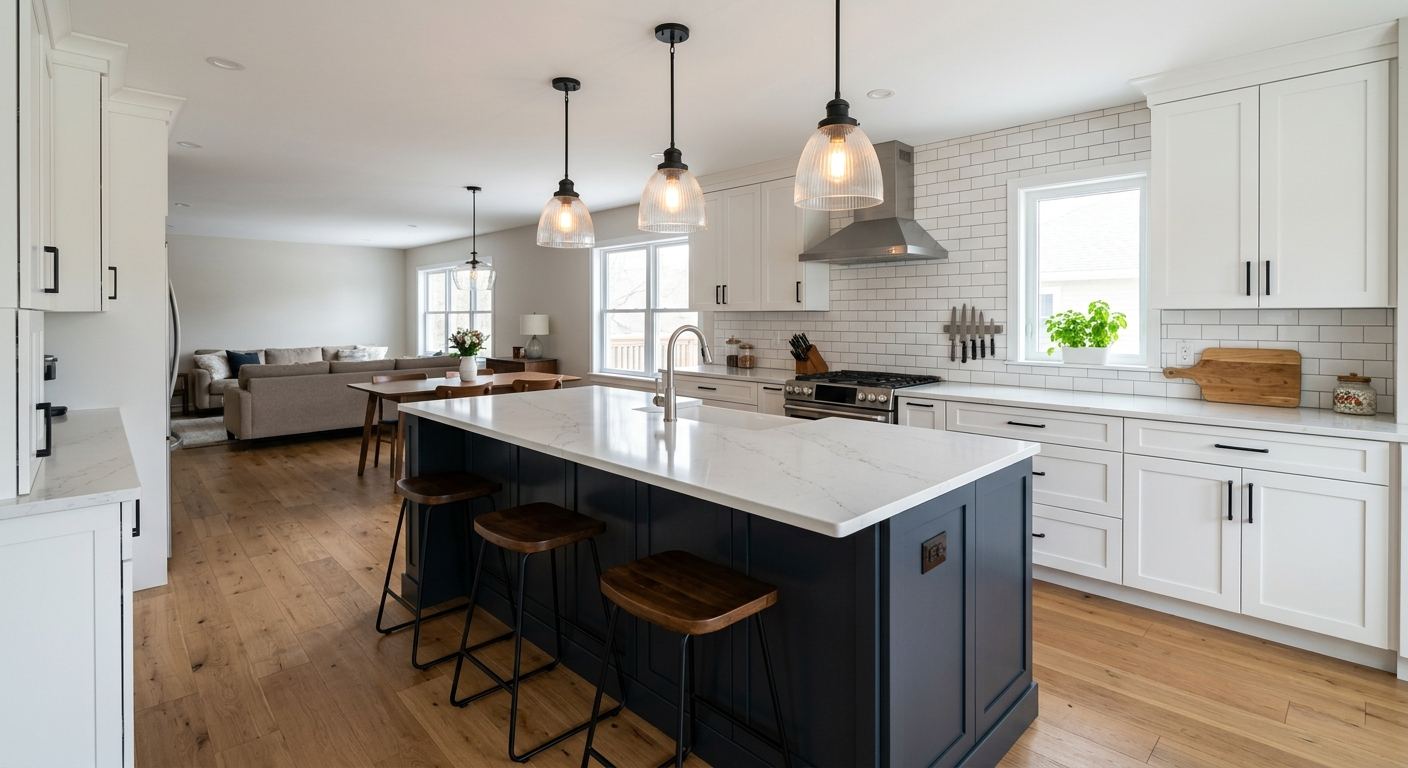
Kitchen renovation options and costs in Aloha Estates
In Aloha Estates, the way you renovate your kitchen usually lines up with how homeowners in the Lower Mainland–Southwest plan to enjoy the space—and whether they’re targeting a resale buyer. While Aloha Estates itself is a smaller community (3,098 people in the 2021 Census, Statistics Canada), many projects still price off the same regional finish expectations as nearby Surrey/Abbotsford-area markets. In the Lower Mainland–Southwest, kitchen pricing is driven more by home value, household income, and the expected finish level than by climate; homeowners often choose the next tier up because it’s easy to justify on resale. In 2021, Canadian households had a wide spread in earnings, and that difference shows up in cabinet and countertop choices: quartz/stone and semi-custom packages are common in higher-value pockets where the cost can be recovered more readily.
Climate still matters in a practical way. British Columbia’s damp winters and indoor humidity swings can accelerate wear on poorly sealed substrates, drawer glides, and grout—so “cheaper” finishes sometimes cost more over time. Labour availability also tightens seasonally, and the region can see faster turnarounds for straightforward refresh scopes when trades are already scheduled for nearby projects.
If you’re seeing a lot of kitchen activity, it’s typically strongest in the Surrey/Fraser Valley corridor, where homeowners frequently refresh for livability before listing. From there, your options fall into predictable cost bands—so it’s easiest to compare tiers side-by-side before you get quotes.
| Renovation Tier |
What's Included |
Typical Duration |
Price Range |
| Cosmetic refresh (paint, hardware, new appliances only) |
Cabinet paint or refinish, new pulls/knobs, appliance swap, light patching, basic cleaning |
3–7 days |
$8,000–$25,000 |
| Mid-range full renovation (new cabinets, counters, sink, tile) |
New cabinets (stock or semi-custom), countertop install, sink/faucet, backsplash tile, flooring patch/replacement, disposal haul-out |
3–6 weeks |
$40,000–$85,000 |
| High-end full renovation (custom cabinets, stone counters, island) |
Custom cabinetry, stone counters (quartz/stone/granite), island build, upgraded hardware, detailed backsplash, higher-end plumbing/electrical finishes |
6–12 weeks |
$85,000–$120,000 |
| Cabinet refacing only (new doors + drawer fronts, same boxes) |
Door/drawer replacement, new drawer boxes (if needed), updated hardware, fresh paint/stain on existing boxes (where salvageable) |
2–4 weeks |
$18,000–$50,000 |
| Countertop swap only (laminate to quartz or stone) |
Remove/install countertop, edge profile, reinstall sink/cooktop (if applicable), basic caulking and sealing |
1–2 weeks |
$10,000–$30,000 |
| Backsplash tile installation only |
Tile supply/setting, waterproofing/adhesive, grout/seal, trim details, caulking transitions |
1–3 weeks |
$1,500–$6,000 |
Prices are estimates only and vary by project scope, site access and material selection.
What affects the price of kitchen renovation in Aloha Estates
In the Lower Mainland–Southwest, quotes for the “same” kitchen can swing 30–50% because homeowners are often buying different finish tiers, not because of weather. Across British Columbia, the biggest drivers are local home value and buyer expectations at resale, which push decisions like quartz/stone counters and semi-custom cabinetry. Climate plays a smaller role than many people expect: a kitchen here doesn’t cost more simply because it’s wet; it costs more when moisture-sensitive installs (poorly sealed backsplashes, underlayment choices, or cabinets set on uneven subfloors) lead to rework. Contractor availability can also tighten around peak scheduling, which makes timelines and labour costs more variable.
Here are two practical ways that local market conditions shift pricing in Aloha Estates. First, in higher-value areas of the Lower Mainland, homeowners commonly default to quartz or stone counters and semi-custom cabinetry because it’s easier to recover the upgrade later. If you’re moving from a refresh into a mid-range full renovation, typical budgets fall into the $40,000–$85,000 zone; a step toward premium materials and island buildwork is where the total often climbs into $85,000–$120,000. Second, layout changes create the most unpredictable costs regardless of finish—removing a wall, adding an island, or moving a gas line or plumbing supply can trigger additional trades, inspections, and patch/repair work behind the scenes.
Concrete examples we see in the Aloha Estates area: (1) replacing a laminate-to-quartz countertop is usually straightforward, but if the existing base cabinets are out of level, the contractor may need rebuild/adjustments that add labour; (2) upgrading backsplash to full-height tile can raise costs because it changes waterproofing details and increases tile cutting/waste. If your kitchen is older (common in many Lower Mainland homes), you may also uncover dated electrical or undersized shutoff valves—costs that show up only once walls open.
| Price Factor |
Why It Matters |
Cost Impact |
| Cabinet tier — stock vs. semi-custom vs. fully custom millwork |
Material quality, fit/finish, internal accessories, and how many pieces are truly made-to-measure |
Typically the largest variable; can move a full project by tens of thousands (often aligning with $40,000–$85,000 vs. $85,000–$120,000 bands) |
| Countertop material — laminate vs. quartz vs. granite vs. stone |
Material cost, fabrication time, and installation complexity (especially for slabs/edges) |
Can add thousands to the total; countertop installation commonly sits in the $3,000–$12,000 range |
| Layout change — wall removal, island add, plumbing/gas move |
Trade coordination, structural considerations, and new rough-in work |
Highest unpredictability; often shifts you into a higher renovation tier even if cabinetry stays similar |
| Appliance package tier — builder vs. mid-range vs. pro-grade |
Power requirements, dimensions, trim integration, and finish matching |
May add or reduce several thousand depending on whether you need cabinetry modifications |
| Flooring — refinish existing vs. full replacement |
Subfloor condition and whether existing flooring can be patched cleanly |
Partial patching is usually cheaper; full replacement adds cost and schedule time |
| Backsplash — ceramic tile vs. marble vs. full-height slab |
Material weight, waterproofing requirements, and labour-intensive detailing |
Backsplash & tile commonly budgets to $1,500–$6,000 depending on finish |
| Electrical — new circuits for island, under-cabinet lighting |
Electrical scope and coordination with cabinet install/lighting placement |
Can add several thousand; complexity rises if panel upgrades are needed |
| Permit fees and licensed trade requirements |
Where rough-in work requires permits, inspections, and licensed specialists |
Usually a smaller line item than materials, but it can impact scheduling and total labour cost |
Permits & regulations in British Columbia
In British Columbia, a straight cabinet or countertop swap typically does not require a permit. You can usually replace cabinet faces/doors or install new countertops as long as you’re not moving plumbing supply/drain lines, relocating a gas connection, or doing structural work. Homeowners in Aloha Estates often start with a countertop change or refacing because it’s faster and keeps the work inside the existing footprint.
Where permits and licensed trades are required is usually tied to rough-in changes. Permits are typically needed when you move or modify plumbing supply or drain lines, relocate gas (for a stove/range and related components), remove a load-bearing wall, or add new electrical circuits (for example, an island power run or new dedicated lighting circuit). Gas work must be done by a licensed gas fitter, and electrical work by a licensed electrician; both require inspections as part of the approved process.
Step-by-step, verify your contractor’s readiness before you sign in Aloha Estates:
- Ask for a written scope that states who pulls permits and what trades are included.
- Check licensing using the relevant provincial online licence registry (ask the contractor for licence numbers; confirm they match the company doing the work).
- Request a certificate of insurance showing liability coverage; review the coverage dates and project address.
- Get proof of required workplace coverage (commonly WCB clearance/coverage documentation for the involved trades).
- Confirm in writing who is responsible for compliance, inspections, and any permit requirements before work starts.
This responsibility wording belongs in the contract—so you don’t end up paying to correct an omission after the fact.
Cabinets, countertops and layout decisions in Aloha Estates
For a kitchen renovation in Aloha Estates, the three most consequential decisions are (1) the cabinet tier, (2) the countertop material, and (3) whether you change the layout. These choices affect not just the “look,” but also daily usability, maintenance workload, and how confidently the renovation will hold up to British Columbia’s humidity swings. In the Lower Mainland–Southwest resale market, buyers often expect clean, updated surfaces and a cohesive finish—especially in kitchens where open sightlines connect to dining/living areas.
Cabinet tier: Stock cabinets are the fastest and cheapest path, but semi-custom is the most popular mid-range option because it balances better fit with predictable lead times. Custom cabinets cost more because they’re built to your exact measurements and allow design flexibility, especially for awkward corners and hood/island details.
Countertop material: Laminate is budget-friendly but can chip at edges and tends to age faster visually. Quartz is durable and low-maintenance, with a realistic “upgrade” jump that often improves buyer perception. Granite/stone adds natural variation and can be excellent for durability, while butcher block brings warmth but needs attentive sealing and care—important if you get condensation or water splash common in busy family kitchens.
Layout changes: Open-concept wall removal, island addition, or plumbing/gas relocation is where costs justify themselves only when you gain meaningful space or improve traffic flow. If you’re simply swapping surfaces, stay within the existing layout to control unpredictable rough-in work.
Dollar example: If you’re budgeting around a mid-range full renovation, a countertop swap to quartz can keep you in the $40,000–$85,000 band. But if you add an island that requires new electrical and potentially moving plumbing/gas connections, the same cabinetry choice can push the total toward the $85,000–$120,000 high-end band.
| Option |
Durability |
Maintenance |
Best For |
Price Range |
| Stock cabinets (big-box) |
Good everyday durability; limited flexibility for unusual dimensions |
Low; keep hardware tightened and address moisture exposure quickly |
Fast timelines and a practical refresh |
$8,000–$25,000 |
| Semi-custom cabinets (local dealer) |
Very solid; improved fit and accessory options |
Low to moderate; wipe spills promptly and maintain seals |
Most mid-range remodels in the Lower Mainland |
$18,000–$45,000 |
| Custom cabinets (local millwork shop) |
Excellent; built for your exact layout and sightlines |
Low; longevity depends on proper installation and moisture management |
Design-led kitchens and premium resale positioning |
$35,000–$70,000 |
| Laminate countertop |
Moderate; susceptible to edge chipping and heat/scratch wear |
Low but be careful with standing water and hot pans |
Budget-focused upgrades with minimal disruption |
$3,000–$7,000 |
| Quartz engineered countertop |
High; resistant to staining and day-to-day wear |
Low; routine cleaning only, minimal sealing needs |
Busy family kitchens and resale-friendly modern look |
$6,000–$12,000 |
| Granite / natural stone countertop |
High; strong with proper sealing |
Moderate; sealing schedule and careful stain prevention |
Premium appearance with natural variation |
$7,000–$14,000 |
| Butcher block countertop |
Moderate to high; durable but can dent/scratch |
Higher; regular oiling and prompt drying needed |
Warm, heritage-style kitchens and lighter food prep mess |
$4,000–$10,000 |
| Marble countertop |
Moderate; beautiful but can etch/stain with acidic exposure |
Moderate to high; frequent sealing and gentle cleaning |
Statement kitchens where upkeep is acceptable |
$8,000–$16,000 |
How to choose a kitchen renovation contractor in Aloha Estates
Choosing the right contractor in Aloha Estates is mostly about confirming three things: licensing/compliance, a detailed scope, and a payment/timeline structure that protects you. In British Columbia, you’ll want the contractor to coordinate the correct licensed trades (gas fitter for any gas changes, and electrician for electrical work). To verify coverage, ask for (1) licence numbers and confirm them through the provincial online registry, (2) a certificate of insurance that lists the right project address and coverage dates, and (3) workplace coverage documentation (commonly a WCB clearance/coverage proof for the trades involved). If they can’t provide these quickly, that’s a sign to slow down.
Get 2–3 itemised written quotes—not just a lump sum. Your quote should break out labour and materials by major trade tasks (demo, framing, cabinet install, countertop fabrication/installation, electrical/plumbing allowances, tile/backing prep, disposal). Confirm whether permits are included, who pulls them, and whether disposal/haul-away is covered. Read the exclusions: “new drywall not included” or “floor patching by others” can become expensive surprises.
Warranty matters too. Look for a workmanship warranty length (often 1+ year) and separate product/manufacturer warranties. Also ask whether warranties are transferable if you sell. For payment schedule, never allow more than 10–15% upfront; hold back until key milestones are completed and inspected. Make sure the start date and completion estimate are in writing, with lead-time assumptions clearly stated.
- Ask who is pulling permits and include it in the contract.
- Request licence numbers and confirm them online.
- Verify liability insurance and project-address coverage.
- Confirm workplace coverage documentation for the trades.
- Get quotes with labour and material breakdowns, not lump sums.
- Confirm countertop measurement and templating responsibility.
- Check what’s included for disposal/haul-away.
- Ask whether flooring patching is included or extra.
- Ensure electrical allowances are itemised (island circuits, under-cabinet lighting).
- Review warranty: workmanship plus product terms.
- Use a payment schedule with a holdback until completion.
- Get a written schedule with lead times and change-order process.
Red flags I commonly see in Aloha Estates kitchen projects: a quote that won’t itemise labour/materials, no clear permit responsibility, vague “allowances” with no numbers, pressure to take large upfront payments, and missing or outdated insurance/coverage proof.
Frequently asked questions — kitchen renovation in Aloha Estates
Do I need a permit for a kitchen renovation in British Columbia?
In British Columbia, simple cabinet refacing or countertop swaps typically don’t require a permit because you’re not changing rough-in systems. However, if your Aloha Estates renovation includes moving plumbing supply/drain lines, relocating gas for a stove, removing a load-bearing wall, or adding new electrical circuits (for example, powering an island or adding dedicated lighting), permits and licensed trade work usually come into play. The safest approach is to confirm the permit responsibility in your written contract before demo begins. Ask your contractor to list exactly which tasks require licensed trades and which permits will be pulled (if any). This prevents schedule surprises and ensures inspections happen when required.
What's the ROI on a kitchen renovation?
ROI is difficult to guarantee, but in the Lower Mainland–Southwest the kitchen is one of the highest-impact rooms buyers scrutinise. Your ROI is usually strongest when you match the finish tier to the home’s value and buyer expectations: mid-range renovations tend to be more “safe” for resale than a fully premium custom build in a modest-value home. For budgeting, many homeowners aim for a mid-range scope around $40,000 – $85,000 because that typically upgrades cabinetry, counters, and finishes without over-improving the rest of the property. If you go high-end (often $85,000 – $120,000), it should align with your home’s overall quality so the renovation doesn’t feel disproportionate at sale.
How do I budget for a kitchen renovation?
Start with your renovation tier and work backward. For a cosmetic refresh—paint, hardware, and new appliances only—most budgets remain relatively restrained, often within the $8,000 – $25,000 range. For a full mid-range renovation (new cabinets, counters, sink, and backsplash/tile), a realistic starting point is $40,000 – $85,000. If you’re adding design complexity such as custom cabinetry and an island with upgraded stone, budgets frequently align with $85,000 – $120,000. Also set aside an “unknowns” buffer for what older kitchens often reveal once walls open (outdated electrical, uneven subfloors, or hidden plumbing shutoffs). In Aloha Estates, keeping the layout unchanged is one of the best ways to protect your budget.
Can I move my kitchen sink or stove?
You can, but whether it’s worth it depends on rough-in work complexity. In British Columbia, moving a sink usually means altering plumbing supply and/or drain lines, and that can trigger permits and licensed plumbing work. Moving a stove is often more involved because gas relocation (if you have gas) must be performed by a licensed gas fitter and requires permitting/inspection typically. If you’re considering moving either in an Aloha Estates kitchen, ask for a clear plan: new locations, route paths, and whether cabinetry changes are required. Many homeowners choose to keep plumbing/gas within the existing footprint because layout changes are where the most unpredictable costs show up, regardless of the finish tier.
What's the most cost-effective kitchen upgrade?
The most cost-effective upgrade is usually one that upgrades the “big visual surfaces” without requiring rough-in changes. In practice, that often means either a countertop swap (for example, from laminate to quartz) or a cabinet refresh/refacing when the boxes are still solid. Countertop installation commonly lands in the $3,000 – $12,000 range depending on material, edge profile, and complexity. A backsplash tile installation only can be a smaller budget win, often $1,500 – $6,000, especially if you choose a durable, timeless pattern that matches your appliances and hardware. If your current layout works, these upgrades typically deliver better “wow factor per dollar” than major layout changes.
Custom vs stock cabinets — is custom worth it?
Custom cabinets can be worth it if you have a challenging layout, want a highly integrated design (island details, hood surround, pantry geometry), or need a precise fit to unusual dimensions common in older homes. Stock cabinets are typically the most cost-effective and fastest option, but they may require filler pieces or compromises in corners. Semi-custom is often the balanced choice for Aloha Estates homeowners: it upgrades fit, interior storage, and finishes while keeping pricing within the mid-range renovation reality. In most cases, if you’re targeting a mid-range budget, you’ll likely get better overall value by investing where buyers look most—countertops and cohesive hardware—rather than paying fully custom millwork premiums. If you’re going high-end (often $85,000 – $120,000), custom cabinetry can align better with that finish level.