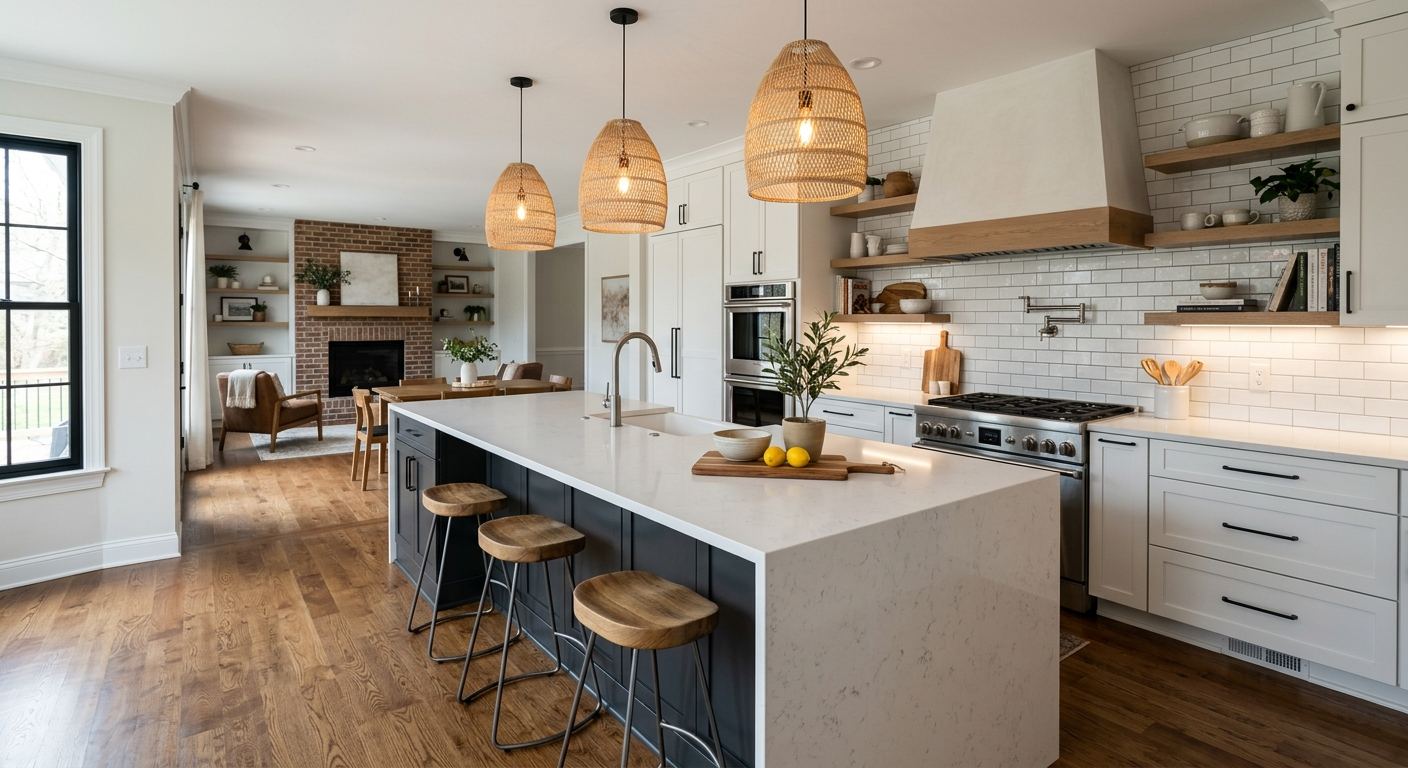
Kitchen renovation options and costs in Gellatly
Renovating a kitchen in Gellatly is usually about balancing looks, resale value, and how long you want the upgrades to last. With a population of 1,955 (Statistics Canada, 2021 Census), the local trade scene tends to be smaller and more scheduling-driven than big-city markets, so choosing a contractor early can reduce delays. In the Lower Mainland–Southwest, most homeowners are also planning around the realities of a higher-cost region; that’s why kitchens here more often “step up” into semi-custom cabinetry and upgrade-ready layouts compared with smaller markets where laminate and stock cabinets dominate. In other words, local demand isn’t just about taste—it’s about what buyers expect when you sell.
Lower Mainland–Southwest pricing is less about climate and more about home value, income, and finish level. British Columbia’s coastal weather does influence material behaviour (humidity swings affect wood, and temperature variation affects sealants and caulking), but it rarely changes the overall renovation budget as much as cabinetry complexity and countertop choice. Contractor availability also matters: the region’s higher volume of renovations near major centres can raise labour rates and tighten appointment windows, particularly for cabinet installers and countertop crews. In Gellatly, this trade demand is especially noticeable for coastal-adjacent homes where owners want durable surfaces for day-to-day use and easier maintenance—common in the neighbourhoods along the West St / Gellatly-side residential corridors.
To make shopping for quotes easier, here are realistic cost tiers you can compare head-to-head—then we’ll dig into what drives the biggest swings in Section 2.
| Renovation Tier |
What's Included |
Typical Duration |
Price Range |
| Cosmetic refresh (paint, hardware, new appliances only) |
Cabinet paint or refinishing (no box changes), new hardware, new appliance set, minor caulking/trim touch-ups, basic cleaning and ready-to-use finish |
3–7 days (often scheduled alongside countertop/backsplash work if desired) |
$8,000 – $25,000 |
| Mid-range full renovation (new cabinets, counters, sink, tile) |
Semi-custom or upgraded stock cabinets, countertop replacement, sink + taps, backsplash tile, appliance hookups, new flooring transitions as needed, disposal and standard site protection |
2–4 weeks |
$40,000 – $85,000 |
| High-end full renovation (custom cabinets, stone counters, island) |
Fully custom cabinetry/millwork, quartz or natural stone counters, island build-out, integrated lighting, upgraded backsplash (potentially full-height), premium hardware, coordinated plumbing/gas moves, higher-end finishing |
4–8+ weeks |
$85,000 – $120,000 |
| Cabinet refacing only (new doors + drawer fronts, same boxes) |
Replace doors/drawer fronts, new end panels and mouldings where needed, hardware swap, re-surface visible areas; counters may stay in place (if condition is good) |
1–3 weeks |
$8,000 – $35,000 |
| Countertop swap only (laminate to quartz or stone) |
Remove existing surface, install new quartz/stone/other countertop, cut-outs for sink/cooktop, new caulking at perimeter, backsplash tie-in if included |
3–10 business days (often dependent on template timing) |
$3,000 – $12,000 |
| Backsplash tile installation only |
Tile supply allowance, wall prep, tile set and grout, seal where needed, matching outlet covers and clean finish at countertops |
3–7 days |
$1,500 – $6,000 |
Prices are estimates only and vary by project scope, site access and material selection.
What affects the price of kitchen renovation in Gellatly
In Gellatly and across the Lower Mainland–Southwest, it’s common to see quotes for the “same” kitchen land 30–50% apart between companies or between finish tiers. The biggest drivers tend to be local home value and expected buyer finish level, not the coastal climate alone. In higher-value Lower Mainland–Southwest pockets, homeowners more often choose quartz or stone counters and semi-custom cabinetry because the renovation cost is more likely to be recovered on resale. In more modest areas, laminate and stock cabinet packages keep projects closer to a refresh budget, and they can still deliver a meaningful visual upgrade. Across British Columbia, that same pattern shows up: a basic refresh might stay relatively restrained, while a full remodel climbs quickly once cabinetry, trades coordination, and premium finishes are included.
Layout changes are the cost wild card regardless of finish. Removing a wall, adding an island, or moving a gas line typically creates extra framing, subfloor/ceiling modifications, longer inspection timelines, and more shop drawings. Those impacts are why two kitchens at the same square footage can look identical on paper but price very differently in real life.
Concrete examples I see around Gellatly: (1) older homes often need extra work to bring electrical outlets up to modern spacing and to support under-cabinet lighting, which adds labour even if cabinet boxes are staying put; (2) if your existing countertop openings were cut for a standard cooktop, a new overhang or different sink model can trigger more fabrication changes; and (3) if you’re upgrading from laminate to quartz, the countertop price difference usually lands inside the $3,000 – $12,000 band, but the real change in total project cost comes from how that upgrade pairs with backsplash height and cabinet upgrades.
If you’re comparing scope, treat a mid-range full renovation band like $40,000 – $85,000 as the “practical baseline,” and then layer in what’s truly changing: layout, plumbing/gas, and cabinet tier. Those are the levers that usually move your quote most.
| Price Factor |
Why It Matters |
Cost Impact |
| Cabinet tier — stock vs. semi-custom vs. fully custom millwork |
Custom doors, internal storage, and made-to-fit frames require more design and shop time; fit-and-finish expectations are higher in resale markets. |
Largest swing factor; often accounts for a major portion of the $40,000 – $120,000 full-renovation spread |
| Countertop material — laminate vs. quartz vs. granite vs. stone |
Material cost, fabrication complexity, and seam layout drive price. Stone requires more careful measuring and handling. |
Can move totals by several thousand dollars even before backsplash is considered; typically falls within $3,000 – $12,000 for install/supply |
| Layout change — wall removal, island add, plumbing/gas move |
Expect new framing, modified subfloor/ceiling, and more coordinated trades. This is unpredictable in older housing stock. |
Commonly adds weeks and can push projects into the higher end of full-renovation bands |
| Appliance package tier — builder vs. mid-range vs. pro-grade |
Electrical requirements, venting complexity, and dimensions vary. Some models need premium installation details. |
Can shift the budget meaningfully within a refresh or appliance-included scope |
| Flooring — refinish existing vs. full replacement |
Kitchen renos often disturb flooring edges, and matching existing levels can require patching or replacement. |
Replacement typically increases labour and material costs; refinishing is usually cheaper |
| Backsplash — ceramic tile vs. marble vs. full-height slab |
Premium tile or full-height surfacing increases tile setting time, measuring, and trim detailing. |
Usually within $1,500 – $6,000, but full-height upgrades can test the top end |
| Electrical — new circuits for island, under-cabinet lighting |
New circuits, GFCI placement, and lighting runs add licensed electrician time and planning. |
Often a “hidden” cost that lifts renovation totals even when cabinets/counters stay the same |
| Permit fees and licensed trade requirements |
Permits and inspections are tied to plumbing/gas/electrical and certain structural changes. |
Not always the biggest dollar line, but it can add cost and scheduling risk |
Permits & regulations in British Columbia
In British Columbia, not every kitchen change requires a permit, but several do—especially when you’re altering services or structure. Typically, cabinet and countertop swaps don’t require a permit. That includes replacing cabinets in-place (even if you change door/drawer fronts), installing new laminate, quartz, or stone counters, and setting a standard backsplash, as long as plumbing, gas, electrical, and structural elements are not changed beyond cosmetic disconnection/reconnection in an approved manner.
Permits and licensed trades are typically required when you move plumbing supply or drain lines, relocate gas for a stove/range, remove a load-bearing wall, or add new electrical circuits (for example, powering outlets on an island, adding under-cabinet lighting that requires new wiring, or altering the panel plan). Gas work must be done by a licensed gas fitter, and electrical work must be done by a licensed electrician—both require inspections tied to the permit process.
For a homeowner in Gellatly, the easiest verification method is to confirm three things before signing: (1) licence status (ask for the contractor’s licence details and the specific licensed trades they’ll use); (2) liability insurance with your contractor named; and (3) clearance coverage for worker-related coverage requirements, which is often handled through WSIB/WCB coverage documentation depending on the trade setup. Request the certificate of insurance and clearance letter (or the equivalent documentation your contractor provides) and confirm dates are current. Then, ensure the contract clearly states which items require permits and who pulls them. If that responsibility is vague, you’re likely paying for surprises later.
Cabinets, countertops and layout decisions in Gellatly
When you’re planning a kitchen renovation in Gellatly, three decisions drive the outcome more than anything else: (1) cabinet tier, (2) countertop material, and (3) layout changes. Cabinet tier sets the foundation for fit and functionality. Stock cabinets are the fastest and cheapest path, while semi-custom tends to be the “sweet spot” for many Lower Mainland–Southwest homeowners because it improves storage and fit without the full premium of made-to-fit custom millwork. Fully custom cabinets cost the most but can solve awkward corners, sloped walls, and specific storage goals.
Countertop material choice should reflect how you live. Laminate is budget-friendly and holds up reasonably well to everyday use, but it’s more sensitive to heat and moisture at seams. Quartz delivers a strong balance of durability and low maintenance for busy households, and natural stone (granite/other stone) can add a premium look with excellent longevity when installed and sealed correctly. In coastal British Columbia, good installation practices matter—proper sealing at seams and careful caulking protect the substrate during humidity swings.
Layout changes are where costs become justified—or not. Adding an island or opening an existing wall can be worth it when the space gain improves circulation, creates seating, or supports a realistic cooking zone. But if your kitchen already has workable clearance, you may not need a full island move; a refacing or countertop-only approach can deliver 80% of the visual impact at a fraction of the disruption.
Dollar example: if you’re comparing laminate to quartz, the countertop install/scope is commonly in the $3,000 – $12,000 band, but the “real” difference in total cost often shows up only when the upgrade triggers new backsplash coordination and any cabinet changes needed for correct overhang and edge detailing. If you keep the layout stable, you usually avoid the biggest unknowns tied to plumbing/gas and can stay closer to a practical mid-range plan like $40,000 – $85,000.
| Option |
Durability |
Maintenance |
Best For |
Price Range |
| Stock cabinets (big-box) |
Solid for standard dimensions; less forgiving for out-of-square rooms. |
Low—focus on gentle cleaning and careful hardware tightening. |
Fast turnaround, straightforward layouts, budget-first renovations. |
$8,000 – $25,000 |
| Semi-custom cabinets (local dealer) |
Better fit and storage options; strong performance for daily use. |
Low; wipe-down and routine hardware checks. |
Most mid-range remodels in the Lower Mainland–Southwest. |
$25,000 – $55,000 |
| Custom cabinets (local millwork shop) |
Best overall fit, including special shapes and tailored storage. |
Low; premium finishes still benefit from regular cleaning. |
Hard-to-fit spaces, design-led kitchens, higher resale expectations. |
$55,000 – $90,000 |
| Laminate countertop |
Decent for everyday use, but seams and edges are more vulnerable. |
Wipe clean; use trivets; avoid prolonged heat and standing water. |
Budget refreshes and renters/shorter ownership timelines. |
$3,000 – $6,500 |
| Quartz engineered countertop |
Very durable surface with strong resistance to staining and scuffs. |
Low; routine cleaner is usually enough; avoid abrasive pads. |
Busy households wanting a premium, low-maintenance surface. |
$6,500 – $12,000 |
| Granite / natural stone countertop |
Excellent longevity; requires attention to sealing and installation quality. |
Medium; periodic sealing and careful cleaning at seams. |
Homeowners seeking natural variation and long-term use. |
$7,000 – $14,000 |
| Butcher block countertop |
Durable but can scratch; sensitive to standing moisture without upkeep. |
Higher; oiling and drying routines help prevent warping. |
Enthusiasts who want warmth and a “lived-in” cooking feel. |
$4,500 – $10,000 |
| Marble countertop |
Beautiful but softer than quartz; can etch with acidic spills. |
Higher; sealing and prompt clean-up are important. |
Low-to-moderate use kitchens or homeowners who love high-end finishes. |
$10,000 – $18,000 |
How to choose a kitchen renovation contractor in Gellatly
Choosing the right contractor in Gellatly is mostly about verification and clarity. In British Columbia, confirm the contractor and trades are licensed for the work they’ll do: licensed electrician coverage for electrical changes, and a licensed gas fitter when gas connections are moved or altered. To verify, ask for licence details tied to the actual trade teams on your project, then check the contractor’s documentation alongside the product and labour scope they’re quoting. Liability insurance matters because kitchen renovations carry risk—sharp materials, site impacts, and trades coordination. Request a certificate of insurance showing current coverage and the correct legal entity.
You should also check WSIB/WCB-style coverage documentation for labour-related risk. Ask for the clearance letter (or equivalent coverage proof your contractor provides) and verify it’s current before work begins. If they can’t provide documentation promptly, that’s a major slowdown indicator.
For accurate kitchen renovation quotes in Gellatly, get 2–3 itemised written quotes (labour + materials breakdown), not a single lump sum. Read the scope carefully: what’s excluded? Is permit pulling included when required? Is demolition and disposal included, or will you pay separate hauls? Warranty matters too: confirm the workmanship warranty length, the manufacturer warranty for products, and whether warranties transfer if you sell the home. Payment schedule should be conservative—never more than 10–15% upfront, and hold back a portion until key milestones or completion. Finally, insist on a start date and completion estimate in writing so you can plan around cabinet and countertop lead times.
- Require itemised quotes: labour, materials, demolition, disposal, and allowance amounts.
- Confirm who pulls permits (and when) for plumbing/gas/electrical or structural work.
- Ask for a schedule that includes cabinet lead times and countertop templating.
- Verify licensed trades for any electrical, plumbing, or gas scope.
- Request and review the certificate of insurance and clearance/coverage documentation.
- Check workmanship warranty terms and exclusions in writing.
- Confirm product warranties and whether they’re transferable to future owners.
- Clarify demolition scope: what gets removed, what gets protected, and where waste goes.
- Confirm disposal: dump fees and hauling should be stated, not assumed.
- Lock in finish selections (cabinet colours, countertop type, hardware) with written allowances.
- Use a payment schedule with a defined holdback until inspection/near-completion.
- Get a written change-order process so surprises are priced and documented.
Red flags in Gellatly: (1) quotes that aren’t itemised and don’t separate labour from allowances; (2) refusal to provide insurance/coverage or licence details promptly; (3) vague scope around plumbing/electrical—especially if the kitchen includes an island or any gas appliance changes; (4) unrealistic timelines that ignore cabinet and countertop lead times; and (5) asking for high upfront deposits beyond 10–15% without a contract milestone plan.
Frequently asked questions — kitchen renovation in Gellatly
What's the most popular kitchen style in Gellatly right now?
In Gellatly and across the Lower Mainland–Southwest, the most requested look right now is a clean, modern-transitional kitchen: flat-panel or simple shaker-style fronts, warm neutral paint colours, and brighter lighting. Homeowners commonly pair semi-custom cabinetry with quartz countertops because it reads premium without the upkeep burden of more porous stone. Many projects also include an upgraded island footprint, even if it’s modest, because it improves daily circulation for typical family layouts. In British Columbia’s coastal climate, sealed installation details (caulking and seam protection) are important for long-term performance, so installers who are careful about finishing edges tend to be in demand. If you’re working within a practical scope, many mid-range renovations in the $40,000 – $85,000 band land on this “buyer-friendly” style.
How do I know if I need to update my kitchen plumbing in Gellatly?
You usually need a plumbing update when you’re seeing active issues (slow drains, leaks under the sink, inconsistent hot-water temperature) or when you’re changing the layout. In Gellatly homes—many of which were built with older service layouts—moving a sink, dishwasher, or adding an island can require new supply/drain runs, and that’s when pipe replacement or valve upgrades become common. Even if you’re not moving anything, contractors may recommend refreshed shutoff valves, improved shutoff access, or replacing corroded lines once walls/cabinets open. Planning point: permit requirements tend to trigger when you move supply or drain lines, so factor that into your timeline. If you’re doing a refresh only, you may avoid the plumbing scope, but a mid-range renovation often includes sink + tap changes (and sometimes valve updates) as part of a clean, durable reset within the $40,000 – $85,000 tier.
What is the difference between a galley and open-concept kitchen?
A galley kitchen is narrow and typically has counters on two opposite sides, which can be very efficient for cooking but limits traffic flow. An open-concept kitchen opens the space to adjacent living/dining areas so you can move around the cooking zone and see into the rest of the home. In Gellatly, the decision often depends on how your existing walls and soffits are set up and what you’d gain from removing or altering a wall. An open-concept approach can be worth it, but it’s the layout work that usually adds the most unpredictability—especially if it involves structural changes, ventilation adjustments, or any plumbing/gas relocation. For many homeowners, a “stay galley but improve storage” renovation can still deliver a big visual upgrade with far less disruption than a full wall opening. That’s why some projects can fit a refresh-style budget while others climb into full-renovation pricing like $40,000 – $120,000 when services and structure change.
How do I get accurate kitchen renovation quotes in Gellatly?
To get quotes that reflect your real budget in British Columbia, start by being specific: measure your existing layout, list exactly what moves (sink, stove, refrigerator location), and confirm whether you want the same flooring footprint or a full replacement. Ask for 2–3 itemised quotes that break out labour, materials, demolition, disposal, electrical/plumbing/gas allowance (if applicable), and permit handling. In Gellatly, kitchen timelines often hinge on cabinet and countertop lead times, so the best contractors will explain templating steps and when inspections are scheduled. Also confirm inclusions and exclusions: is backsplash included, are electrical hookups included for under-cabinet lighting, and is the countertop install tied to backsplash finish details? A common mistake is comparing one company’s “mid-range” plan to another company’s “high-end” allowance without noticing the cabinet tier or countertop material difference. As a reference point, if you’re aiming for a mid-range scope, use the $40,000 – $85,000 band to benchmark what’s included, not just what’s “possible.”
What's the best countertop material for a busy Gellatly kitchen?
For most busy households in Gellatly, quartz engineered countertops are the most practical “best overall.” They balance durability with easy maintenance: they resist many stains and day-to-day scuffs better than laminate, and they generally don’t require the periodic sealing that comes with granite/natural stone. Quartz also works well with modern flat-panel cabinet styles and tends to look consistent across the length of the kitchen. That matters in coastal British Columbia, where good seam finishing and installation quality help protect the substrate during humidity swings. Laminate can still make sense in a refresh where you’re trying to keep the project lean; a countertop-only swap is often within the $3,000 – $12,000 band, but the long-term wear pattern tends to be less forgiving for heavy cooking and frequent cleanup. Granite can be excellent too, but it’s usually higher-maintenance than quartz. Marble is beautiful but generally needs more prompt spill care.
How do I add an island to my Gellatly kitchen?
Adding an island in a Gellatly kitchen starts with clearance and service planning. First, confirm circulation space (so you can open drawers and walk past without bottlenecks) and measure your doorways and fridge path. Next, decide whether the island is purely cosmetic (seating base, prep surface) or functional (sink and/or cooktop). If you want a sink or cooktop, you’ll likely be changing plumbing and possibly gas or electrical circuits—those are the areas that typically require permits and licensed trades in British Columbia. This can add time and coordination complexity even when cabinetry and countertops are straightforward. If you’d rather control budget, a common approach is to add the island base and wiring-ready provisions now, then complete the service later—though your contractor should confirm code requirements before you proceed. In many mid-range projects, the island upgrade pushes totals upward, often moving a kitchen toward the $85,000 – $120,000 tier when cabinetry is custom and layout changes are involved.