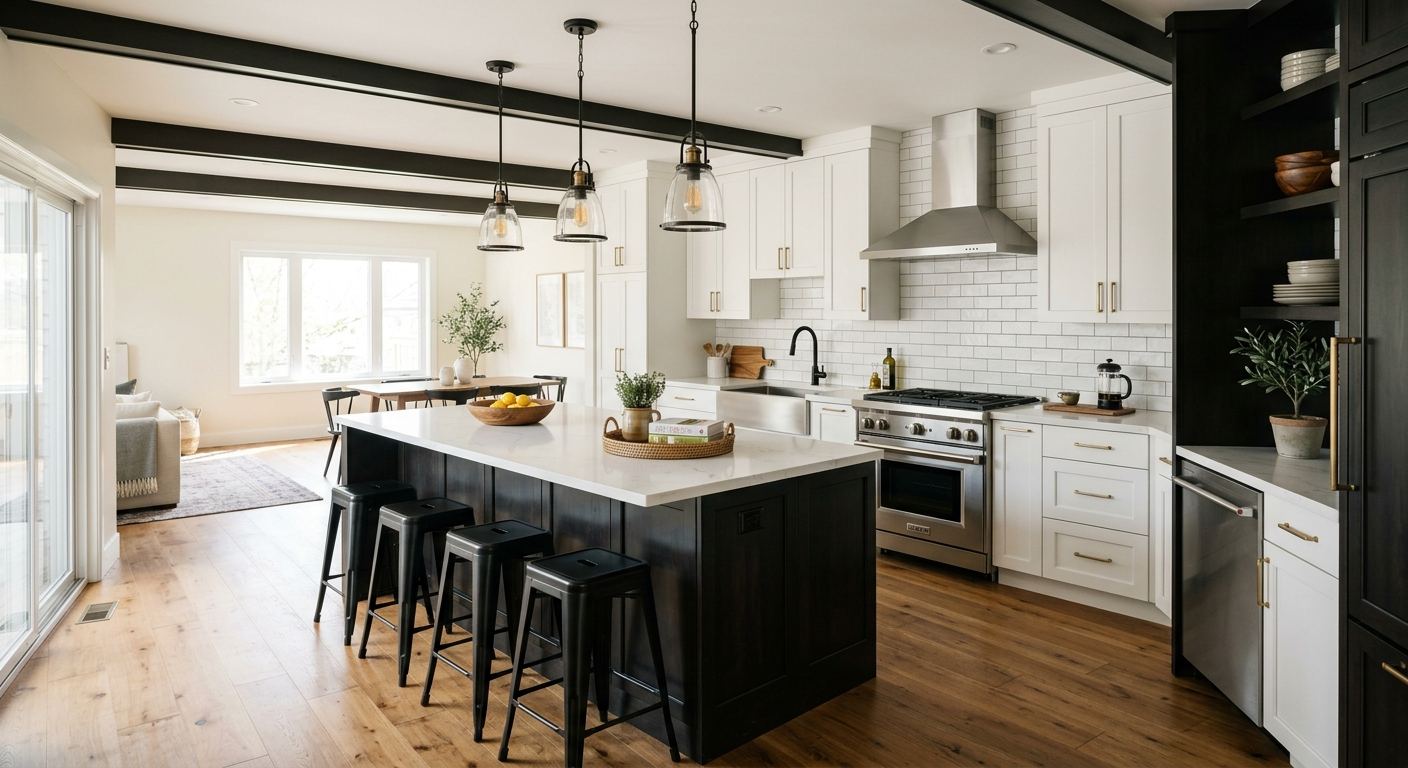
Kitchen renovation options and costs in Gordon Head
Kitchen renovations in Gordon Head often start with the same question: “What will it cost for my specific kitchen?” Because Gordon Head sits within the broader Lower Mainland–Southwest market, pricing is driven more by homeowner expectations and the resale value of finishes than by the climate itself. That’s helpful for homeowners because it means you can budget by scope and finish tier more predictably. In a population of 21,270 (Statistics Canada, 2021 Census), many residents are long-term owners and are willing to pay for durable, design-led upgrades that look “current” when buyers tour in spring and summer. In higher-value pockets of Metro Vancouver nearby, owners frequently choose semi-custom cabinetry and quartz or stone counters; those types of choices tend to carry a larger portion of the budget than labour rates alone. (Statistics Canada, 2021 Census.)
In practical terms, contractor availability across the Lower Mainland–Southwest is strongest for work that can be scheduled tightly—cabinet and countertop lead times, demolition windows, and trades sequencing. Moisture and temperature swings do matter in British Columbia, but for most kitchens the bigger cost swings come from whether you’re keeping the layout versus changing plumbing, gas, and electrical. In Gordon Head, renovations are especially in demand around the University of Victoria area, where older homes are being updated for family living and resale readiness.
Below are realistic renovation tiers and ranges you can use to compare quotes and understand where your dollars typically go, before we break down what moves price up or down in section 2.
| Renovation Tier |
What's Included |
Typical Duration |
Price Range |
| Cosmetic refresh (paint, hardware, new appliances only) |
Repaint cabinets/room, new hardware, replace appliances, minor caulking/grout touch-ups, countertop polish where applicable |
2–7 days |
$8,000–$18,000 |
| Mid-range full renovation (new cabinets, counters, sink, tile) |
New semi-custom or quality stock cabinets, new counters, sink + faucet, backsplash tile, new flooring prep, basic lighting updates |
3–8 weeks |
$40,000–$75,000 |
| High-end full renovation (custom cabinets, stone counters, island) |
Fully custom millwork, stone/quartz counters, island cabinetry, premium tile/backsplash, upgraded hardware and lighting, enhanced storage |
6–14 weeks |
$85,000–$120,000 |
| Cabinet refacing only (new doors + drawer fronts, same boxes) |
Remove/replace doors and drawer fronts, refinish or veneer, new hardware, adjust some reveals if needed |
1–3 weeks |
$8,000–$28,000 |
| Countertop swap only (laminate to quartz or stone) |
Remove existing top, new quartz/stone installation, seam planning, sink cut-out and faucet reseal, basic backsplash tie-in |
3–10 days |
$5,000–$12,000 |
| Backsplash tile installation only |
Surface prep, waterproofing/membrane where required, tile installation, grout/seal, edge finishing |
3–7 days |
$1,500–$6,000 |
Prices are estimates only and vary by project scope, site access and material selection.
What affects the price of kitchen renovation in Gordon Head
Two quotes for the same kitchen can differ by 30–50% across the Lower Mainland–Southwest and other parts of British Columbia even when the floorplan looks similar. In Gordon Head, it’s usually not because contractors charge wildly different labour rates—it’s because homeowners in higher-value areas more often select semi-custom or custom cabinetry, quartz/stone counters, and higher-end hardware. When the finish tier rises, so does the amount of on-site labour (custom measurements, more detailed install tolerances, extra merchandising like moulding and hardware packages). It also becomes easier for the budget to “creep” once you start adding scope like an island, upgraded under-cabinet lighting, or moving plumbing lines.
Local home values and median income shape the typical finish tier far more than climate. In higher-value {region} markets, homeowners default to quartz or stone counters and semi-custom cabinetry because the renovation cost is easier to recover on resale. In more modest markets, laminate and stock cabinets dominate because they offer better ROI and shorter lead times. In Gordon Head specifically, renovations in older housing stock often require more prep due to prior repairs, older subfloors, and imperfect wall planes—cost shows up in time spent getting everything square.
Concrete examples: (1) If you’re replacing laminate countertops with quartz and leaving the cabinets untouched, you may stay closer to the “countertop swap” tier; (2) if you’re adding an island that needs new power and potentially a plumbing tie-in, the layout change can push your job toward mid-range full renovation pricing (and sometimes into high-end territory); and (3) if your existing backsplash is poorly bonded, expect extra surface prep before tile—especially with older kitchens where adhesives don’t hold well.
Even with British Columbia’s wet season, most kitchen water performance is dictated by how well trades seal under sinks, protect edges at seams, and manage tile waterproofing. That’s why a properly detailed installation can matter as much as material choice, and why many budgets in Gordon Head land in the $40,000–$120,000 full-renovation bands once you include layout work.
| Price Factor |
Why It Matters |
Cost Impact |
| Cabinet tier — stock vs. semi-custom vs. fully custom millwork |
Higher tiers have better fit, more storage options, and more labour for custom sizing and finishing |
Can swing roughly $15,000–$50,000 within full renovations depending on scope |
| Countertop material — laminate vs. quartz vs. granite vs. stone |
Material price, fabrication complexity, and seam planning affect both material and installation time |
Typical countertop totals can range from about $3,000–$12,000+ |
| Layout change — wall removal, island add, plumbing/gas move |
Layout work drives trade coordination, framing changes, and often permit scope |
Often the biggest unpredictable swing; can add $10,000–$40,000+ |
| Appliance package tier — builder vs. mid-range vs. pro-grade |
Electrical requirements, fit/trim details, and finish matching (panels, venting) vary |
Can add $2,000–$12,000 depending on brand tier and venting needs |
| Flooring — refinish existing vs. full replacement |
Kitchen reno sequencing changes; removal/disposal and subfloor repair affect cost |
Can add $1,500–$8,000 depending on whether it’s partial or full |
| Backsplash — ceramic tile vs. marble vs. full-height slab |
Premium surfaces need more careful substrate prep and finishing details |
Typically $1,500–$6,000, with higher-end going beyond |
| Electrical — new circuits for island, under-cabinet lighting |
Electrical work must be done by a licensed electrician and inspected; island circuits often trigger upgrades |
Commonly $800–$5,000+ depending on scope |
| Permit fees and licensed trade requirements |
Some changes require permits and inspections; licensed trades increase coordination time |
Often $500–$3,000 in direct costs plus scheduling overhead |
Permits & regulations in British Columbia
In British Columbia, cabinet and countertop swaps generally do not require permits when you’re keeping the existing plumbing, gas, and electrical where they are. That means replacing cabinets, installing new countertop material, swapping a sink and faucet, or redoing a backsplash usually falls into the “no permit” bucket. However, permits and licensed trades are typically required when the work changes a system or structure: moving plumbing supply or drain lines, relocating a gas connection (including a stove/range and any gas-integrated hood needs), removing a load-bearing wall, or adding new electrical circuits (for example, power to an island or new lighting circuits).
Here’s how a homeowner in Gordon Head can verify a contractor’s readiness before signing: start with the contractor’s licence and business details (ask for their proof of trade credentials where applicable), then confirm liability insurance and workers’ compensation coverage. For insurance, request a certificate of insurance showing current general liability and applicable endorsements. For workers’ compensation coverage, ask for WSIB/WCB proof (or their current equivalent documentation) before work begins. If a contractor says “we’re covered but you don’t need paperwork,” that’s a red flag.
Finally, confirm responsibility in writing: who pulls permits (if any), who schedules inspections, and who covers any rework. When gas or electrical work is in scope, always ensure the contractor coordinates licensed trades and inspections—those details protect your home and your budget.
Cabinets, countertops and layout decisions in Gordon Head
In a Gordon Head kitchen renovation, three decisions usually matter most for both cost and long-term satisfaction: (1) cabinet tier, (2) countertop material, and (3) layout changes. Cabinet tier drives the “look and fit” you’ll notice every day. Stock cabinets are fastest and typically cheapest, but you’ll trade some flexibility in storage and end-panel finishing. Semi-custom cabinets are the most popular mid-range choice in the Lower Mainland–Southwest because they balance lead times with better sizing for older home walls. Custom cabinets can be the best fit in challenging layouts, but budgets rise quickly once you add an island and more complex storage.
Countertops are where daily wear becomes visible. Laminate can be economical and looks good, but it’s more susceptible to edge wear and can be harder to repair neatly. Quartz engineered tops offer a strong middle ground: durable, less stain-prone than many natural options, and usually easier to maintain for busy families. Granite/natural stone can add premium appeal but requires more attention to sealing and care. Butcher block brings warmth, yet it needs a disciplined sealing/maintenance routine—especially important in British Columbia’s humid/wet seasons when splashes and wipe-down habits are constant.
Layout changes are the “cost wildcard.” Removing an open-concept wall or adding an island can justify the spend if it creates usable circulation and better work zones. But when you move plumbing/gas lines, you’re paying for more than materials—you’re paying for demolition, rebuild time, and coordination.
Dollar example: upgrading from laminate to quartz while keeping the layout often lands around the countertop swap tier (commonly $5,000–$12,000 depending on size and sink cut-outs). If, instead, you add an island and relocate power and possibly plumbing, you can easily move from a mid-range refresh toward the $40,000–$75,000 full renovation range, even with similar cabinetry.
| Option |
Durability |
Maintenance |
Best For |
Price Range |
| Stock cabinets (big-box) |
Solid for normal use; hinges and finishes vary by line |
Low; touch-ups possible but limited customization |
Time-sensitive projects and straightforward layouts |
$18,000–$35,000 |
| Semi-custom cabinets (local dealer) |
Better fit tolerances and storage options; durable hardware packages |
Low to moderate; standard cleaning and tightening as needed |
Most Gordon Head renovations aiming for resale-ready finishes |
$28,000–$60,000 |
| Custom cabinets (local millwork shop) |
Highest build quality and best alignment in challenging walls/ceilings |
Low; occasional hardware servicing |
Unusual layouts, premium storage, and design-led kitchens |
$45,000–$85,000 |
| Laminate countertop |
Moderate; edges are the weak point if abused |
Easy daily care; avoid prolonged standing water at seams/edges |
Budget-focused renos where style upgrades matter most |
$3,000–$6,000 |
| Quartz engineered countertop |
High; resists staining and everyday scratches well |
Low; wipe clean, avoid extreme heat direct exposure |
Busy households that want a “set and forget” surface |
$6,000–$11,000 |
| Granite / natural stone countertop |
High; varies by slab but generally tough |
Moderate; periodic sealing and careful stain management |
Premium look with stone character |
$8,000–$14,000 |
| Butcher block countertop |
Moderate to high if maintained; can dent or scratch |
Higher; regular oiling/sealing and careful water control |
Homes where warmth and food-prep comfort are a priority |
$4,500–$9,000 |
| Marble countertop |
Moderate; beautiful but can etch and stain |
Higher; needs diligent care and quick wipe-downs |
Design-forward kitchens with lighter-duty use |
$10,000–$18,000 |
How to choose a kitchen renovation contractor in Gordon Head
Choosing the right contractor in Gordon Head starts with verification, not promises. In British Columbia, confirm the contractor’s licensing where their trade requires it, and request proof of liability insurance before any work begins. Ask specifically for workers’ compensation coverage documentation (WSIB/WCB equivalent) so you’re not left holding the risk if a worker is injured on site. If the contractor subcontracts licensed trades (like electrical or gas), they should provide those trades’ credentials as part of the plan.
Next, get 2–3 itemised written quotes—not a single lump-sum number. You want a breakdown that separates demolition, framing, cabinet installation, countertop installation, tile/backsplash labour, electrical allowance, plumbing allowance, and disposal. This matters because two “mid-range” kitchens can look the same, but one quote may include permit pulls, disposal, and electrical trim-outs while the other doesn’t. Read the scope carefully: what is excluded? Is permit pulling included when needed? Is construction debris disposal included, and is there a haul-away plan?
Warranty should be clear: workmanship warranty length, how it handles product defects, and whether manufacturer warranties are transferable if you sell the home. Also watch payment structure—never pay more than about 10–15% upfront. Use a holdback until the work is complete and deficiencies are corrected. Finally, insist on a written timeline with a start date and completion estimate, and make sure lead times for cabinets/counters are discussed up front.
- Ask for a written scope and line-by-line allowances (don’t accept vague “allowance” language).
- Confirm who pulls permits (if any) and who schedules inspections.
- Require proof of liability insurance and workers’ compensation coverage before demolition.
- Request the cabinet and countertop installation responsibilities in writing (who takes measurements, who verifies cut-outs).
- Make sure disposal/hauling is included (or priced clearly).
- Confirm electrical scope for island/undercabinet lighting is included if shown in the plan.
- Verify backsplash prep requirements (flatness, waterproofing membrane where needed).
- Check start-date feasibility against cabinet/counter lead times.
- Review warranty terms in writing: workmanship and product/manufacturer warranties.
- Ask about change-order process and what triggers extra charges.
- Use a payment schedule with a holdback until punch-list completion.
- Get references from projects in the Greater Victoria area if possible, not just general portfolios.
Red flags I see in Gordon Head: quotes that don’t itemise labour vs materials, no mention of permit responsibility (when plumbing/gas/electrical is changing), unusually long “we can start anytime” claims without lead-time reality, refusal to provide insurance/coverage paperwork, and warranties that are only verbal or vaguely defined.
Frequently asked questions — kitchen renovation in Gordon Head
What is the difference between a galley and open-concept kitchen?
In a galley kitchen, counters and storage run along two parallel walls, often with a walkway down the middle. In British Columbia (including Gordon Head), galley layouts are common in older homes and can be very efficient for cooking because everything is close. Open-concept kitchens remove barriers to connect the kitchen with dining/living space, which usually improves sightlines and resale appeal for many buyers, but it typically increases scope—especially if wall removal changes plumbing/electrical routing. Pricing changes when you go open-concept because demolition, framing, venting, and electrical coordination tend to add labour. If you keep the plumbing where it is, a mid-range refresh can stay nearer the $40,000–$75,000 band; if you move lines or add an island for better flow, many projects climb toward higher totals.
How do I get accurate kitchen renovation quotes in Gordon Head?
To get accurate quotes in Gordon Head, start with a written scope that includes what stays and what changes: cabinets, countertop material, backsplash, sink location, appliance tier, and whether you’re moving plumbing or electrical. Ask for 2–3 itemised quotes where labour and materials are broken out separately (not just one number). Confirm whether permit pulling is included if any work involves moving plumbing supply/drains, relocating gas, removing a load-bearing wall, or adding circuits. Include allowances for fixtures (faucet, lighting) and confirm disposal/haul-away is part of the quote. Because lead times can drive scheduling costs, ask about cabinet and countertop fabrication timeframes. A well-built quote should map to realistic full-renovation bands like $40,000–$120,000 depending on cabinet tier and countertop choice.
What's the best countertop material for a busy Gordon Head kitchen?
For a busy Gordon Head kitchen, quartz engineered countertops are often the best balance of durability and low maintenance. They resist staining better than many natural options and are generally easier to keep looking good in a household that cooks daily. British Columbia’s wet season can mean more condensation and quick wipe-downs at the sink area, so a surface that handles everyday moisture well matters. Laminate can work if you’re budget-conscious, but edges and seams are where wear typically shows first. Marble looks premium but requires more careful care to prevent etching or staining. If you want the “safe upgrade” route, most homeowners land in countertop totals around $6,000–$11,000 for quartz depending on size and cut-outs. If you’re moving to stone with complex seams or an island, the cost can rise accordingly.
How do I add an island to my Gordon Head kitchen?
Adding an island usually starts with layout planning and clear decisions about services. If the island is purely cabinetry with storage and seating, the main considerations are floorplan clearance and cabinetry positioning. If you want an overhang, sink, or cooktop, then you’re likely adding plumbing and/or gas and electrical—those changes usually involve permits and licensed trades in British Columbia. The cost justification is straightforward: an island is worth it when it improves work zones, adds storage, or creates a better traffic flow for daily life. It’s less worth it if it forces narrow walkways or small compromises around the fridge and entry path. In budgeting terms, a kitchen refresh can remain relatively controlled, but an island with electrical and/or plumbing can push a job toward the $40,000–$120,000 full-renovation bands depending on cabinet tier and countertop choice.
How much does a kitchen renovation cost in Gordon Head?
In Gordon Head, kitchen renovation costs typically fall into three practical lanes. A cosmetic refresh with paint, hardware, and new appliances usually lands around $8,000–$18,000 when no layout or system changes are involved. A mid-range full renovation—new cabinets, counters, sink, and tile—often fits the $40,000–$75,000 range. High-end projects with custom cabinets, stone counters, and an island commonly run $85,000–$120,000 or more. The biggest swing factor is whether you change the layout and move plumbing/gas/electrical, not whether it’s summer or winter. British Columbia’s moisture conditions can affect finishing details, but pricing is primarily driven by finish tier, labour sequencing, and permitting scope. Always compare quotes by scope, not just by total number.
How long does a kitchen renovation take in Gordon Head?
Timelines in Gordon Head depend heavily on whether you’re doing a cosmetic refresh, a full renovation, or layout changes that require more trades coordination. Cosmetic refreshes are often 2–7 days because you’re mainly updating finishes and swapping appliances. A mid-range full renovation commonly takes 3–8 weeks, assuming cabinet and countertop leads are scheduled properly and you’re not doing major plumbing/gas relocation. If you’re doing a high-end renovation with custom millwork and an island, plan for about 6–14 weeks. British Columbia wet-season conditions don’t usually add weeks by themselves, but they can affect drying times for certain finishes and the timing of inspections if trades aren’t coordinated. To avoid surprises, ask contractors to provide start and completion dates in writing and confirm their lead-time assumptions for cabinets and countertops.