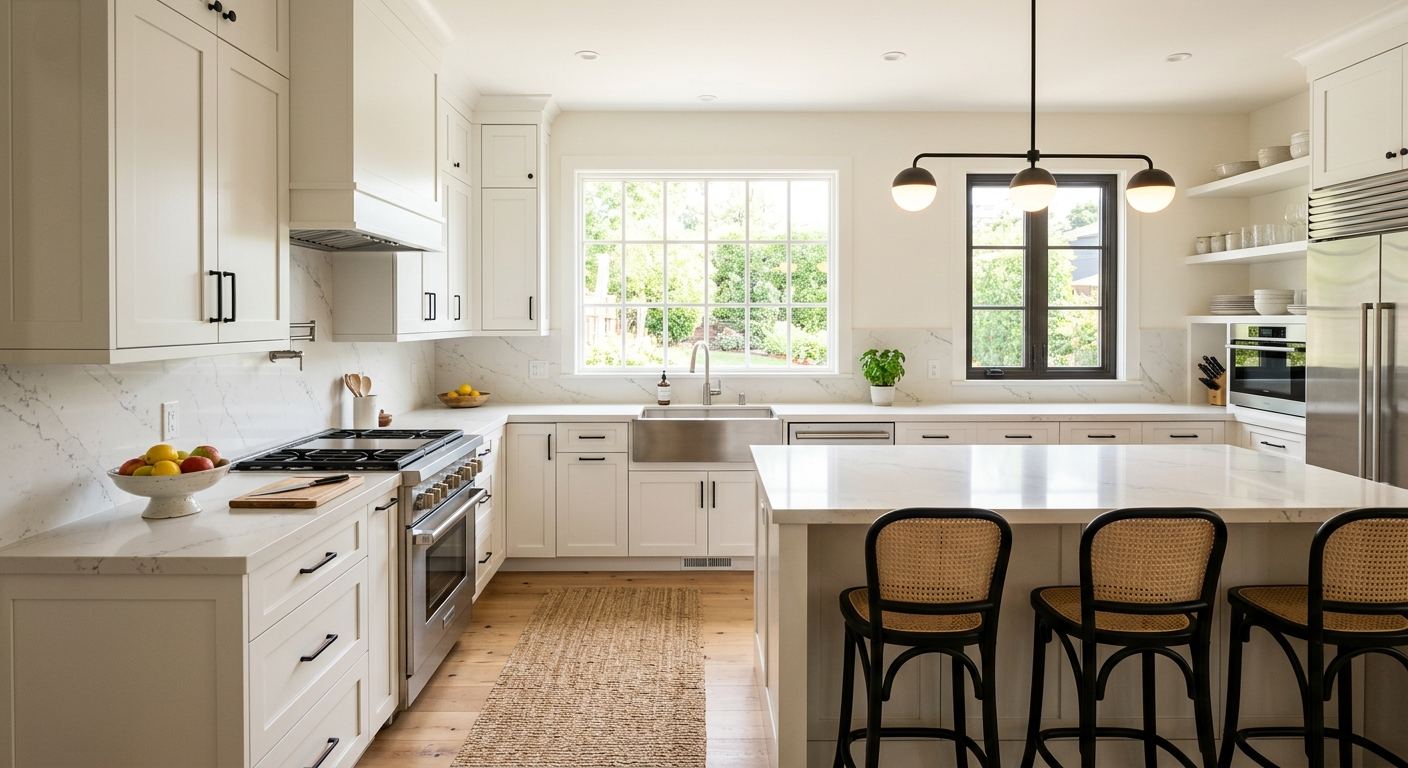
Kitchen renovation options and costs in Victory Heights
In Victory Heights, British Columbia, kitchen renovation costs usually start with your “finish intent” more than anything else. Even with the same cabinet layout, homeowners in this Lower Mainland–Southwest area often choose different tiers based on what buyers in Metro Vancouver are willing to pay—especially in a market where the local population is still growing (4,186 residents, Statistics Canada, 2021 Census). That matters because higher home-value areas tend to reward upgrades like quartz counters and semi-custom cabinetry with better resale confidence, while more practical, ROI-focused updates land closer to refresh-level pricing.
Contractors also price around availability and build staging. In the Lower Mainland–Southwest, labour demand is steady, so trades can be booked farther out during peak seasons. Climate plays a secondary role compared with market pricing, but it still shows up in the materials strategy: moisture-resistant products and good ventilation are important for kitchens that see seasonal humidity swings. Another factor is housing stock—older homes in the Victory Heights orbit often have dated electrical and plumbing runs, which can push a “simple” renovation toward a mid-range scope once you open up walls.
Whether you’re on a street where renovations are common in the neighbourhood around Victory Heights / Cloverdale-area commuter pockets (where cabinetry and countertop trades are in frequent demand) or you’re planning a full rebuild, the tiers below give a realistic starting point. Next, compare options by included work and typical turnaround time.
| Renovation Tier |
What's Included |
Typical Duration |
Price Range |
| Cosmetic refresh (paint, hardware, new appliances only) |
Cabinet paint/refinish (if chosen), new pulls/knobs, faucet swap, appliance-only replacement, basic cleaning/caulking |
1–2 weeks |
$40,000–$45,000 |
| Mid-range full renovation (new cabinets, counters, sink, tile) |
New semi-custom or stock cabinets, countertop replacement (quartz or similar), sink and faucet, backsplash tile, updated trim/caulking, some plumbing/electrical adjustments |
4–7 weeks |
$55,000–$80,000 |
| High-end full renovation (custom cabinets, stone counters, island) |
Custom millwork, stone counters (granite/marble/upgrade stone), island fabrication, upgraded hardware/undercabinet lighting, full backsplash, broader layout changes (often) |
7–12 weeks |
$90,000–$125,000 |
| Cabinet refacing only (new doors + drawer fronts, same boxes) |
Replace doors/drawer fronts, new hardware, repaint/finish on existing boxes (if feasible), optional new trim and backsplash top treatment |
2–4 weeks |
$20,000–$35,000 |
| Countertop swap only (laminate to quartz or stone) |
Remove/install countertops, handle cut-outs for sink/cooktop (if same footprint), edge profile upgrade, basic sealants |
1–3 weeks |
$8,000–$18,000 |
| Backsplash tile installation only |
Tile supply and install, prep/surface leveling, grout/seal where required, caulking at counters and corners |
3–7 days |
$2,000–$6,000 |
Prices are estimates only and vary by project scope, site access and material selection.
What affects the price of kitchen renovation in Victory Heights
Across the Lower Mainland–Southwest, the same “kitchen size” can land 30–50% apart between quotes depending on home value and the finish tier homeowners expect. Climate is not the main driver here; in British Columbia, seasonal humidity and temperature shifts influence material choices, but pricing is more tightly linked to what resale buyers in Metro Vancouver recognize as premium. In higher-value local pockets, homeowners often default to quartz or stone counters and semi-custom cabinetry because that investment is easier to justify on resale. In more modest scenarios, laminate surfaces and stock cabinetry can deliver the look without pushing the budget to the top of the band.
Layout changes are the biggest wildcard regardless of finish level. Removing a wall, adding an island, or moving a gas line can trigger extra framing, new plumbing/electrical runs, insulation work, and permit steps—so even a countertop swap can turn into a full rebuild once walls open. Here are a few Victory Heights examples that commonly shift costs:
- More cabinet runs in older homes: if your walls aren’t square, installers spend more time shimming and aligning, which adds labour (often pushing a “mid-range” plan toward the upper end of the $55,000–$80,000 band).
- Ventilation and ducting upgrades: upgrading range hoods for proper capture can require additional electrical and vent routing, especially where duct paths are awkward.
- Water lines behind older tile: if shutoffs are dated or inaccessible, plumbers may need additional valves or replumbing, which can narrow the gap between a “cosmetic refresh” and a more involved renovation.
Finally, contractor availability affects how a project is sequenced. When trades are booked tight, demolition and rough-in are scheduled in tighter windows, which can increase minimum labour mobilisation costs. That’s why a full renovation often falls into the broader $40,000–$120,000 range, even when the materials look similar on paper.
| Price Factor |
Why It Matters |
Cost Impact |
| Cabinet tier — stock vs. semi-custom vs. fully custom millwork |
Custom work changes lead times, detailing, and fit; it also increases install time and material waste management |
Can move a project by roughly $15,000–$40,000+ |
| Countertop material — laminate vs. quartz vs. granite vs. stone |
Material and fabrication/edge profiles affect both cost and install complexity |
Often $3,000–$12,000 more depending on upgrade |
| Layout change — wall removal, island add, plumbing/gas move |
Drives structural work, rough-in revisions, and permit/licensed trade coordination |
Typically $5,000–$30,000 depending on extent |
| Appliance package tier — builder vs. mid-range vs. pro-grade |
Pro-grade models increase venting, electrical requirements, and sometimes lead times |
Often $2,000–$12,000+ swing |
| Flooring — refinish existing vs. full replacement |
Removing and reinstalling flooring can add prep time and require patching around cabinets |
Commonly $1,500–$8,000+ |
| Backsplash — ceramic tile vs. marble vs. full-height slab |
Natural stone and taller coverage raise fabrication, coverage quantity, and labour |
Can add $1,500–$6,000+ (or more) |
| Electrical — new circuits for island, under-cabinet lighting |
New circuits and code-compliant upgrades require licensed electrician time and inspection |
Often $1,500–$6,000+ |
| Permit fees and licensed trade requirements |
Work that changes plumbing, gas, wiring, or structure triggers permits/inspections |
Can add $500–$3,500+ and schedule time |
Permits & regulations in British Columbia
In British Columbia, simple cabinet and countertop swaps often do not trigger permits. Replacing cabinets in place and swapping countertops (without changing the sink/cooktop plumbing footprint) typically falls under “like-for-like” renovations. However, once you start changing services, permits and licensed trades commonly come into play.
Work that typically requires a permit includes: moving plumbing supply or drain lines; relocating a gas appliance connection or changing where a gas stove/range sits; removing a load-bearing wall or making structural changes; and adding new electrical circuits (for example, wiring a new island circuit or adding multiple under-cabinet lighting runs where circuits need expansion). Gas work must be performed by a licensed gas fitter, and electrical work must be done by a licensed electrician—both require inspections when permits apply.
For homeowners in Victory Heights, the best practice is to verify before signing. Step-by-step: (1) ask your contractor which permit(s), if any, apply to your specific scope and who files them; (2) confirm licensing using online provincial licence registries for the applicable trades; (3) request a current certificate of insurance showing liability coverage; and (4) ask whether the contractor and key trades carry WCB coverage (and obtain proof/clearance if they provide services through subtrades). Make it explicit in the contract that the contractor is responsible for permits where required, or clearly list what the homeowner is responsible for.
Cabinets, countertops and layout decisions in Victory Heights
In Victory Heights, the three decisions that most strongly shape both cost and how your kitchen “feels” for resale are: (1) cabinet tier, (2) countertop material, and (3) layout changes. Cabinet tier sets the baseline look and how well the kitchen fits the room—stock cabinets are the fastest option, semi-custom is the most common mid-range choice, and fully custom millwork gives the best alignment for uneven walls common in older homes. Countertops determine day-to-day satisfaction: laminate can look great on a budget but is less durable than engineered quartz, while natural stones offer premium appearance and stain resistance (with different maintenance needs). Layout changes—opening up a wall, adding an island, or relocating plumbing/gas—are the only upgrades that can materially increase usable space, but they’re also the most expensive to get wrong.
Because Lower Mainland–Southwest buyers often compare kitchens by “visible premium,” the market tends to favour quartz or stone at the mid-to-upper finish levels. A practical example: upgrading from laminate to quartz in a typical mid-range renovation can be a relatively efficient add, often aligning with the $3,000–$12,000 countertop installation band. By contrast, changing plumbing locations to chase an island can quickly multiply labour and rough-in costs, pushing you toward a full renovation budget closer to the top of the $40,000–$120,000 range.
Climate matters most indirectly. Kitchen ventilation and moisture management help protect cabinetry edges, backsplash grout, and cabinet backing in a coastal BC environment. When you combine good ventilation with durable materials, you reduce long-term repairs—an important consideration for families who want a kitchen that stays “tight” for years, not months.
| Option |
Durability |
Maintenance |
Best For |
Price Range |
| Stock cabinets (big-box) |
Solid where installed level; performance depends on door quality and installation accuracy |
Low—regular cleaning; avoid heavy steam on finishes |
Fast refreshes, tighter budgets, straightforward layouts |
$8,000–$20,000 |
| Semi-custom cabinets (local dealer) |
Good durability with better options for sizing, interiors and drawer hardware |
Low—typical wipe-down; keep hardware tightened seasonally |
Most Victory Heights homeowners seeking a balance of fit and cost |
$20,000–$45,000 |
| Custom cabinets (local millwork shop) |
Highest fit and longevity for unusual rooms; upgraded details reduce wear points |
Low—higher-quality finishes, but treat natural wood carefully |
Complex spaces, statement storage, and premium resale positioning |
$45,000–$80,000 |
| Laminate countertop |
Moderate—can chip at edges and wear around heavy-use zones over time |
Easy—avoid abrasive pads; protect seams from prolonged water |
Budget refreshes where appearance matters more than long-term wear |
$2,500–$6,000 |
| Quartz engineered countertop |
High—resists staining and everyday impacts better than many laminates |
Low—normal cleaning; less sensitive to typical kitchen spills |
Most mid-range remodels aiming for a premium look without stone upkeep |
$5,000–$12,000 |
| Granite / natural stone countertop |
Very high—tough and heat-tolerant; performance varies by stone type |
Moderate—requires periodic sealing depending on the specific stone |
Premium aesthetics and a “forever kitchen” feel |
$7,000–$15,000 |
| Butcher block countertop |
Good—durable but can show cuts; best with mindful care |
Moderate—oil/maintenance helps keep it stable in a coastal climate |
Family kitchens that want warmth and repairable surface character |
$4,000–$10,000 |
| Marble countertop |
High beauty, but softer than quartz/granite—can etch with acids |
Higher—seal and avoid prolonged acidic spills |
Statement look where homeowners accept extra care |
$8,000–$18,000 |
How to choose a kitchen renovation contractor in Victory Heights
Choosing the right contractor in Victory Heights is mostly about verifying capability—and proving it in writing. Start with licensing and coverage. In British Columbia, confirm the contractor’s registration for the work they perform and ask for proof of liability insurance (a certificate of insurance is standard). For coverage, ask how they handle WCB/WCB-equivalent obligations for their crew or subtrades and request documentation/clearance letters where applicable. If they won’t provide documentation promptly, that’s your first sign to move on.
Next, get 2–3 itemised written quotes—not a single lump sum. You want labour and materials broken out by scope: demolition, cabinet installation, countertop templates and install scheduling, tile prep, electrical and plumbing provisions (if included), disposal, and any permit pull. Read exclusions carefully: is disposal included? Is permit processing included? Who manages dust containment and protection for floors/doorways?
Warranty matters in kitchens because cabinets, caulking and tile joints live at the “wear edge.” Ask for: workmanship warranty length (typical for cabinetry/tile should be clearly stated), product/manufacturer warranty details, and whether any warranty is transferable to future owners if you sell.
Finally, keep payment sensible. Never pay more than about 10–15% upfront. Use milestone payments and hold a reasonable completion holdback until the punch list is done. You should also receive a written start date and a realistic completion estimate that accounts for countertop lead times and trade scheduling.
- Ask for licence numbers and verify them online for the trades involved.
- Request a current certificate of liability insurance before work starts.
- Confirm WCB/WCB coverage for the contractor and document subtrade coverage.
- Insist on itemised quotes (labour vs materials, and by line item).
- Confirm who pulls permits, what permits apply, and what’s included.
- Verify disposal and haul-away are included (and where debris is taken).
- Require dust protection details (floor protection, containment, clean-up plan).
- Get a written countertop schedule (template date and install date).
- Ask about cabinet tolerances and how they handle out-of-square walls.
- Clarify who corrects measurement errors and how change orders are priced.
- Ask for warranty terms in writing (workmanship + manufacturer).
- Use a milestone payment schedule with a completion holdback.
In Victory Heights, red flags include: quoting without a site visit or measurements; avoiding line-item pricing; promising “no permits needed” when you’re moving plumbing, gas, or adding circuits; refusing to share proof of insurance and coverage; or asking for large upfront payments without a signed agreement and schedule.
Frequently asked questions — kitchen renovation in Victory Heights
Custom vs stock cabinets — is custom worth it?
In Victory Heights, custom cabinets are worth it when your room has challenging dimensions (out-of-square walls, unusual soffits, odd corners) or when you want a specific storage layout that stock can’t achieve. Stock can be the best value if you’re doing a practical refresh and keeping the layout largely as-is. Semi-custom is the common middle ground because it improves fit and drawer interiors without jumping to the highest cost tier. If you’re aiming to stay within a realistic mid-range renovation, many homeowners pair semi-custom cabinetry with quartz for a look that matches what local buyers expect. As a rough planning reference, cabinet installation/refacing projects commonly sit in the $8,000–$50,000 band depending on tier and scope, while full kitchen renovations typically range from about $40,000 up to $120,000 for higher-end work.
How do I choose a kitchen contractor in Victory Heights?
Start by verifying British Columbia trade licensing and coverage. Ask the contractor for their certificate of insurance (liability) and proof/clearance for WCB coverage for their workforce and how they handle subtrades. Then request 2–3 itemised quotes with labour and materials broken out, including disposal, permit responsibility, and dust-control measures. In Victory Heights, countertop lead times and appliance delivery dates often determine the schedule, so make sure the quote includes a start date and a completion estimate in writing. Finally, read warranties carefully: you want workmanship coverage for installs and tile/grout/cabinet adjustments, plus the manufacturer warranty for cabinets and counter products. A contractor who avoids documentation or uses vague “allowances” can create surprises later.
What order do kitchen renovation steps happen in?
Most Victory Heights kitchen renovations follow a dependable sequence. First comes design confirmation and measurements (including countertop templating dates if counters are changing). Next is demolition and protection of surrounding areas. After that, rough-in work happens: plumbing supply/drain adjustments, electrical (new circuits, island power, under-cabinet lighting), and any ventilation changes. Then you install cabinets, followed by countertops (after templating and fabrication). Tile/backsplash typically goes next, once surfaces are prepped and cabinets are set. Flooring changes occur either before cabinet install (if replacing the whole floor) or with careful integration around the cabinet base. Final steps include trim, caulking, painting-touch-ups, appliance installation, and punch-list corrections. This order reduces rework and helps keep the project within the expected cost bands.
Can I live at home during a kitchen renovation in Victory Heights?
Often, yes—especially for cosmetic refreshes, refacing, or partial rebuilds where demolition is contained. In Victory Heights, whether you can stay depends on how disruptive your scope is and how your contractor manages dust and access. A cosmetic refresh with new appliances only is usually the least disruptive, while a full renovation involves shutoffs, cabinet removal, and rough-in work that can affect daily routines. If you can stay, set up a temporary kitchen area (microwave, kettle, hot plates if safe, basic food storage) and protect floors and doorways with containment. Ask your contractor how they handle garbage/disposal and how often they do site clean-up. If you’re moving plumbing or adding gas/electrical work requiring permits, expect a longer disruption window and plan accordingly.
Should I renovate my kitchen before selling in Victory Heights?
It depends on your timeline and what buyers in British Columbia will see first. In the Lower Mainland–Southwest, kitchen upgrades are a high-impact feature, but you don’t want to overspend on finishes that don’t match your home’s buyer tier. If you’re considering a refresh, updates like hardware, paint, appliance swaps, and a backsplash can improve appearance without pushing you into a full budget. Many sellers choose a mid-range path—new semi-custom cabinets and upgraded countertops—to look current while staying realistic. For example, countertop swaps alone can fall in the $3,000–$12,000 countertop installation band, and backsplash tile-only work can be a few thousand. If you’re planning major layout changes (island expansion, moving plumbing), make sure the expected resale uplift justifies the higher-end total, which can run up toward $90,000–$125,000+ for premium work.
What's the most popular kitchen style in Victory Heights right now?
Right now in Victory Heights and the broader Lower Mainland–Southwest, the most common direction is a clean, modern look with warm neutrals: flat-panel or shaker-style cabinetry in light to mid tones, quartz counters, and a straightforward, functional layout (often with an island if the room supports it). Homeowners typically pair this with durable, easy-care finishes because daily use is constant and maintenance matters. Backsplashes often stay classic—ceramic tile or simple patterns—unless the project is targeting a higher-end stone statement. Because coastal British Columbia kitchens can see moisture and humidity shifts, good ventilation and well-sealed seams are a big deal for keeping cabinets and grout looking fresh. If you’re choosing between tiers, the “most popular” look usually lands around mid-range full renovations, not the lowest refresh level.