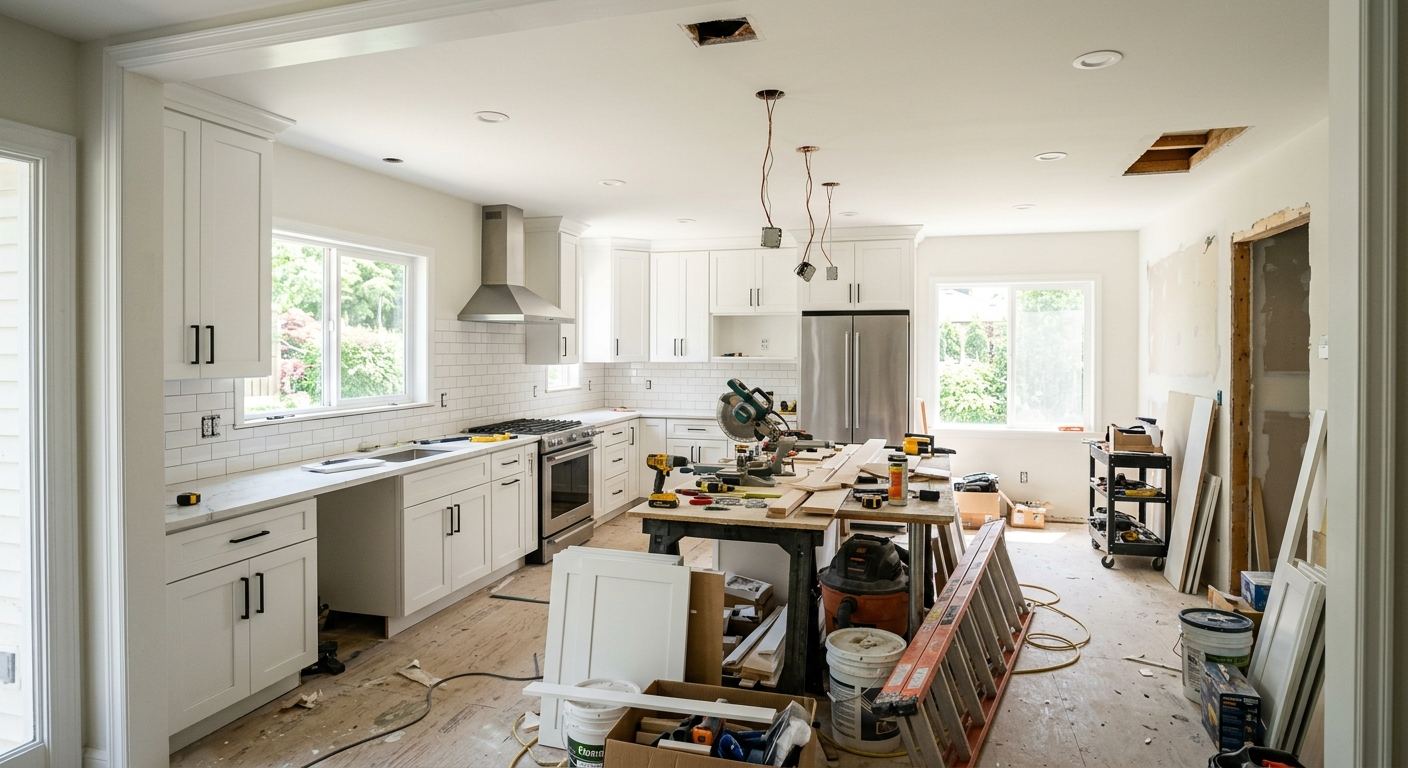
Kitchen renovation options and costs in Twin Creeks
Twin Creeks homeowners usually have the same end goal—more storage, better lighting, and a layout that works—but the path to get there varies widely. In a community of 2,577 residents (Statistics Canada, 2021 Census), you tend to see kitchen renovations clustered around practical updates rather than constant “trend” changes. At the same time, Lower Mainland–Southwest pricing is strongly influenced by local buying expectations and resale economics—more than by weather alone. In higher-value pockets of the region, buyers often expect quartz or stone counters and more fitted, semi-custom cabinetry, which is why upgrades can feel “worth it” when you’re planning to sell. (Statistics Canada, 2021 Census)
Contractor availability also matters. The Lower Mainland–Southwest has steady demand across Surrey, Abbotsford, and Burnaby corridors, and that demand can tighten scheduling windows when multiple trades are booked at once—plumbing, electrical, cabinet install crews, and tile setters. Climate plays a smaller role than you might expect in kitchen pricing, but it does affect material handling: coastal moisture and temperature swings can increase the time needed for proper subfloor checks, ventilation tuning for ranges and hoods, and sealing at countertop interfaces.
In Twin Creeks, trade demand is especially strong around the older housing stock where owners refresh cabinets, replace worn laminate, and rework backsplash and lighting to modern standards—often in the same phases as flooring updates. From there, it’s easy to compare “refresh” jobs versus full renovations, which is what the tiers below are designed to show. Use the table as a baseline, then we’ll map it to the choices you’re considering.
| Renovation Tier |
What's Included |
Typical Duration |
Price Range |
| Cosmetic refresh (paint, hardware, new appliances only) |
Cabinet paint or restain (if included by scope), new hardware, matching trim touch-ups, swap appliances (dishwasher, range, fridge as selected), re-seal sinks as needed |
1–3 weeks |
$8,000–$22,000 |
| Mid-range full renovation (new cabinets, counters, sink, tile) |
New semi-custom or upgraded stock cabinets, countertop replacement, sink and faucet, backsplash tile, standard under-cabinet lighting, minor plumbing adjustments, disposal install if included |
4–8 weeks |
$40,000–$80,000 |
| High-end full renovation (custom cabinets, stone counters, island) |
Fully custom cabinetry, premium stone counters, island with integrated features, expanded backsplash (often full-height), electrical upgrades for island lighting, more complex plumbing/gas coordination |
8–16 weeks |
$90,000–$120,000 |
| Cabinet refacing only (new doors + drawer fronts, same boxes) |
New door and drawer fronts, veneer/laminate on existing carcasses if suitable, hardware upgrades, minor refinishing, alignments after assessment |
2–5 weeks |
$12,000–$35,000 |
| Countertop swap only (laminate to quartz or stone) |
Remove old counters, template, install new countertop (often includes sink cut-out adjustments), seal where required, basic edge treatments |
1–3 weeks |
$6,000–$12,000 |
| Backsplash tile installation only |
Surface prep, tile supply from selected line, grout/seal, electrical outlet detailing as needed, caulking at counter and wall transitions |
1–2 weeks |
$1,500–$6,000 |
Prices are estimates only and vary by project scope, site access and material selection.
What affects the price of kitchen renovation in Twin Creeks
In Twin Creeks and across British Columbia, you can see quotes for the “same” kitchen swing by 30–50% because contractors price risk and finish expectations differently, and because Lower Mainland–Southwest buyers often pay more for a look that photographs well and holds up at resale. Even when the footprint is identical, the cabinet tier, countertop type, and how much layout work is involved can push a project from the $40,000–$80,000 mid-range into the $90,000–$120,000 full high-end band quickly. Climate isn’t the main driver of that spread—market economics are.
Local home values and income shape the typical finish tier far more than the weather. In higher-value areas of the Lower Mainland–Southwest, homeowners and agents expect quartz or stone counters and more fitted millwork, so semi-custom cabinetry and upgraded hardware are a “default” rather than a luxury add-on. In more modest settings, laminate and stock cabinets dominate because they deliver better ROI and quicker lead times. The biggest unpredictable cost regardless of finish level is layout change: removing a wall, adding an island, or moving a gas line or major plumbing run.
Two Twin Creeks examples we see often: (1) older cabinets may hide uneven walls, so “simple” cabinet installs can require extra drywall, shimming, and longer finish time; (2) if you’re swapping laminate for quartz, the countertop installer may need additional blocking to ensure the new stone edge doesn’t stress weak wall conditions. Also, coastal moisture exposure can make ventilation and sealing more important around sinks and counters, which is why budgets sometimes add small allowances for refinishing and air-tight caulking rather than only materials.
| Price Factor |
Why It Matters |
Cost Impact |
| Cabinet tier — stock vs. semi-custom vs. fully custom millwork |
Tier affects fit, customization, lead time, and how well the layout hides irregular wall conditions common in older homes |
$5,000–$60,000 swing depending on scope |
| Countertop material — laminate vs. quartz vs. granite vs. stone |
Materials change cost of slab/template/installation and long-term maintenance expectations |
$3,000–$12,000+ |
| Layout change — wall removal, island add, plumbing/gas move |
Layout work triggers demolition, structural checks, and trades coordination (plumbing/electrical/gas) |
$10,000–$40,000+ |
| Appliance package tier — builder vs. mid-range vs. pro-grade |
Higher tiers often require different electrical clearances, venting, and premium trim integration |
$2,000–$12,000+ |
| Flooring — refinish existing vs. full replacement |
Matching existing finishes can be cheaper, while full replacement adds demo, underlayment, and transitions |
$1,500–$8,000+ |
| Backsplash — ceramic tile vs. marble vs. full-height slab |
Complex materials and full-height installs require more prep, detailing, and higher labor rates |
$1,500–$6,000+ |
| Electrical — new circuits for island, under-cabinet lighting |
New circuits and lighting plans require licensed work, inspections, and careful routing |
$800–$6,000+ |
| Permit fees and licensed trade requirements |
When permits are required, schedules and compliance steps add cost and timing |
Variable; commonly several hundred to a few thousand dollars |
Permits & regulations in British Columbia
In British Columbia, a simple cabinet and countertop swap typically does not require a permit: replacing cabinets in place, changing counters, and installing a backsplash are usually treated as finishing work. However, once you change plumbing or gas routing, or you alter the structure or electrical scope, permits and licensed trades become part of the job. For a homeowner in Twin Creeks, the difference is usually clear-cut when you look at what’s being moved.
Work that typically does NOT require a permit (common examples): painting cabinets, installing new doors/fronts for refacing (if boxes stay put), countertop replacement without moving sink plumbing, and backsplash tile installation.
Work that typically DOES require a permit / inspections (common examples): moving sink supply or drain lines; relocating a gas stove or making changes to gas lines; removing or altering a load-bearing wall; adding new electrical circuits for an island, upgrading wiring to meet load requirements, or adding new lighting that requires new wiring routes. Gas work must be completed by a licensed gas fitter, and electrical work must be done by a licensed electrician, both with inspections.
To verify your contractor before signing, ask for (1) the contractor’s licence details and trade numbers where applicable; (2) current liability insurance with certificate of insurance naming you as applicable; and (3) coverage documentation for workers. In practice, you confirm coverage by requesting a certificate of insurance from the contractor and checking the worker coverage information they provide for the project. Then make sure your contract clearly states which party pulls permits, pays permit fees, and schedules inspections—so responsibility is unmistakable in writing.
Cabinets, countertops and layout decisions in Twin Creeks
When you renovate a kitchen in Twin Creeks, three decisions influence the budget the most: (1) cabinet tier, (2) countertop material, and (3) whether you change the layout. In the Lower Mainland–Southwest, those choices are tied to what buyers expect at each price point. Coastal humidity and rain patterns also mean we pay attention to sealing around sinks, ventilation performance, and how countertops meet walls—small details that protect finishes over the long term.
Cabinet tier: stock cabinets are the fastest and usually the lowest cost, because sizing is standard and installation is straightforward. Semi-custom cabinets are the “most popular mid-range” option: you get better fit around irregular walls and more flexibility for drawers, pull-outs, and corner solutions. Custom cabinets cost more, but they shine where ceilings, alcoves, or unusual wall conditions would otherwise force compromise.
Countertop material: laminate is budget-friendly and durable enough for many households, but it has a shorter “wow and wow-again” lifespan. Quartz is a strong balance for busy kitchens—resilient to everyday wear and generally lower maintenance than natural stone. Granite and other natural stones bring premium visuals, with sealing and care considerations. (In renovation planning, we also consider the time required for templates and stone fabrication.)
Layout changes: removing a wall, adding an island, or relocating plumbing/gas creates the most cost risk. A justified island is one that improves workflow—clearances for walk paths and seating—and doesn’t force major gas line rerouting. For example, if you want a simple island with water staying put, you might add cabinetry and electrical while keeping plumbing moves minimal; that’s often easier to keep closer to the mid-range band ($40,000–$80,000). If the island requires moving a gas line and changing venting, costs commonly drift toward the high-end range ($90,000–$120,000) even if finishes are “only” semi-custom and quartz.
| Option |
Durability |
Maintenance |
Best For |
Price Range |
| Stock cabinets (big-box) |
Good for everyday use; fit depends on how square your walls and layout are |
Basic cleaning; touch-up for chips and hardware wear as needed |
Fast refresh timelines and lower budgets |
$8,000–$25,000 |
| Semi-custom cabinets (local dealer) |
Very strong; better adjustability for real-world wall conditions |
Wipe clean; replace hardware components as trends change |
Most Twin Creeks homeowners aiming for resale-ready results |
$20,000–$55,000 |
| Custom cabinets (local millwork shop) |
Highest long-term fit and finish; built to the exact space and detailing |
Simple cleaning; occasional hardware or hinge replacement over many years |
Complex layouts, angled walls, ceiling-height ceilings, and premium installs |
$45,000–$80,000+ |
| Laminate countertop |
Decent day-to-day durability; seams and edges can be more vulnerable over time |
Wipe dry; protect seams/edges from water exposure |
Budget-focused renovations and rentals where replacement is planned later |
$3,000–$6,000 |
| Quartz engineered countertop |
Excellent stain resistance and consistent look; performs well in busy kitchens |
Clean with mild soap; avoid harsh abrasives; no sealing typically |
Homeowners wanting “premium look” with low upkeep |
$5,500–$10,000 |
| Granite / natural stone countertop |
Very durable surface; natural variation is part of the appeal |
Periodic sealing depending on stone type; wipe-up spills promptly |
Premium styling when you want authentic stone character |
$8,000–$12,000 |
| Butcher block countertop |
Strong but can be sensitive to standing water and heat; needs care |
Oil/condition regularly; use cutting boards; manage moisture |
Family kitchens that like warmth and a “lived-in” look |
$4,500–$9,000 |
| Marble countertop |
Premium surface but more susceptible to etching/staining than quartz |
Seal and clean carefully; avoid acidic cleaners and prolonged spills |
Low-spill households and high-finish aesthetic priorities |
$10,000–$14,000+ |
How to choose a kitchen renovation contractor in Twin Creeks
Choosing a contractor in Twin Creeks is mostly about verifying three things: (1) licensing and trade compliance, (2) insurance/coverage, and (3) how clearly they describe scope, schedule, and warranty. For British Columbia, confirm that the contractor and any trades are licensed for their parts of the work. Then request proof of liability insurance and coverage documentation for the job. Ask for the certificate of insurance (showing your address or “additional insured” status if applicable), and keep a copy in your renovation file. If the project includes plumbing, gas, or electrical work, those trades must be licensed appropriately—don’t let it slide into “we’ll have someone handle it.”
Next, get 2–3 itemised written quotes with a line-by-line breakdown of labour and materials—cabinet package, countertop supply and template/installation, tile install, demolition, electrical scope, plumbing adjustments, and disposal. A lump-sum estimate is fine for planning, but it’s not enough for comparing contractors fairly. Read the scope for exclusions: who supplies permits, who pays disposal, whether drywall patching is included, and what happens if site conditions differ from what was visible during the walk-through.
For warranty, ask for the workmanship warranty length and whether product warranties are transferable to you as the homeowner. Payment schedule matters: never pay more than 10–15% upfront; use milestone payments and a holdback until completion. Finally, insist on a written start date and a realistic completion estimate, including lead times for cabinets and countertops.
- Verify licensing and confirm the specific trades included (gas fitter, electrician, plumber where needed).
- Request a certificate of liability insurance before work starts.
- Confirm coverage details for workers and ask how claims are handled if something goes wrong.
- Use itemised quotes: labour, materials, demolition, and install should be separated.
- Ask whether permits and inspections are included in the quote cost and who pulls them.
- Clarify disposal and dump fees: who hauls away demo materials.
- Confirm backsplash and countertop details: tile type, grout choice, edge profiles, and sealing responsibilities.
- Ask what’s included in electrical work (circuits, switches, under-cabinet lighting, island lighting).
- Demand a timeline that includes cabinet and countertop lead times, not just labour days.
- Review warranty terms in writing: workmanship duration and what is covered/excluded.
- Check payment terms: keep a holdback until punch-list items are complete.
- Request sample contracts or standard workmanship terms so you can compare consistently.
Red flags we commonly see with kitchen renovation contractors in Twin Creeks: vague scopes (“kitchen update” without line items), no proof of liability insurance or unclear coverage, promises to “start next week” without discussing cabinet/countertop lead times, refusal to include permit responsibility in the contract, and change orders that arrive without documentation or cost breakdowns.
Frequently asked questions — kitchen renovation in Twin Creeks
How do I get accurate kitchen renovation quotes in Twin Creeks?
For Twin Creeks and the Lower Mainland–Southwest, the fastest way to get accurate quotes is to standardize what you’re comparing. Ask for 2–3 itemised quotes that break down labour and materials (cabinet package, countertop supply/template/install, tile scope, electrical and plumbing adjustments, disposal, and any patch-and-paint). If your plan includes an island or relocating plumbing/gas, include those exact intentions in writing because layout changes are what create the largest cost swings. Also, request a site visit where the contractor measures and checks wall flatness and subfloor conditions—older housing can hide surprises that affect cabinet fit. As a pricing reference, a mid-range full renovation often lands in the $40,000–$80,000 band, while high-end full renovations with premium stone and custom millwork commonly reach $90,000–$120,000.
What's the best countertop material for a busy Twin Creeks kitchen?
For most busy households in British Columbia, quartz is the most practical “best overall” choice because it balances durability, consistent appearance, and low maintenance. It’s resistant to everyday staining and doesn’t require the same sealing routine as natural stone. If you’re comparing against laminate, the trade-off is usually worth it for family kitchens where spills happen frequently—quartz tends to look better for longer with less worry about seams and edge wear. Natural stone like granite can also be excellent, but homeowners need to follow care guidance (including sealing depending on the slab). In price terms, countertop projects often sit around the $3,000–$12,000 install band depending on material and complexity; laminate can land closer to the lower end, while stone tops the higher end once you add fabrication and edge work.
How do I add an island to my Twin Creeks kitchen?
Adding an island is usually the most “transformational” change, but it’s also where costs get unpredictable. Start with your workflow: clearances for walking paths, seating, and whether doors open freely with the island positioned. Next, decide what you want the island to include—power for outlets, under-cabinet or pendant lighting, and possibly plumbing or a gas cooktop. If plumbing or gas is involved, permits and licensed trades apply, and inspections may be required. To keep the budget realistic, many homeowners choose an island that only needs electrical (no gas line or major drain moves) so you avoid the highest-risk scope. In Twin Creeks and across the Lower Mainland–Southwest, if you add island features that require moving major utilities, the project often moves toward the higher end of full renovation pricing rather than staying in a basic refresh.
How much does a kitchen renovation cost in Twin Creeks?
Kitchen renovation costs in Twin Creeks typically follow the same regional bands you’ll see across the Lower Mainland–Southwest, where finish expectations and resale economics influence pricing. A cosmetic refresh (paint, hardware, and new appliances only) often stays relatively restrained in the $8,000–$22,000 range. A mid-range full renovation with new cabinets, counters, a sink, and tile commonly lands in the $40,000–$80,000 band. If you want custom cabinetry, premium stone counters, and an island with upgraded lighting and more complex trade coordination, high-end full renovations frequently move into the $90,000–$120,000 band. Remember: layout changes, plumbing/gas moves, and electrical scope are the biggest levers that push budgets up or down regardless of whether you pick laminate or quartz.
How long does a kitchen renovation take in Twin Creeks?
Timelines depend on what you’re changing and how quickly your materials arrive. Cosmetic refresh projects are often the quickest—commonly 1–3 weeks when appliances and paint/hardware are ready. Mid-range full renovations with new cabinets and countertops typically take about 4–8 weeks, while high-end projects with custom millwork and an island can run 8–16 weeks. The schedule is strongly affected by cabinet and countertop lead times as much as by labour capacity. In British Columbia, also plan for licensed trade availability when permits or inspections are required—especially if you’re moving plumbing supply/drain lines, relocating gas equipment, or adding electrical circuits for island lighting. Build cushion into your plan so you’re not surprised by inspection dates or fabrication/template timelines.
Quartz vs granite countertops — which is better?
Neither is universally “better”; the best choice for a Twin Creeks kitchen comes down to how you use the space. Quartz is often the easiest win for busy households because it’s consistently beautiful, typically doesn’t require sealing, and handles everyday staining and wear well. Granite brings unique natural patterns and can look very upscale, but it generally needs more care—most granite types require sealing and prompt spill cleanup to preserve the finish. If you want a lower-maintenance lifestyle with a predictable look for resale, quartz usually fits best. If you want authentic stone character and you’re willing to follow care guidance, granite can be ideal. In pricing, countertop install scopes often fall within the $3,000–$12,000 range depending on material choice and complexity: quartz commonly lands mid-range, while granite usually trends toward the higher end once fabrication and install requirements are included.