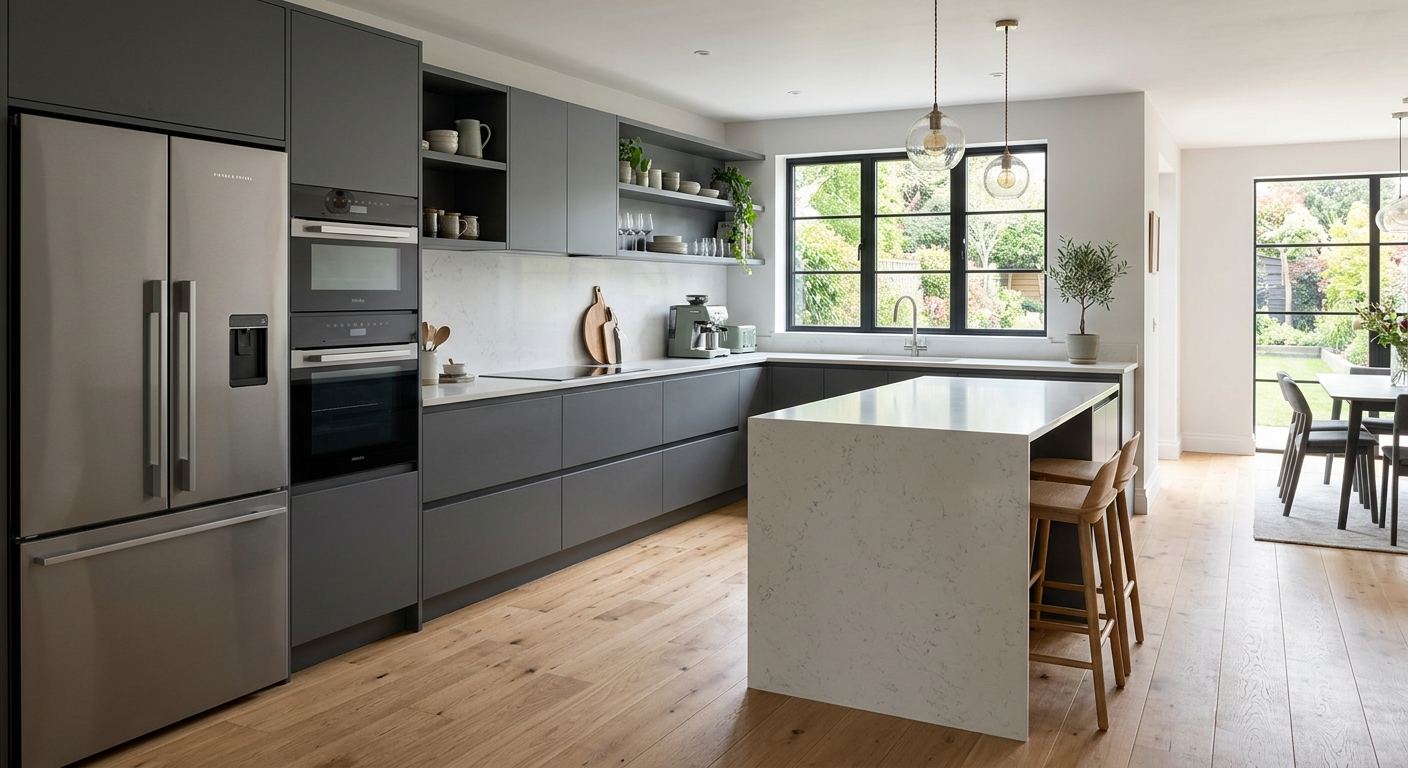
Kitchen renovation options and costs in Maple Ridge
Kitchen renovation in Maple Ridge often starts with a simple question—“What can I get for my budget?”—but the answer depends heavily on how closely you want the finished kitchen to match the expectations of a Lower Mainland–Southwest buyer. With a median household income of $105,000 (Statistics Canada, 2021 Census), many homeowners choose finishes that feel “resale-ready,” especially as homeownership remains high (26,205 homeowner households; 79.1% own). That income level matters because it influences the typical finish tier: homeowners commonly move beyond basic laminate and starter hardware toward quartz counters, upgraded lighting, and semi-custom cabinetry.
In our region, pricing is driven more by home value and expected finish level than by climate alone. Maple Ridge’s wet winters and occasional freeze–thaw cycles can be harder on water-exposed areas if your current plumbing seals are aging, but they rarely change the overall contractor labour availability the way a major climate constraint would. Instead, the Lower Mainland–Southwest market pushes contractors toward current trends: practical layouts, durable surfaces, and packages that hold up to daily use for years. You’ll see the most renovation activity around east Maple Ridge and the downtown-adjacent neighbourhoods where older housing stock (28.6% built before 1981) often needs cabinet box replacement, updated electrical, or new countertop bases.
To compare options in a way that helps you budget, here are typical tiers and what they usually include, before we get into the factors that move pricing up or down.
| Renovation Tier |
What's Included |
Typical Duration |
Price Range |
| Cosmetic refresh (paint, hardware, new appliances only) |
Prep/paint, new cabinet hardware and pulls, appliance swap, touch-ups, basic caulking |
3–7 days |
$8,000–$18,000 |
| Mid-range full renovation (new cabinets, counters, sink, tile) |
New semi-custom or quality stock cabinetry, countertop install, sink + faucet, backsplash tile, updated sealants, plumbing/electrical tie-ins as needed |
2–4 weeks |
$40,000–$75,000 |
| High-end full renovation (custom cabinets, stone counters, island) |
Custom millwork, quartz/stone counters, island with upgraded lighting, full backsplash (often to height), premium hardware, expanded electrical (e.g., under-cabinet lighting) |
4–8 weeks |
$85,000–$120,000 |
| Cabinet refacing only (new doors + drawer fronts, same boxes) |
New doors/drawer fronts, refinishing or overlay where applicable, hardware, labour to prep and align; existing countertop/seams typically remain |
5–12 days |
$12,000–$35,000 |
| Countertop swap only (laminate to quartz or stone) |
Remove/replace existing countertop, sink cut-out updates, basic reseal, disposal and patching where required |
2–5 days |
$3,000–$12,000 |
| Backsplash tile installation only |
Demo of old backsplash (if needed), new tile layout/installation, grout/seal, trimming at outlets |
3–7 days |
$1,500–$6,000 |
Prices are estimates only and vary by project scope, site access and material selection.
What affects the price of kitchen renovation in Maple Ridge
Two quotes for the same kitchen can differ by 30–50% across the Lower Mainland–Southwest and other British Columbia markets, even when the cabinet style looks similar. In practice, it’s rarely “climate” that causes the swing—it’s the local expectations tied to home values, the finish tier homeowners feel is appropriate, and how much complexity the plan includes. In higher-value areas of the Lower Mainland–Southwest, many owners default to quartz or stone counters and semi-custom cabinetry because the renovation cost is more easily recovered on resale. In lower-cost markets (or on more budget-conscious projects), laminate and stock cabinetry dominate because they deliver strong day-to-day improvement without pushing the total into the premium bands.
Layout changes are the biggest unpredictability driver regardless of finish level. Removing a wall, adding an island, or moving a gas line or plumbing can force additional carpentry, subfloor work, venting changes, and extra licensed-trade time. For example, adding an island often increases electrical scope for under-cabinet lighting and dedicated circuits, while moving a sink changes waterproofing details at the base and behind the dishwasher. On older Maple Ridge homes—especially those built before 1981—aging valves, braided supply lines, and older drains can also require upgrades once surfaces open up, which can add thousands even if cabinet and counter choices stay mid-range.
Concrete cost examples we commonly see: (1) swapping to quartz can move a countertop-only job from roughly the mid-band to the upper end of the countertop band (while a straight laminate swap stays leaner), and (2) a backsplash that’s “just tile” in an open area can become much higher when it has multiple outlet revisions and height transitions. If you’re targeting a full renovation budget near $40,000–$75,000, keeping utilities where possible helps protect your spend. If you’re aiming closer to $85,000–$120,000, plan on premium cabinetry packages, more electrical, and island-level complexity.
| Price Factor |
Why It Matters |
Cost Impact |
| Cabinet tier — stock vs. semi-custom vs. fully custom millwork |
Differences in fit, material quality, internal organization, and build flexibility (including unusual dimensions) |
Typically shifts the project by tens of thousands for full renos |
| Countertop material — laminate vs. quartz vs. granite vs. stone |
Material cost, fabrication complexity, and edge profiles change both shop time and installation labour |
Can add thousands; stone can push total upward quickly |
| Layout change — wall removal, island add, plumbing/gas move |
Triggers additional trades, subfloor changes, and verification/permits; hardest to price accurately early |
Often the largest swing factor in the quote |
| Appliance package tier — builder vs. mid-range vs. pro-grade |
Electrical requirements, venting needs, and install tolerances vary by model |
Can move the “appliance portion” by several thousand |
| Flooring — refinish existing vs. full replacement |
Kitchen renos commonly disturb adjacent floors; matching new materials can increase labour and waste |
Replacement generally costs more than touch-ups/refinishing |
| Backsplash — ceramic tile vs. marble vs. full-height slab |
Cut complexity, weight/handling, and finishing requirements (sealants, crack control) |
Full-height or marble can significantly increase material and labour |
| Electrical — new circuits for island, under-cabinet lighting |
Additional wiring, load calculation, and workmanship complexity; must be done by licensed trades |
Commonly adds meaningful cost beyond “cabinet and counter” budgets |
| Permit fees and licensed trade requirements |
Work that changes gas, plumbing, load-bearing structure, or electrical circuits increases paperwork and inspection steps |
Costs vary by scope, but can be a noticeable add-on |
Permits & regulations in British Columbia
In British Columbia, many “swap-in-place” kitchen upgrades do not require permits. Cabinet and countertop swaps typically don’t need a permit when you’re not changing plumbing, gas lines, structural elements, or electrical circuitry. However, once you move supply/drain lines, relocate gas components (stove/range connections or gas-related venting), remove or alter a load-bearing wall, or add new electrical circuits (for example, an island receptacle circuit or dedicated under-cabinet lighting runs), permits and licensed trade involvement become part of the process.
Step-by-step, here’s how a Maple Ridge homeowner can verify a contractor is set up correctly before signing: (1) Ask for the company’s business information and confirm who is pulling permits (if any). (2) For gas-related work, require a licensed gas fitter and an inspection/clearance where applicable to the scope. (3) For electrical, require a licensed electrician and evidence of electrical permits/inspections when circuits are added or modified. (4) Check liability insurance—request a certificate of insurance showing current coverage and the contractor’s legal name. (5) For worker coverage, confirm WCB/WSIB coverage—many BC projects expect WCB coverage for workers; the contractor should be able to provide clearance documentation if required.
Always confirm permit responsibility in writing. If your contract is vague, you can end up paying for corrective work or delays caused by missing permits.
Cabinets, countertops and layout decisions in Maple Ridge
When homeowners in Maple Ridge ask what matters most, I usually point to three decisions that make or break both cost and long-term satisfaction: (1) cabinet tier, (2) countertop material, and (3) whether your layout justifies plumbing or gas relocation. Cabinet tier is the foundation. Stock cabinets are the quickest and cheapest path to visible improvement. Semi-custom is the “sweet spot” for most Lower Mainland–Southwest renos because it provides better height/width flexibility and internal storage without the sticker shock of fully custom millwork. Custom cabinets are best when your room has unusual measurements, you want a specific style, or you’re aiming for a premium, built-in look that matches high-end resale expectations.
Countertops are where day-to-day durability meets budget. Quartz engineered countertops are popular because they handle the routine kitchen wear well and are generally straightforward to maintain. Natural stone (granite/other stone) and marble look exceptional, but marble typically needs more care, and higher-end materials can increase both supply and fabrication time. Butcher block can work beautifully for warmth, yet it demands regular maintenance and is more sensitive to moisture management—important in a region where wet winters can increase humidity and where older plumbing may expose water-related issues if seals are compromised.
Layout decisions decide whether you’ll pay for complexity. If you’re adding an island or removing a wall, it can be worth it when the space gain improves how traffic flows, creates seating, or opens sightlines for resale. But if the goal is only “more counter space,” many projects can keep plumbing and gas where they are to avoid permit-driven costs.
For a realistic dollar example: a countertop-only upgrade from laminate to quartz often lands in the countertop band (roughly $3,000–$12,000 depending on size and edge work). If you keep plumbing in place and focus on cabinets + counters, you’re more likely to stay near the mid-range full renovation band of $40,000–$75,000. If you move gas lines and add island electrical, your budget can jump even if cabinet and counter choices remain “mid-range,” because the trades and changes become the costly part—not the visible surfaces.
| Option |
Durability |
Maintenance |
Best For |
Price Range |
| Stock cabinets (big-box) |
Good for everyday use; durability depends on finish and construction quality |
Low; periodic hardware tightening and gentle cleaning |
Fast remodels, tighter budgets, standard room dimensions |
$8,000–$20,000 |
| Semi-custom cabinets (local dealer) |
Very good; better internal options and improved fit |
Low to moderate; manage hinges, keep hardware clean |
Most Maple Ridge homeowners aiming for resale-ready quality |
$18,000–$45,000 |
| Custom cabinets (local millwork shop) |
Excellent; built for your exact dimensions and detailing preferences |
Low; premium finishes still benefit from routine care |
Complex layouts, high-end look, maximum storage optimization |
$35,000–$70,000 |
| Laminate countertop |
Decent; can chip or scratch with abuse and may show seams more readily |
Easy; avoid prolonged heat and protect edges |
Budget-friendly refreshes where you’re keeping other costs controlled |
$3,000–$6,000 |
| Quartz engineered countertop |
Very durable; strong stain resistance and consistent look |
Low; wipe clean with non-abrasive products |
“Set it and forget it” kitchens that still look high-end |
$6,000–$12,000 |
| Granite / natural stone countertop |
Durable; varies by slab hardness and finish |
Moderate; periodic sealing depending on stone type and finish |
Owners who want distinctive veining and a natural premium look |
$7,000–$14,000 |
| Butcher block countertop |
Good; durable but can be dented; needs careful moisture management |
Higher; regular oiling and edge protection are recommended |
Warm, traditional styling and cooks who like maintenance |
$4,000–$10,000 |
| Marble countertop |
Beautiful but softer; more susceptible to etching and staining |
Higher; careful cleaning and sealing discipline |
Statement kitchens where aesthetics outweigh “no-fuss” maintenance |
$9,000–$18,000 |
How to choose a kitchen renovation contractor in Maple Ridge
Choosing the right contractor in Maple Ridge is mostly about risk control: licensing, insurance, a clear scope, and realistic scheduling. Start by verifying British Columbia licensing for relevant trades: ask for the contractor’s trade partners (gas fitter and electrician) and confirm their credentials. Next, check liability insurance by requesting a certificate of insurance that matches the legal company name on your contract and shows active coverage. For worker coverage, confirm WCB/WSIB status—your contractor should be able to provide proof or a clearance letter if their workers are on site.
Then, get 2–3 itemised written quotes rather than one lump sum. You want labour + materials separated: cabinetry supply and install, countertop fabrication and install, tile supply and labour, demolition/disposal, and any allowance items. Read the scope for exclusions: Are permits included if you’re changing plumbing, gas, or electrical? Is demolition disposal included or will you pay a separate hauling fee? What about patching/painting in adjacent areas?
Warranty matters too. Ask for the workmanship warranty length (not just “manufacturer warranty”), whether it’s tied to completion milestones, and if it transfers if you sell the home. For payment schedules, I recommend never paying more than 10–15% upfront. Hold back a portion until the job is complete and the punch list is addressed. Finally, confirm timeline details in writing: start date, estimated completion, and how delays for cabinets/counters will be communicated.
- Request written proof of BC trade licensing for involved trades (gas/electrical where required).
- Confirm liability insurance: certificate of insurance, correct legal name, coverage dates.
- Verify WCB/WSIB clearance or proof of coverage for workers on your site.
- Get 2–3 itemised quotes (labour vs materials vs allowances).
- Require a line item for demolition and disposal (not “included” vaguely).
- Ask whether permits are included for any plumbing/gas/electrical changes.
- Confirm countertop fabrication responsibility and who measures templating.
- Check cabinetry warranty and workmanship warranty—how long, what’s covered.
- Clarify who handles missing parts/backorders and how timelines adjust.
- Use a holdback: don’t release final payment until punch list is completed.
- Ensure the quote lists finish selections (cabinet finish, countertop colour, tile type).
- Get start date and completion estimate in writing, including critical path items.
Red flags I see in Maple Ridge: a contractor who won’t provide insurance proof, quotes that lump labour and materials with no breakdown, vague scope language like “permits by others,” pressure to pay most of the amount upfront, and no clear start/completion timeline tied to materials lead times.
Frequently asked questions — kitchen renovation in Maple Ridge
What order do kitchen renovation steps happen in?
In Maple Ridge, a typical full renovation flows like this: initial measurements and ordering (cabinet templates and countertop fabrication), then demolition and rough work, followed by any necessary framing/subfloor adjustments. Next come electrical and plumbing changes (especially if you’re moving a sink or adding island circuits), and then insulation and drywall patching if walls were altered. Cabinet installation is usually first after rough work is approved—then countertop templating and install, followed by backsplash, final trim, and paint touch-ups. Appliances get installed last once surfaces are complete. If you’re only doing a refresh (paint, hardware, appliances), the order compresses into surface prep and finish work without the rough-trade steps.
Can I live at home during a kitchen renovation in Maple Ridge?
Many homeowners in British Columbia do stay home during parts of the renovation, especially for smaller scopes like a cabinet refacing or countertop-only project. For a mid-range full renovation (often in the $40,000–$75,000 band), it’s still possible to remain in the home, but you’ll need a workable plan for dust control, a temporary food setup, and safe access through the work zone. If you’re doing a high-end full renovation with an island and more trades, most families either move the kitchen function off-site or limit access for a few weeks. A practical approach is to keep a microwave, kettle, and basic prep station in a different room, use plastic containment, and confirm how the contractor handles debris and daily cleanup.
Should I renovate my kitchen before selling in Maple Ridge?
Often, yes—if your goal is to improve buyer confidence without overbuilding. In Maple Ridge’s housing stock (including a meaningful share built before 1981), kitchens can be a major decision factor even when the rest of the home is solid. That said, you should match your spend to the finish expectations of local buyers. Mid-range renovations with durable surfaces—like quartz counters and quality semi-custom cabinetry—tend to attract buyers more reliably than very budget refreshes. If you can only manage a smaller scope, focusing on cabinets/hardware and a countertop or backsplash update can still deliver visible impact while controlling total costs, similar to keeping projects closer to the lower bands (for example, refreshes often stay well under full remodel pricing). Avoid making layout changes unless the space gain is real; unnecessary complexity can extend timelines and raise costs.
What's the most popular kitchen style in Maple Ridge right now?
In Maple Ridge and the Lower Mainland–Southwest generally, the most requested direction is a clean, modern look with warm neutrals: shaker-style or simple slab profiles, soft whites/greiges, and practical hardware finishes. Many homeowners pair semi-custom cabinetry with quartz countertops for a crisp, low-maintenance result. Island seating and under-cabinet lighting are also common because they improve daily function and photographs well for resale. Style trends don’t change as fast as materials do; what homeowners tweak year to year is cabinet colour and countertop pattern. If you’re aiming for a premium finish tier, you’ll also see more stone accents and more integrated lighting—those choices typically align with higher full renovation budgets.
How do I know if I need to update my kitchen plumbing in Maple Ridge?
There are a few common signs. First, check for age and condition: older shutoff valves, slow drains, recurring leaks under the sink, moisture damage near the dishwasher area, or inconsistent hot water can indicate hidden issues. Second, look at the materials—if your supply lines are old or brittle, a reno is the right time to replace them rather than reusing questionable components. Third, consider scope: if you’re moving a sink, dishwasher, or relocating a gas range area where venting connections are relevant, plumbing updates are almost guaranteed. British Columbia requirements also come into play when you change supply/drain routes—licensed work and permits may be required depending on what’s altered. A reputable contractor will do a pre-demo check and propose upgrades with clear explanations before walls are closed up.
What is the difference between a galley and open-concept kitchen?
A galley kitchen is a narrow, two-wall layout—often efficient for cooking but limited for entertaining and traffic flow. An open-concept kitchen removes barriers to create a wider sightline into the living/dining areas, which usually requires more coordination with structural elements and often increases scope if you’re changing walls, vents, or electrical routes. In Maple Ridge, choosing between them usually comes down to your home’s layout and how much you want to invest in changing the plan. If you’re keeping it “functional and simple,” a galley renovation can often focus on cabinets, countertops, and lighting within a more controlled budget (sometimes aligning with smaller bands like countertop-only upgrades). If you want open concept, be prepared for higher project totals because wall removal, subfloor work, and additional electrical/plumbing coordination are more complex.