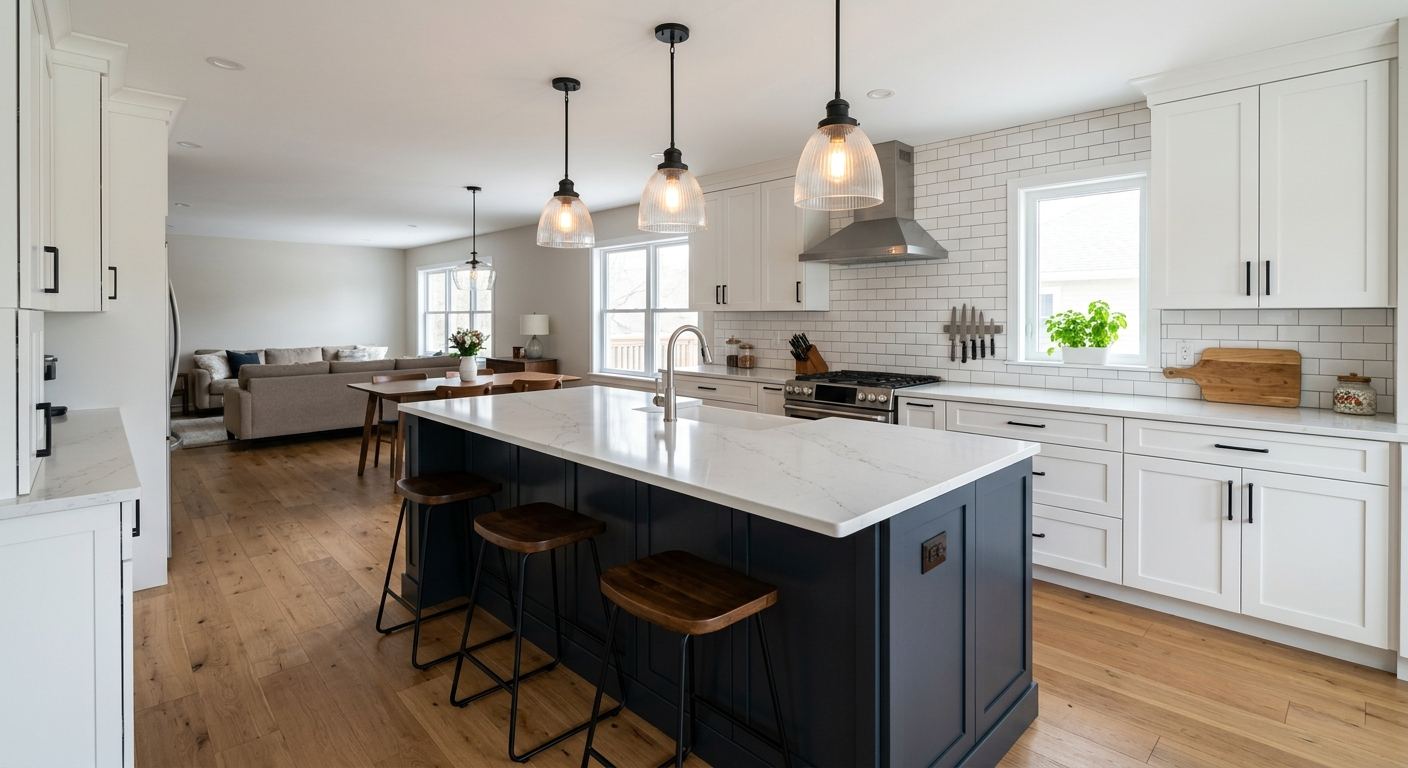
Kitchen renovation options and costs in Hearst
Hearst kitchen renovations tend to land on a pretty predictable path: decide how much you want to change, then match finishes to your household budget and the type of home you’re renovating. With a median household income of $76,500 (Statistics Canada, 2021 Census), many homeowners in town choose a mid-range “hybrid” plan—new cabinets or refacing plus updated countertops, backsplash, and lighting—rather than starting from the studs. Also, because 60.7% of households own their homes (Statistics Canada, 2021 Census), there’s often a focus on long-term durability and resale-ready looks.
In the Northeast market around Hearst, the local housing stock skews older: 72.2% of homes were built before 1981 (Statistics Canada, 2021 Census). That matters for costing because older layouts, outlet locations, and in-wall plumbing/drain runs may require more labour to access and modify safely. Ontario’s seasonal freeze-thaw and indoor humidity swings also affect renovation scheduling—drying time, flooring acclimation, and the ability to keep work areas properly ventilated can influence the calendar. Contractor availability can be tighter during peak construction months, so firms may prioritize jobs with clear material selections and confirmed lead times.
In Hearst, renovations are especially in demand around the town core where many older single-detached homes are being refreshed for everyday use and buyer appeal. Once you know the scope you’re aiming for, the price bands below help you compare realistic options side-by-side.
| Renovation Tier |
What's Included |
Typical Duration |
Price Range |
| Cosmetic refresh (paint, hardware, new appliances only) |
Paint, new pulls/knobs, cabinet hardware install, appliance swap (no plumbing/gas/electrical rework), basic caulking and touch-ups |
3–7 days |
$8,000–$18,000 |
| Mid-range full renovation (new cabinets, counters, sink, tile) |
Cabinet installation, countertop install, new sink and faucet, backsplash tile, under-cabinet lighting (if planned), flooring patching/repair, disposal and cleanup |
2–4 weeks |
$30,000–$55,000 |
| High-end full renovation (custom cabinets, stone counters, island) |
Custom or semi-custom cabinetry, premium stone counters, island build (often with electrical/plumbing as needed), full-height feature backsplash, expanded lighting and trim detailing |
4–7 weeks |
$60,000–$80,000 |
| Cabinet refacing only (new doors + drawer fronts, same boxes) |
Door and drawer-front replacement, new hardware, veneer/cover panels, optional lighting upgrade at cabinets, backsplash refresh (if included) |
1–3 weeks |
$6,000–$20,000 |
| Countertop swap only (laminate to quartz or stone) |
Remove old top, install new countertop, cut-outs for sink and cooktop, new undermount sink install if required, basic resealing and caulking |
3–7 days |
$3,500–$15,000 |
| Backsplash tile installation only |
Tile supply and install, edge finishing, waterproofing prep where needed, grout sealing, outlet trim and caulking |
3–10 days |
$2,500–$12,000 |
Prices are estimates only and vary by project scope, site access and material selection.
What affects the price of kitchen renovation in Hearst
In Hearst and across Ontario’s Northeast, two quotes for the “same” kitchen can easily differ by 30–50% because pricing usually isn’t driven only by finish level—it’s driven by how much is hidden behind walls. Even when homeowners want the same look, labour and material costs change based on cabinet layout, electrical/plumbing complexity, and how much demolition is needed to reach wiring, drains, or the subfloor. In older homes (like many built before 1981), surprises are more common, and that’s where contractors’ contingency allowances show up.
Local home values and median income shape the typical finish tier far more than climate. When a project sits in a higher-value “buyers expect polished finishes” bracket, owners more often choose quartz or other premium stone and semi-custom cabinetry because the cost is easier to justify on resale. In more modest plans, laminate counters and stock cabinetry keep the ticket closer to the $30,000–$55,000 mid-range band, while still delivering a meaningful refresh. In both cases, the biggest unpredictable swing is layout change—moving a wall, adding an island, or relocating a gas line or plumbing run can add complexity regardless of whether you’re using laminate or stone.
Concrete examples in Hearst: (1) A pre-1981 home may have older valve locations, meaning sink plumbing reroutes can add labour even if the new cabinet footprint is “nearly the same.” (2) If you want an island with power for outlets and lighting, electrical work may require additional wiring pathways and longer inspections, pushing costs toward the upper side of full-renovation budgets like $60,000–$80,000. (3) If the subfloor is uneven or there’s moisture-related patching near exterior walls, tile and countertop install timelines can stretch because surfaces must be corrected and leveled first.
| Price Factor |
Why It Matters |
Cost Impact |
| Cabinet tier — stock vs. semi-custom vs. fully custom millwork |
Higher tiers improve fit, hardware options, internal organization, and customization for awkward spaces |
$6,000–$25,000 for install/refacing portion |
| Countertop material — laminate vs. quartz vs. granite vs. stone |
Material cost and installation requirements (template, seam layout, edge profiles) drive both budget and labour time |
$3,500–$15,000 depending on tier and sink/cooktop complexity |
| Layout change — wall removal, island add, plumbing/gas move |
Demolition, structural checks, new rough-in, and inspections raise labour and timeline uncertainty |
Often adds $5,000–$25,000 beyond cosmetic changes |
| Appliance package tier — builder vs. mid-range vs. pro-grade |
Premium brands cost more and may require different cut-outs, ventilation specs, and faster/longer commissioning |
Typically $2,000–$10,000 difference versus entry packages |
| Flooring — refinish existing vs. full replacement |
Cabinet and countertop installs often reveal whether subfloor/underlayment needs repair |
$1,500–$8,000 swing for patching vs full replacement |
| Backsplash — ceramic tile vs. marble vs. full-height slab |
Harder-to-cut materials and larger coverage areas increase labour, thinset prep, and waste |
$2,500–$12,000 depending on extent and material |
| Electrical — new circuits for island, under-cabinet lighting |
New lighting and dedicated receptacles require licensed electrical work and inspection |
Commonly $500–$4,500 for lighting plus $1,000–$5,000 for added circuits |
| Permit fees and licensed trade requirements |
Permit handling, inspections, and licensed trade scheduling can affect both direct fees and sequencing |
Typically $300–$2,500 plus scheduling impacts |
Permits & regulations in Ontario
In Ontario, swapping cabinets or changing countertops usually does not require a permit, because you’re not altering building systems. That means a like-for-like cabinet installation, a countertop replacement, or a backsplash install are typically permit-free. However, once you move beyond surfaces, permits and licensed trades become part of the job. Examples of work that does require permits and proper licensed installation include: relocating plumbing supply or drain lines (sink, dishwasher drain, or faucet plumbing changes), moving or installing gas equipment connections (such as relocating a stove/range or making changes that involve gas supply), removing a load-bearing wall or doing structural changes, and adding electrical circuits for outlets or under-cabinet lighting.
For homeowners in Hearst, the practical approach is to verify licensing and coverage in writing before you sign. Step-by-step: (1) Ask the contractor for their Ontario licence information (and confirm it via the applicable online registry they provide), (2) request a current certificate of insurance showing liability coverage and confirm the subcontractors’ coverage too, and (3) ask whether they have WSIB/WCB clearance (or the equivalent coverage proof they use in Ontario) and request the clearance letter. If a subcontractor is doing electrical or gas work, ensure they’re licensed, insured, and identified in the contract. Finally, confirm permit responsibility in the contract—“we’ll pull the permit” or “you’ll pull it” should be clearly assigned before any work starts.
Cabinets, countertops and layout decisions in Hearst
The three most consequential decisions in a Hearst kitchen renovation are cabinet tier, countertop material, and layout changes. First, cabinet tier determines how fast the project moves and how well the kitchen fits real-life needs: stock cabinets are the quickest and most budget-friendly, semi-custom is the most popular mid-range choice because you can adjust sizing and storage details, and fully custom millwork is for homeowners who want the best fit for awkward corners and a “built-in” look.
Second, countertop material affects daily use and long-term maintenance. Laminate can be a smart entry option for older homes needing cost control, while quartz is a common mid-to-upper pick because it’s durable and low-maintenance. Granite/natural stone looks premium but benefits from correct sealing practices and careful installation. In a Northeast climate with temperature swings and frequent indoor humidity changes, you’ll still get the same practical result—good ventilation and proper sealing matter more than the material alone—but the installation quality (subbase, seams, and cut-out finishing) becomes critical.
Third, layout changes justify cost only when the space gain matches your routines and buyer expectations. An island can add prep space and storage, but it’s usually the driver for added electrical and sometimes plumbing. For example, if you keep the renovation in the $30,000–$55,000 mid-range band, you can often upgrade from laminate to quartz by reallocating budget toward material rather than structure. If you add an island with power and new circulation paths, your budget typically trends toward the higher range like $60,000–$80,000 because the rough-in work and longer install sequencing add labour.
That’s why many Hearst homeowners with pre-1981 homes choose: semi-custom cabinetry, a durable quartz top, and minimal layout disruption—unless they’re ready for the added cost that comes with moving plumbing or electrical.
| Option |
Durability |
Maintenance |
Best For |
Price Range |
| Stock cabinets (big-box) |
Good everyday durability; limited sizing flexibility |
Low; wipe-clean surfaces, handle hardware checks |
Speed and budget control, especially for older layouts that match common sizes |
$6,000–$15,000 |
| Semi-custom cabinets (local dealer) |
Very good durability; better fit and storage options |
Low; replaceable parts easier to source |
Most Hearst homeowners aiming for a resale-ready upgrade |
$15,000–$30,000 |
| Custom cabinets (local millwork shop) |
Excellent durability; tailored solutions for corners and ceilings |
Low to moderate; depends on finish system |
Maximizing storage and achieving a premium built-in look |
$30,000–$45,000 |
| Laminate countertop |
Good for daily use; can be less forgiving at seams and edges |
Wipe clean; avoid standing water on seams |
Budget-conscious refresh when you’re keeping layout changes minimal |
$3,500–$7,500 |
| Quartz engineered countertop |
Very durable for cutting and everyday prep |
Low; no sealing required, just routine cleaning |
Busy households that want a premium look without heavy maintenance |
$7,500–$13,500 |
| Granite / natural stone countertop |
High durability and heat resistance |
Moderate; periodic sealing may be needed |
Premium aesthetic with natural variation and classic value appeal |
$10,000–$15,000 |
| Butcher block countertop |
Durable if maintained; sensitive to water sitting in seams |
Moderate; regular oiling and careful drying |
Family kitchens that want warmth and are comfortable maintaining surfaces |
$6,500–$12,000 |
| Marble countertop |
Beautiful but more prone to etching/staining than quartz/granite |
Higher maintenance; protect with appropriate cleaners and sealing approach |
Low-abuse kitchens or homeowners willing to maintain a luxury finish |
$12,000–$18,000 |
How to choose a kitchen renovation contractor in Hearst
Choosing the right contractor in Hearst starts with proof, not promises. In Ontario, confirm the business is properly licensed for the work they claim to do, and verify liability insurance with a current certificate showing adequate coverage for your project. For coverage, ask for WSIB/WCB clearance documentation and request the clearance letter so you can see it’s current. If electrical or gas-related work is involved, the contractor should clearly name the licensed trade(s) and provide their credentials as well.
Next, get 2–3 itemised written quotes. You want a labour + materials breakdown rather than a single lump sum, including line items for demolition, cabinet install, countertop template and install, backsplash tile supply and labour, disposal, and any subfloor/floor prep. Read the scope carefully: ask what’s excluded (for example, drywall patching beyond a set allowance, moving existing appliances, or floor replacement). Confirm whether permits are handled by the contractor, whether inspections are included, and whether site cleanup and debris removal are included. A good contractor will also explain how they handle lead times for cabinets and stone—especially since scheduling issues can stretch timelines.
Warranty matters: look for a workmanship warranty (often covering install defects) and separate product/manufacturer warranties. Ask if warranties are transferable if you sell your home. Payment schedule should be conservative—generally no more than 10–15% upfront, and use a holdback until key milestones are complete. Finally, insist on a start date and completion estimate in writing, plus a plan for what happens if materials are delayed.
- Ask for 2–3 Ontario references for similar-sized kitchen jobs in older homes.
- Verify contractor and subcontractor licensing before work begins.
- Confirm liability insurance limits and request the certificate for your file.
- Request WSIB/WCB clearance letter (not just an insurance statement).
- Get quotes that separate labour vs materials vs allowances.
- Confirm permit responsibility is explicitly stated in the contract.
- Confirm demolition limits and who repairs drywall/flooring after install.
- Ensure disposal and jobsite cleanup are included in the scope.
- Ask who templates countertops and when (before cabinets are fully fixed in).
- Review how changes/overages are priced (change order process).
- Confirm workmanship warranty length and what it covers in plain language.
- Use staged payments tied to milestones, with a holdback until final walkthrough.
Red flags to watch for in Hearst: a contractor who won’t provide itemised quotes; unclear warranty terms or “we’ll figure it out later” language; requesting large upfront payments beyond 10–15%; skipping written timelines; and avoiding discussion of permits/licensed trades when plumbing, gas, or electrical work is part of the plan.
Frequently asked questions — kitchen renovation in Hearst
How do I get accurate kitchen renovation quotes in Hearst?
To get an accurate kitchen quote in Hearst, start by having measurements taken and a clear scope defined: what’s staying (existing cabinets, flooring, layout) and what’s changing (cabinets, counters, backsplash, appliances). A walkthrough with photos helps, but contractors still need on-site verification for dimensions, outlet locations, and any uneven subfloor—especially in older homes (72.2% built before 1981, Statistics Canada, 2021 Census). Request 2–3 itemised quotes so labour, material, disposal, and allowances are visible, not hidden in a lump sum. If you’re considering a quartz upgrade, ask how it changes pricing from a laminate plan (for example, countertop installation budgets commonly fall in the $3,500–$15,000 range). Finally, confirm whether permits are included for any plumbing, gas, structural, or electrical work.
What's the best countertop material for a busy Hearst kitchen?
For a busy Hearst household, quartz is often the best balance of durability and low maintenance. It handles daily prep well, resists stains better than many natural stone options, and doesn’t require periodic sealing the way granite or marble can. That matters in Ontario homes where indoor humidity can vary seasonally and people want “wipe-clean” surfaces. If your budget is tighter, laminate can still work for a cosmetic or hybrid renovation, but you’ll want careful seam and edge detailing. As a reality check on pricing, countertop installs often land in the $3,500–$15,000 range depending on material choice and sink/cooktop cut-outs. If you’re already planning a mid-range full renovation around $30,000–$55,000, quartz is usually the cleanest upgrade-to-stress ratio.
How do I add an island to my Hearst kitchen?
Adding an island in Hearst is usually justified when you gain real function: more prep space, extra storage, or better traffic flow. The cost impact comes from rough-in work. If the island needs power for outlets or under-cabinet lighting, you’ll typically need electrical work by a licensed electrician and an inspection. If it also includes a sink or dishwasher drain, or if you’re changing any gas-related components, plumbing/gas-related permits and licensed trades apply. Start by verifying your available clearance for walking paths and appliance doors, then choose whether the island is “decorative” (no utilities) or “functional” (with power/plumbing). A functional island is often the key driver that pushes budgets from the mid-range toward higher full-renovation totals (commonly in the $60,000–$80,000 range).
How much does a kitchen renovation cost in Hearst?
Kitchen renovation cost in Hearst generally tracks scope rather than just climate. If you’re doing a cosmetic refresh—paint, hardware, and new appliances only—you may stay roughly in the $8,000–$18,000 band. A mid-range full renovation with new cabinets, counters, a sink, and backsplash commonly falls around $30,000–$55,000. For higher-end full renovations—custom cabinets, premium stone counters, and islands—budgets commonly land in the $60,000–$80,000 range. Cabinet refacing is often a cost-conscious middle step (commonly $6,000–$25,000), and countertop-only projects frequently fall in the $3,500–$15,000 range. The biggest swing comes from layout changes in older homes where plumbing/electrical routes may not line up with modern plans. Always compare itemised quotes to ensure like-for-like scope.
How long does a kitchen renovation take in Hearst?
Typical timelines in Hearst depend on how much demolition and how many trades are involved. Cosmetic refreshes—painting, hardware, and appliance swaps—often take about 3–7 days. Mid-range full renovations with cabinet and countertop work usually take around 2–4 weeks, assuming materials are ready and there aren’t major subfloor surprises. High-end projects involving custom millwork and an island commonly run 4–7 weeks. Countertop-only swaps may take about 3–7 days, while backsplash tile-only installs typically range from 3–10 days. In older homes, extra time can be required for leveling, patching, and making sure wiring and plumbing are properly rough’d in and inspected. Winter conditions can also affect drying and scheduling, so it’s smart to lock selections early.
Quartz vs granite countertops — which is better?
“Better” depends on how you live in the kitchen. Quartz is engineered for consistent performance: it’s low-maintenance, resists staining well, and doesn’t require sealing in the way many natural stones do. Granite is extremely durable and heat-resistant, with unique natural patterning, but it typically needs more attention to sealing practices to maintain stain resistance. For busy Hearst kitchens—where people want fast cleanup and reliable everyday durability—quartz often wins on convenience. If you want the natural look and are comfortable with routine sealing and more deliberate care, granite can be ideal. In pricing, both can land in the countertop install window (often $3,500–$15,000), with premium installs and more complex cut-outs pushing toward the upper side. A good installer’s templating and seam planning usually affects long-term satisfaction as much as the material.