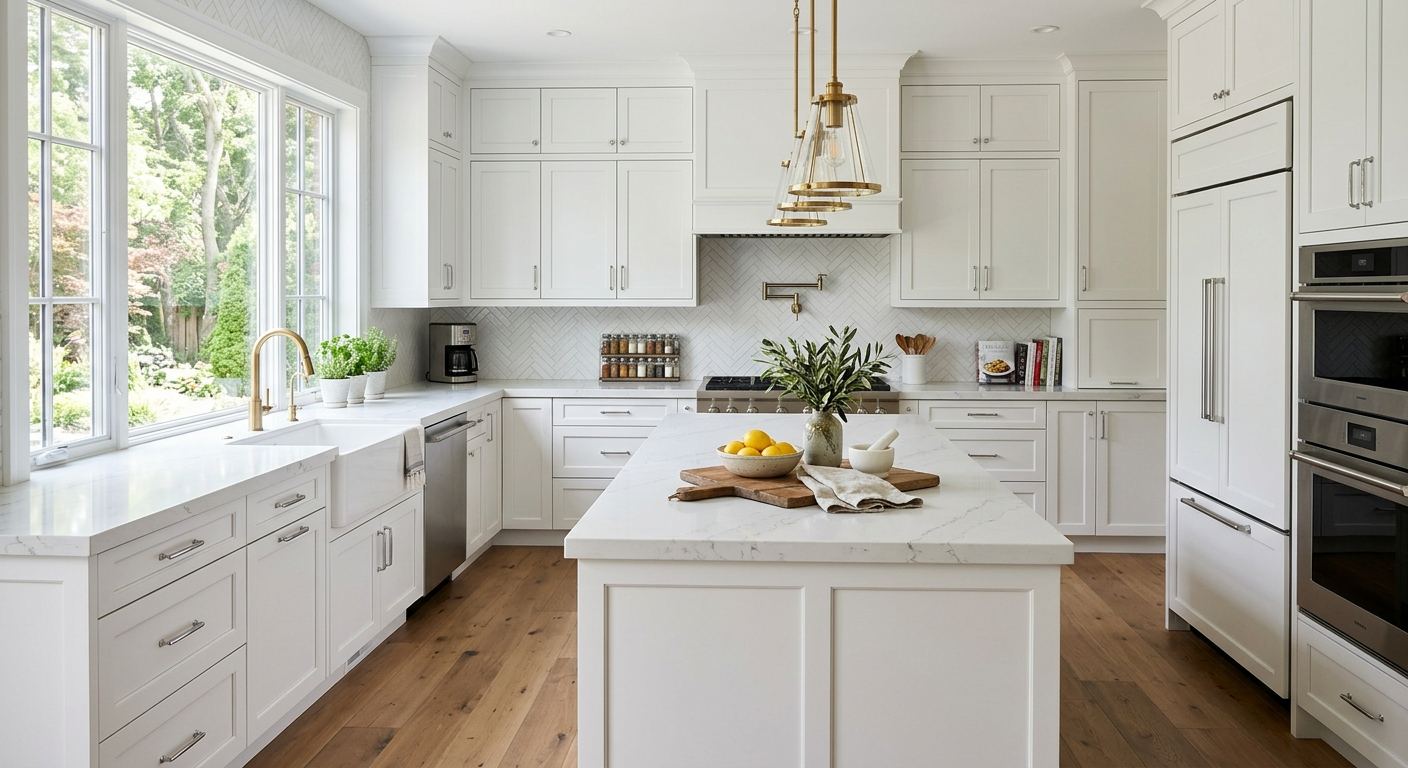
Kitchen renovation options and costs in Camlachie
Camlachie homeowners often start their kitchen plans by comparing what’s possible within a realistic budget, because Camlachie isn’t a “one-size-fits-all” market—preferences and project scope change from house to house. With a population of 7,506 (Statistics Canada, 2021 Census), you’ll typically see demand cluster around practical upgrades in the local area and nearby GTA buyers who look for turnkey finishes. In the broader Toronto economic region, renovation budgets usually track home values and household incomes, and that’s why higher-finish choices (like quartz or natural stone and custom cabinetry) show up more often in higher-value pockets of the region where owners can more easily recover renovation costs on resale.
Ontario pricing for kitchens also moves with market activity: when trades are busy across the Greater Toronto Area, availability tightens and labour scheduling can add cost, even if your materials stay the same. Climate plays a smaller role in the price of kitchens than most people expect—these projects are indoors—but it can affect what you’ll notice once work is complete. In winter, low indoor humidity and temperature swings can widen gaps in older cabinetry and stress certain flooring installations, so properly prepped substrates and moisture-aware installation details matter.
In Camlachie, renovations tend to be especially in demand along the older residential stretches where kitchens were built with simpler layouts and standard cabinet depths—those homes usually benefit from better storage, updated finishes, and a layout adjustment that makes daily use feel effortless. From there, the easiest way to compare contractors is to match your target scope to a price band—see the table below.
| Renovation Tier |
What's Included |
Typical Duration |
Price Range |
| Cosmetic refresh (paint, hardware, new appliances only) |
Cabinet paint/stain touch-up, new hardware, backsplash patch/refresh (if existing), appliance swap (no plumbing/gas changes), minor caulking and trim updates |
1–2 weeks |
$12,000–$22,000 |
| Mid-range full renovation (new cabinets, counters, sink, tile) |
Semi-custom or stock cabinets, new countertops (quartz or good laminate), sink and faucet, tile backsplash, new flooring refresh or replacement (scope-dependent), basic electrical updates (as needed) |
3–5 weeks |
$25,000–$55,000 |
| High-end full renovation (custom cabinets, stone counters, island) |
Custom cabinetry, premium quartz/stone, island with seating, upgraded appliance package, full-height or enhanced backsplash, more extensive lighting/electrical, potential structural/layout work (if applicable) |
5–9 weeks |
$60,000–$90,000 |
| Cabinet refacing only (new doors + drawer fronts, same boxes) |
New doors/drawer fronts, veneer refacing, new hardware, new toe-kick/trim where needed, optional peel-and-stick or updated backsplash transitions (if selected) |
2–3 weeks |
$8,000–$25,000 |
| Countertop swap only (laminate to quartz or stone) |
Remove old tops, install new countertops, new sink cut-out (if sink retained, may require adjustments), basic countertop underlayment and sealing |
1–2 weeks |
$3,500–$15,000 |
| Backsplash tile installation only |
Prep, tile supply/labour, grout/seal, caulking at change-of-plane, electrical outlet finishing (as needed) |
3–7 days |
$2,000–$10,000 |
Prices are estimates only and vary by project scope, site access and material selection.
What affects the price of kitchen renovation in Camlachie
In the Toronto economic region, it’s common to see quotes for the “same” kitchen range by 30–50% once you compare cabinet brands, countertop quality, and what’s actually changing behind the walls. That’s because local home values and household income shape the typical finish tier far more than climate. In higher-value pockets around the Toronto region, homeowners often default to quartz or stone counters and semi-custom cabinetry because the renovation cost is easier to justify on resale—especially when they’re aiming for the “move-in ready” look buyers expect. In more price-sensitive areas, laminate and stock cabinets can deliver a strong visual refresh while keeping total spending closer to the low–mid bands (for example, staying closer to a mid-range full renovation rather than a fully custom build).
Layout changes are the biggest wild card regardless of finish level. Removing a wall, adding an island, or moving plumbing/gas lines can drive labour and permit-related work and create longer schedules, because trades have to coordinate rough-in and inspections before finishes begin. For example, swapping laminate for quartz can land you in the countertop band (often around $3,000–$15,000 depending on size and sink complexity), while relocating a sink that requires new drain and supply lines typically shifts the project out of “swap-only” territory and into a full renovation budget.
Concrete Camlachie cost drivers also include how your existing kitchen was built and what you’ll uncover during demo. Older framing and subfloor conditions can add prep time (shimming, reinforcing, repairing water-affected areas under windows), and winter indoor conditions can highlight gaps if cabinets aren’t installed and levelled on properly cured substrates. If your kitchen has older electrical that can’t support modern under-cabinet lighting or an island receptacle, electrical scope can add cost even if cabinets and counters stay in a mid-range tier.
To plan confidently, treat finish choices as the “controllable dial” and layout/behind-the-wall work as the “risk dial.”
| Price Factor |
Why It Matters |
Cost Impact |
| Cabinet tier — stock vs. semi-custom vs. fully custom millwork |
Controls door/drawer quality, fit tolerance, interior organization, and how many custom sizes need to be fabricated |
$6,000–$35,000 |
| Countertop material — laminate vs. quartz vs. granite vs. stone |
Material cost, edge profiling, and fabrication complexity (especially for islands and sink cut-outs) |
$2,500–$15,000 |
| Layout change — wall removal, island add, plumbing/gas move |
Adds demolition, structural coordination, rough-in work, inspections, and rebuild time |
$8,000–$35,000 |
| Appliance package tier — builder vs. mid-range vs. pro-grade |
Purchase price plus delivery/installation complexity; higher tiers may need more electrical planning |
$2,000–$12,000 |
| Flooring — refinish existing vs. full replacement |
If the new cabinets land on different elevations or you uncover subfloor issues, replacement can expand quickly |
$1,500–$10,000 |
| Backsplash — ceramic tile vs. marble vs. full-height slab |
Material and labour intensity, plus how much prep is needed around outlets and uneven walls |
$2,000–$10,000 |
| Electrical — new circuits for island, under-cabinet lighting |
Electrical permits/inspections and the labour of running wiring before cabinets are installed |
$800–$6,000 |
| Permit fees and licensed trade requirements |
Work that affects plumbing, gas, load-bearing walls, and electrical usually triggers permitting and inspections |
$500–$8,000 |
Permits & regulations in Ontario
In Ontario, many kitchen “swap” projects are straightforward from a permitting standpoint. Cabinet and countertop swaps generally do not require permits because you’re not altering the building’s core services. However, once you start moving plumbing supply/drain lines, relocating gas appliances (including a stove/range or a gas-powered range hood that vents with gas considerations), removing a load-bearing wall, or adding new electrical circuits (for example, an island receptacle or new lighting run), permits and licensed trades are typically required. Gas work must be completed by a licensed gas fitter, and electrical work must be done by a licensed electrician—both require inspections before the finishes are closed in.
For a Camlachie homeowner, the best way to protect yourself is to confirm permit responsibility in writing before you sign. Here’s a practical step-by-step verification approach: (1) Ask the contractor for their Ontario licence numbers and the specific trade(s) involved in your scope; (2) Request a current certificate of insurance and confirm it includes general liability (and professional coverage where relevant); (3) Ask for WSIB/WCB clearance documentation so you’re not stuck with liability if an injury occurs onsite; (4) Verify the licence information on the appropriate online registry or by cross-checking the licence number on their proof documents; and (5) Ensure the permit application responsibility, inspection scheduling, and close-out documentation are listed in the contract.
If someone bids your kitchen renovation without asking whether plumbing, gas, or electrical is changing, that’s usually a sign the scope is incomplete.
Cabinets, countertops and layout decisions in Camlachie
When planning a kitchen renovation in Camlachie, the three most consequential decisions are: (1) cabinet tier, (2) countertop material, and (3) layout changes. Cabinet tier drives fit and function. Stock cabinets install faster and usually cost less, but semi-custom is often the sweet spot for storage upgrades without fully custom pricing. Custom cabinets provide the tightest fit, best storage details, and the most design control—yet they cost more and can extend schedules due to fabrication.
Countertop material affects not only the look but also maintenance and long-term performance. Laminate is budget-friendly and can be a good choice for a cosmetic refresh, but it’s generally less durable around seams and heat exposure. Quartz is popular in Ontario because it’s low maintenance and holds up well to everyday cooking demands; natural stone like granite/stone adds unique veining and heat tolerance but can require more careful sealing depending on the product. Butcher block can be beautiful and warm, though it needs ongoing maintenance to protect against moisture and seasonal indoor dryness.
Layout changes are where value becomes real—or disappears. In the Toronto resale market, open sightlines and efficient work zones tend to sell best, but moving plumbing/gas lines or adding an island is justified only when the space gain improves usability and doesn’t force compromises elsewhere. For example, if your current kitchen is small, upgrading from laminate to quartz might be the more defensible investment, while spending on a sink relocation could outweigh the benefit unless you’re truly gaining counter space and a better workflow.
Across the broader GTA, many homeowners choose mid-range full renovations when they want a modern cabinet/counter look without triggering the highest layout complexity, often landing in the $25,000–$55,000 band—then selectively upgrade finishes where it matters most.
| Option |
Durability |
Maintenance |
Best For |
Price Range |
| Stock cabinets (big-box) |
Good everyday durability; less flexibility for unusual dimensions |
Low—keep clean, re-tighten hardware as needed |
Quick renovations and budget planning |
$8,000–$18,000 |
| Semi-custom cabinets (local dealer) |
Very solid build; better drawer organization and fit options |
Low—routine cleaning, adjust hinges/tolerances early |
Most Camlachie homeowners aiming for value + upgraded storage |
$15,000–$30,000 |
| Custom cabinets (local millwork shop) |
Highest fit quality; tailored to your room’s constraints |
Low to moderate—depends on finish type and usage |
Islands, ceiling-height goals, and hard-to-fit layouts |
$25,000–$45,000 |
| Laminate countertop |
Moderate durability; seams and edge wear over time |
Low—avoid sustained heat and sharp impacts; wipe up spills promptly |
Cosmetic refreshes and best bang-for-buck swaps |
$3,000–$8,000 |
| Quartz engineered countertop |
High durability; resists staining and everyday wear |
Low—standard cleaning; no routine sealing like some stones |
Busy households and buyers expecting a modern, clean look |
$6,000–$13,000 |
| Granite / natural stone countertop |
High heat and scratch resistance; varies by stone type |
Moderate—often requires periodic sealing and careful spill management |
Premium visual impact with natural variation |
$8,000–$15,000 |
| Butcher block countertop |
Durable with proper care; sensitive to prolonged moisture |
Moderate—oil maintenance and sealing schedule |
Casual, warm designs and active cooking styles |
$4,000–$10,000 |
| Marble countertop |
Elegant but softer; can etch or stain without protection |
Higher—needs disciplined cleaning, sealing, and quick spill response |
Showpiece kitchens where maintenance is acceptable |
$10,000–$18,000 |
How to choose a kitchen renovation contractor in Camlachie
Choosing the right kitchen contractor in Camlachie comes down to proof, not promises. First, verify Ontario licensing for any regulated work. Ask for the licence details for electrical and gas (if your scope includes either), then confirm their status using the province’s online registry resources or by cross-checking their licence number on the documentation they provide. Next, request a certificate of insurance that clearly shows general liability limits and coverage that matches your job. Also ask for WSIB/WCB clearance so you know the trades are compliant and you’re protected if there’s an onsite injury. Don’t rely on verbal assurances—use copies in your records.
For pricing, request 2–3 itemised written quotes. You want a breakdown that separates labour and materials and lists line items for demo, carpentry, cabinet supply/installation, countertop fabrication/installation, electrical/plumbing/gas allowances, tile work, disposal, and any permit-related items. A responsible contractor will include what’s excluded (for example, drywall patch beyond a certain square footage, subfloor repairs, or additional electrical circuits beyond the baseline). Confirm whether disposal and dump fees are included and whether permit pulling is included if required.
Warranty matters. Ask for the workmanship warranty length and what it covers, plus manufacturer product warranties for cabinets, countertops, and appliances. Find out whether warranties are transferable if you sell the home. Finally, payment schedules should be controlled—never more than 10–15% upfront, and hold back a portion until the job is complete, cleaned, and punch-list items are addressed. Get a start date and a completion estimate in writing.
- Ask for licence numbers (and the specific trade scope where each licence applies).
- Request current certificate of insurance and verify expiry dates.
- Obtain WSIB/WCB clearance documentation before work begins.
- Get 2–3 quotes with line-by-line labour and material totals.
- Confirm permit responsibility in the signed contract (who pulls, who pays, who schedules inspections).
- Ensure disposal/dump fees are explicitly included or excluded.
- Verify measurements: do they base pricing on site measurements, or only drawings?
- Ask how they handle hidden damage (subfloor, water stains, outdated wiring).
- Request a detailed countertop template/fabrication process and change-order handling.
- Confirm cabinet installation includes level/flat adjustments and shimming approach.
- Ask for timeline sequencing (demo → rough-in → inspections → cabinets/counters → finishes).
- Review warranty terms in writing (workmanship vs manufacturer, and transferability).
Red flags I see in Camlachie include: (1) only providing a lump-sum number with no scope detail, (2) skipping insurance/WSIB documentation until after you pay, (3) promising “no permits ever” even when plumbing/gas/electrical changes are proposed, (4) delaying the start date without a written schedule or reasoned lead times, and (5) offering overly large upfront deposits or refusing a holdback for punch-list completion.
Frequently asked questions — kitchen renovation in Camlachie
Should I reface or replace my cabinets?
In Camlachie, refacing is often the better choice when your cabinet boxes are solid, doors and drawer fronts are the only things aging out, and your layout isn’t changing. If your boxes are warped, water-damaged, or the hardware area is sagging, replacement usually performs better long-term—especially with Toronto-area buyers who notice functionality (soft-close drawers, straight alignment) in showings. As a pricing reality check, cabinet refacing commonly falls in the $8,000–$25,000 range, while a mid-range full renovation tends to start much higher (often $25,000–$55,000) because you’re also renewing counters, sink, tile, and more. A good contractor will assess box condition, measure door/hinge compatibility, and show you both options with clear scope and expected service life.
Do I need a permit for a kitchen renovation in Ontario?
In Ontario, simple cabinet and countertop swaps generally don’t require permits. But permits are typically required when you move plumbing supply/drain lines, relocate gas appliances or gas-related venting considerations for a stove/range hood, remove a load-bearing wall, or add new electrical circuits (like an island receptacle or added under-cabinet lighting run). In Camlachie projects, I usually recommend you confirm permit responsibility in the contract because it affects cost and timeline—permits drive scheduling for licensed trades and inspections. If you’re considering changes beyond “swap-only,” ask your contractor to list exactly what work triggers permits, which trades are licensed, and when inspections will happen. That clarity helps you avoid surprise delays and rework costs.
What's the ROI on a kitchen renovation?
ROI varies by the market and how far you push the finish tier, but in the Toronto economic region most owners find that kitchens don’t have a one-to-one “cost back” guarantee. Owners in higher-value pockets often invest a larger share of property value into the kitchen (commonly 8%–15%), leaning into custom cabinetry and upgraded surfaces like quartz or stone because it aligns with buyer expectations. In more price-sensitive outer areas of the region, ROI tends to be stronger when you stay mid-range—think semi-custom cabinets and quartz within a $25,000–$55,000 style budget—then upgrade only where it impacts daily function and appearance. Your best ROI usually comes from improving workflow, storage, and consistent finishes, rather than from structural or layout changes that don’t create real usability gains.
How do I budget for a kitchen renovation?
A practical way to budget in Ontario is to pick your scope first, then assign costs to the main bands. Start by deciding whether you’re doing a cosmetic refresh, a mid-range full renovation, or a high-end full renovation. For example, a full renovation commonly falls between $25,000–$90,000 depending on cabinetry tier, countertop choice, and whether layout/plumbing/gas work is changing. Break your budget into: cabinetry (stock/refacing vs semi-custom/custom), countertops, backsplash/tile, and allowances for electrical/plumbing/gas permits and licensed trade work. Don’t forget disposal, prep repairs, and any subfloor/drywall fixes you can’t see yet. If you want a controlled plan, keep the “big-ticket” scope—like island additions or sink/stove moves—only if you’re confident it will improve how you use the space every day.
Can I move my kitchen sink or stove?
Yes, but moving a kitchen sink or stove is one of those “worth it or not” upgrades because it can trigger major behind-the-wall costs and Ontario permitting. Moving a sink usually means new plumbing supply and drain work; moving a stove may involve gas considerations and additional venting planning for the new location. That’s why quotes can swing widely even when the visible finishes are the same. If you keep your cabinet footprint and just adjust within existing plumbing/electrical runs, costs stay closer to a mid-range refresh. If you’re extending lines across longer distances, budget for the layout change risk: rough-in work, possible inspections, and patching that follows the trades. A contractor should sketch the route, confirm licensed trade involvement, and include those permit/inspection steps in the written timeline.
What's the most cost-effective kitchen upgrade?
The most cost-effective upgrade in Camlachie is usually either (1) cabinet refacing when the boxes are still in good shape, or (2) a countertop swap that upgrades the “face” of the kitchen quickly. Refacing targets the most visible surfaces while keeping demolition and installation disruption lower; it commonly lands in the $8,000–$25,000 range. A countertop-only swap—especially moving from laminate to quartz—can be a fast way to modernize the kitchen without the complexity of moving plumbing or electrical; it often falls around $3,000–$15,000 depending on size and sink/edge details. If you want the biggest visual change for the least disruption, pair a countertop upgrade with a well-designed backsplash (tile installation can run $2,000–$10,000). The key is selecting upgrades that match your existing cabinet box condition and kitchen layout.