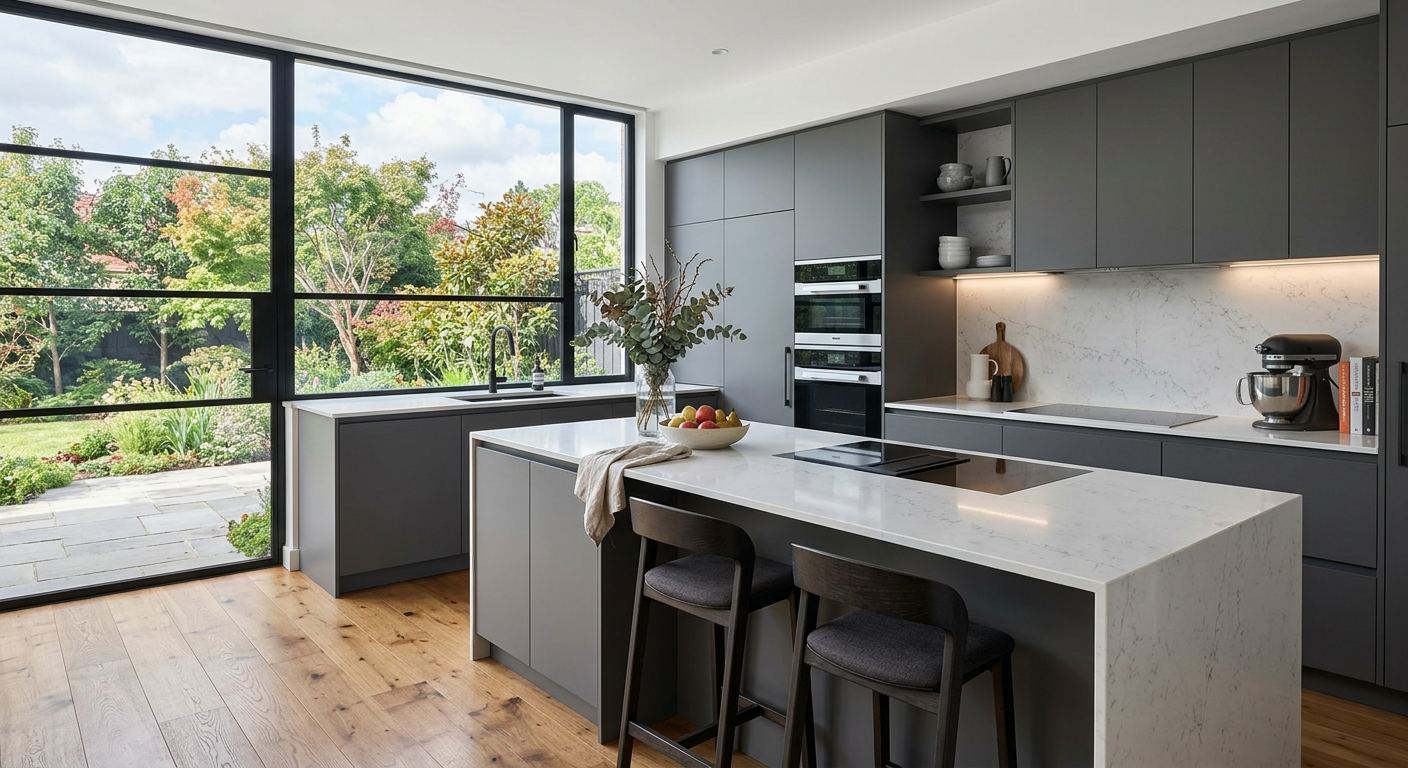
Kitchen renovation options and costs in Quinte West
In Quinte West, homeowners typically start by choosing how big the kitchen change should be—cosmetic only, a mid-range refresh, or a high-end full renovation with new millwork and stone. With a median household income of $81,000 (Statistics Canada, 2021 Census), many families plan for a practical “upgrade with resale in mind,” especially in neighbourhoods with a mix of older houses and growing buyer demand. Quinte West also has a lot of housing built before 1981 (Statistics Canada, 2021 Census), which often means upgrades are as much about modernising layouts, wiring, venting, and finishes as they are about style.
In the Kingston–Pembroke economic region, kitchen budgets track more closely with household income and local home value expectations than with weather. That said, Ontario’s freeze–thaw cycles and seasonal humidity can expose installation details—subfloor movement, cabinet scribing, and grout cracking—so contractors usually account for proper ventilation, caulking, and moisture-tolerant finishes. Labour availability can also shift in peak renovation months, particularly for trades that handle tile, electrical, and gas servicing. In Quinte West, trade demand is especially noticeable around the Bay of Quinte corridor and established pockets near downtown Belleville-area spillover (including older residential streets), where buyers are more likely to pay for “turnkey” kitchens.
Below is a realistic comparison of renovation paths and what they usually include, so you can line up your scope before you request quotes.
| Renovation Tier |
What's Included |
Typical Duration |
Price Range |
| Cosmetic refresh (paint, hardware, new appliances only) |
Cabinet paint or repaint (or hardware change), new hardware/pulls, appliance swap (no layout change), touch-up repairs |
3–7 days |
$8,000–$18,000 |
| Mid-range full renovation (new cabinets, counters, sink, tile) |
Semi-custom or mid-range stock cabinets, countertop and backsplash tile, sink + faucet, new base/wall finishes, updated lighting where required |
4–8 weeks |
$25,000–$55,000 |
| High-end full renovation (custom cabinets, stone counters, island) |
Fully custom cabinetry, premium quartz or natural stone, island build with electrical, upgraded tile details, higher-end plumbing fixtures |
7–12 weeks |
$55,000–$65,000 |
| Cabinet refacing only (new doors + drawer fronts, same boxes) |
Door/drawer replacement, new hardware, refinishing/surface prep, matching trim, optional cabinet interior upgrades |
2–4 weeks |
$10,000–$25,000 |
| Countertop swap only (laminate to quartz or stone) |
Template + install new countertop, cut-outs, edge upgrade options, dispose old surfaces (where agreed) |
3–10 days |
$6,000–$12,000 |
| Backsplash tile installation only |
Tile supply/installation (scope-dependent), backer prep, grouting/sealing, caulking transitions to countertop |
3–7 days |
$1,500–$8,000 |
Prices are estimates only and vary by project scope, site access and material selection.
What affects the price of kitchen renovation in Quinte West
It’s common to see the “same” kitchen renovation come in 30–50% apart across the Kingston–Pembroke region and Ontario overall. The difference usually isn’t climate—it’s finish tier, how much of the existing work can be reused, and how many trades have to intervene to fix older-house realities. In Quinte West, home values and the typical income level of buyers strongly shape whether homeowners pick laminate and stock cabinets for value, or quartz/stone and semi-custom cabinetry to match what buyers expect on resale. In higher-value pockets, a fully assembled kitchen can feel more “recoverable” on resale, so budgets more often land toward the upper mid-range of $25,000–$55,000 and sometimes beyond.
For more modest budgets, laminate countertops and stock cabinetry keep the project inside a tighter range, often closer to the lower end of the mid-market band, because cabinetry typically represents 30–40% of the budget and countertops/backsplash add another 15–25% combined. Layout changes add the most unpredictable costs regardless of finish tier. Removing a load-bearing wall, adding an island, or moving plumbing/gas lines forces carpentry plus licensed plumbing/gas work, and it can require drywall refacing, electrical rework, and flooring patching.
Two concrete Quinte West examples I see often: (1) pre-1981 homes can have out-of-square runs, so cabinet adjustments take more labour and can affect how tile lines up; (2) older electrical panels or undersized circuits may require new work for under-cabinet lighting or island receptacles—pushing electrical scope upward. The result is that even “simple” jobs can drift upward if you uncover hidden deficiencies once walls open up.
| Price Factor |
Why It Matters |
Cost Impact |
| Cabinet tier — stock vs. semi-custom vs. fully custom millwork |
Cabinet quality, door styles, internal hardware, and fit/finish directly affect material and installation time |
High impact: cabinetry can be a ~30–40% share of the total budget |
| Countertop material — laminate vs. quartz vs. granite vs. stone |
Material cost and fabrication complexity drive price; edge profiles and cut-outs add more |
Moderate to high impact: material differences can be thousands |
| Layout change — wall removal, island add, plumbing/gas move |
Triggers multiple trades, longer schedules, and additional drywall/floor/electrical work |
Highest unpredictability: often the #1 driver of scope creep |
| Appliance package tier — builder vs. mid-range vs. pro-grade |
Pro-grade units and specialty ventilation require more coordination and can change cut-outs |
Moderate impact: can noticeably shift total budget |
| Flooring — refinish existing vs. full replacement |
Matching existing floors is harder in older homes; removal can uncover subfloor issues |
Moderate impact: replacement adds material + labour |
| Backsplash — ceramic tile vs. marble vs. full-height slab |
Slab and high-spec tile require stricter prep and more labour for alignment |
Moderate impact: tile scope commonly falls in the smaller bands |
| Electrical — new circuits for island, under-cabinet lighting |
New receptacles, lighting, and ventilation control often require additional rough-in and finishing |
Moderate to high impact depending on existing wiring |
| Permit fees and licensed trade requirements |
Work that touches gas plumbing, electrical circuits, or structural changes needs permits and inspections |
Low to moderate cost directly, but high impact on schedule and compliance |
Permits & regulations in Ontario
In Ontario, a straightforward cabinet-and-countertop swap usually does not require a permit—so long as you’re not moving plumbing, gas lines, or electrical wiring and you’re not altering the structure. If you’re simply replacing countertops (for example, laminate to quartz) and keeping the sink in the same location, most renovations proceed without permitting.
Permits are typically required when you change systems or structure: moving or adding plumbing supply/drain lines, relocating a gas stove (or modifying the gas line), removing a load-bearing wall, or adding new electrical circuits (such as for an island with receptacles or under-cabinet lighting that requires new wiring). Gas work must be performed by a licensed gas fitter, and electrical work by a licensed electrician; both require inspections through the applicable permitting process.
To verify a contractor in Quinte West, start with three checks: (1) licensing—ask for their proof of registration and confirm through the appropriate online registry for the trade they perform; (2) liability insurance—request a current Certificate of Insurance showing coverage amount and effective dates; and (3) WSIB/WCB coverage—ask for clearance documentation or proof of coverage, depending on what applies to their business structure. Then confirm, in writing, who pulls permits and who pays for inspections—this responsibility should be clearly stated in your contract before work begins.
Cabinets, countertops and layout decisions in Quinte West
When planning a Quinte West kitchen renovation, I tell homeowners to focus on three decisions first: cabinet tier, countertop material, and whether the layout change is worth the disruption. Cabinet tier controls both schedule and fit. Stock cabinets are the fastest and cheapest because sizing is standard and installation is straightforward. Semi-custom (the most common mid-range choice) balances cost with better flexibility for widths, finishes, and storage. Custom cabinets cost the most, but they shine when you have odd wall lengths common in older homes built before 1981 or you want built-ins that maximise every inch.
Countertop material is where durability meets day-to-day maintenance. Laminate is budget-friendly and forgiving if you’re replacing just the surface layer, but it can chip at edges over time and is less resistant to heat. Quartz is typically the best “busy household” compromise: it resists staining and most routine wear. Granite/natural stone adds a premium look and resilience, but it may require sealing depending on the stone and finish. Butcher block works well in kitchens where you’re willing to maintain it—conditioning the surface is part of the deal.
Layout changes are justified when they improve function rather than just aesthetics. In Quinte West, if your goal is to create better circulation for resale—especially in markets where buyers expect a modern work triangle—moving toward an open-concept flow or adding an island can add value. But if the plumbing/gas relocation and electrical rewiring push you toward the upper $55,000–$65,000 band, ensure you’re gaining real usable space (counter seating, better appliance placement, or storage) rather than only widening the room visually.
| Option |
Durability |
Maintenance |
Best For |
Price Range |
| Stock cabinets (big-box) |
Good for general wear; durability depends on door/core quality |
Low—simple cleaning; upgrades are limited |
Fast timelines and cost control; straightforward layouts |
$10,000–$25,000 |
| Semi-custom cabinets (local dealer) |
Very good—often better options for internal storage and doors |
Low to moderate; standard care, better hardware longevity |
Most Quinte West mid-range renovations and resale-focused upgrades |
$20,000–$40,000 |
| Custom cabinets (local millwork shop) |
Excellent—best fit, strongest options for specialty storage and finishing |
Low with proper build quality; craftsmanship can reduce long-term problems |
Challenging dimensions and high-end finish expectations |
$35,000–$55,000 |
| Laminate countertop |
Moderate; can chip at edges and wear faster at hot/impact points |
Low—routine cleaning; avoid heat directly on the surface |
Budget projects where you want a clean look without major spend |
$2,500–$5,500 |
| Quartz engineered countertop |
High—excellent stain and scratch resistance for everyday use |
Low—wipe clean; minimal sealing needs |
Busy households and resale-friendly “set it and forget it” performance |
$4,500–$9,500 |
| Granite / natural stone countertop |
High—strong and heat-tolerant depending on the stone |
Moderate—may need periodic sealing; careful with acidic cleaners |
Premium look and texture variety |
$7,000–$12,000 |
| Butcher block countertop |
Moderate to high if maintained; can dent but can be sanded/refinished |
Moderate—conditioning/oiling required and heat protection recommended |
Families who enjoy a warm, practical food-prep surface |
$4,000–$8,000 |
| Marble countertop |
Moderate—beautiful but can etch/stain more than quartz or granite |
Higher—requires sealing and careful cleaning routines |
Statement kitchens where appearance is the top priority |
$8,000–$14,000 |
How to choose a kitchen renovation contractor in Quinte West
Choosing the right contractor matters as much as picking cabinets. Start by verifying Ontario licensing for the trades involved—especially if you’re adding electrical circuits, changing ventilation, or touching gas lines. Ask for proof of liability insurance (with the coverage amount and expiry date clearly shown) and confirm WSIB/WCB coverage. In Quinte West, I recommend you request the documentation up front before a contract is signed, not after demolition. If a contractor can’t provide clear proof, keep looking.
Next, get 2–3 itemised written quotes, not lump sums. You want a breakdown that separates labour and materials: cabinet supply, hardware, countertop fabrication, tile installation, electrical scope, plumbing/gas scope, disposal, and any permit-related work. Carefully read what’s excluded—common exclusions include demo disposal, floor protection, patching drywall, allowance items for lighting fixtures, and “unknown conditions” discovered after walls open. Make sure permit pull responsibility is stated (who pulls it, who pays, and whether inspections are included).
For warranty, ask for both workmanship and product/manufacturer warranty details. Workmanship warranties vary; longer coverage is better, but the key is whether it’s in writing and what it covers. For payment schedule, never accept more than 10–15% upfront; keep a holdback until completion (and ideally after final walkthrough). Finally, insist on a written start date and completion estimate, so the schedule is accountable if you’re coordinating with work or school.
- Request proof of Ontario licensing for any trade involved (gas/electrical/plumbing as applicable).
- Confirm liability insurance with a current Certificate of Insurance.
- Verify WSIB/WCB coverage with clearance documentation where applicable.
- Get 2–3 itemised quotes separating labour vs materials and allowances.
- Ask who pulls permits and whether permit fees/inspection scheduling are included.
- Confirm disposal and debris handling (dump fees included or extra?).
- Ensure demolition protection is included (floor/tile/door protection, if applicable).
- Require a detailed scope for electrical and lighting locations, including island receptacles.
- Clarify countertop templating responsibilities and timing (template date included?).
- Confirm warranty terms in writing: length, process, and what qualifies as workmanship defects.
- Set a payment schedule with 10–15% upfront max and a holdback until final sign-off.
- Get start and completion timelines in the agreement, including milestones (demo, cabinets, install).
Red flags I see in Quinte West: vague “no surprises” pricing with no line items, promises of a start date without trade availability planning, refusal to list exclusions (especially disposal and patching), lack of written warranty details, and pushing for large upfront deposits (well beyond 10–15%).
Frequently asked questions — kitchen renovation in Quinte West
How do I know if I need to update my kitchen plumbing in Quinte West?
In Quinte West, the biggest clue is not just age—it’s performance. If you’ve got slow drains, recurring under-sink leaks, low hot-water pressure, corrosion around shutoffs, or moisture damage to the cabinet base, plan for plumbing review during demolition. Homes built before 1981 can have older supply routing or fittings that don’t pair well with modern fixtures, and that’s when plumbing updates become necessary. If you’re keeping the sink in the same spot, you may only need targeted repairs. If you’re moving the sink, adding a dishwasher, or changing the layout around an island, you should expect more extensive drain/supply work. Ask your contractor whether plumbing updates are included in your quote scope, and whether they’ll confirm what can be reused versus replaced.
What is the difference between a galley and open-concept kitchen?
A galley kitchen is a narrow, two-wall layout (often with a walkway down the centre). It’s efficient for cooking but can feel tight, especially in older homes where circulation is limited. An open-concept kitchen connects the kitchen to living/dining space with fewer barriers, which typically improves sightlines and makes the home feel larger—useful for resale buyers in Quinte West who want modern flow. In terms of cost, open-concept projects can rise because you may need structural assessment and additional drywall/electrical/ventilation coordination, and sometimes permits depending on what’s removed or changed. A straightforward galley refresh (new cabinets/counters) can often stay within the mid-range $25,000–$55,000 band, while open-concept changes can push budgets toward the upper end if systems and finishes are updated together.
How do I get accurate kitchen renovation quotes in Quinte West?
For accurate quotes in Ontario (and specifically in Quinte West), you need consistent scope details. Provide measurements, photos, and—most importantly—your planned outcomes: cabinet tier, countertop material, backsplash style, appliance level, and whether plumbing/gas/electrical locations are changing. Get 2–3 itemised estimates so you can compare allowances and labour lines, not just the total. Ask if the quote includes demolition/disposal, patching and paint touch-ups, and whether countertop templating and appliance installation are included. For older homes built before 1981, request an “unknown conditions” approach (how the contractor handles surprises found behind walls). Finally, confirm timeline expectations and permit responsibility in writing so you’re not paying for schedule delays you weren’t warned about.
What's the best countertop material for a busy Quinte West kitchen?
For most busy households in Quinte West, quartz is the best balance of durability and low maintenance. It resists staining and day-to-day wear well, and it typically doesn’t require the same periodic sealing that natural stone can. Quartz also handles the kinds of daily stress kitchens see—coffee spills, food prep, and frequent wipe-downs—without looking worn. If you’re budget-sensitive, laminate can still deliver a clean, modern look, but it’s more prone to edge chipping and heat sensitivity, so it needs more care. Natural stone like granite can be excellent for heat resistance and style variety, but upkeep can be higher depending on the stone. In real-world projects, countertop-only upgrades in the $6,000–$12,000 range are common, with quartz often landing in the mid portion of that band.
How do I add an island to my Quinte West kitchen?
Adding an island is less about the island “box” and more about what happens underneath and behind the walls. You may need electrical work for island receptacles and under-cabinet lighting, and if you include a sink or cooktop, you’ll also be dealing with plumbing and potentially gas ventilation. Because these are system changes, the scope may require permits and licensed trades (electrical and gas/plumbing where applicable). Start by confirming your island goals: seating versus full prep with a sink, plus whether you want a cooktop. Then ensure you have clearance for traffic—especially in older homes where door swings and hallway widths can’t be expanded easily. In many Quinte West renovations, island additions are one of the most reliable ways to move a project toward the upper part of the $25,000–$65,000 kitchen renovation band.
How much does a kitchen renovation cost in Quinte West?
Kitchen renovation cost in Quinte West typically depends on finish tier and whether you change layout systems. Across the Kingston–Pembroke economic region, full renovations commonly fall in the mid-range band of roughly $25,000–$55,000, with higher-end projects—especially those including custom cabinetry, premium stone, and an island—often reaching around $55,000–$65,000. Cosmetic refreshes (paint, hardware, new appliances without layout or plumbing/electrical changes) are usually much lower than full remodels. Cabinet refacing-only projects often sit around $6,000–$25,000 depending on whether you’re upgrading interior storage and hardware. If your home is built before 1981, it’s smart to budget for potential electrical/plumbing updates once demolition begins, because that’s where older wiring and fittings can drive cost.