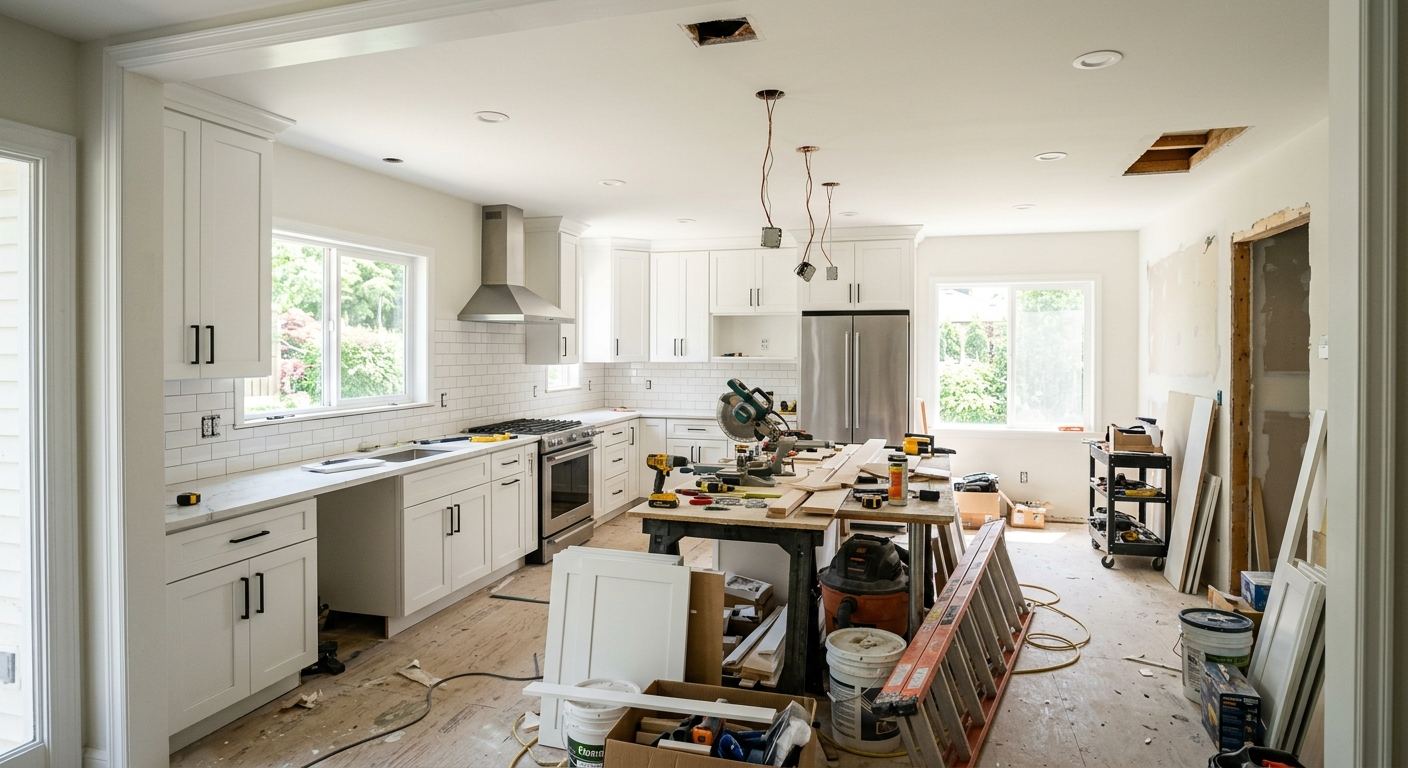
Kitchen renovation options and costs in Eastwood
Kitchen renovations in Eastwood are often shaped more by buyer expectations and resale economics than by weather. Eastwood’s small local population of 1,768 (Statistics Canada, 2021 Census) means many homeowners rely on the broader Toronto market when choosing finishes—especially when planning to recoup costs at resale. In the Toronto economic region, kitchens in higher-value pockets tend to attract more investment in upgrades like custom cabinetry and quartz, since owners can more easily recover that spend. In practical terms, GTA projects frequently land in the mid-$20k to $80k+ range depending on the finish tier and how much of the kitchen is rebuilt (not the calendar season).
Toronto-area construction timelines and contractor availability can also influence your budget. When lead times for custom millwork tighten, pricing can bump up; likewise, if your kitchen renovation overlaps peak demand months, scheduling labour becomes more expensive. The good news: kitchen materials (cabinets, counters, tile) are usually price-stable across the GTA, so your biggest cost swing comes from whether you’re swapping surfaces only or changing the layout and services. In Eastwood, the trade is especially active around the local family-focused neighbourhood pockets where upgraded kitchens drive buyer interest and help homes compete quickly.
If you want a clear starting point, use the table below to match your scope to a realistic budget—then we’ll break down what moves those numbers up or down.
| Renovation Tier |
What's Included |
Typical Duration |
Price Range |
| Cosmetic refresh (paint, hardware, new appliances only) |
Cabinet painting or repainting (or existing paint touch-ups), new hardware/pulls, paint/trim refresh, appliance swap (like-for-like sizing), optional minor caulking and touch-up tile/backsplash cleaning |
3–7 days |
$25,000–$35,000 |
| Mid-range full renovation (new cabinets, counters, sink, tile) |
New semi-custom or stock cabinets, countertop replacement (quartz or good laminate), sink + faucet swap, backsplash tile, paint/trim refresh, basic plumbing hook-up (no major line moves), new flooring allowance where needed |
2–4 weeks |
$45,000–$65,000 |
| High-end full renovation (custom cabinets, stone counters, island) |
Fully custom cabinetry, premium quartz or natural stone, island with seating, upgraded appliance package, under-cabinet lighting, likely electrical upgrades, upgraded backsplash (e.g., full-height feature), potential structural considerations for island/clearances |
4–8 weeks |
$70,000–$90,000 |
| Cabinet refacing only (new doors + drawer fronts, same boxes) |
Refaced cabinet faces (doors/drawer fronts), new hardware, interior re-laminating where applicable, labour for removal/reinstall, touch-ups to adjacent walls, no countertop replacement unless bundled |
1–2 weeks |
$8,000–$25,000 |
| Countertop swap only (laminate to quartz or stone) |
Remove existing laminate/old tops, measure templating, install new quartz/stone, new sink cut-out adjustments as needed, sealant and finishing (backsplash not included unless specified) |
2–5 days |
$6,000–$15,000 |
| Backsplash tile installation only |
Surface prep, install tile and grout, caulking to match existing finishes, optional trim/edge profiles, excludes full-wall demolition |
3–7 days |
$2,000–$8,000 |
Prices are estimates only and vary by project scope, site access and material selection.
What affects the price of kitchen renovation in Eastwood
If you’re comparing quotes in Eastwood, it’s common to see the same “new kitchen” project land 30–50% apart—especially when one contractor assumes you’ll keep the existing plumbing path and another includes a new layout with moved services. In Toronto, that spread is mostly tied to local home values and how homeowners plan for resale. In higher-value pockets, many buyers expect quartz or natural stone counters and semi-custom cabinetry, so renovations lean toward a higher finish tier. In more price-sensitive pockets, homeowners often choose laminate or stock cabinets and limit the scope so the project stays closer to the mid-$20k band for modest refreshes or the $25,000–$90,000 band for fuller renovations depending on how much changes.
Climate plays a smaller role than people think in kitchen cost—Toronto’s freeze-thaw weather can affect exterior materials and window/roof work more than interior finishes. Where it does matter: humidity swings and seasonal temperature changes can reveal installation issues sooner, which is why proper venting, under-sink protection, and secure silicone/caulking still affect long-term costs (warranty claims and callbacks). The bigger cost drivers remain scope and coordination.
Concrete examples from Eastwood: (1) If your kitchen is older and the existing electrical panel or wire routing doesn’t support an island with new outlets and under-cabinet lighting, the electrical package can add meaningful labour. (2) If you want to keep your current sink location, countertop swaps may stay in the lower countertop-install range; but if you move the sink and drain line, expect the layout-change portion to dominate your budget. (3) Full-height tile backsplashes and premium stone can quickly push a project from a mid-range finish into the high-end territory, even if the footprint stays the same.
| Price Factor |
Why It Matters |
Cost Impact |
| Cabinet tier — stock vs. semi-custom vs. fully custom millwork |
Custom work increases fabrication time, adjustability, and material detailing; stock is faster to order and install. |
Shifts the cabinet portion by thousands; often the main driver of overall project tier. |
| Countertop material — laminate vs. quartz vs. granite vs. stone |
Material price, thickness, edge profiles, and templating complexity vary; natural stone can also require additional fabrication. |
Can move the project from mid-range to high-end quickly, especially with premium edges. |
| Layout change — wall removal, island add, plumbing/gas move |
New layout means new trades coordination, potential structural checks, and service line changes. |
Often the least predictable line item and can be the biggest cost swing regardless of finishes. |
| Appliance package tier — builder vs. mid-range vs. pro-grade |
Higher tiers add cost and sometimes require electrical/gas readiness and venting changes. |
Increases budget variance even when cabinetry stays the same. |
| Flooring — refinish existing vs. full replacement |
Subfloor conditions and damage from demo can force replacement; matching existing flooring can be difficult. |
Can add mid-range costs if replacement is required across more square footage. |
| Backsplash — ceramic tile vs. marble vs. full-height slab |
Slab installs and premium tile increase labour precision and material waste. |
Full-height and premium materials tend to push backsplash into the upper band. |
| Electrical — new circuits for island, under-cabinet lighting |
Electrical scope changes create permitting/inspection needs and licensed trade involvement. |
Commonly adds several thousand dollars when power routing changes are required. |
| Permit fees and licensed trade requirements |
Any work that triggers permits increases administrative time and required inspections. |
Direct add-on costs plus schedule impact; typically modest compared to full layout changes. |
Permits & regulations in Ontario
In Ontario, a straightforward cabinet and countertop replacement typically does not require a permit—because you’re refreshing finishes without changing the plumbing, gas, structural elements, or electrical system. That means cabinet swaps, counter swaps, and installing a backsplash are usually permit-light. However, once you start changing the kitchen’s services or structure, permits often come into play.
Work that commonly requires permits includes: moving or altering plumbing supply/drain lines (sink relocation, changing dishwasher drain routing), relocating gas appliances or making changes related to a gas stove and gas venting, removing a load-bearing wall or doing structural modifications, and adding electrical circuits for an island, new dedicated microwave circuits, or under-cabinet lighting that requires wiring changes. Gas work must be performed by a licensed gas fitter, and electrical work must be done by a licensed electrician—both require inspections as part of the permitted process.
For an Eastwood homeowner, verify three things step-by-step before signing: (1) contractor licence status using the appropriate Ontario online resources for the applicable trade (where applicable), (2) liability insurance (ask for a current certificate of insurance), and (3) WSIB/WCB coverage evidence—either clearance letters or current coverage documentation depending on the contractor’s situation. Always confirm who pulls permits in writing, and ensure it’s included in the contract scope so there’s no “surprise” during inspections or at the final closeout.
Cabinets, countertops and layout decisions in Eastwood
In Eastwood kitchens, the three most consequential decisions are (1) cabinet tier, (2) countertop material, and (3) layout changes. Cabinet choice sets your timeline and visual “fit.” Stock cabinets are the fastest and cheapest, while semi-custom is the most popular balance in the Toronto resale market—buyers see the difference in door styles, storage options, and corner solutions without jumping to fully custom. Custom cabinets cost the most because millwork is tailored to your space, walls, and exact hardware/door choices.
Countertops drive both day-to-day use and long-term appeal. Laminate is budget-friendly and can be installed quickly, but it won’t match quartz in heat and stain resistance. Quartz is the most common “safe upgrade” for homeowners targeting a broad resale audience because it offers consistent performance with minimal maintenance. Natural stone (granite/marble) looks premium, but marble can require more care with etching and sealing depending on the finish. In Toronto homes where winter storage and cooking habits can be busy, durability and easy cleanup matter more than novelty.
Layout decisions are where ROI becomes space-dependent. If you have a closed galley or tight corridor, opening up for sightlines or adding an island can justify cost because it changes how the home functions. But moving plumbing or gas lines is often the least predictable cost. A realistic example: upgrading from a laminate top to a quartz top can be a few thousand dollars, and that jump is usually worth it when the rest of the cabinets and backsplash are updated. By contrast, paying to move a sink two locations away can exceed countertop savings and should only be done if the new layout meaningfully improves circulation or creates the island you want.
| Option |
Durability |
Maintenance |
Best For |
Price Range |
| Stock cabinets (big-box) |
Good durability with standard materials; may be less flexible for uneven walls. |
Low—keep hardware tight and wipe clean; finish chips can be more noticeable. |
Quick refreshes and cost-controlled renovations in Eastwood |
$8,000–$20,000 |
| Semi-custom cabinets (local dealer) |
High durability; better fit and storage options (pull-outs, better corner access). |
Low—routine cleaning and occasional hardware tightening. |
Most common Toronto resale-targeted projects |
$20,000–$35,000 |
| Custom cabinets (local millwork shop) |
Excellent durability; built for your exact kitchen dimensions and hardware choices. |
Low—stays stable if installed correctly and venting is respected. |
High-end kitchens, unique layouts, and premium storage |
$35,000–$60,000 |
| Laminate countertop |
Moderate durability; seams and edges are most vulnerable to damage. |
Easy daily cleaning; avoid prolonged heat exposure and heavy impacts at seams. |
Budget refreshes where the goal is modern appearance |
$3,000–$8,000 |
| Quartz engineered countertop |
Very durable for everyday cooking; resistant to stains and everyday scratches. |
Low maintenance; regular cleaner is usually enough and sealing isn’t typically required. |
Busy Eastwood households wanting a “fit-and-forget” upgrade |
$7,000–$15,000 |
| Granite / natural stone countertop |
Highly durable with unique patterning; performance depends on the stone and finish. |
Moderate—often benefits from periodic sealing and careful stain management. |
Premium look with strong resale appeal |
$10,000–$18,000 |
| Butcher block countertop |
Durable but can show wear with heavy use; sensitive to standing water. |
Requires oiling/conditioning; use cutting boards and wipe spills promptly. |
Warm, “traditional” kitchens and homeowners who like maintenance |
$6,000–$14,000 |
| Marble countertop |
Beautiful and classic; can be softer and prone to etching from acidic foods. |
Higher maintenance; sealing and careful cleaning are important to protect the surface. |
Statement kitchens and design-forward upgrades |
$12,000–$22,000 |
How to choose a kitchen renovation contractor in Eastwood
Choosing the right kitchen contractor in Eastwood comes down to proof, not promises. Start by verifying Ontario licensing: if the scope includes gas work, ensure the installer uses a licensed gas fitter; for electrical changes, confirm a licensed electrician is assigned. Next, verify liability insurance—ask for an up-to-date certificate of insurance—and request WSIB/WCB coverage evidence (clearance letter or coverage documentation, depending on how the contractor operates). A reputable crew will provide these quickly because they understand homeowners want certainty.
Then request 2–3 itemised written quotes that break down labour and materials (cabinet supply, countertop fabrication/templating, demo, framing/repairs, electrical/plumbing allowances). Avoid quotes that only show a lump sum without clarifying what’s excluded: permit pull included or not, disposal/salvage of debris, appliance installation responsibility, and whether flooring or patching is part of the scope. For warranties, look for a written workmanship warranty length and clarify product/manufacturer warranties—also ask whether warranties are transferable if you sell.
For payment, use a staged schedule and never accept a heavy upfront deposit. In practice, keep upfront payments around 10–15% and use a holdback until punch-list completion and final walkthrough. Finally, insist on a written timeline with start date and a realistic completion estimate, including fabrication lead times.
- Confirm assigned trades are licensed for gas/electrical when required.
- Ask for liability insurance certificate and verify expiry date.
- Request WSIB/WCB coverage proof or clearance letter.
- Use itemised quotes (labour vs. material vs. allowance lines).
- Verify permit responsibility is stated in the contract.
- Confirm disposal and dump fees are included or priced clearly.
- Check what “appliance install” includes (hook-up, brackets, trim).
- Get backsplash tile scope clarified (surface prep, waterproofing, full-height or not).
- Ask about cabinet installation details (shimming, anchoring, wall irregularities).
- Confirm countertop templating and cut-out responsibility for sink cooktop.
- Request a written workmanship warranty and manufacturer warranty terms.
- Ensure the schedule includes lead times for cabinets and countertops.
Red flags to watch for in Eastwood: a quote that’s not itemised and won’t explain allowances; refusing to provide insurance/WSIB evidence; promising “no permits needed” for work that moves plumbing, gas, or electrical; asking for most payment upfront; and giving an aggressive timeline with no mention of cabinet/counter lead times.
Frequently asked questions — kitchen renovation in Eastwood
Should I renovate my kitchen before selling in Eastwood?
In Eastwood and across the Toronto region, a kitchen refresh can help buyers say “yes,” but only if the improvements match the expected finish tier for the market. If your current layout is functional, a mid-range refresh (new cabinets and counters) often makes the best sense—think realistic budgets in the $45,000–$65,000 band for a balanced upgrade. If the kitchen has dated cabinets, worn counters, and a tired backsplash, buyers typically notice immediately. On the other hand, if you’re considering a major layout change that moves plumbing or gas lines, the cost risk rises and the project can overshoot what buyers will pay for your home type. The safest approach is usually to modernize finishes, then evaluate whether structural/service changes are truly needed. (Statistics Canada, 2021 Census)
What's the most popular kitchen style in Eastwood right now?
Right now in Eastwood (and the GTA generally), homeowners gravitate toward clean-lined, transitional looks: shaker-style cabinet fronts, soft neutral colours, and a quartz countertop paired with a simple tile backsplash. That style works well across different home ages because it updates the kitchen without creating a highly niche look. In practice, the popularity also reflects what’s easiest to finance and install on a timeline—semi-custom cabinets and quartz are a common “sweet spot.” You’ll also see more islands or peninsula seating in renovations, but most clients choose modest structural changes rather than major re-plumbing unless the space truly supports it. If you’re targeting resale, avoid extremely bold colours on all surfaces; instead, focus on durable countertops and consistent hardware finishes.
How do I know if I need to update my kitchen plumbing in Eastwood?
Look for warning signs first: slow-draining sink or dishwasher, recurring leaks under the sink, water staining near plumbing access panels, or frequent clogging that isn’t resolved by basic cleaning. Even if the plumbing “works,” older homes may have supply lines or shutoffs that can’t handle modern fixture expectations without repairs. You typically need updates if you’re moving the sink, dishwasher, or adding a new appliance configuration—moving drain and supply lines is where costs and permit requirements can change. If you’re staying in the same location and doing a counter or cabinet swap, plumbing updates may not be necessary, and you can stay closer to countertop-only pricing like the $6,000–$15,000 band. For anything involving line relocation, confirm the licensed plumbing scope before signing.
What is the difference between a galley and open-concept kitchen?
A galley kitchen is a corridor-style layout with counters on two parallel walls, typically maximizing efficiency but limiting sightlines and social interaction. An open-concept kitchen combines kitchen space with living/dining areas by removing or not including dividing walls, improving flow and making it easier to entertain. In Eastwood homes, the cost difference isn’t just cosmetic—opening walls can involve structural checks and permits, and it may affect electrical, ventilation, and where you can safely position an island. If you stay with a galley layout, you can often focus on cabinet tier and countertop upgrades without major service moves. If you go open-concept, the budget shifts toward layout and coordination costs, sometimes pushing projects from a modest refresh toward a full renovation range like $25,000–$90,000 depending on services and finishes.
How do I get accurate kitchen renovation quotes in Eastwood?
To get accurate quotes in Eastwood, start by making your scope measurable: include your cabinet tier choice, countertop material, backsplash height, and appliance list (or at least sizes). Request 2–3 itemised quotes with labour and materials separated, including disposal, patching/drywall repairs, and whether permit pulling is included. Ask specifically about what’s excluded—floor replacement, electrical work beyond basics, under-cabinet lighting, and whether plumbing/gas work is covered if the layout changes. Contractors should conduct a site visit or a clear measurement process and explain allowances (especially for tile patterns, plumbing adjustments, and electrical routing). If one quote is lower because it assumes you’ll keep the sink where it is, that’s not “better”—it’s a different scope.
What's the best countertop material for a busy Eastwood kitchen?
For a busy Eastwood household, quartz is usually the best balance: durable for everyday cooking, resistant to common stains, and typically lower maintenance than many natural stones. Homeowners also like quartz because it fits well with today’s buyer expectations in the Toronto resale market—clean surfaces and consistent appearance. Laminate can work if you’re aiming to control cost, and a countertop swap can sometimes keep you within a $6,000–$15,000 window depending on the kitchen size and cut-outs. Natural stone like granite can be very attractive, but it may require more care with sealing and stain prevention, while marble usually needs more attention due to etching risk from acidic foods. For the “busy but not fussy” homeowner, quartz is the most dependable choice.