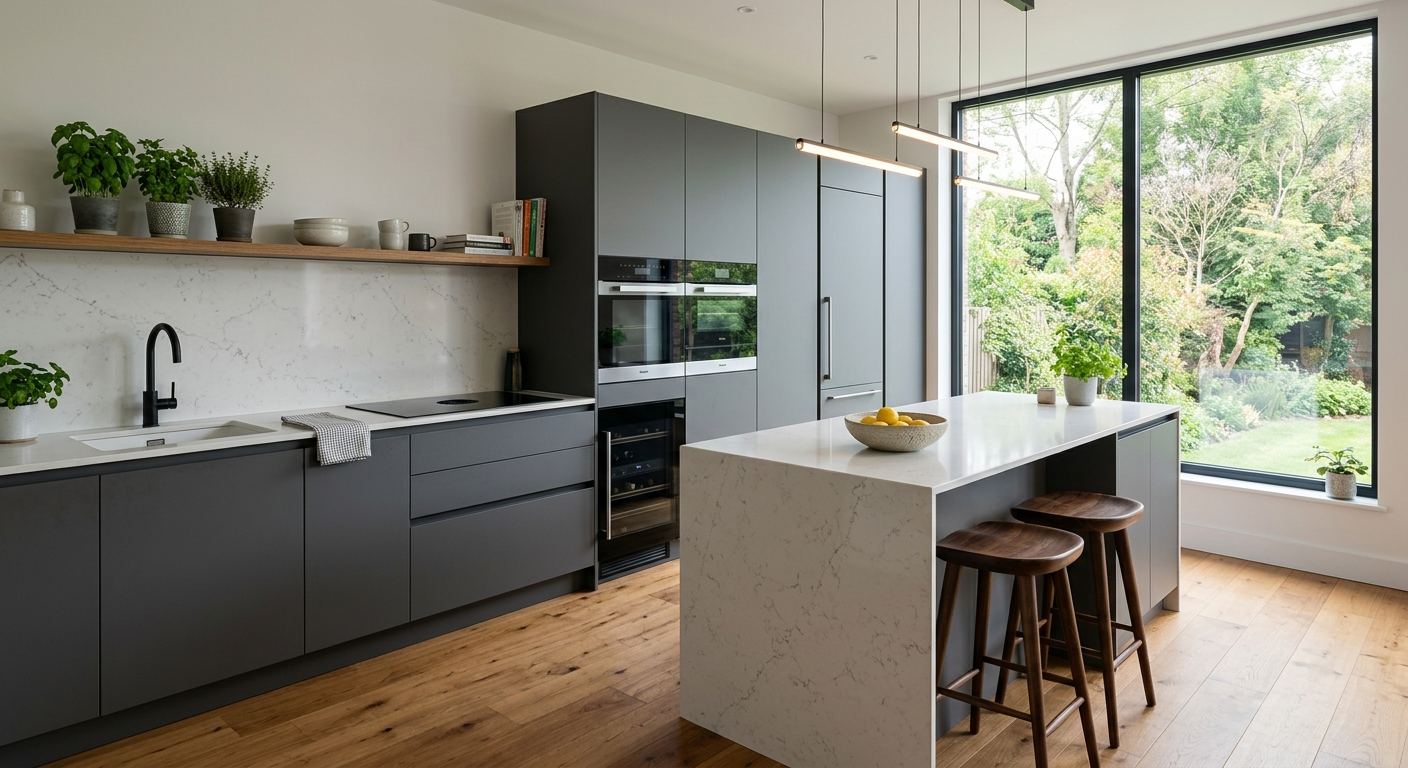
Kitchen renovation options and costs in Colonial Acres
Kitchen renovation options in Colonial Acres, Ontario start with the same reality: your budget is driven more by where you sit in the Toronto-area housing market than by the season. In a community with a population of 8,163 (Statistics Canada, 2021 Census), homeowners typically want a durable, resale-friendly kitchen that matches what buyers expect in the Greater Toronto Area. In higher-value pockets around the Toronto economic region, kitchens often represent about 8–15% of home value, so it’s common to see upgrades like quartz or natural stone, upgraded lighting, and semi-custom cabinetry even when a full remodel isn’t strictly “necessary.”
That market pressure is what shapes labour demand and pricing. In practice, contractor availability can tighten when multiple renovations are scheduled for the same spring and summer window, and that can move labour pricing slightly upward. Climate affects kitchens indirectly: Ontario temperature swings and humidity changes put stress on older cabinet boxes, sealants, and flooring transitions—so projects sometimes include additional prep work (relevelling subfloors, moisture-proofing underlayment, or replacing failing under-cabinet bases). Even then, finish tier remains the main driver: stock and laminate stay in the low–mid range, while custom millwork and stone move quickly into premium budgets.
In Colonial Acres, demand is especially steady for cabinetry-and-counter projects near busy commercial corridors and for family homes that are being refreshed before listing—so refinishing and counter swaps are frequently booked alongside mid-range renovations. Below is a practical comparison to help you align your expectations with real Toronto pricing, from modest refreshes to fully custom builds.
| Renovation Tier |
What's Included |
Typical Duration |
Price Range |
| Cosmetic refresh (paint, hardware, new appliances only) |
Cabinet paint or touch-ups, new hardware, appliance swap, minor caulking/silicone, basic countertop cleaning/polish (no structural changes) |
3–7 days |
$7,000–$18,000 |
| Mid-range full renovation (new cabinets, counters, sink, tile) |
New semi-custom cabinets, quartz counters, sink/faucet, backsplash tile, flooring refinishing or replacement allowance, new under-cabinet lighting (as needed) |
2–4 weeks |
$25,000–$60,000 |
| High-end full renovation (custom cabinets, stone counters, island) |
Fully custom cabinetry, premium stone (quartz/stone-grade granite or natural stone), island build, enhanced lighting package, upgraded appliance package, tile to ceiling options |
4–8 weeks |
$65,000–$90,000 |
| Cabinet refacing only (new doors + drawer fronts, same boxes) |
New cabinet doors/drawer fronts/veneer, new hardware, optional interior upgrades (lazy susan/organizers allowance), finish matching and alignment work |
1–2 weeks |
$8,000–$28,000 |
| Countertop swap only (laminate to quartz or stone) |
Removal and install of new countertop, new sink cut-out allowance, seam finishing, basic caulking and backsplash tie-in allowance |
3–6 days |
$3,000–$12,000 |
| Backsplash tile installation only |
Tile supply/selection allowance, removal of old backsplash (if needed), tile install, grout/caulk detailing, trim finishing |
2–5 days |
$2,000–$10,000 |
Prices are estimates only and vary by project scope, site access and material selection.
What affects the price of kitchen renovation in Colonial Acres
It’s normal to see quotes for the “same” kitchen renovation vary by 30–50% across Toronto and Ontario—because the scope is rarely identical. Two contractors may both say “new counters and cabinets,” but one includes demo/disposal, electrical adjustments, new lighting rough-ins, floor prep, and appliance delivery coordination, while the other leaves those items for later. In the Toronto economic region, local housing market positioning and median household income expectations tend to steer finish tier far more than climate. When homeowners view the kitchen as part of the resale story, they often default to quartz or stone counters and semi-custom cabinetry; in more value-sensitive situations, laminate and stock or refaced cabinets dominate because they keep the project within a controllable range and protect resale ROI.
Layout decisions are the wild card. Removing a wall, adding an island, or moving a gas line (or plumbing supply/drain) can add complexity and trades coordination that drives costs unpredictably, regardless of whether you choose a laminate top or premium stone. For example, in Colonial Acres homes with older plumbing runs or awkward cabinet depths, we sometimes need extra under-sink framing and subfloor patching—small items that add up when they’re discovered during demolition.
Concrete local examples that raise or lower costs include: (1) older kitchens with out-of-square walls that require more custom filler panels and careful countertop templating; (2) flooring transitions where the existing subfloor is uneven, leading to additional levelling work before cabinets go in; and (3) appliance package changes that require different venting clearances or electrical upgrades. As a result, you may start at a mid-range budget like $25,000–$60,000 and still land higher if the electrical and layout scope expands, while some homeowners can hold closer to $8,000–$28,000 with refacing-only if the cabinet boxes are truly in good shape.
| Price Factor |
Why It Matters |
Cost Impact |
| Cabinet tier — stock vs. semi-custom vs. fully custom millwork |
Material quality, door styles, internal storage options, and lead times vary significantly. |
Typically shifts the project by roughly +$10,000–$35,000 depending on size and scope. |
| Countertop material — laminate vs. quartz vs. granite vs. stone |
Premium stone and complex edges/seams increase material and templating/install time. |
Commonly adds +$2,000–$12,000 versus laminate in comparable layouts. |
| Layout change — wall removal, island add, plumbing/gas move |
Structural and MEP changes require extra labour, engineering/permits (where applicable), and schedule coordination. |
Often increases totals by +$8,000–$25,000+. |
| Appliance package tier — builder vs. mid-range vs. pro-grade |
Higher tiers can require different electrical/venting clearances and sometimes custom installation steps. |
Can swing +$1,500–$10,000+ depending on the package. |
| Flooring — refinish existing vs. full replacement |
Whether we preserve or remove existing flooring changes demo time, labour, and disposal. |
Typically varies by +$2,000–$8,000. |
| Backsplash — ceramic tile vs. marble vs. full-height slab |
Material weight, pattern matching, and coverage height change install difficulty and waste. |
Often changes by +$1,500–$8,000. |
| Electrical — new circuits for island, under-cabinet lighting |
New circuits and lighting upgrades require a licensed electrician and careful load planning. |
Commonly adds +$800–$4,000 (or more with major changes). |
| Permit fees and licensed trade requirements |
Permits and inspections add administrative steps and require properly licensed trades. |
Often adds +$500–$3,000+ depending on scope. |
Permits & regulations in Ontario
In Ontario, simple cabinet and countertop swaps typically don’t require permits. If you’re replacing cabinets in the same locations, installing new countertops on the existing footprint, and keeping plumbing and gas lines where they are, most jobs proceed as a standard renovation. However, permits and licensed trade involvement are commonly required when you change plumbing supply/drain runs, relocate a gas stove or gas line, remove a load-bearing wall, or add new electrical circuits—especially for island outlets or new under-cabinet lighting that requires wiring changes.
Here’s the practical way to think about it for Colonial Acres homeowners:
- Usually no permit: repainting cabinets, changing cabinet doors/frames (refacing) without moving boxes, replacing countertops in the same footprint, installing a backsplash (tile) without moving services.
- Typically needs permits + licensed trades: moving sink supply/drain lines, relocating a stove/range (including gas-related changes), adding electrical circuits for new receptacles, and removing or altering load-bearing structures.
To verify your contractor in Ontario, ask for (1) their Ontario licence number (as applicable for the work), (2) proof of liability insurance, and (3) proof of coverage for workplace compensation such as WSIB/WCB. Then check their documentation: request a certificate of insurance with your name or project listed as certificate holder, look up licence details through Ontario’s relevant online registry tools, and obtain a clearance letter where required for your project file. Always confirm in writing who is responsible for pulling permits and scheduling inspections before you sign.
Cabinets, countertops and layout decisions in Colonial Acres
Your three most consequential decisions in a Colonial Acres kitchen renovation are cabinet tier, countertop material, and whether you’ll change the layout. In the Toronto-area resale market, buyers often recognize quality immediately: drawers that glide smoothly, cabinets that sit level, and counters that don’t look “dated.” Stock cabinets are the fastest and cheapest option, but they offer fewer storage upgrades and fit flexibility. Semi-custom cabinets are the most common mid-range choice because they balance price with better sizing and options like deeper drawers, split storage, and better door profiles.
Countertop material drives day-to-day satisfaction. Laminate can be a budget-friendly upgrade, while quartz is popular for its durability and low maintenance in busy family kitchens. Granite and natural stone can offer a premium look and heat resistance, but it may require more care depending on finish and sealing. Butcher block looks warm and traditional; it’s workable for families, though it needs routine sealing and is more vulnerable to moisture and impacts than quartz. Marble is the most delicate for everyday kitchens and can etch if you spill acidic substances.
Layout changes should be justified by space gain and real usability. If you remove a wall or add an island, you’re paying for more than drywall and framing—you’re paying for electrical, plumbing/gas coordination, and schedule risk. Where a simple cosmetic refresh keeps you near the lower end of the market (like $7,000–$18,000), a structural change is what pushes projects toward $25,000–$60,000 and beyond. For example, if you’re considering moving the sink for better workflow, the plumbing move plus adjustments to base framing can add several thousand dollars; it’s only “worth it” if the new layout clearly improves circulation and storage.
Ontario’s seasonal humidity shifts also matter for cabinet longevity and seal integrity—especially in older housing stock—so we plan for proper ventilation and secure caulking around sinks and backsplash edges. That’s how you protect the investment through wet winters, dry summers, and everything in between.
| Option |
Durability |
Maintenance |
Best For |
Price Range |
| Stock cabinets (big-box) |
Good durability with standard materials; fit may require more filler adjustments. |
Minimal; keep hinges aligned and wipe spills promptly. |
Quick renovations and budget-conscious refreshes |
$8,000–$18,000 |
| Semi-custom cabinets (local dealer) |
High consistency with better sizing and stronger internal storage options. |
Low; standard care for hinges and finishes. |
Most Colonial Acres homeowners aiming for resale-friendly quality |
$18,000–$35,000 |
| Custom cabinets (local millwork shop) |
Excellent fit and build quality; best for unusual spaces and full storage planning. |
Low to moderate; quality hardware makes upkeep easier. |
High-end builds and homeowners who want a perfect match |
$35,000–$65,000 |
| Laminate countertop |
Moderate; can chip or lift at seams if water gets underneath. |
Easy; avoid standing water around edges and seams. |
Affordable upgrades and fast turnarounds |
$3,000–$6,000 |
| Quartz engineered countertop |
Very durable; resistant to stains and everyday impacts. |
Low; wipe clean and address spills quickly but no sealing routine. |
Busy households and resale-focused upgrades |
$6,000–$12,000 |
| Granite / natural stone countertop |
High durability; natural resistance with variation by slab. |
Moderate; sealing may be required based on stone and finish. |
Premium look with classic stone character |
$8,000–$15,000 |
| Butcher block countertop |
Moderate; susceptible to dents and moisture at seams. |
Moderate; regular oil/seal upkeep and careful spill management. |
Warm, traditional kitchens and homeowners who maintain surfaces |
$4,000–$9,000 |
| Marble countertop |
Moderate to high for strength, but more prone to etching/staining. |
Higher; requires diligent cleaning and quick attention to acidic spills. |
Statement kitchens where aesthetics matter most |
$10,000–$18,000 |
How to choose a kitchen renovation contractor in Colonial Acres
Choosing the right contractor in Ontario comes down to proof, clarity, and jobsite discipline. Start with licensing and coverage: ask for their Ontario licence details (as applicable to the work they’re performing), their liability insurance certificate, and confirmation of workplace compensation coverage such as WSIB/WCB. How to check: (1) request the certificate of insurance and verify the coverage is active and not expired, (2) ask for WSIB/WCB clearance documentation or letter for the project file, and (3) if they’re doing regulated trade work (electrical/gas-related scope), confirm those permits and licensed trade credentials are in place. A reputable team will provide documents quickly without pressuring you.
Next, get 2–3 itemised written quotes. Look for a breakdown that separates labour, materials, demolition/disposal, countertop installation, and any electrical/plumbing allowance. Avoid “all-in” lump sums that don’t show what’s included or excluded. Then read the scope like a contract, not a brochure: disposal included or not, permit pull included or not, dust protection, protection of floors during cabinet install, and whether old materials are hauled away or left for you.
Warranty matters. Ask for workmanship warranty length (and what triggers it), manufacturer warranty for cabinets and countertops, and whether warranties are transferable if you sell the home. Payment schedule should be conservative: never pay more than 10–15% upfront; use progress payments tied to milestones and hold back until substantial completion and sign-off.
Finally, get the timeline in writing. You want a stated start date and a completion estimate that reflects typical lead times for cabinets and countertops in the GTA market, so you’re not squeezed by back-ordered materials.
- Provide a signed contract with an itemised scope (labour + materials breakdown).
- Show proof of liability insurance and WSIB/WCB coverage (or clearance letter).
- Confirm who pulls permits and who schedules inspections (in writing).
- List allowances (appliances, flooring transitions, trim, hardware) and what happens if selections change.
- Include demolition and disposal handling in the quote.
- Ask who is responsible for protecting floors and adjacent rooms during dust-generating work.
- Get cabinet lead time and countertop templating schedule in writing.
- Clarify backsplash scope: grout/caulk, electrical outlet modifications, and trim details.
- Confirm electrical scope: new circuits for island receptacles and lighting, if applicable.
- Ask for warranty terms in plain language and who honours them.
- Use milestone-based payments with a holdback until completion.
- Confirm jobsite supervision: who is on-site daily and who you contact after hours.
Concrete red flags we commonly see in Colonial Acres include: quotes with no line-by-line scope (just totals), contractors who won’t provide insurance/WSIB/WCB documentation, promises to “handle permits” without stating responsibility in writing, overly aggressive upfront payments, and vague timelines that ignore cabinet/countertop lead times. If you hear “don’t worry, it’s all included” without details, ask for an itemised amendment before you commit.
Frequently asked questions — kitchen renovation in Colonial Acres
Quartz vs granite countertops — which is better?
For most Colonial Acres homeowners renovating in the Toronto area, quartz is often the easier “better” choice for day-to-day life. Quartz is engineered for consistent colour and resists stains well, which helps in busy kitchens where spills happen and you want a low-maintenance surface. Granite is extremely durable too, and its natural character can look stunning, but it can require periodic sealing depending on the slab and finish. If you’re budgeting, quartz tends to land in the mid range—for example, a quartz install is commonly within $6,000–$12,000 depending on size, edge profiles, and seam complexity. Granite/natural stone often runs higher, commonly around $8,000–$15,000. Climate-wise, the bigger difference isn’t Ontario weather itself—it’s how your household uses the counter: moisture at seams and how quickly you wipe up liquids. Either material works well when the template and support structure are done correctly.
Should I reface or replace my cabinets?
Refacing is usually the smart move when your cabinet boxes are solid, the doors are the only thing that looks dated, and the layout is staying put. In Colonial Acres and across Ontario, cabinet refacing can be a cost-effective way to modernize without the mess of full removal, commonly priced in the $8,000–$28,000 range for typical kitchen sizes. Full replacement makes more sense when boxes are damaged by moisture, sagging hinges, poor alignment, or when you want to overhaul storage (deeper drawers, pull-outs, and different cabinet heights) that the existing boxes can’t support well. A full mid-range replacement typically sits closer to $25,000–$60,000 once you include new counters and related finishes. The fastest way to decide is a site inspection: we check cabinet box condition, wall flatness, water damage near sink/dishwasher, and whether the existing footprint still matches your desired workflow.
Do I need a permit for a kitchen renovation in Ontario?
In Ontario, many kitchen renovations don’t require a permit—especially if you’re doing cosmetic work or swapping cabinets and countertops in the same footprint. Typically no permit is needed for tasks like repainting, refacing, installing new countertops, and adding a backsplash when plumbing and gas lines aren’t moved. Where permits often come into play is when you change the “services” part of the kitchen: moving plumbing supply/drain lines, relocating a gas stove or making gas-related changes, removing a load-bearing wall, or adding electrical circuits (for example, new island outlets). For Colonial Acres homeowners, the key step is confirming in your contract who pulls permits and pays permit/inspection fees. Also verify your contractor’s approach to licensed trades: gas work should be performed by a licensed gas fitter, and electrical work by a licensed electrician with inspections completed. If a quote treats everything as optional extras, it’s a sign to get the scope clarified before work starts.
What's the ROI on a kitchen renovation?
ROI in the Toronto area is real, but it’s not a single guaranteed number—it depends on finish tier, layout logic, and how much of your kitchen you’re changing. In higher-value GTA pockets, homeowners often target upgrades that align with resale expectations, and kitchens can represent about 8–15% of home value when owners invest heavily in custom millwork and premium counters. For more cost-sensitive projects, ROI improves when you focus on high-impact upgrades like functional storage, durable countertops, and good lighting without moving the entire plumbing/gas layout. A conservative budget can still make a difference: some homeowners keep scope in the $25,000–$60,000 band for a mid-range renovation that modernizes appearance and function. Fully custom work and structural changes usually push toward $65,000–$90,000, which can recoup more only if it matches buyer expectations for your specific street and home type. The best ROI strategy is practical: spend where buyers look first, and avoid unnecessary structural changes that don’t improve usability.
How do I budget for a kitchen renovation?
Budgeting starts with choosing the tier, then adding a realistic allowance for the surprises demolition reveals. In Colonial Acres, most kitchen budgets align with Toronto-region finish tiers rather than seasonal weather effects. A cosmetic refresh might land in the $7,000–$18,000 range, while a mid-range full renovation commonly targets $25,000–$60,000 when you’re doing new cabinets, counters, and tile. If you’re planning custom cabinetry, stone counters, and an island, plan for the $65,000–$90,000 band—especially if plumbing/gas and electrical scope expands. A practical approach is to request itemised quotes with allowances for flooring, electrical adjustments, and disposal. Include a contingency for older housing stock: damaged toe-kicks, out-of-square walls, or subfloor levelling needs often appear after demo. Lastly, confirm lead times for cabinets and countertops so you don’t get stuck paying for extended accommodation or delaying other trades.
Can I move my kitchen sink or stove?
Yes, you can move a sink or stove, but it’s the scope that determines feasibility, cost, and permits. Moving a sink typically means rerouting plumbing supply and drain lines, which can trigger permit requirements and licensed trade work. Moving a stove depends on whether it’s gas or electric: gas-related relocation requires licensed gas fitting and inspections, and it’s often the most expensive move because of venting and line requirements. For Colonial Acres homeowners, this is also where older home layouts can create surprises—existing plumbing runs may be awkward to reroute without opening more walls or adjusting subfloor/framing. Cost-wise, relocation is usually what pushes a renovation beyond a “straight refresh” budget; it’s why layout changes can make a project swing upward even when cabinet and countertop choices stay mid-range. If you want better workflow without major service changes, consider keeping plumbing in the same approximate zone and improving layout with storage, appliance positioning, and lighting.