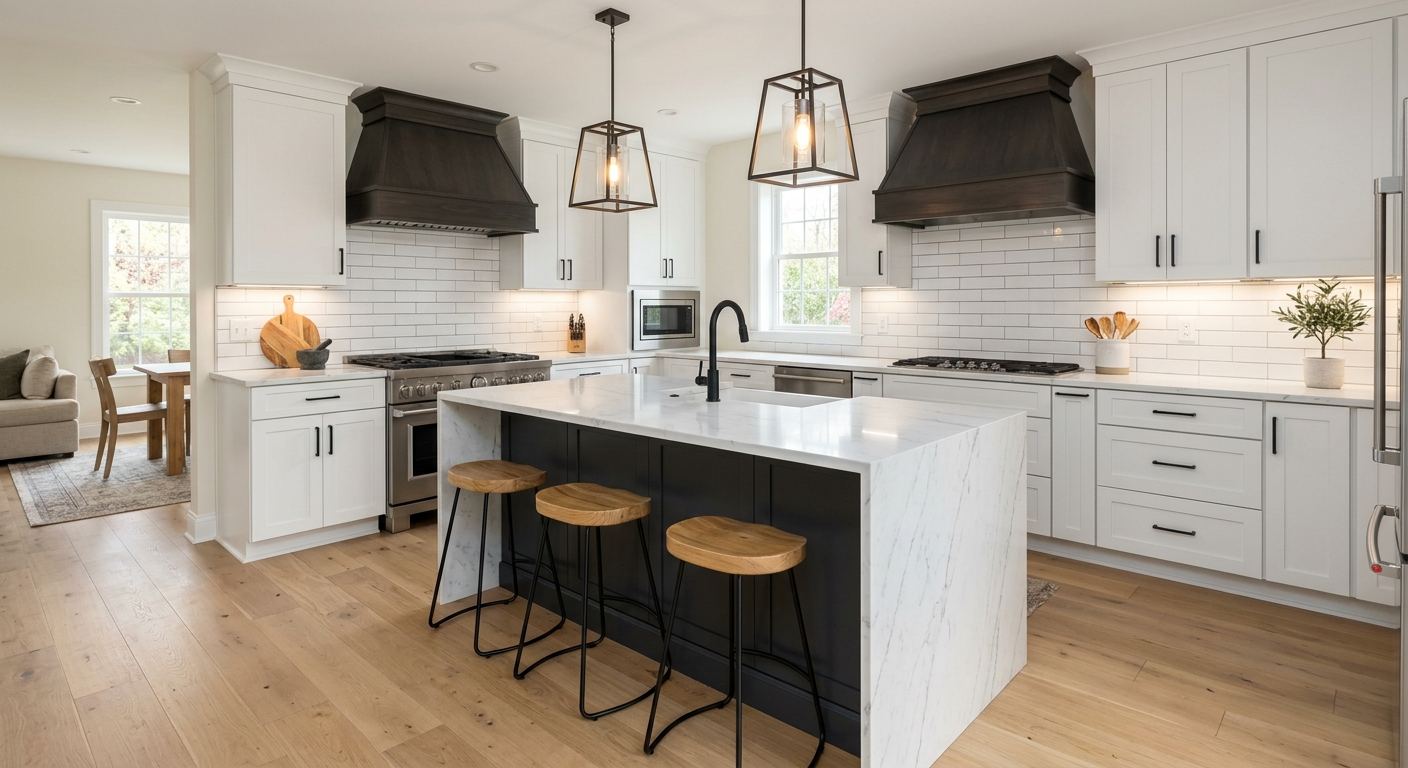
Kitchen renovation options and costs in Univercity
In Univercity, British Columbia, your kitchen renovation options usually start with what you’re trying to change—and then align to the finish level expected in the Lower Mainland–Southwest. With a small local population of about 5,000 people (Statistics Canada, 2021 Census), trades availability can be tighter than in the biggest Metro Vancouver cores, so scheduling and lead times for cabinetry and stone can affect the total. Most homeowners in this region also weigh resale impact heavily, and that’s where housing economics matter: higher-value areas across the Lower Mainland–Southwest tend to reward quartz/stone and semi-custom cabinetry because buyers expect “move-in ready” upgrades.
Cost is shaped less by climate than by market demand: the Lower Mainland–Southwest pricing model is driven more by home values, income, and the expected end finish. That said, the coastal environment (moisture/condensation risk, wet-season drafts, and temperature swings) can influence installation details—ventilation upgrades, caulking/fastener choices, and how tile is layered around plumbing penetrations. If you’re renovating in a dense pocket where access is limited—common around townhouse and older infill areas—crews may price differently for staging and waste handling.
Demand is often highest for practical upgrades near growing commuter corridors like the Univercity-area commercial/service strip, where homeowners want efficient layouts and durable surfaces that hold up through busy family use. Use the options below to compare typical scopes, then match your plan to a realistic budget.
| Renovation Tier |
What's Included |
Typical Duration |
Price Range |
| Cosmetic refresh (paint, hardware, new appliances only) |
Cabinet paint/stain (no new boxes), new hardware, appliance swap (dishwasher/range hood/refrigerator range), minor caulking and touch-ups |
1–2 weeks |
$10,000–$25,000 |
| Mid-range full renovation (new cabinets, counters, sink, tile) |
New semi-custom or quality stock cabinets, countertop install, new sink + tap, backsplash tile, flooring touch-ups, standard electrical refresh, basic plumbing reconnections |
3–6 weeks |
$40,000–$80,000 |
| High-end full renovation (custom cabinets, stone counters, island) |
Custom cabinetry, stone counters (quartz or natural stone), island build/fit, upgraded hardware/soft-close, detailed backsplash (including design cuts), appliance package, expanded lighting, more complex plumbing/electrical coordination |
6–12 weeks |
$90,000–$140,000 |
| Cabinet refacing only (new doors + drawer fronts, same boxes) |
New doors/drawer fronts, trim/edges, hardware swap, limited prep/repairs to existing boxes, new backsplash tie-in where feasible |
1–3 weeks |
$18,000–$45,000 |
| Countertop swap only (laminate to quartz or stone) |
Remove/install counters, new sink cut-out (if compatible), seal/transition details, basic backsplash adjustments where needed |
3–7 days |
$4,000–$12,000 |
| Backsplash tile installation only |
Surface prep, tile layout/install, trim/caulk/cleanup, grout sealing where appropriate, outlet detailing |
3–10 days |
$1,500–$6,000 |
Prices are estimates only and vary by project scope, site access and material selection.
What affects the price of kitchen renovation in Univercity
In the Lower Mainland–Southwest, the same kitchen job can land 30–50% apart from one quote to the next, and that gap usually comes from finish expectations and design complexity—not climate. Across British Columbia, contractors price based on local market demand, replacement timelines, and how easily trades can schedule your job. Even when the countertop and cabinet brands look similar, labour hours can swing widely if demolition is messier, framing is out of square, or plumbing/electrical needs a longer path.
Local home values and median income shape the finish tier far more than weather. In higher-value Lower Mainland–Southwest pockets, homeowners commonly default to quartz or stone counters and semi-custom cabinetry because the cost is easier to justify on resale; that’s why mid-range projects often cluster around the $40,000–$80,000 band. In more modest scopes, laminate and stock cabinets can deliver a strong ROI while keeping total spend closer to the $10,000–$25,000 refresh range—especially when you keep most plumbing and electrical where they are.
In Univercity specifically, two conditions often move pricing up or down. First, older housing stock and renovations-in-place sometimes mean hidden out-of-level framing or aging subflooring—real labour adds fast. Second, coastal moisture management matters: if ventilation is dated or there’s condensation near exterior walls, installers may recommend improved venting and better caulking/underlayment details. A simple layout shift—wall removal, adding an island, or moving a gas line—typically becomes the biggest unpredictable cost driver regardless of whether you’re targeting mid-range or high-end finishes.
| Price Factor |
Why It Matters |
Cost Impact |
| Cabinet tier — stock vs. semi-custom vs. fully custom millwork |
Higher tiers need more design, fitting time, and often custom sizes/finishes |
Can move total by roughly $15,000–$40,000 on full projects |
| Countertop material — laminate vs. quartz vs. granite vs. stone |
Material cost, templating, and install complexity increase with natural stone and large slabs |
Typically $3,000–$12,000 just for counter install scope |
| Layout change — wall removal, island add, plumbing/gas move |
Framing, permits, and longer trade coordination add risk and labour hours |
Often the largest swing factor on quotes (commonly $5,000–$30,000) |
| Appliance package tier — builder vs. mid-range vs. pro-grade |
Pro-grade models increase electrical/plumbing fit-up and sometimes require ventilation upgrades |
May add $2,000–$15,000 depending on brands and integration |
| Flooring — refinish existing vs. full replacement |
Cabinet removal and water protection affect how much flooring must be replaced |
Can be $1,500–$10,000 depending on current surface condition |
| Backsplash — ceramic tile vs. marble vs. full-height slab |
More premium materials require tighter tolerances and longer cutting/finishing |
Typically $1,500–$6,000 for tile-only scope |
| Electrical — new circuits for island, under-cabinet lighting |
New circuits trigger licensed work and extended inspection/coordination time |
Commonly $1,000–$6,000 depending on how much changes |
| Permit fees and licensed trade requirements |
Permits and inspections add admin time, and certain work must be done by licensed trades |
Usually $500–$5,000 plus scheduling impacts |
Permits & regulations in British Columbia
In British Columbia, a straightforward cabinet and countertop swap typically does not require a permit—if you’re keeping plumbing, gas, and electrical locations the same. For Univercity homeowners, the key distinction is whether your renovation changes the service lines or building structure. Moving a sink drain, relocating supply lines, changing where a range/stove connects, or adding circuits for an island are all examples of work that usually does require permits and licensed trades.
Here’s what typically does not require a permit: replacing existing cabinets with the same footprint, swapping countertops, installing a standard backsplash, and replacing appliances where the connections remain in the same locations. Work that typically does require permits includes: moving plumbing supply/drain lines, relocating or adding gas connections (including work around stove/range hood gas setups), removing or altering a load-bearing wall, and adding new electrical circuits (for example, island outlets or under-cabinet lighting runs that require new wiring pathways).
Step-by-step verification in Univercity: (1) ask for the contractor’s certificate of insurance (liability) and confirm coverage limits; (2) request proof of WCB coverage or acceptable equivalent clearance for relevant trades; (3) verify licences—gas work must be done by a licensed gasfitter and electrical by a licensed electrician; and (4) keep copies of permits/inspection confirmations in your binder. Before signing, confirm in writing who is pulling permits and who covers inspection scheduling—responsibility should be explicit in the contract.
Cabinets, countertops and layout decisions in Univercity
For most Univercity kitchens, the three biggest money-and-value levers are (1) cabinet tier, (2) countertop material, and (3) layout changes. Cabinet tier is the foundation: stock cabinets are the fastest and usually cheapest, semi-custom is the sweet spot for most renovations, and custom cabinetry provides the best fit for uneven walls, unique storage needs, and modern sightlines that buyers notice. In the Lower Mainland–Southwest resale market, many buyers respond to clean hardware alignment and durable finishes that look intentional.
Countertop material drives both durability and day-to-day maintenance. Laminate is budget-friendly and easy to live with, but seams and burn/scorch risk can show sooner in high-use households. Quartz delivers a more premium look with good stain resistance, while granite/natural stone adds variation and heat tolerance (though it may require periodic sealing). One realistic choice example: upgrading from laminate to quartz may add roughly $3,000–$7,000 on a typical countertop-only scope, but if you’re also doing a mid-range full renovation (often $40,000–$80,000), the quartz upgrade commonly improves the perceived “whole kitchen” quality more than spending the same dollars on minor tile changes.
Layout changes—open-concept wall removal, island addition, and plumbing/gas relocation—are where costs justify themselves only when you gain real function. In a smaller kitchen, adding an island can fix storage and workflow; if it also requires moving plumbing or gas, the project becomes permit-heavy and labour-intensive. On coastal houses, ensure ventilation and moisture detailing are included so your new surfaces and tile stay sealed through wet-season swings.
| Option |
Durability |
Maintenance |
Best For |
Price Range |
| Stock cabinets (big-box) |
Good with proper installation; limited custom fitting |
Wipe-clean finishes; hardware adjustments may be needed as houses settle |
Fast timeline and tighter budgets |
$8,000–$20,000 |
| Semi-custom cabinets (local dealer) |
Very good; broader style options and better sizing flexibility |
Simple cleaning; typically durable hardware and soft-close options |
Most Univercity homeowners targeting strong resale appeal |
$18,000–$45,000 |
| Custom cabinets (local millwork shop) |
Excellent; best for complex walls, storage needs, and bespoke layouts |
Designed-to-fit for longevity; requires careful ongoing hardware care |
High-end remodels and architectural features |
$35,000–$75,000 |
| Laminate countertop |
Moderate; can chip at edges and show wear near seams |
Use cutting boards; avoid prolonged heat directly on the surface |
Budget upgrades and rental-friendly refreshes |
$1,500–$4,500 |
| Quartz engineered countertop |
High; resistant to staining and daily wear |
Low maintenance; wipe with mild cleaner; protect from extreme heat |
Mid-range to high-end renovations across the Lower Mainland–Southwest |
$3,000–$10,000 |
| Granite / natural stone countertop |
High; naturally durable and heat-tolerant |
May need periodic sealing; clean promptly to prevent etching |
Premium look with natural variation |
$4,500–$12,000 |
| Butcher block countertop |
Good to high; can be very durable with proper care |
Oil/condition regularly; avoid soaking and standing water |
Warm, traditional or “chef” kitchens where maintenance is acceptable |
$2,500–$7,500 |
| Marble countertop |
Beautiful but softer; can scratch and etch |
Higher maintenance; seal carefully and clean gently |
Statement kitchens with lighter day-to-day use |
$6,000–$15,000 |
How to choose a kitchen renovation contractor in Univercity
Start by confirming British Columbia licensing, then move to insurance and coverage. For cabinet, flooring and general carpentry, ask for the contractor’s liability insurance certificate and confirm WCB/WorkSafe BC coverage for workers. For the trades that can’t be “handed off” informally: gas work must be performed by a licensed gasfitter, and electrical work by a licensed electrician—request licence proof or the trade contractor’s documentation before they begin. You can also ask to see clearance letters or equivalent evidence related to coverage; never rely on verbal assurances.
Next, get 2–3 itemised written quotes. You want a breakdown that separates labour from materials (cabinets, countertops, tile, plumbing/electrical, demolition, disposal) rather than a single lump sum. Read the scope line-by-line: what’s excluded (for example, subfloor repair, drywall patching, paint, permit fees), whether permit pulling is included, and if debris disposal is part of the service. Warranty matters too: confirm the workmanship warranty length, who covers it, what it includes, and whether product warranties are transferable to you. Also check the timeline—ask for a start date and completion estimate in writing, plus expected lead times for cabinets and countertops.
Payment schedule guidance in Univercity: never pay more than 10–15% upfront. Hold back a portion until key milestones (not just “mostly done”) are completed, especially at cabinet installation close-out and countertop templating/installs.
- Verify BC licence(s) for the specific trades involved (gas/electrical at minimum).
- Request liability insurance and confirm current certificate dates and limits.
- Ask for WCB/WorkSafe BC clearance or coverage proof for workers.
- Get 2–3 quotes with labour and materials itemised—no vague allowances.
- Confirm permit responsibility in the contract (who pulls and who pays).
- Ask what’s included for demolition, drywall patching, and wall finishing.
- Confirm disposal: dumpster location, hauling, and whether recycling is handled.
- Require drawings or a written scope that matches your kitchen layout plan.
- Check warranty: workmanship (length and coverage) and product warranty transferability.
- Insist on a written schedule and milestone dates (template, order, install).
- Set a realistic change-order process: pricing method and approval in writing.
- Keep a paper trail: invoices, change forms, and inspection/permit documents.
Red flags I see in Univercity kitchen builds include contractors who won’t provide insurance/WCB evidence, quotes that use extremely broad “allowances” (with no brand/model ranges), schedules that don’t account for cabinet/stone lead times, no written scope for permits/disposal, and a payment request that asks for large upfront deposits beyond the typical 10–15% guidance.
Frequently asked questions — kitchen renovation in Univercity
Quartz vs granite countertops — which is better?
In Univercity and the broader Lower Mainland–Southwest, quartz is often the practical “best overall” choice because it’s consistent in appearance, highly resistant to staining, and usually keeps maintenance simple (wipe and go). Granite is also durable and can handle heat well, but it varies by slab and often needs periodic sealing depending on the stone and finish. If you’re comparing budgets, a full countertop swap commonly sits around $3,000–$12,000 total for install scope, and quartz frequently lands in the mid portion of that range while natural stone can be higher. For busy households, quartz is easier to keep looking new through daily cooking. For a statement, unique look, granite can be worth the extra attention.
Should I reface or replace my cabinets?
Refacing is usually the smarter move when the existing cabinet boxes are structurally sound—no widespread warping, failing hardware mounts, or water damage around sinks/dishwashers. In that case, you keep the cabinet carcasses and replace doors/drawer fronts, which can save labour and demolition costs. Typical refacing-only pricing commonly runs around $18,000–$45,000, while a full mid-range renovation that includes new cabinets, counters, sink and tile often runs $40,000–$80,000. Replace rather than reface if you’re changing layout, need new internal storage (like pull-outs sized to your actual needs), or your current boxes are out of square—especially common in older infill homes. A site inspection is the fastest way to confirm what your boxes can realistically support.
Do I need a permit for a kitchen renovation in British Columbia?
In British Columbia, many kitchen finish upgrades don’t require permits—like countertop swaps and cabinet replacements when you’re not changing plumbing, gas, or electrical locations. However, permits and licensed trades generally apply when you move plumbing supply/drain lines, relocate gas connections (including stove/range hood setups involving gas), remove or alter load-bearing walls, or add new electrical circuits (common with island outlets and certain lighting runs). For Univercity homeowners, the easiest way to avoid surprises is to ask your contractor to confirm, in writing, exactly what permit(s) will be pulled, who pulls them, and who pays the fees. Also request evidence of licensed work: gasfitter for gas and electrician for electrical, with inspections completed before close-up.
What's the ROI on a kitchen renovation?
Kitchen ROI in the Lower Mainland–Southwest is strongly influenced by whether the renovation matches buyer expectations for the neighbourhood and home value tier—more than by the type of paint or minor hardware differences. In practice, upgrades that buyers clearly “feel” (good layout flow, durable countertops, consistent cabinet finishing, and modern lighting/ventilation) tend to carry better resale value than purely cosmetic changes. If you’re doing a mid-range full renovation commonly around $40,000–$80,000, the highest ROI typically comes from choosing timeless materials like quartz and semi-custom cabinetry, and fixing functional gaps (storage, lighting, workflow). If your budget is closer to a cosmetic refresh around $10,000–$25,000, your ROI is more about visual lift and appliance modernization. Your local market fit matters most—especially in Univercity where buyer expectations can be sensitive to finish quality.
How do I budget for a kitchen renovation?
A solid budget starts with defining your renovation tier and then assigning dollars to the big drivers: cabinets, countertops, and layout/plumbing/electrical changes. For Univercity projects, many homeowners keep totals within regional backbone bands: full kitchen renovations often land around $40,000–$120,000, while cabinet refacing is commonly $8,000–$50,000 depending on prep and scope. Countertop installation is often $3,000–$12,000, and backsplash tile is commonly $1,500–$6,000. Add a contingency line item (commonly 10–15%) because older kitchens can hide surprises in framing, subfloor, and wiring. Also budget for timing: stone and cabinet lead times can affect how long you’re without a full kitchen setup, which can change your day-to-day costs.
Can I move my kitchen sink or stove?
Yes, you can move a kitchen sink or stove in British Columbia, but it’s rarely “just a location change.” Moving a sink usually means reworking plumbing supply and drainage, which typically requires permits and licensed plumbing work; moving a stove may also involve gas line relocation (requiring a licensed gasfitter) and electrical adjustments for ignition/venting controls. The cost impact is why contractors say layout changes are the most unpredictable part of the budget—labour hours, inspections, and coordination can all increase. If you want to manage cost in Univercity, consider moving within the same wall/joist cavity where possible or staying close to the existing supply/drain routes. If you’re set on a new island layout, plan earlier for routing complexity so you don’t lose time waiting on inspections.