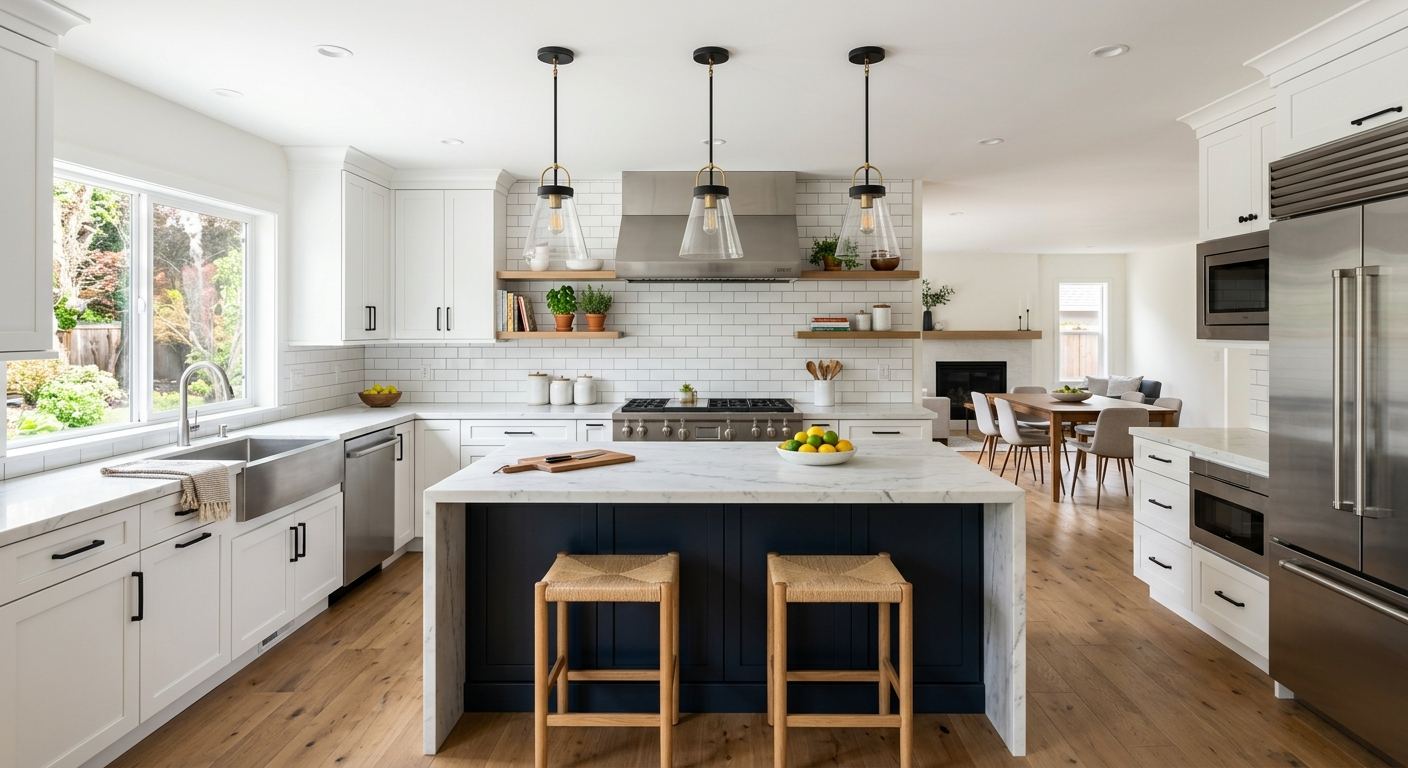
Kitchen renovation options and costs in Courtenay
Courtenay is a great place to renovate because homeowners here tend to invest in durable, practical upgrades that still look sharp. With a median household income of $72,000 (Statistics Canada, 2021 Census), many projects land in the mid-range finishes—especially when buyers want “move-in ready” kitchens for family life and entertaining. Courtenay’s housing mix also influences expectations: 30.2% of homes were built before 1981 (Statistics Canada, 2021 Census), so older plumbing/electrical realities often show up during demolition and drive some costs upward even when the finish tier stays mid-range.
On Vancouver Island and the Coast, kitchen renovation pricing is shaped more by desired finish level and local resale expectations than by climate. That said, wet-season humidity can be harder on poorly detailed cabinetry-to-wall joins and on wood trim, which is why good installers prioritize moisture-resistant materials, proper flashing behind tile, and thorough sealing at the sink area. Contractor availability also tightens around summer and early fall for carpentry and tile work—so scheduling and lead times can add cost through labour-day urgency.
In Courtenay—particularly around Royston and nearby newer developments—trade demand is steady because many homeowners are balancing livability upgrades with resale appeal. From there, the budget question is mostly about how much you change: a refresh versus a full rebuild, versus cabinet-only or countertop-only work.
Use the tiers below as your starting point before you compare contractor quotes.
| Renovation Tier |
What's Included |
Typical Duration |
Price Range |
| Cosmetic refresh (paint, hardware, new appliances only) |
New cabinet hardware, cabinet repaint or refinish, appliance swap (no plumbing/electrical moves), basic touch-ups |
1–2 weeks |
$15,000–$35,000 |
| Mid-range full renovation (new cabinets, counters, sink, tile) |
New semi-custom or quality stock cabinets, countertop replacement, sink & tap, backsplash tile, under-cabinet lighting (as selected), select plumbing/electrical updates |
4–7 weeks |
$40,000–$85,000 |
| High-end full renovation (custom cabinets, stone counters, island) |
Custom millwork, natural stone or premium engineered stone counters, island build, upgraded appliance package, full backsplash/tile detailing, more extensive electrical/plumbing coordination |
7–12 weeks |
$90,000–$150,000+ |
| Cabinet refacing only (new doors + drawer fronts, same boxes) |
New door/drawer fronts, veneer/trim upgrade, new hardware, re-set sink if needed (no box replacement) |
2–4 weeks |
$8,000–$35,000 |
| Countertop swap only (laminate to quartz or stone) |
Remove old counters, template/measure, install new counters (includes cut-outs for sink/cooktop if specified) |
1–2 weeks |
$3,000–$12,000 |
| Backsplash tile installation only |
Demo (as needed), tile installation, waterproofing/backer prep, grout/seal, caulking |
3–7 days |
$2,500–$9,000 |
Prices are estimates only and vary by project scope, site access and material selection.
What affects the price of kitchen renovation in Courtenay
Even when two homeowners in Courtenay ask for the “same” kitchen, quotes can swing by 30–50%. The biggest drivers aren’t the beach-coast fog or the wet season—they’re finish tier, cabinet and countertop choices, and how often the job expands once walls are opened. British Columbia projects also price labour with a mix of shop lead times and scheduled trades; when carpentry, tile, and countertop fabrication are booked tightly, labour tends to be billed at the time-sensitivity of the schedule, not just hourly cost.
Locally, home values and the median household income shape the typical finish tier far more than climate. Owners in higher-value pockets often default to quartz or natural stone counters and semi-custom cabinetry because the renovation cost is easier to recover on resale. Where budgets are tighter, laminate counters and stock cabinets dominate since they deliver a strong functional refresh without carrying the full build cost. That’s why you’ll commonly see Courtenay budgets cluster around mid-range remodels in the $40,000–$85,000 bracket, with fewer projects below the basic refresh band and fewer still that reach the high-end custom rebuild tier.
Layout changes are the most unpredictable line item regardless of finish level. For example, removing a wall or adding an island may require extra framing, new subflooring support, and re-routing plumbing or gas lines—costs that don’t show up until demolition. In older homes built before 1981, it’s also common to discover knob-and-tube remnants, under-sized electrical capacity, or older shutoff valves, all of which can increase electrical and plumbing scope. Conversely, if you keep the sink and dishwasher footprint, countertop swap only is often a faster path into the kitchen $3,000–$12,000 band.
| Price Factor |
Why It Matters |
Cost Impact |
| Cabinet tier — stock vs. semi-custom vs. fully custom millwork |
Custom boxes, trims, and interior options change material cost and fabrication time; installation labour rises with complexity. |
Can shift the total project by roughly 20–60% depending on scope |
| Countertop material — laminate vs. quartz vs. granite vs. stone |
Material price, edge profiles, seam layout, and fabrication/templating complexity affect labour and downtime. |
Often a 10–30% swing within a cabinet + counter project |
| Layout change — wall removal, island add, plumbing/gas move |
Structural and trade rework drives permits, inspections, and coordination among trades. |
Can add tens of thousands; it’s the biggest variability factor |
| Appliance package tier — builder vs. mid-range vs. pro-grade |
Integration requirements, ventilation needs, and accessories (pantries, built-ins) change rough-in work and finish fit. |
Typically adds 5–20% depending on appliance level |
| Flooring — refinish existing vs. full replacement |
Matching height transitions, underlayment, and damage from demolition can trigger full replacement costs. |
Often 3–15% depending on whether subfloor prep is needed |
| Backsplash — ceramic tile vs. marble vs. full-height slab |
Prep requirements and specialty materials add labour time and risk; full-height coverage needs precise waterproofing. |
Can range from a few thousand to a major uplift on full-height designs |
| Electrical — new circuits for island, under-cabinet lighting |
Licensed electrical work, panel capacity checks, and wiring runs are required when you add circuits or move outlets. |
Commonly adds a few thousand; can rise sharply with older wiring |
| Permit fees and licensed trade requirements |
Permits, inspections, and scheduling by licensed trades affect direct costs and project timeline. |
Usually incremental, but can meaningfully increase total labour days |
Permits & regulations in British Columbia
In British Columbia, not every kitchen renovation needs permits. Cabinet and countertop swaps typically do not require a permit, assuming you’re not changing the plumbing or moving electrical rough-ins—so a refacing job or a countertop replacement is usually straightforward from a regulatory standpoint. However, Courtenay homeowners should plan on permits and licensed trades for work that changes services or structure.
Work that typically does require a permit includes: moving plumbing supply or drain lines (for example, changing where your sink or dishwasher sits), relocating gas lines or doing any gas-related work (including stove/range hookups and changes affecting a gas appliance), removing a load-bearing wall, and adding new electrical circuits (for example, powering an island or adding a new dedicated circuit for under-cabinet lighting plus upgraded receptacles). Electrical and gas work must be completed by the appropriate licensed professional, and inspections are required before you close things up.
Step-by-step, here’s how to verify a contractor in Courtenay: (1) ask for their business licence/credentials and check the provincial public registry for the relevant trade category; (2) request a Certificate of Insurance showing liability coverage (and confirm the work is insured for your address); (3) ask for confirmation of workers’ compensation coverage (WSIB/WCB) documentation; (4) verify the exact scope in writing—your contract should clearly state who is pulling permits and who is responsible for inspections; and (5) confirm timelines for permit processing so your schedule doesn’t stall after demolition.
Cabinets, countertops and layout decisions in Courtenay
Your biggest impact comes from three decisions: cabinet tier, countertop material, and whether you change the layout. In Courtenay’s Vancouver Island and Coast market, buyers tend to pay attention to how the kitchen feels daily—drawer function, storage depth, countertop seams, and how easily the work triangle flows.
Cabinet tier: stock cabinets are the fastest and cheapest, but they can look more “standard” if you have unusual wall lengths or want deep pantry organization. Semi-custom (the most popular mid-range choice) balances price with better fit and interior options. Custom cabinets cost more, but they shine in awkward spaces and for full-height storage, integrated appliance panels, and premium finishes.
Countertops: laminate is budget-friendly and easy to refresh visually, but it’s less resilient to heat and can chip at edges over time. Quartz is a durable, low-maintenance middle-to-premium choice that holds up well to daily use; natural stone like granite or other stone looks high-end and takes more care around sealing. Butcher block can be warm and repairable, but it needs ongoing oiling and careful drying around sinks—especially important in our wet-season conditions.
Layout: removing a wall or adding an island is often worth it when it creates a clearer path for traffic flow, seating, or accessibility. But plumbing/gas relocation can be costly and permit-driven, so the cost is justified when the space gain meaningfully improves usability. For example, keeping the sink in roughly the same footprint can keep you in the $3,000–$12,000 countertop swap band. By contrast, adding an island and moving a gas line can push a renovation into the mid-range or beyond (often within the $40,000–$85,000 bracket) because of extra rough-in, licensed trade scheduling, and inspection steps.
| Option |
Durability |
Maintenance |
Best For |
Price Range |
| Stock cabinets (big-box) |
Solid for everyday use; limited height/width customization |
Low; protect from prolonged moisture at sink/water lines |
Budget-conscious refresh with a straightforward layout |
$8,000–$25,000 |
| Semi-custom cabinets (local dealer) |
Very good durability; better hardware options and interior storage |
Low to moderate; wipe and dry around humidity-prone areas |
Most Courtenay renovations aiming for resale appeal |
$20,000–$55,000 |
| Custom cabinets (local millwork shop) |
Excellent; tailored fit and higher-end finishes |
Low; requires good installation detailing at seams and backsplashes |
Complex spaces, full-height storage, premium design |
$45,000–$100,000+ |
| Laminate countertop |
Good for normal use; edge damage can occur with impacts |
Low; avoid heat damage and keep seams clean/dry |
Value-focused projects |
$3,000–$7,000 |
| Quartz engineered countertop |
Very durable; consistent finish and resistant to staining |
Low; wipe clean, use trivets for cookware as recommended |
Low-maintenance mid-to-premium kitchens |
$6,000–$12,000 |
| Granite / natural stone countertop |
Durable with the right thickness; unique veining and appearance |
Moderate; periodic sealing may be needed depending on stone |
Homeowners who prioritize natural variation |
$8,000–$16,000 |
| Butcher block countertop |
Repairable and warm; can be sensitive to standing water |
Moderate; oiling and careful drying near sinks |
Casual, cottage-style kitchens and prep-heavy use |
$5,000–$11,000 |
| Marble countertop |
Beautiful but softer than quartz; needs protection from acids |
Moderate to high; sealing and careful cleaning habits |
Showpiece kitchens where maintenance is acceptable |
$10,000–$20,000+ |
How to choose a kitchen renovation contractor in Courtenay
Start by verifying the right British Columbia credentials and coverage. Ask the contractor for their licence information for the trades involved, then check the provincial public registry for the specific business and licence category. Request a Certificate of Insurance showing liability coverage for the work at your Courtenay address, and confirm they have current workers’ compensation coverage (WSIB/WCB) for their employees. If they do sub-trades, ask for the same documentation for those subcontractors—don’t assume “covered” automatically.
Next, get 2–3 itemised written quotes with a labour and materials breakdown, not just a lump sum. You want line items that clearly separate: demolition, framing adjustments, cabinet installation, countertop templating and install, tile/backer prep, electrical rough-in by a licensed electrician, and plumbing/gas work where applicable. Read the scope carefully for inclusions and exclusions: permit pull (included or not), disposal and dump fees, protection of floors during construction, appliance connections, and whether you’re getting new caulking/sealant at wet areas.
Warranty matters in kitchens because moisture and movement show up over time. Confirm workmanship warranty length and what it covers (often cabinet install/tile waterproofing items), plus the manufacturer warranty on products. Ask if warranties are transferable to future owners—this is valuable if you sell soon. For payment, a safe schedule is small deposits: never pay more than 10–15% upfront, and hold back a portion until the job is complete and walkthrough items are signed off. Finally, get the start date and completion estimate in writing so summer scheduling doesn’t become open-ended.
- Provide licence details for relevant trades and confirm who is pulling permits.
- Share proof of liability insurance with your project address listed or covered.
- Confirm workers’ compensation coverage (WSIB/WCB) for installers and subcontractors.
- Use itemised quotes with labour/materials—not “allowances” that are too vague.
- Clarify what disposal includes (haul-away, dump fees, and recycling where used).
- Confirm protection measures for flooring, doors, and walls during demo.
- Ask who verifies cabinet level/flatness and countertop templating responsibility.
- Ensure electrical scope includes outlet/circuit changes and under-cabinet lighting if specified.
- Get tile details: backer type, waterproofing approach, and grout/seal expectations.
- Confirm workmanship warranty terms in plain language (duration and coverage).
- Discuss lead times for cabinets and countertops so you’re not surprised by delays.
- Payment schedule should be front-loaded lightly; holdbacks should be written.
Red flags to watch for: (1) quoting without a site visit or measuring for layout and cabinet fit; (2) refusing to explain who pulls permits and schedules inspections; (3) pressuring you into a large upfront payment beyond 10–15%; (4) giving only a lump-sum number with no line items for labour, tile prep, or licensed trade work; and (5) vague warranty language (“covered if we can”) rather than clear workmanship and product terms.
Frequently asked questions — kitchen renovation in Courtenay
How long does a kitchen renovation take in Courtenay?
In Courtenay, a typical cosmetic refresh (paint/hardware and appliance swaps with no service changes) often takes about 1–2 weeks. A mid-range full renovation usually lands around 4–7 weeks once demolition is done and cabinet/countertop lead times are in motion. If you’re going high-end—custom millwork, stone counters, and an island with more extensive plumbing/electrical—plan for roughly 7–12 weeks. Timing is also impacted by material ordering and trade scheduling on Vancouver Island. If your home is older (and 30.2% of dwellings were built before 1981 per Statistics Canada, 2021 Census), hidden electrical or plumbing repairs can add days because licensed trades and inspections may be required. A detailed schedule in writing is the best way to keep expectations realistic.
Quartz vs granite countertops — which is better?
For most Courtenay homeowners, quartz is the “best all-around” choice because it’s low-maintenance and consistent—important when you want a durable surface without regular sealing routines. Quartz typically fits the mid-to-premium range and often supports budgets in the countertop band of $6,000–$12,000 depending on size, edge profiles, and cut-outs. Granite or other natural stone has unique veining and can be the right look for resale appeal, but it may require periodic sealing and more careful stain/acid management. In our wet-season climate, both materials perform well when properly installed and sealed around sink edges, but workmanship at the perimeter is what protects your investment. If you’re unsure, choose quartz for everyday ease; choose granite when appearance and natural variation are your priority.
Should I reface or replace my cabinets?
If your existing cabinet boxes are in good shape—straight, stable, not swollen from moisture—refacing can be a cost-effective way to modernize the kitchen. Cabinet refacing is commonly priced around $8,000–$35,000, and it can reduce disruption because the installation is focused on doors, drawer fronts, and trim rather than full removal. Replacement is usually the better decision when boxes are damaged, layout is changing, or you want a major interior upgrade (deep drawers, pull-outs, and better storage geometry). In Courtenay homes built before 1981 (30.2% per Statistics Canada, 2021 Census), older boxes sometimes have hidden moisture damage near the sink run—refacing won’t fix underlying issues. The right call comes from a careful in-place inspection and checking alignment after doors are removed.
Do I need a permit for a kitchen renovation in British Columbia?
Often, no permit is needed for simple cabinet and countertop swaps in British Columbia, and most homeowners can complete those changes without the paperwork burden. However, permits are commonly required when you move plumbing supply/drain lines, relocate gas appliances or lines, remove a load-bearing wall, or add new electrical circuits (for example, powering island receptacles or adding significant under-cabinet lighting circuits). Licensed trades are required for gas work (by a licensed gas fitter) and electrical work (by a licensed electrician), and inspections may follow. A practical tip for Courtenay homeowners: confirm in your written contract who is responsible for permits and inspections before signing—so you aren’t surprised later during rough-in. This is especially important in older homes where service sizes and wiring capacity may need upgrading.
What's the ROI on a kitchen renovation?
Kitchen ROI varies a lot by finish tier and how closely the renovation matches local buyer expectations on Vancouver Island. While no renovation guarantees a specific dollar-for-dollar return, data-driven reality is that kitchens with durable cabinets, quartz/stone counters, and a clean, functional layout generally sell better than purely cosmetic upgrades. In Courtenay, homeowners often recover more value when they choose a finish level aligned with the broader market rather than overspending on ultra-premium elements without layout improvements. Practically, many projects land in the $40,000–$85,000 mid-range band where buyers frequently see the “serious upgrade” difference versus a basic refresh. If you only repaint and swap appliances, it can look new, but it won’t always deliver the same buyer-perceived value as cabinet and countertop replacement. The best ROI usually comes from addressing layout usability and visible durability.
How do I budget for a kitchen renovation?
Budgeting in Courtenay is easiest when you start with the renovation tier and then build a realistic allowance for the items most likely to change. First, pick your tier: a cosmetic refresh might start in the mid-teens to mid-thirties, while a mid-range full renovation often sits around $40,000–$85,000. Next, decide cabinet and countertop direction—cabinets are typically the biggest component, and countertop material can shift costs quickly (for instance, laminate vs quartz). Set aside a contingency because opening walls in older homes (30.2% built before 1981 per Statistics Canada, 2021 Census) can reveal electrical or plumbing updates that aren’t obvious pre-demo. Also budget for tile/backsplash, disposal, and licensed trade work if you’re moving services. Finally, require itemised quotes with clear exclusions so you can compare apples to apples across contractors.