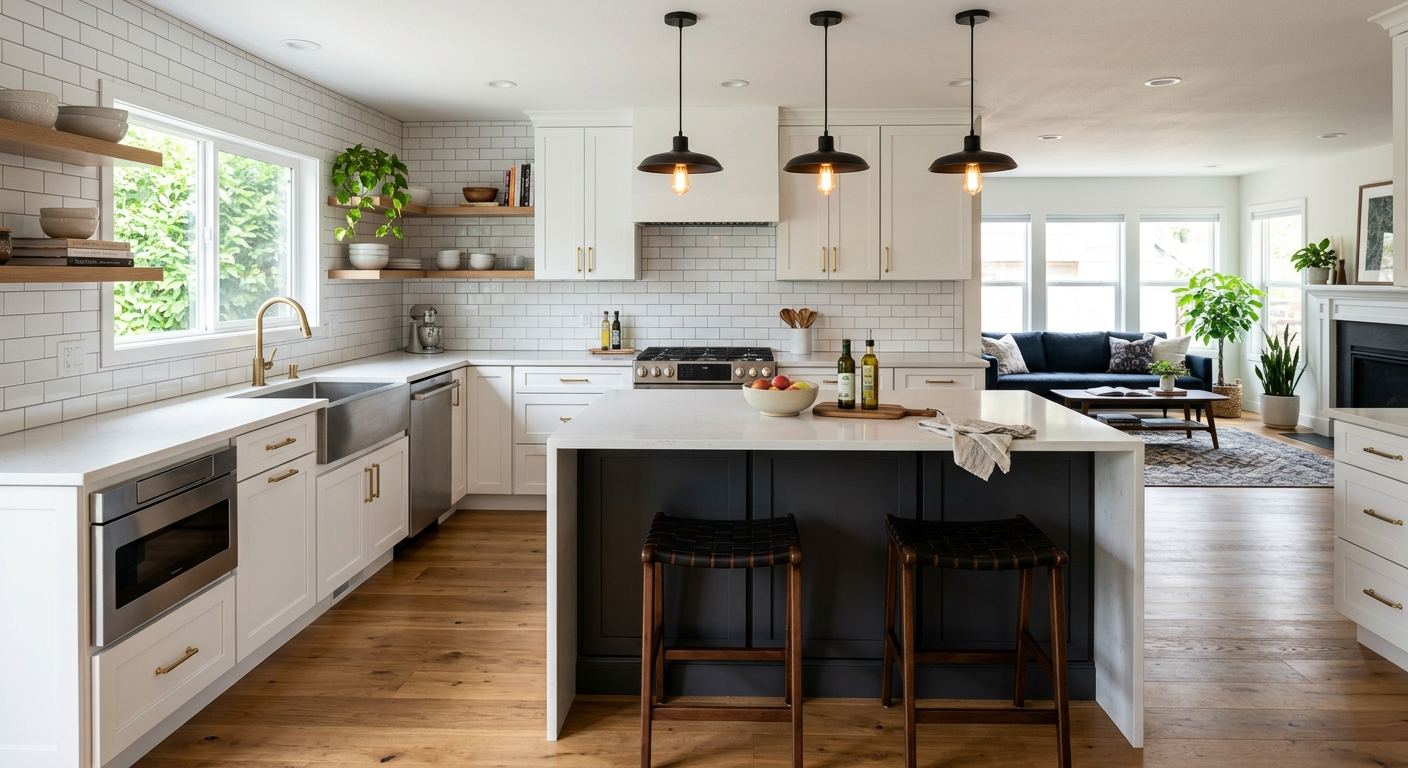
Kitchen renovation options and costs in East Newton South
In East Newton South, British Columbia, kitchen renovation pricing is driven less by the weather and more by the typical buyer expectations tied to the Lower Mainland–Southwest housing market. With a 2021 population of 7,881 people in the area, demand tends to cluster around practical family layouts and mid-range finishes rather than ultra-specialty showpieces for every project (Statistics Canada, 2021 Census). In the Lower Mainland–Southwest, kitchens also often reflect the resale logic of higher-value neighbourhoods: owners who expect to sell soon tend to choose finish packages that read “current” in photos and showings—like quartz counters and semi-custom cabinetry—because those upgrades are easier to justify when the kitchen is a focal point.
Climate still matters, but mostly in how it affects materials and installation details. Humidity swings, coastal rain exposure, and the way Vancouver-area basements and crawlspaces behave can influence cabinet box sealing, under-sink waterproofing, and the longevity of tile grout and caulking. In East Newton South (and nearby Newton/South Surrey-style shopping corridors), contractors are especially busy during spring and early summer, when homeowners can stage dust control and coordinate utility shut-offs with fewer schedule conflicts.
Because similar kitchens can land in different price tiers, it helps to pick the “tier” first, then price the components. Use the table below as a realistic starting point for comparing a cosmetic refresh against a full rebuild.
| Renovation Tier |
What's Included |
Typical Duration |
Price Range |
| Cosmetic refresh (paint, hardware, new appliances only) |
Cabinet paint/finish (no box changes), new pulls/knobs, new appliances, touch-up repairs, basic caulking |
1–3 weeks |
$12,000–$30,000 |
| Mid-range full renovation (new cabinets, counters, sink, tile) |
New semi-custom cabinets, countertop replacement, sink + faucet, backsplash tile, flooring patching, labour for install |
4–7 weeks |
$55,000–$85,000 |
| High-end full renovation (custom cabinets, stone counters, island) |
Custom millwork, stone/quartz with upgraded edges, island build, premium hardware, extended backsplash coverage, higher-complexity layout work |
7–12 weeks |
$95,000–$120,000 |
| Cabinet refacing only (new doors + drawer fronts, same boxes) |
Refacing panels, new drawer fronts and doors, new hardware, install and finishing alignment |
2–5 weeks |
$18,000–$40,000 |
| Countertop swap only (laminate to quartz or stone) |
Remove old counters, install new quartz/stone, new sink cut-out adjustments (where feasible), seam work |
1–2 weeks |
$8,000–$15,000 |
| Backsplash tile installation only |
Tile supply and install, layout and waterproofing behind, edging details, grout seal (as required) |
3–7 days |
$1,500–$6,000 |
Prices are estimates only and vary by project scope, site access and material selection.
What affects the price of kitchen renovation in East Newton South
In the Lower Mainland–Southwest, you’ll often see quotes for the “same” kitchen vary by 30–50% because the real drivers are tied to home value, expected finish level, and how much trades coordination the plan requires—not simply the season. A basic refresh with laminate surfaces can stay restrained, while a kitchen that swaps cabinetry, changes the layout, and upgrades to quartz or stone counters typically escalates quickly once you factor in millwork lead times and additional electrical/plumbing work.
Local conditions matter, but the biggest influence is how the market recovers renovation cost on resale. In higher-value pockets of Metro Vancouver and nearby Surrey-adjacent areas, homeowners more commonly choose quartz or stone counters and semi-custom cabinetry because those materials photograph well and hold up to busy family use. In more modest-scoped jobs, laminate and stock cabinetry dominate because the ROI remains strong when you’re updating the look without triggering major plumbing or electrical revisions. In East Newton South, that balance shows up in how many projects land around the mid-range full renovation band of $40,000–$120,000 total, depending on whether the plan is “replace and align” or “rebuild and re-route.”
Two concrete examples of cost swing in East Newton South: (1) moving a sink to line up with a window can add cabinet rebuilds, new shut-offs, and longer plumbing runs, even if the visible kitchen size looks unchanged; (2) adding an island often means new lighting circuits and, if gas is involved, gas line coordination—costs that can push a countertop swap (roughly $3,000–$12,000) into a larger full kitchen timeline. Even though the region’s climate isn’t the primary price driver, consistent humidity and occasional coastal moisture exposure make waterproofing details and caulking execution more important for longevity.
| Price Factor |
Why It Matters |
Cost Impact |
| Cabinet tier — stock vs. semi-custom vs. fully custom millwork |
Different construction tolerances, drawer quality, interior organizers, and lead times |
Can shift a full kitchen by tens of thousands, often the largest line item after layout |
| Countertop material — laminate vs. quartz vs. granite vs. stone |
Material cost, installation complexity, edge/seam planning, and durability |
Typically the countertop portion can range from “swap-only” to a major scope change |
| Layout change — wall removal, island add, plumbing/gas move |
Triggers structural checks, permits, and more trade coordination |
Often adds the most unpredictable costs, regardless of finish tier |
| Appliance package tier — builder vs. mid-range vs. pro-grade |
Electrical requirements, ventilation specs, and fitting complexity |
Can add several thousand, and may increase electrical/plumbing allowances |
| Flooring — refinish existing vs. full replacement |
Removal waste, subfloor repairs, and matching patching can be more work than expected |
Full replacement usually adds material + demo labour |
| Backsplash — ceramic tile vs. marble vs. full-height slab |
Weight, substrate prep, and finishing details change labour intensity |
Can move the backsplash from budget to premium quickly |
| Electrical — new circuits for island, under-cabinet lighting |
Requires licensed work and careful layout planning for lighting/charging |
Often adds cost and schedule time, especially when moving outlets |
| Permit fees and licensed trade requirements |
Work that affects systems needs approvals and inspection coordination |
Can add administrative costs plus coordination time |
Permits & regulations in British Columbia
In British Columbia, a cabinet and countertop swap typically does not require a permit, as long as you’re keeping the plumbing and electrical in the same location and you’re not altering structural components. For example, replacing existing countertops with new quartz, granite, or laminate, and swapping cabinet fronts/doors (refacing) generally falls into “like-for-like” work that doesn’t trigger building permits.
Permits and licensed trades are usually required when you change building systems or the structure. That includes moving plumbing supply lines and drain lines, relocating a gas appliance (stove/range) or gas-related venting, removing a load-bearing wall (or making changes that affect structural support), and adding new electrical circuits (for example, dedicated island circuits, under-cabinet lighting tied into new junctions, or moving outlets). Gas work must be performed by a licensed gas fitter, and electrical work must be done by a licensed electrician, both followed by required inspections as applicable.
For a homeowner in East Newton South, verify three things before signing: (1) the contractor’s licensing/credentials (ask for their business registration details and trade credentials where applicable), (2) proof of liability insurance (certificate of insurance) and (3) clear coverage documentation for workers. You should ask whether they carry WSIB/WCB coverage and obtain clearance letters or COI confirmations in writing. The key point: even if the contractor says “permits are handled,” the responsibility for permit scope should be explicitly stated in the contract, including who pulls the permit and who pays the fees.
Cabinets, countertops and layout decisions in East Newton South
When homeowners in East Newton South renovate, there are three decisions that most strongly determine both cost and long-term satisfaction: (1) cabinet tier, (2) countertop material, and (3) layout changes. In the Lower Mainland–Southwest resale market, buyers often expect an updated look with durable, easy-to-clean surfaces. That expectation pushes many mid-range projects toward semi-custom cabinetry and quartz counters, while stock cabinets and laminate are more common in budgets that prioritize speed and lower risk.
Cabinet tier sets your baseline. Stock cabinets are typically the fastest and cheapest because they come in standard sizes, which reduces lead time. Semi-custom cabinets are the popular middle ground because you can dial in dimensions without the full premium of custom millwork. Custom cabinets cost more, but they’re worth it when your kitchen has odd angles, high ceilings, soffits, or you want a truly seamless fit.
Countertops should be chosen for how the household uses the space and for maintenance. Laminate is budget-friendly, but it can be less resilient to heavy wear and heat exposure. Quartz offers strong durability and low maintenance, and it’s often the best “value” choice when you want the look of stone without the upkeep. A realistic price example: upgrading from laminate to quartz as part of a countertop swap-only scope is often priced in the $8,000–$15,000 band depending on sink cut-outs and edge work; that upgrade commonly feels justified versus saving a smaller amount but accepting a shorter service life.
Finally, layout changes are where costs can jump regardless of material. Removing a wall or adding an island can unlock a better flow for entertaining, but they also trigger electrical, plumbing/gas coordination, and potentially permits and structural review. If your goal is resale appeal, the “space gain” needs to be real—like improved clearance or a functional work triangle—otherwise it’s easy to spend premium dollars without a proportional upgrade in day-to-day use.
| Option |
Durability |
Maintenance |
Best For |
Price Range |
| Stock cabinets (big-box) |
Good for standard households; more limited customization |
Low effort; wipe-down and routine tightening as needed |
Budget timelines and straightforward dimensions |
$8,000–$18,000 |
| Semi-custom cabinets (local dealer) |
High durability with better drawer/door options |
Typical cabinet care; hardware adjustments over time |
Most East Newton South remodels balancing cost and fit |
$18,000–$35,000 |
| Custom cabinets (local millwork shop) |
Best fit and strongest build options; ideal for complex layouts |
Low day-to-day maintenance; quality hardware supports longevity |
Odd ceiling heights, built-ins, and premium resale finishes |
$35,000–$70,000 |
| Laminate countertop |
Moderate; can chip or wear with impact/heat if not protected |
Easy daily cleaning; avoid prolonged heat and heavy dragging |
Lower budgets and quick refreshes |
$3,000–$7,000 |
| Quartz engineered countertop |
High resistance to stains and everyday wear |
Very low maintenance; no sealing required |
Family kitchens wanting a stone look with practical care |
$7,000–$12,000 |
| Granite / natural stone countertop |
Very durable; each slab has unique character |
Requires periodic sealing depending on the stone and finish |
Premium upgrades where natural variation is a feature |
$9,000–$14,000 |
| Butcher block countertop |
Durable with proper maintenance; sensitive to soaking water |
Needs oiling and good drying habits near sinks |
Warm, casual styles and owners willing to maintain |
$6,000–$11,000 |
| Marble countertop |
Beautiful but more susceptible to etching/staining |
Higher maintenance; requires careful cleaning and sealing |
Premium aesthetic kitchens with lighter wear patterns |
$12,000–$18,000 |
How to choose a kitchen renovation contractor in East Newton South
Picking the right contractor in East Newton South comes down to verification, clarity in the scope, and how they handle risk. First, confirm British Columbia licensing and coverage. For trades that require licensing, ask to see current proof of licensure (request their licence numbers and certificates). For insurance, request a certificate of liability insurance naming the right party for the project, and ask for WSIB/WCB/WCA clearance documentation that confirms worker coverage. If a contractor can’t provide documentation promptly, treat that as a scheduling and financial red flag.
Next, get 2–3 itemised written quotes, not lump sums. The best quotes break down labour and materials separately and show assumptions: cabinet line/finish, countertop material and edge profile, backsplash tile type and grout, appliance allowances, disposal costs, and what happens if the installer finds hidden moisture damage behind old cabinets (common in older kitchens). Ensure the contract spells out whether permits are included, who pulls them, and what the timeline includes for inspections. Look for workmanship warranty details (length, what’s covered, and exclusions) and product/manufacturer warranties, plus whether warranties are transferable if you sell your home.
Finally, watch payment scheduling. Avoid large deposits: aim for no more than 10–15% upfront, then hold back a portion until the job is substantially complete and punch-list items are fixed. Require a start date and a completion estimate in writing, with allowances for cabinet/countertop lead times.
- Ask for written licence/credential details where applicable, and confirm they match the specific trades on your scope.
- Request certificate of liability insurance before work begins; verify the policy is active for the project dates.
- Get written confirmation of WSIB/WCB/WCA coverage or clearance letters for the contractor’s workforce.
- Insist on 2–3 itemised quotes: labour, materials, allowances, and exclusions clearly separated.
- Confirm permit responsibility and whether permit fees are included in the quoted price.
- Check disposal and demolition scope: who hauls waste, and what’s included in dump fees.
- Verify measurement process for cabinets and countertops (site measurement vs. template assumptions).
- Confirm the warranty: workmanship length, response time, and whether you keep coverage after sale.
- Use a payment schedule with a holdback until punch list completion (not just “substantial completion”).
- Ask how they protect floors and doors during demolition and install, especially near East Newton South’s older housing stock.
- Ensure electrical/plumbing coordination is covered if you add outlets, under-cabinet lighting, or move a sink.
- Get start/completion dates in writing, including lead-time assumptions for cabinets and counters.
In East Newton South, the most common contractor red flags I see are: quotes that avoid listing product brands/grades and only give a “per foot” estimate, refusal to provide proof of insurance or coverage, a contract that leaves permits “to be determined” after deposit, and payment terms that ask for large upfront amounts without a clear milestone schedule.
Frequently asked questions — kitchen renovation in East Newton South
How long does a kitchen renovation take in East Newton South?
Timelines in East Newton South typically depend on how much you change. A cosmetic refresh (paint, hardware, and new appliances only) often runs about 1–3 weeks. A mid-range full renovation—new cabinets, counters, a sink, and backsplash tile—commonly lands around 4–7 weeks, but cabinet and countertop lead times can push that. A high-end full renovation with custom cabinets and stone counters is often 7–12 weeks. Even when labour is scheduled well, inspections and any required permitting for electrical or plumbing changes can add time, so your best approach is to lock your scope early and confirm material lead times in writing (Statistics Canada, 2021 Census) helps explain why local demand can be seasonal, with peak scheduling in spring/summer.
Quartz vs granite countertops — which is better?
In British Columbia kitchens—especially busy family kitchens in East Newton South—quartz is usually the “best all-round” choice for homeowners who want durability and low maintenance. Quartz is engineered, doesn’t typically require sealing, and resists stains well for everyday cooking. Granite is also very durable and offers natural uniqueness, but you may need periodic sealing depending on the stone and finish. For many renovations, the price difference comes down to how you want to maintain and how visible you want the stone character to be. If you’re budgeting, countertop-only swaps in the market often fall into the $3,000–$12,000 band, while premium slabs and edges can push higher within full kitchen totals of $40,000–$120,000.
Should I reface or replace my cabinets?
Refacing is a strong choice when your cabinet boxes are solid, level, and structurally sound. It typically gives you a newer look without the disruption of full removal and re-installation, and it’s often priced in the $8,000–$50,000 band depending on the kitchen size and door/drawer upgrades. Replacing cabinets makes more sense when boxes are sagging, warped from moisture, or when you need significant layout changes (like adjusting cabinet widths for a new island or upgrading to a different door style that requires modifications). In East Newton South, where some older housing stock can have moisture exposure near sinks, I often recommend a careful inspection before deciding—because if the box is compromised, refacing can look great initially but won’t fix underlying performance issues.
Do I need a permit for a kitchen renovation in British Columbia?
Many kitchen renovations in British Columbia do not require a permit when you’re doing like-for-like upgrades—such as swapping countertops, repainting/finishing cabinets, or installing a backsplash tile. However, permits are commonly required when you move plumbing supply/drain lines, relocate gas appliances (including stove/range changes), remove a load-bearing wall, or add new electrical circuits (for example, wiring for island lighting or relocating outlets). Gas work must be done by a licensed gas fitter and electrical work by a licensed electrician, and inspections are part of that process. In East Newton South, confirm in your written contract who pulls permits and who pays the fees so you’re not stuck with delays or uncovered scope later.
What's the ROI on a kitchen renovation?
ROI varies with the level of finish and how the neighbourhood values “kitchen quality” on resale. In the Lower Mainland–Southwest, homeowners often prioritize durable, modern finishes because kitchens are high-impact for buyer perception and photos. That typically means quartz/stone-looking surfaces and well-functioning cabinetry layouts. If your budget supports it, a mid-range renovation usually provides better ROI than a budget refresh when the existing kitchen is worn out, because you’re improving functionality and perceived quality. If you’re spending in the higher-end band (up to $120,000 for a full renovation scope), you’ll want to make sure the design changes are real—like improved storage, clearer work zones, and reliable lighting—rather than purely aesthetic upgrades. Your specific ROI depends on your starting condition and resale timeline.
How do I budget for a kitchen renovation?
Start by selecting your tier, then build a realistic range. In East Newton South, common budget anchors are roughly $40,000–$120,000 for a full kitchen renovation, $8,000–$50,000 for cabinet installation or refacing, $3,000–$12,000 for countertop installation, and $1,500–$6,000 for backsplash/tile installation. From there, plan for unpredictable costs: layout changes (moving a sink, adding an island, or relocating a gas line) typically introduce more variables than swapping finishes. Add a contingency so you’re not derailed if you find older plumbing, uneven floors, or moisture behind older cabinet bases. Finally, make sure your quote includes permits (where needed), disposal, and the correct allowance for appliances so you can compare contractor proposals apples-to-apples in British Columbia.