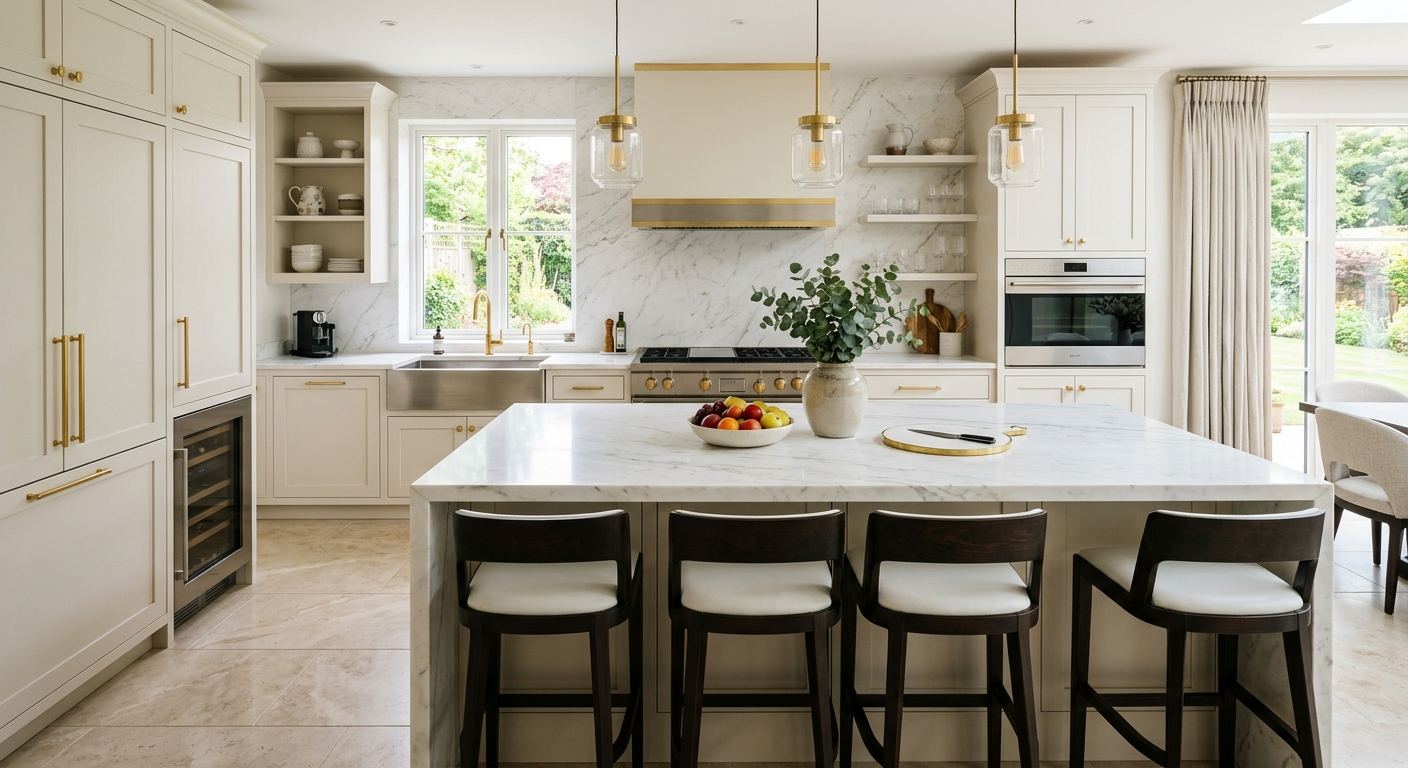
Kitchen renovation options and costs in Brighouse-City Centre
Kitchen renovation in Brighouse-City Centre (Metro Vancouver) typically starts with a simple decision: do you want a fast refresh or a full rebuild? In a city with a population of 62,855 (Statistics Canada, 2021 Census), many homeowners are planning resale-friendly upgrades, and that often means matching today’s buyer expectations for cleaner lines, more storage, and upgraded finishes. Across the Lower Mainland–Southwest, kitchen pricing is also strongly tied to homeowners’ purchasing confidence and the value of the homes themselves—when people can realistically recover the upgrade on resale, they more often choose semi-custom cabinetry and stone-look or stone countertops rather than laminate.
Climate plays a smaller role in cost than in other regions of Canada, because kitchens are indoors and protected from extreme outdoor conditions. That said, Brighouse-City Centre homes still see seasonal humidity shifts, which can affect how surfaces are prepped and how quickly cabinetry installs once the drywall and flooring are conditioned. The other big local driver is contractor availability: high demand in dense Burnaby and nearby corridors can tighten scheduling, and that can add cost if you need a faster turnaround for your appliance delivery or tenant move-out.
In practice, labour and material selections are what move your budget the most. For many projects, the “cosmetic refresh” path keeps totals lean, while “mid-range full renovation” and “high-end full renovation” quickly reflect cabinetry complexity, countertop material, and whether you’re adding or relocating an island. If you’re in the Brentwood area, these upgrades are especially in demand because a lot of homes there get renovated to stay competitive with newer inventory. Use the ranges below as your starting point, then narrow scope with an itemised quote.
| Renovation Tier |
What's Included |
Typical Duration |
Price Range |
| Cosmetic refresh (paint, hardware, new appliances only) |
Cabinet paint or refinish (no box changes), new pulls/handles, backsplash touch-ups as needed, appliance swap (fridge/range/dishwasher), basic caulking and trim |
1–2 weeks |
$8,000–$25,000 |
| Mid-range full renovation (new cabinets, counters, sink, tile) |
Semi-custom or quality stock cabinets, new countertops, sink and faucet, backsplash tile, flooring patching/trim, plumbing hook-ups within existing locations |
3–6 weeks |
$40,000–$80,000 |
| High-end full renovation (custom cabinets, stone counters, island) |
Fully custom cabinetry/millwork, stone counters (quartz/stone), island build, integrated storage upgrades, premium tile or full-height backsplash, upgraded hardware, higher finish detailing |
6–10 weeks |
$80,000–$120,000 |
| Cabinet refacing only (new doors + drawer fronts, same boxes) |
New door/drawer fronts, upgraded hardware, interior face improvements where feasible, countertop left as-is, limited demo and dust control |
2–4 weeks |
$15,000–$45,000 |
| Countertop swap only (laminate to quartz or stone) |
Remove existing surface, templating, new quartz/stone installation, sink cut-outs as required, basic backsplash trim adjustments |
1–3 weeks |
$7,000–$25,000 |
| Backsplash tile installation only |
Ceramic tile or similar backsplash, layout and sealing, removal of existing backsplash as needed, caulking and edge trim |
3–7 days |
$1,500–$6,000 |
Prices are estimates only and vary by project scope, site access and material selection.
What affects the price of kitchen renovation in Brighouse-City Centre
In the Lower Mainland–Southwest, two homeowners can get very different quotes for what looks like the “same” kitchen. It’s common to see a 30–50% swing once you factor in home value and expected finish level, because higher-value neighbourhoods and buyer demographics tend to favour premium cabinetry and stone surfaces. In British Columbia, that means labour, design complexity, and material tiers can shift faster than weather-driven construction impacts.
Local home values and median income (Statistics Canada, 2021 Census) strongly influence the finish tier homeowners choose. In higher-value markets within the Lower Mainland–Southwest, quartz or stone counters and semi-custom cabinetry are popular because the renovation cost is more easily recovered on resale. In more modest scope decisions, laminate and stock cabinets remain attractive because they deliver a refreshed look without triggering expensive box rework or heavy custom millwork.
Layout changes add the most unpredictable cost, regardless of finish level. Moving plumbing or gas, removing a wall to open the kitchen, or adding an island often requires structural checks, new rough-in, and extra electrical work. Those trades are scheduled by availability, which can raise labour costs when the timeline tightens.
Concrete examples from Brighouse-City Centre: (1) a “simple” quartz swap can rise toward the upper end when the existing laminate counters are out of level and require cabinet/edge corrections; (2) adding an island with new power and a venting plan can push the job from a mid-range renovation ($40,000–$80,000) toward high-end ($80,000–$120,000) mainly due to electrical and cabinetry modifications; (3) homes with older, narrower layouts can require more wall patching and longer backsplash and flooring transitions, which adds shop-time and on-site labour.
Finally, housing age matters. Many older condos and townhomes have dated electrical runs and older venting routes, and upgrading those lines can cost more than the visible “finish work.” Even though the climate doesn’t directly attack kitchens, humidity swings can reveal gaps during install—meaning careful prep and re-caulking can protect your finish warranty.
| Price Factor |
Why It Matters |
Cost Impact |
| Cabinet tier — stock vs. semi-custom vs. fully custom millwork |
Custom framing, dovetail drawers, and fit/finish add shop time; stock is faster and cheaper but limited in sizes |
Can swing the budget by roughly 20–50% on the cabinetry portion |
| Countertop material — laminate vs. quartz vs. granite vs. stone |
Material cost, fabrication time, and edge complexity drive price; heavier stones also affect installation handling |
Often a several-thousand-dollar spread; typically $3,000–$12,000 installed depending on material and size |
| Layout change — wall removal, island add, plumbing/gas move |
Triggers structural checks, rough-in trades, and inspection schedules; increases demolition and patching |
Usually the largest “surprise” driver; can add $10,000+ in complex layouts |
| Appliance package tier — builder vs. mid-range vs. pro-grade |
Pro-grade appliances often cost more and may require electrical/venting adjustments or custom panels |
Can add $2,000–$15,000 depending on what you choose |
| Flooring — refinish existing vs. full replacement |
If flooring is old or damaged, replacement may be required to meet new cabinet base alignment |
Replacement commonly adds thousands more than a patch/refinish approach |
| Backsplash — ceramic tile vs. marble vs. full-height slab |
Coverage area and material format affect labour, waterproofing approach, and cutting waste |
Backsplash-only budgets commonly fall in the $1,500–$6,000 range |
| Electrical — new circuits for island, under-cabinet lighting |
New outlets, lighting, and island power require licensed work and re-routing |
Can add several thousand dollars when circuits or pathways are complex |
| Permit fees and licensed trade requirements |
Permits and inspections are tied to certain plumbing/gas/electrical moves and add scheduling and admin time |
Typically a few hundred to a couple thousand, but impacts timeline more than the sticker price |
Permits & regulations in British Columbia
In British Columbia, a straightforward cabinet and countertop swap usually does not require a permit. If you’re replacing doors and drawer fronts, or installing new quartz over existing bases without changing plumbing, gas, or electrical, it’s typically treated as a finish-only scope. However, once you start moving plumbing supply or drain lines, relocating gas for a stove/range, removing a load-bearing wall, or adding new electrical circuits (for an island outlet set, under-cabinet lighting, or any new loads), the work typically requires permits and licensed trades.
Here’s the practical “does require a permit” vs “typically does not” list homeowners in Brighouse-City Centre should use: typically does NOT include paint/refinishing cabinets, replacing countertops with the same sink cut-out locations, and installing a backsplash. typically DOES include cutting into walls for new plumbing runs, changing where a gas range connects, installing new kitchen circuits, or opening up walls for venting and rough-in. Gas work must be performed by a licensed gas fitter; electrical by a licensed electrician; and both require inspections.
To verify contractor compliance in British Columbia, I recommend you do three checks before signing: (1) license/registration details from the appropriate online registry for the trade doing the work; (2) certificate of insurance—confirm it includes liability and that the job is covered for the scope you’re paying for; and (3) workers’ compensation coverage (WSIB/WCB) paperwork or clearance letter. Ask your contractor to spell out in writing what permits they pull, who applies, and which items are excluded from the permit responsibility.
Cabinets, countertops and layout decisions in Brighouse-City Centre
For most Brighouse-City Centre homeowners, three decisions control both cost and satisfaction: (1) cabinet tier, (2) countertop material, and (3) whether you change the layout. In this market, buyers often expect a clean, modern look with strong storage and a durable work surface, so choosing the right tier helps you avoid overspending on features you won’t recoup.
Cabinet tier is where you feel the cost immediately. Stock cabinets are the fastest and generally cheapest, but they limit custom storage and sizing. Semi-custom cabinets are the “sweet spot” for mid-range renovations—better drawer organization, more door styles, and more flexibility for common Metro Vancouver dimensions. Custom cabinets fit perfectly and can handle tricky layouts, but custom millwork usually carries the highest labour and shop costs.
Countertops should be chosen for durability and maintenance over aesthetics alone. Laminate can look great initially but may chip at edges if you’re rough on cookware. Quartz is engineered for consistent performance and is a popular resale-friendly choice in the Lower Mainland–Southwest. Granite/natural stone offers premium veining, but it can require more attention (sealing habits and careful cleaning). Butcher block is warm and practical for prep, but it needs regular oiling and moisture-conscious use.
Layout changes are the cost “multiplier.” If you add an island or open-concept by removing a wall, you may justify the expense through improved traffic flow and storage, but plumbing/gas relocation and new power rough-in often push costs beyond a mid-range scope. For a concrete comparison: upgrading from laminate to quartz is often a smaller incremental line item than moving plumbing. In many kitchens, a quartz countertop swap sits in the $3,000–$12,000 range installed, while island-focused electrical and rough-in complexity can move the project toward the higher renovation tier ($80,000–$120,000) if you’re changing locations rather than only adding finishes.
| Option |
Durability |
Maintenance |
Best For |
Price Range |
| Stock cabinets (big-box) |
Good day-to-day durability; hinges and drawer slides vary by model |
Low; wipe-clean surfaces and tighten hardware as needed |
Fast refresh timelines and lean budgets |
$8,000–$20,000 |
| Semi-custom cabinets (local dealer) |
Very good durability with more reliable drawer construction and options |
Low; occasional hardware tightening and gentle cleaning |
Most Brighouse-City Centre homeowners targeting resale-friendly upgrades |
$18,000–$45,000 |
| Custom cabinets (local millwork shop) |
Excellent durability and best fit for unusual widths, ceilings, and storage needs |
Low; same routine care as higher-end cabinetry |
Complex layouts, appliance garages, and full design-led builds |
$35,000–$80,000 |
| Laminate countertop |
Moderate; edges and seams can be the weak point |
Easy cleaning; avoid impacts and excessive water at seams |
Budget-conscious renovations where you want a clean look quickly |
$3,000–$6,000 |
| Quartz engineered countertop |
High durability; resistant to staining and everyday wear |
Low; wipe and rinse, no sealing required for most products |
Busy households and resale-focused kitchens in British Columbia |
$5,000–$10,000 |
| Granite / natural stone countertop |
High with proper slab selection; natural hardness varies by stone type |
Moderate; sealing and careful cleaning routines |
Premium look with a classic resale appeal |
$7,000–$12,000 |
| Butcher block countertop |
Good for cutting and warmth; can show wear with heavy abuse |
Higher; regular oiling/conditioning and prompt wipe-down of spills |
Home chefs and kitchens that lean into prep work |
$4,000–$9,000 |
| Marble countertop |
Beautiful but softer; can etch or stain without careful protection |
Moderate to high; sealing schedules and careful acidity management |
Statement kitchens with lower abrasion and strong care habits |
$8,000–$15,000 |
How to choose a kitchen renovation contractor in Brighouse-City Centre
Choosing the right contractor in British Columbia starts with compliance and clarity. Before you sign, verify that the contractor is operating legally and that the specific licensed trades are covered for the scope. For gas-related work, you need a licensed gas fitter; for electrical, a licensed electrician. Ask the contractor for their liability insurance certificate and confirm workers’ compensation coverage (WSIB/WCB or clearance letter). Don’t accept “we’re covered” as a verbal statement—request documents and keep them with your contract. You can also check trade licensing details through the relevant provincial registries, then cross-match the name on their quote with the trades scheduled for your project.
Next, get 2–3 itemised written quotes. You want a breakdown that shows labour and materials separately (cabinet supply, install, countertop fabrication/templating, demolition, tile and grout, electrical/electronics, plumbing changes, disposal). Avoid lump-sum only quotes unless the scope is extremely detailed; kitchen renovations become expensive when exclusions are discovered after demolition.
Read the scope and exclusions carefully: is permit pulling included where required, and who pays permit fees? Is demolition and disposal included, including hauling? Is the timeline realistic for cabinet lead times? For warranty, request both workmanship warranty length and manufacturer/product warranty details; confirm whether warranties are transferable if you sell your home.
For payment schedule, never let it go above 10–15% upfront. Use a staged holdback that’s released near completion and after punch-list items are addressed. Finally, get a written start date and completion estimate, and make sure the contract ties schedule commitments to when materials are confirmed.
- Confirm licensed trades for any electrical, plumbing/drain, and gas work—matching names to quote scope
- Request certificate of liability insurance and verify coverage limits match project value
- Ask for proof of workers’ compensation coverage (WSIB/WCB or clearance letter)
- Require an itemised estimate: labour vs materials, with quantities (backsplash square footage, cabinet count, etc.)
- Check what demolition includes (full tear-out vs partial), and who disposes of debris
- Confirm permit responsibility in writing—especially for plumbing moves, gas relocation, and new circuits
- Verify countertop templating timing and whether lead times are built into the schedule
- Make sure electrical is specified for under-cabinet lighting and island outlets (if included)
- Ask how dust control is handled during demo and cabinet install (plastic barriers, negative pressure if needed)
- Review warranty terms in the contract: workmanship duration and manufacturer coverage, plus exclusions
- Use a payment schedule with a holdback until completion and punch-list sign-off
- Get a start date and completion estimate in writing, including dependencies like appliance delivery and inspection dates
Red flags in Brighouse-City Centre: (1) quotes without an itemised breakdown (only “lump sum”); (2) claiming they “don’t need” permits for moving plumbing/gas/electrical; (3) refusing to provide insurance and workers’ compensation proof; (4) short schedules that ignore cabinet lead times; and (5) payment requests higher than 10–15% upfront without a staged plan tied to milestones.
Frequently asked questions — kitchen renovation in Brighouse-City Centre
What is the difference between a galley and open-concept kitchen?
A galley kitchen is a long, efficient layout with counters on two opposing sides, often separated by a narrow walkway. It’s common in townhomes and older condos because it fits small footprints and keeps the work zone tight. An open-concept kitchen removes barriers between the kitchen and living/dining areas, usually by removing a wall or reworking the space to improve sightlines and entertaining flow. In Brighouse-City Centre and throughout British Columbia, open-concept can add cost because it may trigger wall removal assessments and extra rough-in work (especially if plumbing or venting needs changing). If your renovation budget is targeting the mid-range band (often $40,000–$80,000), a galley refresh is usually easier to keep within scope than an open-concept build that requires structural changes and more finish transitions.
How do I get accurate kitchen renovation quotes in Brighouse-City Centre?
To get accurate quotes in Brighouse-City Centre, you need comparable scopes. Start by sharing your measurements, photos, and whether any plumbing/gas/electrical moves are planned. Ask for 2–3 itemised quotes that separate labour and materials (cabinet supply and install, countertop templating and fabrication, tile, electrical, plumbing, demolition and disposal). Ensure the quote clearly states what’s included and what’s excluded—especially permits, inspection scheduling, and whether disposal is part of the contract. A reliable contractor will also confirm cabinet lead times and appliance rough-in requirements (like ventilation). If you’re comparing to typical kitchen renovation bands ($40,000–$80,000 for many mid-range full renos, $80,000–$120,000 for higher-end builds), itemisation prevents you from paying for “extras” later and helps you judge whether a quote is truly like-for-like.
What's the best countertop material for a busy Brighouse-City Centre kitchen?
For most busy households in Brighouse-City Centre, quartz is the safest, most resale-friendly balance of durability and low maintenance. It resists staining and daily wear, and you typically don’t need sealing the way you might with some natural stones. Laminate can work well for a budget refresh, but seams and edge wear are more likely over time if you’re heavy-handed with pans or cleaning. Granite/natural stone looks premium and holds up well, but it can require periodic sealing routines and careful cleaning choices. If you want a practical guideline: countertop-only swaps often land around the $3,000–$12,000 range installed depending on material and size, and full kitchen projects that choose quartz commonly fall into mid-range or high-end totals depending on cabinetry and layout changes (for example, $40,000–$80,000 vs $80,000–$120,000). Your best choice also depends on whether you’re adding an island and how much prep work you do daily.
How do I add an island to my Brighouse-City Centre kitchen?
Adding an island usually starts with layout and service planning: where the island will sit, how much walkway clearance you need, and whether you’ll bring power and lighting to it. In Brighouse-City Centre, the big drivers are electrical and any plumbing/gas relocation (if you plan a sink or cooktop on the island). Even when you’re only moving within the same general wall footprint, new circuits for island outlets and under-cabinet lighting typically require licensed electrical work and may require permits. Step-by-step, I suggest: (1) confirm your island size and clearance requirements; (2) decide whether the island is decorative/prep-only or includes a sink/cooktop; (3) rough-in electrical/plumbing before cabinetry and countertop installation; (4) install cabinets and base framing; then (5) fabricate and install the countertop and finish the backsplash detailing. Because island projects often push kitchen totals higher, it’s smart to plan around the higher end of your intended renovation band (mid-range vs high-end) so you’re not surprised by rough-in scope.
How much does a kitchen renovation cost in Brighouse-City Centre?
Kitchen renovation costs in Brighouse-City Centre typically depend on how much you change the layout and what tier of materials you choose. A cosmetic refresh (paint, hardware, appliances only) often stays relatively lean, while a mid-range full renovation usually lands around $40,000–$80,000 when you’re updating cabinets, counters, a sink, and tile. High-end full renovations with custom cabinetry, stone counters, and an island commonly fall in the $80,000–$120,000 band, largely because custom millwork and service work add labour and coordination. Cabinet refacing can be a middle path when existing boxes are sound, and countertop swaps alone often land around the $3,000–$12,000 range installed depending on material. Because quotes can swing significantly, always compare like-for-like scopes and confirm what’s included for demolition, disposal, permits (where needed), and any new electrical circuits. That’s the quickest way to keep your budget aligned from day one.
How long does a kitchen renovation take in Brighouse-City Centre?
Timelines in British Columbia depend on scope and—especially—material lead times. A cosmetic refresh can often be completed in 1–2 weeks if cabinetry isn’t being replaced and appliances are already on hand. Mid-range full renovations typically take around 3–6 weeks, assuming cabinets and countertops are scheduled smoothly and rough-in work doesn’t uncover hidden issues. High-end renovations commonly take 6–10 weeks because custom cabinetry and stone fabrication require additional shop time and more coordination for islands and premium finishes. Countertop-only swaps are usually shorter (about 1–3 weeks), while backsplash-only work can be done within a few days to a week. For the most reliable estimate in Brighouse-City Centre, ask your contractor for a written schedule tied to inspections and deliveries, and confirm whether start dates depend on cabinet and countertop fabrication readiness.