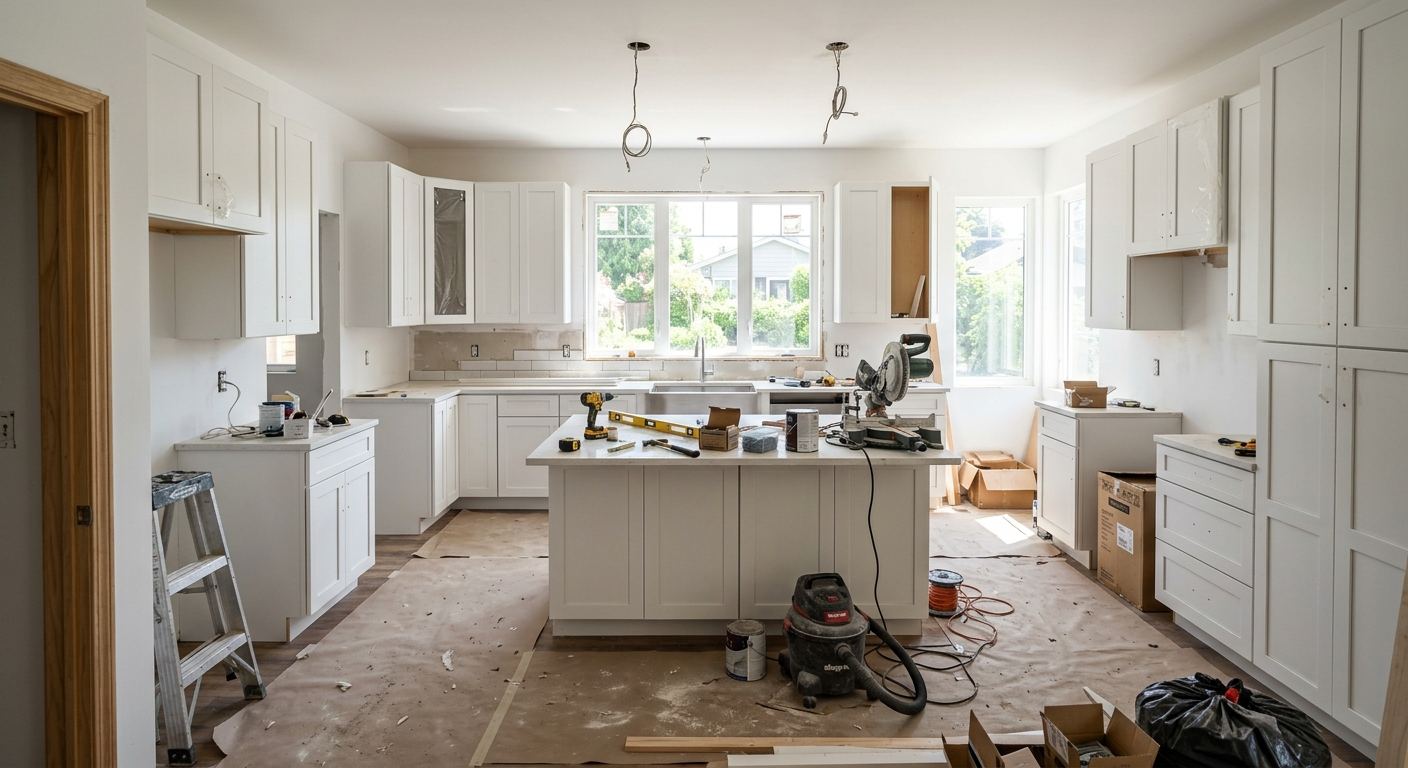
Kitchen renovation options and costs in Cordova Bay
Cordova Bay homeowners typically have three clear paths when planning a kitchen renovation: a quick refresh, a mid-range full update, or a higher-end rebuild that redesigns the room. With a population of about 8,100 (Statistics Canada, 2021 Census), the market is small enough that the best trades can book out early—so timing matters as much as budget. In the Lower Mainland–Southwest, kitchen pricing is also strongly influenced by household purchasing expectations and resale value. When neighbourhoods skew higher-value, owners more often choose semi-custom cabinetry and stone counters, because the improvement is easy to justify on future buyer appeal.
On the cost side, the Lower Mainland–Southwest is less about climate-driven material failure and more about market-driven labour demand and finish selection. Coastal conditions in and around Cordova Bay (salt air, indoor humidity swings, and temperature changes) make ventilation and material sealing important, but the biggest differences usually come from scope: changing layout, upgrading electrical, and moving plumbing or gas. Availability can also push pricing—during peak renovation months, crews spend more time on scheduling and site protection, and that labour cost shows up in your quote.
If you’re in the Belmont/John Manson corridor area of Cordova Bay, kitchen work is especially in demand because many homes there are older and have that classic “needs an update” layout. From that starting point, the comparison below shows what different renovation tiers usually include and how long they take, so you can match your scope to your budget.
| Renovation Tier |
What's Included |
Typical Duration |
Price Range |
| Cosmetic refresh (paint, hardware, new appliances only) |
Paint, new cabinet hardware, appliance swap, minor touch-ups, basic cleaning/caulking |
3–7 days |
$8,000–$25,000 |
| Mid-range full renovation (new cabinets, counters, sink, tile) |
New cabinets (semi-custom or better stock), countertop replacement, sink + faucet, backsplash tile, tile flooring updates as needed |
3–5 weeks |
$40,000–$80,000 |
| High-end full renovation (custom cabinets, stone counters, island) |
Custom cabinetry/made-to-fit millwork, quartz or natural stone counters, island, upgraded hardware, detailed backsplash (often elevated pattern), coordinated electrical/lighting |
6–10 weeks |
$80,000–$120,000 |
| Cabinet refacing only (new doors + drawer fronts, same boxes) |
Refacing/veneers, new door & drawer fronts, alignment adjustments, hardware changes, light prep/paint/trim touch-ups |
1–3 weeks |
$8,000–$35,000 |
| Countertop swap only (laminate to quartz or stone) |
Remove existing counters, fabricate/install new countertop, sink cut-outs as needed, basic backsplash caulking or minor tile touch-up |
3–10 days |
$15,000–$50,000 |
| Backsplash tile installation only |
Tile install (including prep), grout/seal, edge trims, waterproofing details in wet areas |
2–7 days |
$1,500–$6,000 |
Prices are estimates only and vary by project scope, site access and material selection.
What affects the price of kitchen renovation in Cordova Bay
In the Lower Mainland–Southwest, two quotes for the “same” kitchen can easily differ by 30–50% because scope gets interpreted differently and because finishes are tied to resale expectations. While coastal weather does influence how kitchens should be ventilated and sealed, the real driver is local purchasing power and the finish tier buyers expect in a given sub-market. In higher-value parts of Metro Vancouver, homeowners tend to choose quartz or natural stone counters and semi-custom cabinetry; in more modest areas, laminate surfaces and stock cabinetry often deliver better ROI. That’s why the same 10 ft run of cabinets can land in a mid-range $40,000–$80,000 renovation—or stretch into a premium $80,000–$120,000 build once you add made-to-fit cabinetry, an island, and upgraded lighting.
Concrete examples you’ll see in Cordova Bay:
- Older homes and uneven walls: When studs aren’t plumb or floors aren’t perfectly level, contractors spend more labour on shimming, re-framing, and custom adjustments—often adding material and shop time, especially with cabinet systems that require precise mounting.
- Humidity and ventilation upgrades: Coastal air can raise indoor humidity swings; if your existing range hood doesn’t vent properly, upgrades (ducting, fan upgrades, sealing) add cost but protect cabinets and countertops long-term.
- Gas/plumbing proximity: Moving a gas line or drain/p-trap is labour-intensive and requires licensed trades, so even a “small” layout tweak can jump several line items quickly.
Layout changes remain the most unpredictable cost regardless of finish level—removing a wall, adding an island, or moving a gas line changes the plumbing/electrical path and trades sequencing. For budgeting in Cordova Bay, plan your layout early, then select finishes; once the cabinet tier is chosen, the rest becomes easier to price against the common full renovation bands.
| Price Factor |
Why It Matters |
Cost Impact |
| Cabinet tier — stock vs. semi-custom vs. fully custom millwork |
Determines how well cabinetry fits your exact dimensions, door styles, internal organizers and lead times |
Can swing the job by $15,000–$45,000 depending on fit and design complexity |
| Countertop material — laminate vs. quartz vs. granite vs. stone |
Material price, fabrication difficulty, edge profiles, and repairability vary widely |
Typical countertop install can range across $3,000–$12,000, with higher-end installs adding more |
| Layout change — wall removal, island add, plumbing/gas move |
Creates structural, plumbing, electrical and schedule impacts; often introduces permits and more trades |
Often the biggest swing factor; can add $8,000–$30,000+ even when cabinet finishes stay similar |
| Appliance package tier — builder vs. mid-range vs. pro-grade |
Pricing varies by capacity, ventilation integration, finish, and whether electrical/gas specs change |
Can add $2,000–$15,000+ depending on pro-grade selections and venting requirements |
| Flooring — refinish existing vs. full replacement |
Existing surfaces may need prep/level corrections; full replacement adds underlayment, labour, and waste |
Typically shifts $2,000–$10,000+ based on extent and subfloor condition |
| Backsplash — ceramic tile vs. marble vs. full-height slab |
Installation complexity, material fragility, and detailing at outlets/edges affect time |
Often falls within $1,500–$6,000, with special materials pushing higher |
| Electrical — new circuits for island, under-cabinet lighting |
New wiring, pot lights, and lighting placement must match cabinet layout and appliance needs |
Frequently adds $1,500–$7,500+ depending on how extensive the changes are |
| Permit fees and licensed trade requirements |
Permits and inspections add administrative time and licensed-trade scheduling |
Commonly $500–$3,500+ in typical scenarios, plus schedule risk if approvals lag |
Permits & regulations in British Columbia
In British Columbia, many “like-for-like” kitchen swaps don’t require permits, especially when you’re not changing the building’s services or structure. Generally, cabinet and countertop swaps typically do not require permits because you’re replacing finishes, not altering plumbing, gas, or electrical systems. Similarly, a backsplash installation over existing surfaces usually falls into non-permit work, assuming you’re not opening walls extensively for new wiring or plumbing.
Where permits and licensed trades usually do come into play:
- Moving plumbing supply or drain lines (sink relocation, new dishwasher/drain runs)
- Relocating gas (stove/range, gas connections, and often changes to hood venting when gas appliances are involved)
- Adding electrical circuits (island outlets, under-cabinet lighting tied to new circuits)
- Removing a load-bearing wall or making significant structural changes
For a Cordova Bay homeowner, the practical way to verify a contractor is to check three things before signing: (1) licensing for the specific trade scope (gas fitter for gas work; electrician for electrical work), (2) liability insurance with a current certificate of insurance that matches the named insured and project address, and (3) WCB coverage (workers’ compensation coverage) or confirmation they have it for the trades involved. Ask for the documents up front, and confirm the listed clearance/coverage before work begins. In addition, always ensure the contract clearly states which permits are pulled and who is responsible—don’t leave it to “we’ll sort it out later.”
Cabinets, countertops and layout decisions in Cordova Bay
For most Cordova Bay kitchens, the three biggest decisions are: (1) cabinet tier, (2) countertop material, and (3) whether you change the layout. These choices determine not just aesthetics, but how smoothly trades can work together and how much rework happens. In the Lower Mainland–Southwest resale market, buyers commonly expect clean lines and durable surfaces at the mid-to-premium end—especially in homes where the kitchen is a central living space.
Cabinet tier: Stock cabinets are typically the fastest and easiest to install, but the fit may be less perfect in older Cordova Bay homes where walls and floors aren’t always square. Semi-custom is the most popular balance; it usually handles common framing irregularities better without the full custom price. Custom millwork is worth it when you want a specific storage layout (pantries, appliance garages, angled corners) or when you’re building around an awkward footprint.
Countertops: Laminate is budget-friendly and can look modern with the right finish, but quartz is often the sweet spot for long-term maintenance. Quartz generally suits the everyday demands of coastal kitchens—less staining risk than natural stone in typical use—while still needing good care at seams and edges.
Layout changes: Removing a wall or adding an island can be justified when it improves flow and lets you add seating or better work zones. But relocating plumbing or a gas line is the part that can quickly break budgets. For example, if you keep the sink where it is, you can often stay closer to a mid-range full renovation $40,000–$80,000; if you move the sink and add an island with new electrical and plumbing runs, the same cabinet and counter choices can push toward a premium $80,000–$120,000 package.
Because Cordova Bay homes experience coastal humidity swings, plan for proper ventilation and ensure material transitions are sealed correctly—your cabinet longevity and countertop performance depend on that more than you might expect.
| Option |
Durability |
Maintenance |
Best For |
Price Range |
| Stock cabinets (big-box) |
Good for standard dimensions; durability depends on finish and hardware |
Low maintenance; replacement of minor doors may be easy later |
Fast timelines and budgets where fit tolerances are acceptable |
$8,000–$25,000 |
| Semi-custom cabinets (local dealer) |
Very strong build quality; better internal organizers and improved fit |
Low maintenance; durable coatings and hinges |
Most Cordova Bay renovations aiming for resale-ready finishes |
$20,000–$55,000 |
| Custom cabinets (local millwork shop) |
Highest potential durability and fit; made for irregular spaces |
Low maintenance; longevity depends on hardware selection |
Architectural layouts, unique storage, and made-to-fit design |
$45,000–$90,000+ |
| Laminate countertop |
Decent everyday durability; sensitive at seams and heat exposure |
Easy cleaning; avoid heavy abrasion and protect near edges |
Budget-conscious upgrades when appearance is the main goal |
$3,000–$6,500 |
| Quartz engineered countertop |
High durability; resistant to staining and daily wear |
Simple wipe-down; minimal sealing requirements |
Balanced “premium look” with practical maintenance |
$6,500–$12,000 |
| Granite / natural stone countertop |
Very durable but varies by slab; can chip or crack at impact points |
May require periodic sealing; protect from staining |
Homeowners who want natural pattern variation and higher-end style |
$7,500–$14,000 |
| Butcher block countertop |
Durable with proper care; can dent/scratch and needs protection from moisture |
Oiling/maintenance required; dry after heavy wet use |
Warm, traditional looks in homes with proper ventilation |
$4,500–$10,000 |
| Marble countertop |
Beautiful but softer; more susceptible to etching and staining |
Higher maintenance; requires careful cleaning and sealing habits |
Design-forward kitchens where stone care is part of the lifestyle |
$10,000–$20,000+ |
How to choose a kitchen renovation contractor in Cordova Bay
Choosing the right contractor in Cordova Bay comes down to proof and process—especially in British Columbia where licensed trades are required for gas and electrical changes. Start by verifying the contractor’s scope coverage: if they’re doing gas work, confirm the project is handled by a licensed gas fitter; if they’re changing wiring or adding circuits (common for island outlets and under-cabinet lighting), confirm a licensed electrician is included. Request liability insurance and a current certificate of insurance that names the right insured and covers the work. For workers’ compensation coverage, ask for confirmation they’re covered under WCB and that subcontractors are also covered—this is one of the easiest ways to avoid problems on site.
Then get 2–3 itemised written quotes rather than one lump number. A strong quote breaks out labour and materials by line item (demolition, carpentry, cabinet supply, counter fabrication/installation, tile prep/install, electrical/plumbing allowances, disposal). Read the scope carefully for what’s excluded: dust control, permit pull responsibility, disposal of demolition debris, and whether flooring upgrades or subfloor fixes are included if surfaces are damaged.
Warranty also matters. Confirm workmanship warranty length, what it covers (labour vs. callbacks), and whether product warranties are included and transferable if you sell the home. For payment schedule, never agree to pay more than about 10–15% upfront; hold back part of the payment until completion and punch-list sign-off. Finally, insist on a written start date and a completion estimate, including lead-time assumptions for cabinets and countertops.
- Ask for their BC licence/coverage details relevant to your scope (gas/electrical/carpentry) and match them to the quote’s line items.
- Request certificates of insurance and confirm coverage limits are appropriate for renovation work.
- Confirm WCB/workers’ compensation coverage for the contractor and any subcontractors.
- Get itemised quotes that separate labour vs. materials (don’t accept “allowances” without ranges and sources).
- Confirm whether permit pulling is included and, if not, who is responsible.
- Clarify disposal: demo removal, hauling, and whether recycling is part of the service.
- Check demolition protections: floor protection, dust containment and tarping during active phases.
- Verify cabinet installation standards: shimming/leveling approach, mounting method, and handling of out-of-square walls.
- Confirm countertop templating timing and who’s responsible for measurement corrections.
- Ask how electrical and plumbing rough-ins will be coordinated with cabinet layout.
- Review warranty documents in writing (workmanship, product warranty, exclusions and transferability).
- Set a payment schedule that keeps a holdback until the punch list is complete.
In Cordova Bay, a few red flags show up often: contractors who won’t provide written scope exclusions, quotes that rely heavily on vague allowances, refusal to list who is responsible for permits, a payment request that’s too front-loaded, and no proof of insurance or WCB coverage before mobilization.
Frequently asked questions — kitchen renovation in Cordova Bay
Do I need a permit for a kitchen renovation in British Columbia?
In British Columbia, you often don’t need a permit for finish-only changes like replacing cabinets, swapping countertops, or installing a backsplash, as long as you’re not opening walls for new service runs. However, permits typically become necessary when you move plumbing supply/drain lines, relocate gas appliances/lines, remove a load-bearing wall, or add new electrical circuits (for example, island outlets or under-cabinet lighting tied to new wiring). For a Cordova Bay project, the practical step is to ask your contractor to list each permit-triggering task in the quote, then confirm the responsibility in writing—who pulls the permit and who schedules inspections. If your plan includes gas or electrical changes, ensure the licensed trades handle those portions before work starts.
What's the ROI on a kitchen renovation?
ROI in Cordova Bay depends heavily on what you change and the finish tier you choose relative to the rest of the home. In the Lower Mainland–Southwest, buyers tend to pay attention to kitchen layout usability, cabinet quality, and countertop durability; that’s why many homeowners aim for the mid-range renovation band (often around $40,000–$80,000) when they want a noticeable upgrade without going fully custom. Going premium can still pay off if the kitchen becomes more functional (better work triangles, improved storage, island seating), but if you add costly elements without a layout benefit, ROI can soften. Also remember: ROI is influenced by timing, interest rates, and how updated competing homes are—not just your materials.
How do I budget for a kitchen renovation?
Budgeting in Cordova Bay works best when you start with scope and finish tier, then confirm the “unknowns” (condition of walls, subfloors, and service locations). Start with one of the realistic bands: a cosmetic refresh might land around $8,000–$25,000, while a mid-range full renovation commonly falls into $40,000–$80,000. Plan for additional costs if you discover older framing issues (out-of-square walls), if you need more electrical work than expected, or if you’re upgrading ventilation—coastal humidity makes proper range hood performance worth the spend. Get itemised quotes (labour and materials) and ensure allowances are transparent so you can compare like-for-like.
Can I move my kitchen sink or stove?
You can usually move a sink or stove, but the feasibility and cost depend on how far you’re relocating and how your home’s services run. Moving a sink typically means altering plumbing supply and drain lines, which often triggers permits and requires licensed plumbing work. Moving a stove can also involve gas line relocation (or electrical changes if it’s induction), and gas work in British Columbia must be done by a licensed gas fitter. In Cordova Bay, moving these fixtures often becomes the biggest cost unpredictability because it changes rough-in paths and can affect cabinet layout. If you want to control budget, consider keeping plumbing/gas locations where possible and focusing upgrades on cabinets, countertops, and surface finishes.
What's the most cost-effective kitchen upgrade?
The most cost-effective upgrade is usually the one that gives the biggest visual change with minimal service disruption. For many Cordova Bay homes, replacing outdated countertops (for example, moving from laminate to quartz) can deliver a high-end look without the expense of full layout changes. A countertop swap alone often sits roughly in the $15,000–$50,000 range depending on edge profiles, sink cut-outs, and whether any plumbing touch-ups are required. If your cabinets are structurally sound, cabinet refacing can also be a strong value, typically around $8,000–$35,000, because you’re upgrading doors and drawer fronts rather than removing everything. If you’re deciding between options, ask for two quotes: one with countertop/cabinet upgrades only, and one that includes any layout changes you’re considering.
Custom vs stock cabinets — is custom worth it?
Custom cabinets are worth it when the kitchen layout or dimensions are challenging, or when you want a truly tailored storage plan (pull-outs, corner solutions, appliance garages, and precise spacing for your lifestyle). In Cordova Bay, older homes can be slightly out of square, and stock cabinets may require compromises or more filler/modifications for a clean result. Semi-custom often provides the best middle ground for most homeowners: improved fit and options without the full cost of custom millwork. If your budget is closer to a mid-range refresh, you may find better value in semi-custom or refacing rather than going fully custom. If you’re targeting a premium build (often $80,000–$120,000), custom can help your kitchen look integrated and “designed,” which is the level buyers expect when paying for a high-end upgrade.