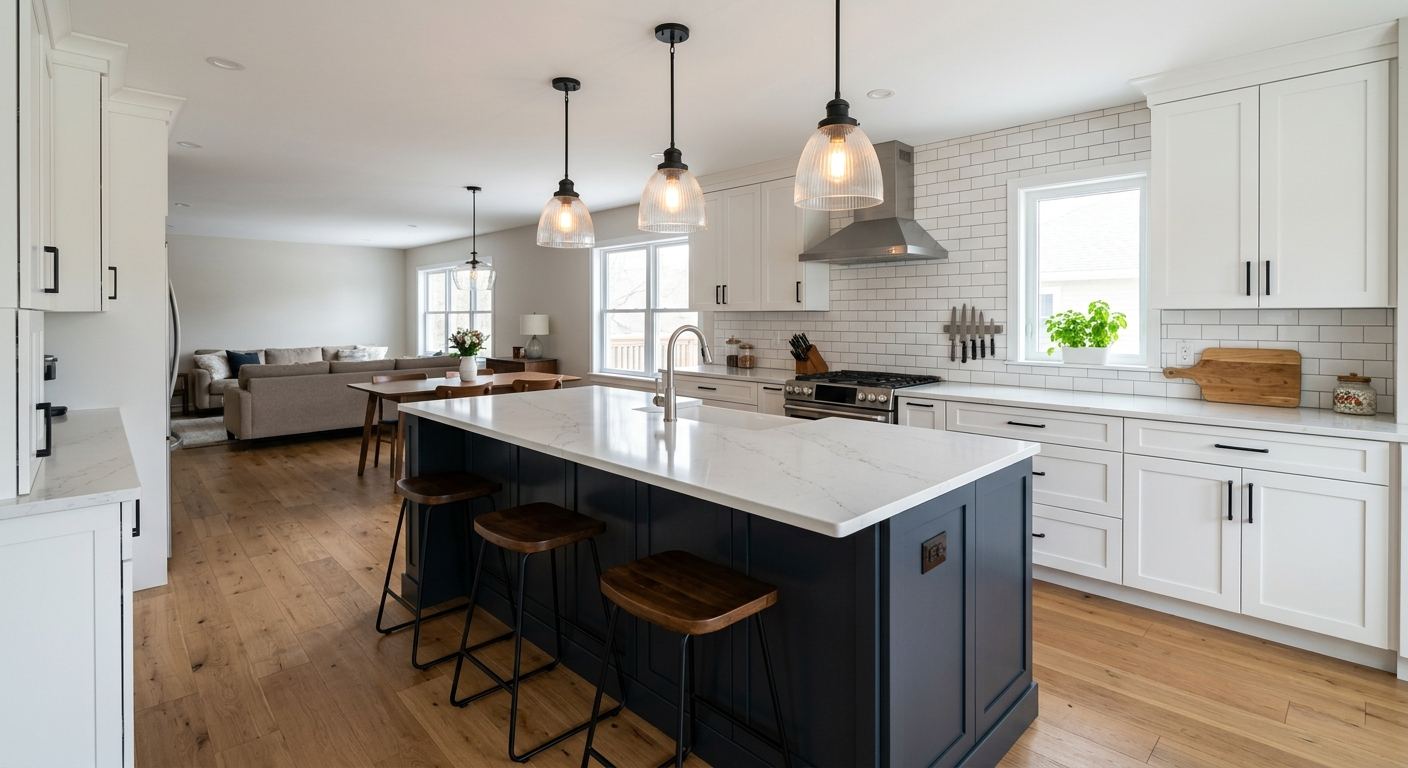
Kitchen renovation options and costs in Vancouver
Kitchen renovation in Vancouver is shaped less by weather and more by market expectations and the type of home you’re improving. In the Lower Mainland–Southwest, the median household income is about $82,000 (Statistics Canada, 2021 Census), which influences what most homeowners can comfortably finance and what finish level feels “right” for the neighbourhood. At the same time, Vancouver’s housing mix includes many older homes—43.0% were built before 1981 (Statistics Canada, 2021 Census)—and that often means dated wiring routes, non-standard framing, and plumbing runs that add labour even when the kitchen footprint stays the same.
Because the Lower Mainland–Southwest is a high-demand trade area, contractor availability stays stronger around Vancouver proper and Richmond than in some farther suburbs, which can actually compress labour quotes during slower periods and loosen them when schedules are full. Still, costs tend to be driven primarily by home value and the expected resale finish: in higher-value pockets, owners more often choose quartz or stone counters and semi-custom cabinetry, while “refresh” jobs (paint, hardware, appliances) remain a practical path for budget-conscious homeowners.
In neighbourhoods like Mount Pleasant, where there’s steady demand for brighter, modern layouts and families frequently refresh to keep homes competitive, we see a lot of conversions from older laminate-and-linoleum kitchens into mid-range, design-led remodels. From there, the options typically split into cosmetic updates, mid-range renovations, or higher-end custom builds—each with a different timeline and price envelope—so use the table below to anchor your planning.
| Renovation Tier |
What's Included |
Typical Duration |
Price Range |
| Cosmetic refresh (paint, hardware, new appliances only) |
Cabinet paint or refinish, new hardware, new appliance set (same footprint), tap/fixture swap (if kept in same location), labour for prep and swap, basic site protection |
1–3 weeks |
$8,000–$25,000 |
| Mid-range full renovation (new cabinets, counters, sink, tile) |
New semi-custom or quality stock cabinets, new countertops (quartz/laminate), sink and faucet, backsplash tile, new flooring/transition trims as required, standard plumbing connections, labour, disposal |
3–6 weeks |
$40,000–$75,000 |
| High-end full renovation (custom cabinets, stone counters, island) |
Fully custom millwork, upgraded stone countertops (quartz/engineered stone with premium edge), island with deeper integration, full-height or premium backsplash, upgraded hardware/pulls, lighting upgrades, layout refinements, enhanced site protection |
6–12 weeks |
$75,000–$120,000 |
| Cabinet refacing only (new doors + drawer fronts, same boxes) |
Refacing materials, new door/drawer fronts, upgraded hardware, hinge adjustments, labour, minor surface repairs, typically keeps existing countertop and plumbing locations |
2–4 weeks |
$8,000–$35,000 |
| Countertop swap only (laminate to quartz or stone) |
Remove and reinstall countertops, new quartz/stone surface, sink cut-out verification, seam/edge work, basic sealing, disposal for old tops |
3–10 days |
$3,000–$12,000 |
| Backsplash tile installation only |
Tile supply allowance, layout and tile install, waterproofing where required, caulking/grout, trim, cleanup and disposal |
3–7 days |
$1,500–$6,000 |
Prices are estimates only and vary by project scope, site access and material selection.
What affects the price of kitchen renovation in Vancouver
In Vancouver and across the Lower Mainland–Southwest, the same “average-sized” kitchen can land 30–50% apart depending on the finish tier, how much the layout changes, and whether trades need to work around older rough-ins. British Columbia labour and material costs are fairly consistent city-to-city, but the big driver of variance is what homeowners in different parts of the market choose to include—especially cabinets and countertops. In higher-value areas of Metro Vancouver, homeowners more often default to quartz or stone counters and semi-custom cabinetry because the upgrade cost is easier to recover on resale; in more modest-scoped projects, laminate surfaces and stock cabinets dominate because they deliver a cleaner look while holding the budget in a tighter band (Statistics Canada, 2021 Census).
Two practical examples we see in Vancouver: first, older homes built before 1981 often have wiring routed through awkward bays; adding under-cabinet lighting or a new island circuit means more labour time for electrical and patch work, pushing the project toward mid-range full renovation pricing (often starting around $40,000). Second, if you’re changing the stove position or adding a peninsula with power and ventilation, you can quickly tip into high-end scope, because the work touches both mechanical and finish carpentry—one reason full remodels commonly reach the $75,000–$120,000 band when premium finishes are selected.
Climate plays a smaller role than resale expectations, but Vancouver’s humid coastal conditions still matter for long-term performance. If cabinets or sub-surfaces weren’t properly dried/conditioned before installation, you can get finish problems later—so reputable contractors budget time for proper prep rather than rushing.
Finally, consider the layout: removing a wall, adding an island, or moving a gas line (or even just the outlet location) creates the most unpredictable cost regardless of whether you choose laminate or stone. That’s why the smartest budgeting approach is to decide on cabinet tier and layout first, then match countertop and backsplash to the remaining budget.
| Price Factor |
Why It Matters |
Cost Impact |
| Cabinet tier — stock vs. semi-custom vs. fully custom millwork |
Custom boxes, better fit/finish, upgraded hardware, and more options for internal storage |
Can add roughly $15,000–$40,000 to a full remodel total depending on kitchen complexity |
| Countertop material — laminate vs. quartz vs. granite vs. stone |
Material cost, fabrication complexity, and edge/seam requirements |
Typically shifts countertop-only work by about $3,000–$12,000, and impacts overall remodel cost indirectly |
| Layout change — wall removal, island add, plumbing/gas move |
Triggers structural considerations and additional trades and inspections |
Often the biggest swing item: increases total cost by $8,000–$30,000+ depending on scope |
| Appliance package tier — builder vs. mid-range vs. pro-grade |
Electrical/venting needs and built-in compatibility |
Can change the appliances portion by $2,000–$10,000+; may also affect labour for integration |
| Flooring — refinish existing vs. full replacement |
Protection, moisture/leveling requirements, and subfloor corrections in older homes |
Usually moves the budget by $1,500–$8,000 based on repair depth and finish |
| Backsplash — ceramic tile vs. marble vs. full-height slab |
Coverage area, substrate prep, and difficulty of premium materials |
Commonly adds $1,500–$6,000+ for tile installation; premium stone can go higher |
| Electrical — new circuits for island, under-cabinet lighting |
Licensed work, load calculations, and patching after rough-in |
Often adds $1,000–$6,000+ depending on how many new runs are required |
| Permit fees and licensed trade requirements |
Fees, inspections, and mandatory licensed contractors for regulated work |
Can add $500–$3,000+ and introduces scheduling lead time |
Permits & regulations in British Columbia
In British Columbia, many “simple swap” kitchen tasks don’t require permits, but a surprising number of common renovation decisions do. Typically, cabinet and countertop swaps do not require permits as long as you’re keeping the same footprint and you’re not altering regulated services. That means replacing cabinets, swapping laminate to quartz, changing a backsplash, and reinstalling countertops on the existing supports are usually permit-free—assuming no electrical, plumbing, or gas relocation is involved.
Where permits usually come into play is when you change the services. Moving plumbing supply or drain lines, relocating a gas stove/range, and any gas-related changes (including certain hood arrangements when gas is involved) generally require permits and must be done by licensed professionals. Removing a load-bearing wall, adding or modifying electrical circuits (for example, new power for an island, adding dedicated outlets, or new lighting circuits), and making changes that affect building safety also require permits and inspections.
For a Vancouver homeowner verifying a contractor before signing, do this in order: (1) Ask for the contractor’s current liability insurance certificate—verify the insurer, policy dates, and that it lists the right parties for the work. (2) Confirm WSIB/WCB coverage for workers—if you’re shown a clearance letter, ensure it’s valid for the time frame of the job. (3) Check licences online for the specific trade that will perform gas or electrical work: gas must come from a licensed gas fitter, and electrical from a licensed electrician. (4) Confirm who is pulling permits—don’t assume; it should be clearly assigned in the contract.
Cabinets, countertops and layout decisions in Vancouver
When you renovate in Vancouver, three choices typically determine 80% of your outcome: (1) cabinet tier, (2) countertop material, and (3) whether you change the layout (open-concept wall removal, island addition, or plumbing/gas relocation). In the Lower Mainland–Southwest resale market, buyers often expect a clean, durable “modern” look—especially in neighbourhoods where older homes are being upgraded to compete with newer builds. That expectation pushes the mid-range tier to be the most common decision point: semi-custom cabinets for fit and storage, paired with quartz or a controlled-cost laminate/quartz combination depending on budget.
Cabinet tier affects not just price, but how well doors align, how storage is organized, and how smoothly trades can work around older Vancouver framing. Stock cabinets are the fastest path, but in homes built before 1981 (43.0% of dwellings) you may face more filler and additional labour to make everything sit square. Semi-custom is usually the “best trade-off” for most Vancouver renovations, while custom millwork shines when you want precise reveals, specialty storage, or a custom island that matches an existing awkward space.
Countertops should be chosen for Vancouver’s coastal wear and long-term maintenance. Quartz is a practical sweet spot: consistent appearance, good stain resistance, and less upkeep than natural stone. Laminate is the budget lever, while granite and natural stone add character but can require more care and higher material/fabrication allowances. Layout changes can be justified when they create meaningful daily use—like better workflow or a real seating space—but moving plumbing or gas ramps unpredictability faster than material upgrades do.
Concrete example: if you’re deciding between standard stock cabinets plus laminate, or semi-custom cabinets plus quartz, a reasonable plan is that adding quartz and stepping up the cabinet tier often costs an incremental amount you can justify when you’re targeting a full mid-range renovation budget (starting around $40,000). But if you also plan a major plumbing/gas move, it’s usually smarter to hold the countertop “upgrade” constant and direct the budget to the layout work first.
| Option |
Durability |
Maintenance |
Best For |
Price Range |
| Stock cabinets (big-box) |
Good for typical use; depend on correct installation and shimming for older walls |
Low day-to-day care; finishes vary by brand |
Fast, budget-forward refresh where layout is staying the same |
$8,000–$25,000 |
| Semi-custom cabinets (local dealer) |
Very solid; better option range for storage and finish; performs well in refinishing/fit |
Low maintenance; smooth surfaces and quality hardware simplify cleaning |
Most Vancouver mid-range full renovations aiming for a timeless look |
$25,000–$60,000 |
| Custom cabinets (local millwork shop) |
Highest fit and finish; best for awkward spaces and complex islands |
Low care; rely on the quality of the finish system |
Design-led kitchens where you want specialty storage and perfect alignment |
$60,000–$95,000 |
| Laminate countertop |
Durable for normal cooking; can chip at edges if impact occurs |
Easy clean; avoid heavy cutting directly on the surface |
Budget-controlled remodels where you want the look refreshed |
$3,000–$6,500 |
| Quartz engineered countertop |
Excellent stain and scratch resistance; very consistent performance |
Low maintenance; usually no sealing required |
Most Vancouver renovations needing durable, resale-friendly finishes |
$6,500–$10,500 |
| Granite / natural stone countertop |
High durability; surface hardness varies by stone type |
May require periodic sealing; treat spills promptly |
Homeowners who want natural variation and premium character |
$8,000–$12,000 |
| Butcher block countertop |
Great for warm aesthetics; can dent if abused, but repairs are possible |
Needs regular oiling and gentle care |
Family kitchens with active food prep |
$4,500–$9,000 |
| Marble countertop |
Beautiful and premium; softer than quartz and more prone to etching |
Higher care requirements; sealing and careful cleaning |
Low-spill lifestyles or design-focused kitchens prioritizing aesthetics |
$9,500–$14,000 |
How to choose a kitchen renovation contractor in Vancouver
Choosing the right contractor in Vancouver is mostly about verifying coverage, matching scope to your expectations, and preventing surprises once site work starts. In British Columbia, confirm the contractor’s general liability insurance and that the company has valid worker coverage (WSIB/WCB) for its team. To check: ask for a current certificate of insurance (you’re looking for policy dates, coverage limits, and the project name/address if applicable), and request proof of clearance/coverage—then verify validity dates rather than relying on an old document. For licensed trades like gas or electrical, ask who will do that portion and request licence details for the specific worker or subcontractor.
Next, get 2–3 itemised written quotes rather than lump sums. A strong quote lists labour and material allowances separately (cabinets, countertops, hardware, tile, demolition, disposal, electrical/plumbing allowances if any), and it clarifies what’s included versus excluded. Carefully review scope language: is permit pulling included, who schedules inspections, and is drywall repair/painting included after trades? Confirm disposal is included (or what the hauling allowance is). Warranty matters too: ask for workmanship warranty length, product manufacturer warranty, and whether coverage is transferable if you sell—this matters in Vancouver’s resale market.
Finally, payment schedule discipline protects you. Avoid large deposits; keep upfront payments around 10–15% maximum, then use holdback until key milestones are completed. Get the start date and a completion estimate in writing, and require a clear change-order process for anything discovered in demolition.
- Request proof of liability insurance and WSIB/WCB clearance with valid dates
- Confirm who is pulling permits and scheduling inspections (in writing)
- Get 2–3 itemised quotes with labour and materials separated
- Verify cabinet and countertop specs match the quote (brand/model/grade)
- Ask who provides disposal and whether dumpster fees are included
- Confirm electrical/plumbing/gas allowance is included when changing services
- Check schedule assumptions: lead times for cabinets and stone fabrication
- Ensure warranty terms for workmanship are in the contract
- Ask whether the manufacturer warranty is transferable to future owners
- Request a sample schedule for demolition, rough-ins, cabinet install, and final finishing
- Keep payment deposits to 10–15% and use milestone-based payments
- Require a written change-order process before any “extra” work proceeds
Red flags in Vancouver kitchen projects: a quote that’s only a single lump sum without itemisation; no clear permit responsibility when you’re moving plumbing or electrical; refusing to provide insurance/coverage documents; vague timelines without material lead times; and contracts that don’t specify warranty length or workmanship coverage.
Frequently asked questions — kitchen renovation in Vancouver
What's the ROI on a kitchen renovation?
In Vancouver and across the Lower Mainland–Southwest, the “ROI” is closely tied to what buyers expect for your home value tier, not just the renovation cost. In higher-value neighbourhoods, upgrading to durable, modern finishes—especially quartz counters, updated hardware, and a well-planned layout—tends to translate better on resale. For budgeting, many homeowners anchor to the mid-range full renovation band; if you’re spending roughly $40,000–$75,000, the goal is to make the kitchen feel current while staying consistent with the rest of the home. It’s also important to avoid over-improving: a custom millwork build in a home that doesn’t support that level may not recover the full spend. A good contractor helps you target features that buyers view as “must-haves” versus personal preferences.
How do I budget for a kitchen renovation?
Start by choosing your tier and locking the layout early. Many Vancouver homeowners run into budget creep when they decide on upgrades (like stone or custom cabinets) before confirming whether they’ll also change plumbing, gas, or electrical. If you’re keeping the footprint and focusing on surfaces, a cosmetic refresh or cabinet refacing can stay in a lower band, while a true mid-range remodel typically starts around $40,000–$75,000. If you’re adding an island, upgrading cabinets to custom, and moving services, you should plan for the high-end band often reaching $75,000–$120,000. Also set aside a contingency for older Vancouver homes—43.0% of dwellings were built before 1981 (Statistics Canada, 2021 Census)—because unexpected wiring routes, subfloor issues, or out-of-square framing can add labour even when finishes are chosen carefully.
Can I move my kitchen sink or stove?
Yes, but moving a sink or stove changes the permitting and trade scope. In British Columbia, moving plumbing supply or drain lines usually requires permits and must be done by the appropriate licensed trades, with inspections. Relocating a gas stove or making gas-related changes generally requires permits and a licensed gas fitter to complete the work safely. The cost impact often exceeds what homeowners expect because you’re not just paying for installation—you’re paying for rough-in access, patching, and re-finishing around the new locations. If you’re trying to stay controlled, consider keeping the sink location and moving only outlets or hardware where possible. Your contractor should outline the plan step-by-step in the contract: what will change, what needs permits, and who is responsible for trade scheduling.
What's the most cost-effective kitchen upgrade?
The most cost-effective upgrade in Vancouver is usually one that changes how the kitchen looks without triggering a full rebuild. Common best-value options include cabinet refacing (new doors and drawer fronts on the existing boxes), a backsplash refresh, or countertop replacement with a durable finish. For example, a countertop swap can be a targeted improvement if your cabinets and layout are already functional; many projects fall in the $3,000–$12,000 band depending on material and cut complexity. If your cabinets are solid but outdated, refacing often delivers a major visual shift without the labour intensity of a full cabinet tear-out. If you want the “new kitchen” feel, upgrades like hardware and lighting can also help—just keep in mind that moving electrical circuits can raise costs quickly compared to purely surface-level refresh work. Your contractor can help you pick the option with the best impact-to-disruption ratio for your home’s condition.
Custom vs stock cabinets — is custom worth it?
Custom cabinets are worth it when you have an awkward space, need specialty storage, or want a high-design look that requires precise sizing (for example, a tailored island or built-in appliance detailing). In Vancouver, many older homes have non-standard wall conditions—43.0% were built before 1981 (Statistics Canada, 2021 Census)—so custom can reduce the need for heavy filler and complicated adjustments. That said, most homeowners get the best value from semi-custom or a good stock system paired with smart storage planning. If you’re aiming for a mid-range rebuild, going semi-custom with quartz is often the “sweet spot” for resale-ready durability. If you’re comparing budgets, custom scope can push you toward the higher end of the full renovation range (often $75,000–$120,000 once layout and premium finishes are included), whereas stock cabinets are frequently used to keep projects in a more controlled $40,000–$75,000 mid-range band.
How do I choose a kitchen contractor in Vancouver?
Choose a contractor by verifying coverage, reading the scope carefully, and comparing itemised quotes. First, confirm British Columbia requirements are handled correctly: ask for the contractor’s liability insurance certificate and proof of worker coverage (WSIB/WCB). Then, for any gas or electrical work, confirm the licensed trades are specifically responsible (gas must be done by a licensed gas fitter; electrical by a licensed electrician) and that inspections are planned. Second, request 2–3 itemised written quotes that break out labour and materials—don’t accept a single lump sum without line items. Third, read exclusions: disposal fees, drywall patch/paint after trades, permit pulling responsibility, and timeline assumptions. Finally, keep payment deposits modest—10–15% upfront—and hold back until milestones are complete. This reduces risk on Vancouver projects where older homes can introduce surprises after demolition.