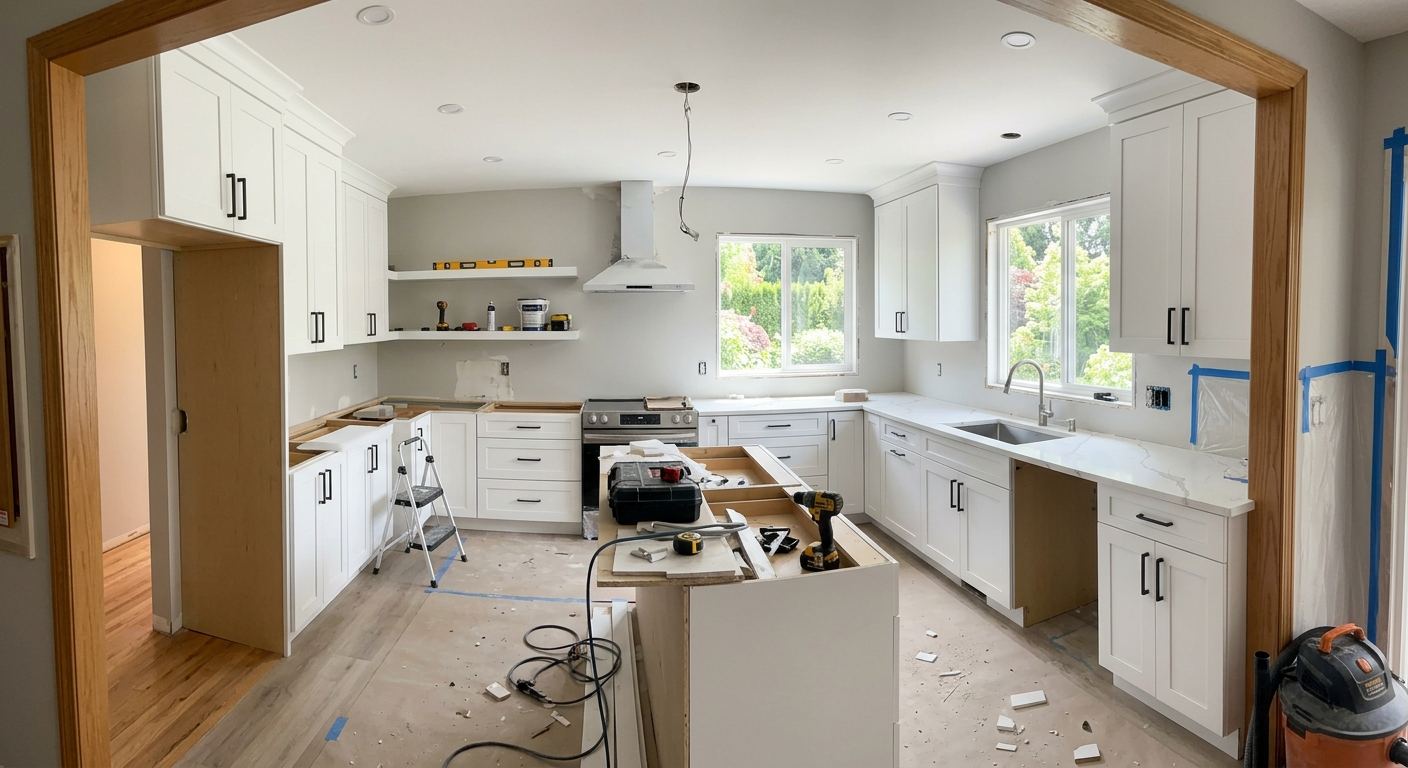
Kitchen renovation options and costs in Gastown
Kitchen renovations in Gastown, British Columbia tend to price by finish level and cabinet package more than by weather alone. With a 2021 population of 10,187 in the area, demand often concentrates around older, character-rich homes and condos where owners want a clean, resale-ready look without extending the project timeline (Statistics Canada, 2021 Census). In the Lower Mainland–Southwest, many buyers also have the financial runway to prioritize durability and “design-led” upgrades—particularly because renovation spend can be recovered more easily in higher-value neighbourhoods. That’s why Vancouver-adjacent projects in this economic region often shift quickly from stock surfaces toward semi-custom or custom cabinetry and quartz/stone counters, even when the footprint stays similar.
While British Columbia’s coastal climate doesn’t “raise” material costs the way some regions’ extreme freeze-thaw cycles do, it can affect installation planning: humidity swings and drying time matter for finishes, adhesives, and cabinet-surface prep. Labour availability also influences price—Gastown-area jobs can move slower when multiple trades are needed for older plumbing routes, gas lines, and service upgrades. In practice, that’s why a kitchen refresh can come in sharply lower than a full rebuild, even when both include new appliances.
Trade activity is especially high around the Gastown/Strathcona edge where heritage conversions and strata turnover commonly drive kitchen upgrades. With that in mind, use the tiers below to compare realistic scopes before you start collecting quotes.
| Renovation Tier |
What's Included |
Typical Duration |
Price Range |
| Cosmetic refresh (paint, hardware, new appliances only) |
Cabinet paint or refinish, new pulls/hinges, caulking, appliance swap (no layout changes), touch-up trim, basic backsplash allowance |
1–2 weeks |
$8,000–$22,000 |
| Mid-range full renovation (new cabinets, counters, sink, tile) |
New semi-custom or upgraded stock cabinets, quartz or comparable counters, sink + faucet, backsplash tile, installation of new under-cab lighting (as allowed), flooring patching |
3–6 weeks |
$40,000–$80,000 |
| High-end full renovation (custom cabinets, stone counters, island) |
Custom cabinetry (made-to-fit), premium stone counters, island build (if space allows), upgraded plumbing/electrical for island, full-height backsplash or slab feature, higher-end hardware and fixtures |
6–12 weeks |
$80,000–$120,000 |
| Cabinet refacing only (new doors + drawer fronts, same boxes) |
Door/drawer replacement, new hardware, surface prep, matching crown/edge details, selective box repairs, light trim adjustments, option to reuse existing counters (if condition allows) |
2–4 weeks |
$12,000–$35,000 |
| Countertop swap only (laminate to quartz or stone) |
Remove/install countertop, edge upgrade, sink cut-out where feasible, faucet/sink hookup allowance, minor backsplash touch-up |
3–7 days |
$5,000–$18,000 |
| Backsplash tile installation only |
Tile supply/installation, wall prep, waterproofing as needed, grout/seal, clean-up, assumes outlets remain unchanged |
3–8 days |
$1,500–$6,000 |
Prices are estimates only and vary by project scope, site access and material selection.
What affects the price of kitchen renovation in Gastown
In the Lower Mainland–Southwest, it’s common to see the “same” kitchen idea—same size, same appliances—land with a 30–50% swing in quotes once you compare cabinet tier, counter material, and how much the contractor expects to adjust plumbing/electrical. That pattern holds across British Columbia because pricing is tied more to home value and the finish buyers expect than to climate extremes. In higher-value Metro Vancouver areas, homeowners often choose quartz or stone counters and semi-custom cabinetry because the spend is easier to justify on resale; the cabinet footprint and “fit and finish” are part of how the kitchen reads at sale time. In more modest markets, laminate counters and stock cabinet lines dominate because they offer better ROI for the dollars per usable surface.
In Gastown specifically, older suites and heritage-adjacent homes can create surprises: routing plumbing through legacy walls, dealing with out-of-date shutoffs, or coordinating gas connections for ranges. Those items are the biggest cost drivers because they add unknown labour and material, regardless of whether you’re targeting a mid-range renovation or a higher-end rebuild.
Here are a few concrete examples that routinely raise or lower cost in Gastown: (1) moving a sink can trigger additional drainage modifications and wall patching, quickly nudging you from a countertop-only job into a larger scope (often pushing you toward the $40,000–$80,000 band if cabinets and tile are refreshed too); (2) converting a flat backsplash to a full-height feature can add prep and waterproofing time, especially on textured walls; (3) island adds often require new circuits for under-cabinet lighting and countertop outlets, which can be more labour than expected when finishes must match existing millwork.
Even with BC’s milder coastal weather, kitchen work still depends on correct drying time and controlled installation sequencing—tight schedules can increase labour to keep trades moving. If you’re renovating in a building with limited access or elevated service requirements, those constraints can push the job toward the upper end of the $40,000–$120,000 full-renovation spectrum.
| Price Factor |
Why It Matters |
Cost Impact |
| Cabinet tier — stock vs. semi-custom vs. fully custom millwork |
Custom boxes, made-to-fit dimensions, and higher-grade hardware drive material and build labour. |
Typically shifts the project toward low/mid/high bands (about 10–40% variance depending on how much is custom). |
| Countertop material — laminate vs. quartz vs. granite vs. stone |
Material cost and fabrication/templating complexity differ, and edges/sinks may require extra work. |
Can swing several thousand dollars (often within the $3,000–$12,000 countertop installation range). |
| Layout change — wall removal, island add, plumbing/gas move |
Electrical/plumbing coordination, structural considerations, and patching work add unpredictable labour. |
Usually the largest single driver of variance, often pushing overall totals upward by 10–25%. |
| Appliance package tier — builder vs. mid-range vs. pro-grade |
Pro-grade appliances can require different clearances and sometimes higher electrical/gas readiness. |
Often adds $1,000–$6,000+, depending on chosen brands and installation needs. |
| Flooring — refinish existing vs. full replacement |
Kitchen renovations frequently destroy subfloor margins and transitions where trades work. |
Refinish keeps costs restrained; full replacement can add several thousand dollars. |
| Backsplash — ceramic tile vs. marble vs. full-height slab |
Prep, waterproofing, and careful matching on corners affect labour time. |
Tile-only typically stays within $1,500–$6,000; slab features trend higher. |
| Electrical — new circuits for island, under-cabinet lighting |
New circuits require licensed work and coordination with cabinet install. |
Can add $1,000–$5,000+ based on outlets, lighting runs, and panel capacity. |
| Permit fees and licensed trade requirements |
Permits/inspections are tied to plumbing/gas/electrical scope and certain structural changes. |
Often modest on paper, but delays or rework increase labour; budget for both planning time and fees. |
Permits & regulations in British Columbia
In British Columbia, a simple cabinet or countertop swap is usually straightforward: replacing cabinets, installing new counters, or swapping a backsplash generally does not require a permit on its own. However, permits and licensed trades are commonly required when you change core services or the building’s safety systems—especially in older Gastown-area homes where lines may not match current standards.
Here’s what typically does require a permit and licensed professionals: moving plumbing supply/drain lines (sink relocation, dishwasher hook-ups that require line reruns), relocating gas equipment (stove/range hood if gas-connected), removing a load-bearing wall, adding new electrical circuits (for island outlets, additional lighting circuits), and any work that triggers electrical or gas service changes. Gas work must be completed by a licensed gas fitter, and electrical work must be performed by a licensed electrician; both require appropriate inspections.
Step-by-step verification for a homeowner in Gastown:
- Ask the contractor for their current licence details and licence numbers before signing.
- Request certificates of insurance (liability) and confirm coverage limits and effective dates.
- Ask for a clearance letter or proof of workers’ compensation coverage (WCB/WSIB coverage is commonly requested by general contractors and strata; the exact document depends on the firm).
- For sub-trades, confirm each licensed contractor’s documentation separately (gas fitter and electrician).
- Confirm in writing who pulls permits (and who pays inspection fees) before work starts; it belongs in the contract scope.
If a quote doesn’t clearly state whether permits are included, treat it as incomplete—even if the contractor promises “we’ll handle it.”
Cabinets, countertops and layout decisions in Gastown
When you renovate a kitchen in Gastown, three decisions drive most of the outcome: (1) cabinet tier, (2) countertop material, and (3) whether you change the layout. Start with cabinet tier: stock cabinets are fastest and typically cheapest, semi-custom is the most popular mid-range choice because you gain better fit and options, and custom cabinetry delivers the best alignment around old walls, angles, and ceiling lines—at the highest cost.
Second, choose your countertop material with maintenance and realistic use in mind. In the Lower Mainland–Southwest, resale buyers often expect quartz or natural stone in renovated kitchens, and that expectation influences upgrade value. Quartz is relatively low-maintenance and performs well for everyday cooking. Granite and other natural stones are durable but require basic care and can be sensitive to staining if not sealed appropriately. Laminate stays budget-friendly but is less forgiving with edges if you bump it or if your kitchen sees heavy daily wear. Butcher block can look warm and heritage-friendly, but it demands regular oiling and careful protection from standing moisture.
Third, layout: removing an obstructing wall, adding an island, or relocating a sink/stove can be justified when it improves traffic flow and unlocks better storage. But layout changes create the biggest unpredictability—especially plumbing and gas routing in older buildings.
A practical dollar example: upgrading from laminate counters to quartz typically adds cost within the countertop installation band (often several thousand dollars). If you’re also keeping the layout unchanged, that upgrade is often easy to justify because it upgrades the kitchen’s “face” without triggering additional plumbing or electrical work. If you’re moving plumbing and adding an island at the same time, you may be better off staging: do cabinets/counters first, then expand layout once services are confirmed.
| Option |
Durability |
Maintenance |
Best For |
Price Range |
| Stock cabinets (big-box) |
Solid for daily use; limited sizes can create gaps if walls are uneven. |
Low; keep hinges adjusted and seal edges where needed. |
Budget-conscious refreshes with minimal layout change. |
$10,000–$20,000 |
| Semi-custom cabinets (local dealer) |
Better fit and finish; stronger build options and more hardware choices. |
Low to moderate; regular cleaning and hardware upkeep. |
Most Gastown renovations aiming for a resale-ready finish. |
$18,000–$35,000 |
| Custom cabinets (local millwork shop) |
Best alignment around older walls/angles; long-term fit quality. |
Low; maintain seals and keep drawers aligned. |
Complex footprints, heritage features, and high-end builds. |
$35,000–$70,000 |
| Laminate countertop |
Good for light-to-moderate use; edges can be vulnerable to impacts. |
Low; avoid prolonged standing water at seams. |
When you want a clean look while keeping total project cost down. |
$3,000–$7,000 |
| Quartz engineered countertop |
Very durable and consistent; resists everyday staining and scratching. |
Low; wipe clean, minimal sealing. |
Most mid-range and higher-end renovations in the Lower Mainland–Southwest. |
$7,000–$12,000 |
| Granite / natural stone countertop |
Extremely durable; depends on stone and finishing. |
Moderate; periodic sealing recommended. |
Natural look with high durability for busy kitchens. |
$8,000–$15,000 |
| Butcher block countertop |
Durable when properly maintained; can dent or scratch like wood. |
Higher; regular oiling and prompt drying to prevent swelling. |
Warm, heritage-friendly kitchens where care routines are realistic. |
$4,000–$10,000 |
| Marble countertop |
Beautiful but softer than quartz/stone; more susceptible to etching. |
Higher; requires careful cleaning and sealing. |
Display-forward kitchens with lower stain/impact risk. |
$10,000–$20,000 |
How to choose a kitchen renovation contractor in Gastown
Choosing the right contractor in Gastown starts with verification. In British Columbia, confirm their licence status for the work they self-perform and request proof of liability insurance. Ask how workers’ compensation coverage is handled and request documentation (clearance letter or equivalent proof) for the contractor and their direct employees/sub-trades. For any gas work, insist on a licensed gas fitter; for electrical, insist on a licensed electrician. Don’t rely on verbal assurance—ask for the certificates and licence numbers before the first deposit.
Next, collect 2–3 itemised written quotes. You want labour and material breakdowns, not only a lump sum, so you can compare cabinet installation labour, countertop templating/fabrication, disposal, and any patch-and-finish work. Read the scope line-by-line: what’s excluded (for example, hidden water damage remediation, structural repair, or subfloor replacement), is permit pulling included, and is demolition disposal included or billed separately? Also check warranties: a workmanship warranty should be clearly stated, and product/manufacturer warranty terms should specify whether they’re transferable to future owners—important for resale in the Lower Mainland–Southwest market.
Finally, align payments to progress. Avoid paying more than 10–15% upfront. Use a holdback until completion (and snagging) is finished. Get a written start date and completion estimate; kitchen work in older Gastown buildings can shift when plumbing/electrical is uncovered, so timelines should be realistic and documented.
- Verify current contractor documentation (licence details and liability insurance).
- Request proof of workers’ compensation coverage (clearance letter/equivalent).
- Confirm gas fitter and electrician are licensed for their scopes.
- Insist on itemised quotes (labour + materials) and allowance breakdowns.
- Clarify permit responsibility and whether fees are included.
- Confirm disposal/haul-away is included in the quoted scope.
- Ask who protects flooring and how they handle debris control.
- Check who handles patching/painting after plumbing/electrical changes.
- Review countertop templating and fabrication scheduling assumptions.
- Confirm cabinet delivery timelines and what happens if materials are late.
- Ensure warranty details are written (workmanship + product warranties).
- Use a payment schedule with 10–15% upfront max and holdback until completion.
Red flags I see in Gastown include: vague scopes with no line items, quotes that promise “no permits needed” despite sink/stove moves, refusal to provide insurance/licence documentation, unusually low pricing that doesn’t include disposal or patch-and-finish, and payment demands that exceed 10–15% upfront.
Frequently asked questions — kitchen renovation in Gastown
Do I need a permit for a kitchen renovation in British Columbia?
In British Columbia, many cosmetic upgrades—like cabinet replacements, countertop swaps, and typical backsplash installation—often do not require a permit by themselves. Where permits typically enter the picture is when you change core services or safety-related systems: moving plumbing supply/drain lines, relocating gas appliances (stove/range setup tied to gas), removing a load-bearing wall, or adding electrical circuits (common for island outlets and under-cabinet lighting). For a Gastown kitchen, older plumbing routes can trigger permit-relevant changes if your sink is moved or if existing lines must be rerouted. Your contractor should clearly state in writing who pulls permits and who is responsible for licensed trade work. If a quote is silent, ask before you sign.
What's the ROI on a kitchen renovation?
ROI depends heavily on what you change and what finish tier you choose in the Lower Mainland–Southwest. In general, kitchens that update “visible” surfaces—cabinets/doors, countertops, and lighting—tend to perform better for resale than projects that focus only on appliances or paint. If you stay practical with layout (no major plumbing/gas/electrical moves), you can capture more value without inflating your budget into the highest full-renovation range. For example, a mid-range full renovation typically sits around $40,000–$80,000, and many owners find that quartz counters and a better cabinet layout read well to buyers. High-end custom builds can be beautiful, but the ROI depends on matching the neighbourhood expectations in Gastown and the rest of your home’s condition.
How do I budget for a kitchen renovation?
Start by choosing a realistic tier, then add line-item allowance for the “hidden” costs that show up in older Gastown-area kitchens. A cosmetic refresh can be much lower (often $8,000–$22,000) if you’re only changing paint/hardware and swapping appliances without moving plumbing or gas. If you’re doing a mid-range full renovation—new cabinets, counters, sink, and tile—plan around $40,000–$80,000. If you’re going custom or adding an island and upgrading electrical/plumbing for it, full high-end totals commonly move toward $80,000–$120,000. Budget separately for disposal, patching/painting, and any flooring transitions, and include a contingency for what inspections reveal behind walls (especially around drainage and supply lines).
Can I move my kitchen sink or stove?
Yes, you can move a sink or stove in British Columbia, but you should expect the scope to expand. Moving a sink usually means plumbing supply and drain modifications, plus wall/ceiling patching—often with permit involvement depending on the changes. Moving a stove that uses gas requires licensed gas work, and relocating a range hood can also trigger additional electrical or ducting coordination. In Gastown, older buildings can have tighter routing or less accessible service pathways, so the job may require exploratory work once demolition begins. That’s why moving fixtures is one of the most unpredictable cost changes. A good contractor will itemise the plumbing/gas/electrical allowances and confirm in writing whether permits are included before demolition starts.
What's the most cost-effective kitchen upgrade?
For many Gastown homeowners, the most cost-effective upgrade is improving the kitchen’s “fronts” and function without forcing major service relocation. If your layout is working and your boxes/cabinet frames are solid, cabinet refacing can be a strong value path—often landing in the broader cabinet/refacing range (commonly $12,000–$35,000 depending on how much repair and trim work is needed). Alternatively, if cabinets are fine but the counters look tired, a countertop swap only can refresh the look quickly, often within the $5,000–$18,000 band. Pair that with a well-chosen backsplash tile and updated lighting and you get a high “visual ROI” without triggering plumbing/gas work. If you want the fastest improvement, start with cabinetry surfaces and lighting, not layout changes.
Custom vs stock cabinets — is custom worth it?
Custom cabinets are worth it when you need tight fit around an awkward layout—common in older Gastown homes—or when you want a specific configuration (pantries, appliance garages, integrated storage) and premium hardware/finishes. Stock cabinets are usually the most cost-effective and fastest, but limited sizes can mean filler panels and compromises if your walls aren’t perfectly straight. Semi-custom is often the “sweet spot” for resale-ready kitchens in the Lower Mainland–Southwest because it balances price and fit. As a rough guide, stock solutions often start lower, while custom can push you into higher totals; cabinet tier differences can materially affect your total budget and move projects toward the upper end of the full-renovation bands. If you’re considering custom, ask for a comparative layout proposal and confirm whether the added fit prevents costly patching or rework later.