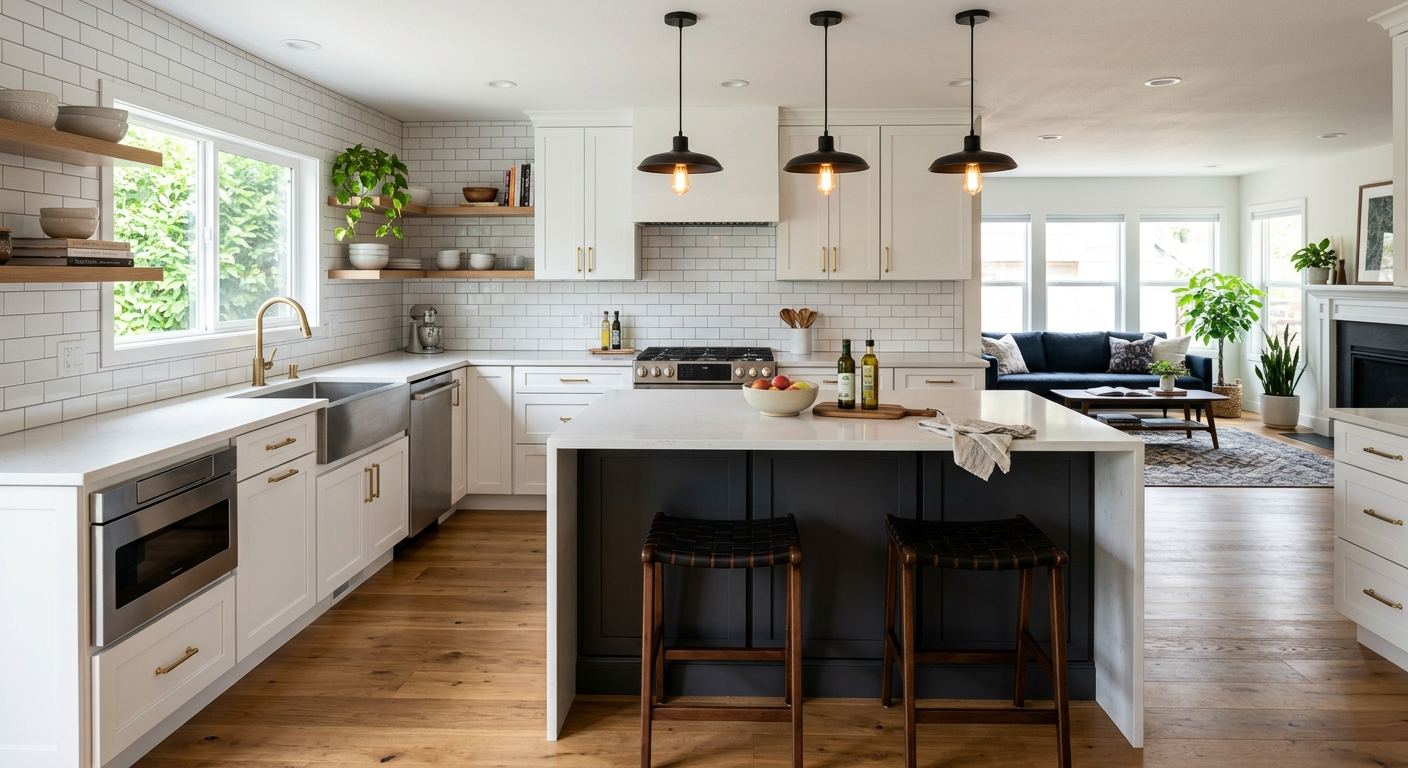
Kitchen renovation options and costs in Burnaby
Kitchen renovation in Burnaby usually starts with a simple question: are you refreshing what you have, or rebuilding the kitchen to a higher finish level? With a median household income of about $83,000 (Statistics Canada, 2021 Census), many Burnaby homeowners choose a practical upgrade path rather than an all-out showpiece. At the same time, Burnaby’s housing mix means a meaningful share of homeowners own, and with 61,185 homeowner households (Statistics Canada, 2021 Census), resale value and buyer expectations strongly influence how far you take the renovation—especially for cabinets, countertops, and hardware.
In the Lower Mainland–Southwest, costs are driven less by “weather damage” and more by market finish expectations and labour demand. Moisture and temperature swings still matter for details like caulking, cabinet leveling, and grout performance, but the bigger pricing levers are product availability, contractor scheduling, and the likelihood that your project includes electrical updates, new plumbing runs, or layout changes. In areas with heavier trade traffic—like Brentwood and Metrotown—contractors are in high demand, so faster turnarounds often come with tighter scheduling and a clearer need for on-site coordination. If your scope is well-defined upfront, you’re more likely to land within the same price band even when the materials choice varies.
Below is a practical comparison to help you match your goal (budget, timeline, and resale positioning) to realistic budget ranges before you review line-item quotes.
| Renovation Tier |
What's Included |
Typical Duration |
Price Range |
| Cosmetic refresh (paint, hardware, new appliances only) |
Cabinet paint or refinishing (or clean/refresh finish), new cabinet hardware, installation of like-for-like appliances, minor touch-ups |
3–7 days |
$8,000–$20,000 |
| Mid-range full renovation (new cabinets, counters, sink, tile) |
Semi-custom or quality stock cabinets, countertop replacement, sink + faucet, backsplash tile, new flooring prep (as needed), basic electrical adjustments |
3–6 weeks |
$40,000–$85,000 |
| High-end full renovation (custom cabinets, stone counters, island) |
Fully custom cabinetry, quartz/stone counters, island build, upgraded hardware, upgraded lighting, full backsplash, higher-end appliance package, possible layout improvements |
6–12 weeks |
$85,000–$120,000 |
| Cabinet refacing only (new doors + drawer fronts, same boxes) |
New door and drawer fronts, updated hinges/soft-close, new hardware, optional cabinet interior adjustments, prep/finish work |
1–3 weeks |
$8,000–$35,000 |
| Countertop swap only (laminate to quartz or stone) |
Remove existing counters, install new quartz/stone, seam/edge finishing, sink cut-out and re-install (if feasible), basic caulking and polish |
3–7 days |
$6,000–$12,000 |
| Backsplash tile installation only |
Tile supply and install (to existing finish prep), edge trim, grout and silicone sealing at transitions |
3–8 days |
$1,500–$6,000 |
Prices are estimates only and vary by project scope, site access and material selection.
What affects the price of kitchen renovation in Burnaby
In Burnaby and across the Lower Mainland–Southwest, you can see the same kitchen renovation swing by 30–50% between quotes because the market tends to price on finish tier, resale positioning, and how much trade work is triggered—not just the square footage. In higher-value parts of Metro Vancouver, homeowners more often default to quartz or stone counters and semi-custom cabinetry because the renovation cost is easier to recover on resale. With a $83,000 median household income (Statistics Canada, 2021 Census), many projects still land in a practical mid-range, but labour and product scheduling can still push the final total toward the upper end of the bands if the scope expands.
Climate plays a smaller role in cost than people expect in British Columbia, but it does influence durability choices. In Burnaby, cabinet installation and sealing around water exposure (sink edges, dishwasher lines, and exterior wall runs) need to be done carefully because long service life depends on workmanship. More importantly, Lower Mainland market conditions shape availability: if your design requires custom cabinet sizing or specific stone slabs, lead times and coordination affect labour costs and overhead. Meanwhile, older homes built before 1981 (35.5% of dwellings, Statistics Canada, 2021 Census) often have out-of-date electrical, narrower service clearances, or plumbing layouts that complicate “simple” upgrades.
Concrete examples from Burnaby: (1) switching from laminate to quartz may look like a single material swap, but the new sink cut-outs and seam layout can add install labour; (2) adding an island often triggers new electrical circuits and sometimes a gas or plumbing re-route; (3) replacing tile flooring or extending tile up the backsplash can change how many trades are involved and how long your subfloor needs to be prepped. For reference, a mid-range full renovation often lands in the $40,000–$85,000 band, while a high-end full renovation with stone and an island is typically $85,000–$120,000.
| Price Factor |
Why It Matters |
Cost Impact |
| Cabinet tier — stock vs. semi-custom vs. fully custom millwork |
Quality of door/drawer construction, fit-and-finish, storage upgrades, and lead time |
Can shift project totals by $10,000–$40,000+ |
| Countertop material — laminate vs. quartz vs. granite vs. stone |
Material cost, fabrication complexity, and edge/seam requirements |
Often adds $3,000–$12,000 for counters alone |
| Layout change — wall removal, island add, plumbing/gas move |
Reworks structural, mechanical, and trade sequencing; hardest to predict |
Commonly the biggest variable: $5,000–$30,000+ |
| Appliance package tier — builder vs. mid-range vs. pro-grade |
Power requirements, depth/fit, trim kits, and integration complexity |
Can swing several thousand dollars quickly |
| Flooring — refinish existing vs. full replacement |
Exposure of subfloor, underlayment compatibility, and matching transitions |
May add $2,000–$8,000 depending on scope |
| Backsplash — ceramic tile vs. marble vs. full-height slab |
Material weight, detailing, waterproofing requirements, and special trims |
Typically $1,500–$6,000+ for tile installs |
| Electrical — new circuits for island, under-cabinet lighting |
Permit-triggering work and trade labour sequencing |
Often $1,500–$6,000+ |
| Permit fees and licensed trade requirements |
Higher compliance steps add time, inspections, and coordination |
Small line item, but can add $500–$3,000+ in overhead |
Permits & regulations in British Columbia
In British Columbia, many “like-for-like” kitchen upgrades don’t require permits, but anything that changes plumbing, gas, structural elements, or electrical circuits typically does. Cabinet and countertop swaps are usually treated as replacement work with no permit—so exchanging cabinets, replacing counters, or installing a new backsplash with the same layout generally falls under non-permit renovation work.
Permits (and licensed trades) are commonly required when you move or alter plumbing supply or drain lines, relocate a gas stove or gas connection (including certain range hood configurations if tied into gas), remove a load-bearing wall, or add new electrical circuits (for example, new island receptacles or a substantial under-cabinet lighting upgrade that adds circuit capacity). Gas work must be performed by a licensed gas fitter, and electrical work must be performed by a licensed electrician; both require proper inspections after completion.
How a Burnaby homeowner can verify a contractor before signing:
- Ask for the contractor’s certificate of insurance (general liability) and confirm the coverage limits match the project size.
- Request clearance/letters and proof of coverage for trades involved (including workers’ protection coverage where applicable).
- Confirm licensing for any trade that requires it (gas fitter and electrician) and ensure the listed trade licence number matches the person who will perform the work.
- For the contract, ensure permit responsibility is stated—who pulls permits, who pays fees, and who schedules inspections.
- Get it in writing: exclusions (what they won’t do), and who completes any required paperwork.
Always confirm permit responsibility with the contractor before signing—moving the right elements can be the difference between a smooth inspection process and a delayed project.
Cabinets, countertops and layout decisions in Burnaby
Your three biggest decisions in a Burnaby kitchen renovation are (1) cabinet tier, (2) countertop material, and (3) whether you change the layout. The Lower Mainland–Southwest resale market tends to reward clean, functional millwork and countertops that look current without demanding constant maintenance. That means the “best value” choice is usually the one that fits your finish tier and the way your home will be shown to buyers—especially in older stock built before 1981, where upgrades often need careful planning for wiring and plumbing.
For cabinets, stock units are the fastest and generally cheapest because they’re standardized and readily available. Semi-custom is the most popular mid-range option in Burnaby because it balances better sizing and storage (corner pull-outs, pantry layouts, and soft-close hardware) with predictable lead times. Custom cabinetry offers the best fit and the strongest design flexibility, but costs climb once you start with complex soffits, tall pantry walls, integrated appliances, and islands built for circulation.
For countertops, laminate can be a budget win but has a shorter lifespan in busy kitchens and can be harder to repair seamlessly. Quartz is a common “smart middle” choice for Burnaby: it’s low-maintenance, resists staining better than many laminate surfaces, and supports a modern look that buyers expect. Natural stones like granite and marble are premium options—marble is especially sensitive to acidic spills and requires disciplined sealing and cleaning.
Layout changes are where budgets grow unpredictably: removing a wall or adding an island frequently triggers electrical work and sometimes plumbing or gas re-routing. The cost is justified when it meaningfully improves flow and daylight presence (for example, opening a narrow galley toward a living area) or when it solves recurring usability problems. If your goal is just visual refresh, staying with a direct replacement layout can keep you within the $40,000–$85,000 mid-range band. If you’re doing a custom island with stone and new millwork, you’re typically moving into the $85,000–$120,000 high-end band.
| Option |
Durability |
Maintenance |
Best For |
Price Range |
| Stock cabinets (big-box) |
Solid for everyday use; limited custom fit |
Low to moderate; focus on door alignment and soft-close quality |
Fast timelines and straightforward layouts |
$8,000–$25,000 |
| Semi-custom cabinets (local dealer) |
Very durable; better storage and sizing options |
Low; maintain hinges and clean regularly as with any finish |
Most Burnaby mid-range renovations |
$15,000–$45,000 |
| Custom cabinets (local millwork shop) |
Highest fit and build quality; tailored storage |
Low; premium finishes with good care last many years |
Complex islands, integrated details, and design-led kitchens |
$30,000–$75,000+ |
| Laminate countertop |
Prone to wear at edges and can be less forgiving to heat |
Moderate; avoid standing water at seams |
Budget-conscious refreshes |
$3,000–$7,000 |
| Quartz engineered countertop |
Highly durable; resistant to staining and everyday impacts |
Low; wipe-clean surface, minimize heat exposure |
Busy households and resale-friendly finishes |
$6,000–$12,000 |
| Granite / natural stone countertop |
Very durable; good scratch resistance |
Moderate; typically needs periodic sealing |
Premium look with robust daily performance |
$8,000–$14,000 |
| Butcher block countertop |
Good durability but vulnerable to water if not maintained |
Higher; oiling and careful cleaning to avoid drying/warping |
Warm design and lighter-use cooking zones |
$5,000–$10,000 |
| Marble countertop |
Premium feel but softer; can etch with acids |
Higher; frequent cleaning and sealing discipline |
Low-spill kitchens or design-forward showpiece upgrades |
$10,000–$20,000+ |
How to choose a kitchen renovation contractor in Burnaby
Choosing the right contractor in Burnaby comes down to verifying credentials, getting apples-to-apples quotes, and ensuring the scope is written clearly. First, confirm British Columbia licensing for any work that requires it (not every task does). Ask for proof of general liability insurance, and verify trade coverage for subcontractors. For trades: your gas work should be done by a licensed gas fitter, and any electrical changes by a licensed electrician—request the licence details and confirm they match the person/company performing the work. Also make sure your contractor can show proof of workers’ protection coverage documentation where applicable, and provide a certificate of insurance that lists your project address and adequate coverage limits.
Then get 2–3 itemised written quotes. You want a labour-and-materials breakdown, not a single lump sum. The quote should specify cabinet tier, countertop type and slab allowance, appliance inclusions, backsplash substrate and tile type, demolition scope, disposal, and any electrical/plumbing work. Scope details matter: ask whether permits are included or handled by the contractor, and whether disposal and patching are included or billed separately.
Warranty and payment schedule are just as important. Look for a workmanship warranty length, and clarify whether manufacturer warranties on cabinets/counters are transferable to you. For payment, avoid heavy upfront deposits—sticking to no more than 10–15% upfront is a good safety baseline, and ask for a holdback until the job is complete and deficiencies are corrected. Finally, get a start date and completion estimate in writing, including key dependencies like cabinet lead times and countertop fabrication schedules.
- Verify the contractor’s general liability insurance certificate before work begins.
- Request licence details for gas and electrical trades, and confirm they’re the ones on the job.
- Ask for an itemised quote: labour, demolition, materials, and “allowances” clearly listed.
- Confirm permit responsibility in writing (who pulls permits and who pays fees).
- Make sure disposal/garbage removal is included (dump fees often surprise homeowners).
- Check the warranty terms for workmanship and finish defects.
- Clarify what happens if cabinets/counters are delayed (schedule impact and costs).
- Ensure the scope includes electrical upgrades for island receptacles or under-cabinet lighting where planned.
- Confirm the countertop install details: seam placement, sink cut-outs, and edge finishing.
- Ask who does patching, priming, and final paint touch-ups after backsplash and flooring work.
- Use a written schedule with milestones (demo, rough-in, cabinet install, countertops, finish).
- Avoid contractors who won’t provide a written contract with exclusions and responsibilities.
Concrete red flags in Burnaby: (1) a quote that’s not itemised and uses vague allowances for counters or cabinets; (2) they refuse to list who is pulling permits when electrical/plumbing/gas changes are in the scope; (3) no proof of insurance or trade licensing when needed; (4) pushing for a large upfront payment beyond 10–15%; (5) they won’t put a realistic timeline in writing, especially around countertop fabrication lead times.
Frequently asked questions — kitchen renovation in Burnaby
Should I renovate my kitchen before selling in Burnaby?
Often yes, but only when the renovation level matches what buyers in Burnaby will pay for. If your kitchen looks dated (worn laminate counters, tired cabinets, limited storage), a targeted refresh can help presentation without overspending. Many homeowners start with a mid-range full renovation path in the $40,000–$85,000 band when they’re updating cabinets, counters, sink, and backsplash—this tends to be a buyer-friendly balance. For older homes built before 1981 (35.5% of dwellings, Statistics Canada, 2021 Census), focus first on functional issues: sealing, electrical adequacy, and layout usability. If you’re planning a layout change (like removing a wall or adding an island), ensure the space gain is worth the unpredictability of plumbing/gas/electrical rework, because that’s what can stretch budgets and timelines.
What's the most popular kitchen style in Burnaby right now?
In Burnaby and the Lower Mainland–Southwest, the most common “safe bet” styling trends lean toward clean, modern lines with warmer neutrals: white or light cabinetry, simple slab or shaker-style doors, quartz counters, and straightforward backsplash patterns. Buyers frequently respond to a bright, uncluttered look and durable surfaces that handle daily use. That’s why quartz engineered countertops are so common in kitchens that target a mid-range $40,000–$85,000 renovation budget—quartz reads premium, resists staining, and supports current design palettes. Many homeowners also choose semi-custom cabinetry for better storage planning (pantries, pull-outs, and better drawer sizing) without going fully custom. The best style is still the one that fits your home’s layout and existing architecture, not just what’s trendy online.
How do I know if I need to update my kitchen plumbing in Burnaby?
You usually don’t need to replace every pipe, but you may need updates if you see recurring leaks, inconsistent hot water, slow draining, or if your renovation includes moving the sink/dishwasher or adding a new gas/electrical/venting plan. In Burnaby, especially in homes built before 1981 (35.5% of dwellings, Statistics Canada, 2021 Census), older rough-in locations can make “simple” relocations more complicated than expected. For example, shifting plumbing supply/drain lines often triggers permit and licensed trade work in British Columbia, and it can add time due to rough-in inspections. A good contractor will confirm what’s staying and what’s being moved before quoting. Ask for a plan: whether they’ll scope the plumbing change during demolition, and how they’ll protect floors and cabinets from leaks during the install.
What is the difference between a galley and open-concept kitchen?
A galley kitchen is typically a narrow, efficient layout with counters and storage on two facing walls, often with a corridor down the middle. An open-concept kitchen blends the cooking area into the living/dining space, usually by removing a wall or reconfiguring the layout so sightlines and traffic flow improve. In Burnaby, many homeowners remodel from galley to more open layouts to make the space feel brighter and more social—especially where the kitchen is adjacent to the main living area. The trade-off is that open-concept changes can require structural review and permit-triggering work, including electrical and sometimes plumbing/gas relocation. Because that work is harder to predict, open-concept renovations more often move from mid-range budgets into higher totals, particularly when an island is added.
How do I get accurate kitchen renovation quotes in Burnaby?
Accurate quotes start with a detailed scope and itemised pricing. In Burnaby, ask contractors for 2–3 written quotes that break labour and materials down, including demolition, disposal, cabinet tier, countertop material, backsplash specifics, and electrical/plumbing/gas changes. Avoid quotes that only show a single “total” without allowances—for example, an unclear countertop slab allowance can create surprise costs. Also confirm permit responsibility in writing: if you’re moving plumbing supply/drain lines, relocating gas appliances, adding electrical circuits, or removing a load-bearing wall, those items require permits and licensed trades in British Columbia. Finally, request timeline estimates tied to lead times for cabinets and countertop fabrication. A contractor who can’t explain what’s included—or who refuses to state exclusions like disposal or patching—usually leads to budget drift.
What's the best countertop material for a busy Burnaby kitchen?
For most busy Burnaby households, quartz is the most reliable “best overall” choice. It’s engineered for consistent appearance, resists staining better than many alternatives, and handles everyday messes from cooking with less fuss—so it fits busy schedules and typical family routines. Compared to laminate, quartz generally costs more, but it’s still a practical middle range when you’re budgeting a full renovation around $40,000–$85,000, where countertops are one of the key price drivers. Granite is also durable and premium, but it usually needs periodic sealing and has a more variable look. Marble can be beautiful, but it’s more sensitive to acidic spills and demands more disciplined maintenance. If you want easy care and resale-friendly durability, quartz is usually the smartest decision for Burnaby kitchens.