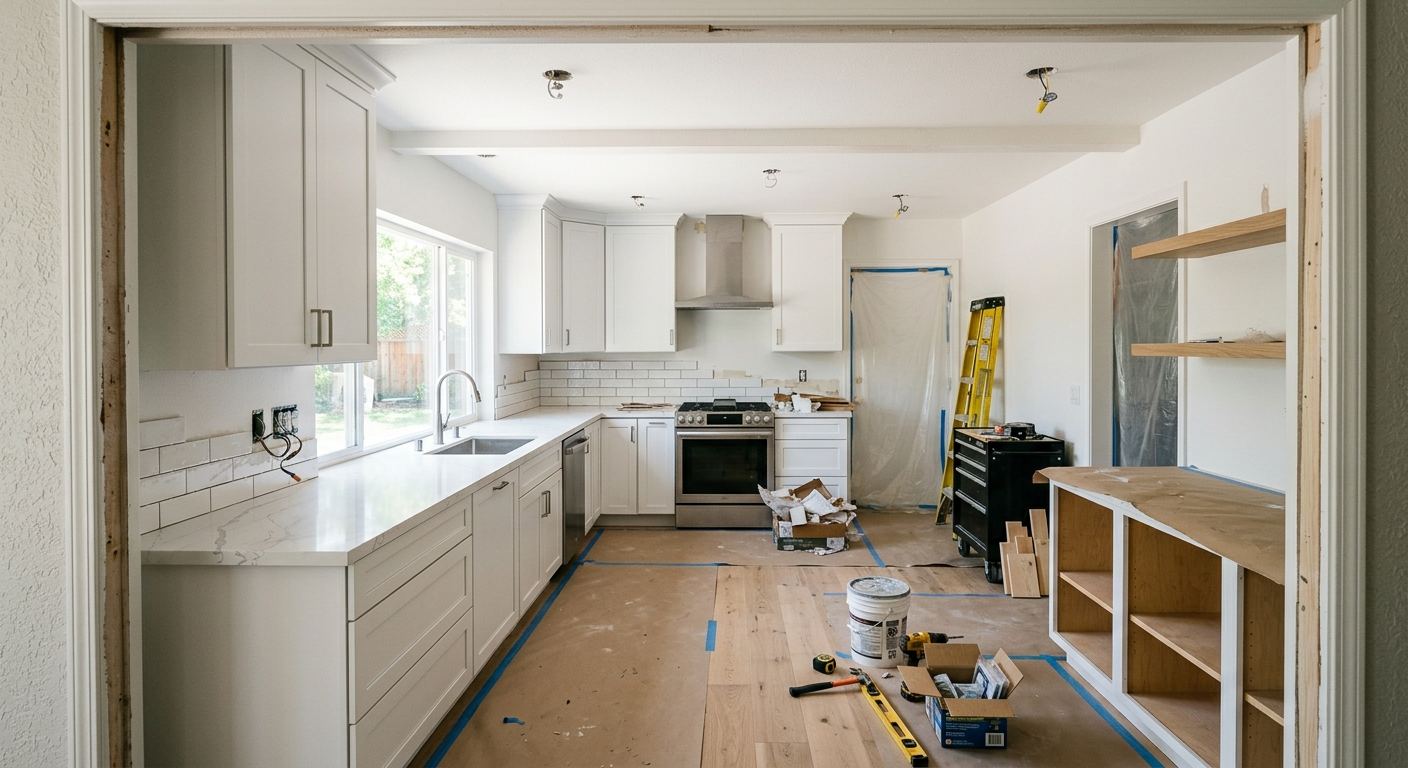
Kitchen renovation options and costs in Taylor
Taylor, British Columbia, is a smaller community where kitchen renovations often track household buying power and the type of homes being updated. With a median household income of about $105,000 (Statistics Canada, 2021 Census), many homeowners target practical upgrades that improve daily function while staying within a recoverable price band. The local housing mix matters too: about 77.1% of households are owner households, so renovations are commonly planned for long-term use and resale value rather than short-term resale flips. In the Northeast resource economy, higher-value properties more frequently lean toward semi-custom or custom cabinetry and premium stone—pushing full reno budgets into the mid-range and above. Meanwhile, older homes (28.4% built before 1981) may see a “hybrid” approach: partial cabinet replacement, laminate or good-quality tops, and a refreshed layout without touching every dated surface.
Climate in the Northeast is less about dictating finish tier and more about scheduling and jobsite readiness: winter conditions and wind can slow delivery/installs and increase protection needs for flooring, countertops, and new electrical work. Strong demand during certain periods can also affect availability of cabinet installers, especially for specialty stone templating and custom millwork lead times.
In Taylor, trade demand is especially noticeable around the central neighbourhood areas near the core services where older housing stock is common and homeowners prioritize durable, easy-to-clean finishes. From there, the most direct way to compare proposals is by renovation tier—see the table below for typical inclusions and timing.
| Renovation Tier |
What's Included |
Typical Duration |
Price Range |
| Cosmetic refresh (paint, hardware, new appliances only) |
Cabinet paint or finish refresh, new hardware, appliance swap, basic caulking/trim touch-ups, existing backsplash repair/replace as needed |
2–5 days plus appliance delivery scheduling |
$8,000–$20,000 |
| Mid-range full renovation (new cabinets, counters, sink, tile) |
New stock or semi-custom cabinets, countertop installation (often quartz or premium laminate), undermount sink and faucet, backsplash tile, under-cabinet lighting allowance, flooring touch-up, labour for demo/install |
3–6 weeks |
$30,000–$60,000 |
| High-end full renovation (custom cabinets, stone counters, island) |
Custom cabinetry, premium stone countertops (e.g., granite/stone), island build, upgraded backsplash (higher-spec tile or slab look), enhanced lighting plan, expanded electrical scope allowance, higher-end sink/faucet package |
6–12+ weeks (lead times can drive schedule) |
$60,000–$80,000 |
| Cabinet refacing only (new doors + drawer fronts, same boxes) |
New veneer/face materials, doors and drawer fronts, new hardware, optional re-level/adjustment, selective backsplash refresh (as specified) |
1–3 weeks |
$6,000–$18,000 |
| Countertop swap only (laminate to quartz or stone) |
Remove old top, templating, new countertop install, sink/faucet retouching as required, backsplash edge finish allowance |
5–15 business days (plus templating and delivery) |
$3,500–$15,000 |
| Backsplash tile installation only |
Surface prep, tile supply install, grout/seal, trim where needed, limited caulking and cleanup |
2–6 days |
$2,500–$12,000 |
Prices are estimates only and vary by project scope, site access and material selection.
What affects the price of kitchen renovation in Taylor
In Taylor and across the Northeast of British Columbia, it’s common to see the “same” kitchen idea land 30–50% apart between quotes. That spread usually comes down to local buying behaviour and finish tiers more than climate itself. In higher-value pockets of the Northeast market, homeowners often default to quartz or premium stone and semi-custom cabinetry because the upgrade cost is more easily recovered on resale. In more modest or older homes, laminate counters and stock cabinet systems are still popular, because they deliver the look of a refreshed kitchen at a safer monthly budget.
Regardless of finish choice, layout changes add the most unpredictable cost from home to home—especially when removing a wall, adding an island, or moving plumbing and gas lines. Even when cabinets and countertops are priced tightly, the labour and trade coordination for plumbing, electrical, and ventilation can swing a project quickly. For many Taylor homes built before 1981 (28.4% of dwellings), the added cost can also reflect outdated rough-ins, unexpected framing adjustments, or the need to patch and re-square openings.
Two practical examples: if you stay in a mid-range full renovation band around $30,000–$60,000 and keep the plumbing where it is, your budget stays more stable. But if you want an island sink or relocate a gas range, that often nudges you toward the upper end of the full renovation range—closer to $60,000–$80,000—even with the same cabinet tier. Similarly, swapping laminate for quartz typically behaves predictably within the countertop band ($3,500–$15,000), while adding tile from counter to ceiling can turn a simple visual refresh into a longer, labour-heavy scope.
| Price Factor |
Why It Matters |
Cost Impact |
| Cabinet tier — stock vs. semi-custom vs. fully custom millwork |
Tier determines design flexibility, hardware quality, materials, and factory lead time; also affects installation time and rework risk |
Can shift overall project by roughly $10,000–$30,000+ depending on scope |
| Countertop material — laminate vs. quartz vs. granite vs. stone |
Material pricing, thickness/edge complexity, and templating/installation labour vary; premium stone typically costs more and requires tighter scheduling |
Often a $2,000–$10,000 swing just for the tops |
| Layout change — wall removal, island add, plumbing/gas move |
Rough-in modifications drive trade coordination, inspections, and wall/ceiling finishing repairs |
Commonly adds $5,000–$25,000+ even if finishes stay mid-range |
| Appliance package tier — builder vs. mid-range vs. pro-grade |
Premium appliances cost more and sometimes require different clearances, power setups, or ventilation specs |
Typically $1,500–$8,000+ difference |
| Flooring — refinish existing vs. full replacement |
Kitchen work can damage floors during demo/stone install; full replacement adds demo, materials, and install time |
Often $2,000–$12,000 depending on flooring type |
| Backsplash — ceramic tile vs. marble vs. full-height slab |
Tile density, stone cut complexity, and height coverage change both labour and material waste |
Can vary $1,000–$7,000+ for the same “visual” area |
| Electrical — new circuits for island, under-cabinet lighting |
Additional circuits and fixtures require licensed electrical work and inspection; wiring runs can open walls |
Often $800–$5,000+ depending on access and number of outlets/lights |
| Permit fees and licensed trade requirements |
Some work triggers permits/inspections and coordination costs; timelines can increase when trades are booked |
Frequently $300–$2,000+ in direct fees, plus scheduling impact |
Permits & regulations in British Columbia
In British Columbia, you usually do not need a permit for simple cabinet and countertop swaps when you’re keeping services where they are. That means replacing cabinets, swapping countertops, and reinstalling a backsplash typically fall into “like-for-like” finish work—no trenching, no moving of drain/supply lines, and no structural changes. However, if you move plumbing supply or drain lines, relocate a gas appliance (for example, your stove/range) or adjust venting, remove a load-bearing wall, or add new electrical circuits for things like an island receptacle or new under-cabinet lighting, permits and licensed trades are typically required.
Here’s the step-by-step way homeowners in Taylor can verify a contractor’s credentials before signing. First, ask for the contractor’s business licence details and their certificate of insurance; don’t accept “we’re insured” verbally—request a current COI. Second, for gas work, confirm the gas fitter is licensed and insured; gas adjustments must be performed by a licensed gas professional. Third, for electrical, confirm the electrician is licensed and provides inspection documentation where applicable. Fourth, review WSIB/WCB coverage where relevant—your quote and subcontractor paperwork should align with the trade’s coverage.
Where to look: use the applicable online licensing registries for the trade categories, request written proof of insurance from the vendor, and keep an eye out for a clearance/coverage letter when provided. Finally, ensure permit responsibility (who pulls permits, who pays, and who schedules inspections) is clearly stated in the contract.
Cabinets, countertops and layout decisions in Taylor
The three biggest decisions that shape both the look and the cost of a Taylor kitchen renovation are: (1) cabinet tier, (2) countertop material, and (3) layout changes. Cabinet tier is the fastest way to control schedule and budget. Stock cabinets are usually the quickest path and suit homeowners who want a refreshed kitchen without extensive design revisions. Semi-custom is the most common choice locally because it balances better storage layouts with predictable lead times. Custom cabinets provide the best fit for older framing quirks in homes built before 1981, but they’re the most expensive and often have longer lead times.
Countertops are the next major lever. In the Northeast market, buyers frequently expect a durable, low-maintenance surface: quartz is a popular “safe” upgrade, while laminate is a cost-controlled option. Granite and other natural stones look premium and resist wear well, but they do require more careful maintenance planning and higher initial cost. Butcher block can be beautiful for a warm look, yet it needs sealing and more ongoing care—especially in a busy household kitchen.
Layout changes should be justified by space gains. For example, adding an island or opening up a wall can be worth it when it improves circulation for everyday use and aligns with the finish level that matches your likely resale expectations. If you’re staying near the mid-range band of $30,000–$60,000, keep plumbing where possible to avoid major rough-in costs. If you want quartz plus an island, it may push you toward the upper end of the full renovation range ($60,000–$80,000), but the premium stone and improved usability can be easier for future buyers to understand at a glance—especially in resource-market homes where dual-income households often value turnkey kitchens.
| Option |
Durability |
Maintenance |
Best For |
Price Range |
| Stock cabinets (big-box) |
Good daily durability with standard hinges/box materials |
Low; wipe-down cleaning; minor adjustments may be needed for older walls |
Fast installs, budget planning, straightforward layouts |
$6,000–$18,000 |
| Semi-custom cabinets (local dealer) |
Very good durability with better interior options and hardware |
Low; occasional alignment checks; finish-care is straightforward |
Most Taylor renovations aiming for stronger storage and better fit |
$15,000–$35,000 |
| Custom cabinets (local millwork shop) |
High durability; tailored builds can strengthen weak points in older frames |
Low to moderate; hinges and hardware quality reduce wear |
Challenging spaces, unique storage needs, higher finish expectations |
$30,000–$55,000+ |
| Laminate countertop |
Decent for light-to-moderate use; edges can be more vulnerable |
Low; avoid standing water at seams and hot items directly |
Cost-effective refresh and homes where budget control matters most |
$3,500–$7,500 |
| Quartz engineered countertop |
Very durable; consistent surface and strong resistance to stains |
Low; routine cleaning only—no sealing like many natural stones |
Most popular Northeast “premium but practical” choice |
$7,500–$14,500 |
| Granite / natural stone countertop |
Highly durable; varies by stone but generally strong against wear |
Moderate; may require periodic sealing and careful stain prevention |
Premium look and a long-term “feature” surface |
$10,000–$15,000 |
| Butcher block countertop |
Good for cutting boards; can dent/scratch without care |
Moderate; regular oiling/sealing and protection from prolonged moisture |
Warm aesthetics and households willing to maintain the surface |
$5,000–$11,000 |
| Marble countertop |
Beautiful but softer; can scratch and etch more easily |
Higher; needs sealing/maintenance and quick wipe discipline |
Low-traffic showpiece kitchens or buyers prioritizing appearance |
$12,000–$15,000 |
How to choose a kitchen renovation contractor in Taylor
Choosing the right contractor in Taylor, British Columbia, is about verifying credentials, comparing like-for-like quotes, and protecting yourself in the contract. Start by confirming British Columbia licensing where trades are involved: electricians must be licensed for any new or altered electrical circuits, and gas work must be performed by a licensed gas fitter. Ask for certificates of insurance and ensure the COI matches the scope (general liability for the contractor and specific coverage if subs are used). For coverage related to worker protection, request proof of WSIB/WCB coverage or clearance documentation where applicable—your goal is to avoid payroll or coverage gaps that can delay a job or create liability for the homeowner.
Next, request 2–3 itemised written quotes. You want labour and materials broken out (demo, cabinetry, countertop templating/installs, tile, electrical/plumbing trades, disposal). Avoid “one-line” lump sums; they make it hard to compare contractor efficiency and inclusions. Read the scope carefully for exclusions: is permit pulling included, is disposal included, and who handles drywall patching and paint touch-ups after countertop and backsplash work? Ask about warranty details—workmanship warranty length, product/manufacturer warranty (and who you call), and whether warranties are transferable to future owners.
Finally, insist on a realistic payment schedule: keep upfront deposits around 10–15% and use holdbacks tied to completion milestones. Get the start date and completion estimate in writing, including a plan for cabinet or stone lead times.
- Verify licensing and insurance before signing; don’t rely on verbal confirmations.
- Confirm each subcontractor (electrician, plumber/gas fitter) is properly licensed for the work.
- Ask for a COI with expiry date and scope wording; request “additional insured” if offered.
- Request proof of WSIB/WCB/coverage where relevant.
- Get 2–3 itemised quotes with labour and materials separated—no vague allowances.
- Check inclusions: demolition, disposal/dump fees, and patch/finish drywall are clearly listed.
- Confirm whether countertop templating and backsplash installation are scheduled after cabinets set.
- Make sure permit pulling and inspection responsibility is stated in writing.
- Review warranty terms: workmanship duration, product warranty handling, and transferability.
- Use milestone-based payments; keep upfront costs around 10–15%.
- Demand a detailed timeline with key dates and acknowledged lead times.
- Ask for references from recent BC kitchen reno projects, ideally with similar scope to yours.
Red flags to watch for: (1) quotes that don’t list materials brands, thicknesses, or hardware specs; (2) promises of “no permits needed” despite planning electrical or plumbing moves; (3) large upfront payments with no milestone holdback; (4) no written workmanship warranty; and (5) unclear disposal/patch-and-paint responsibility after demo.
Frequently asked questions — kitchen renovation in Taylor
What's the most cost-effective kitchen upgrade?
In Taylor, the most cost-effective upgrade is usually a combination of facelift-level changes that look substantial without triggering rough-in work. If your cabinet boxes are still solid, refacing—new doors and drawer fronts—tends to be a strong value. It’s often priced in the cabinet scope band around $6,000–$18,000, and you avoid the larger labour swings of a full demo. If you want more impact for less money, pairing refacing with updated hardware, a new backsplash, and an appliance refresh can look like a full reno while staying controlled. For a slightly different approach, a countertop swap (often $3,500–$15,000) gives a big “first impression” upgrade, especially in kitchens built before 1981 where surfaces tend to show wear.
Custom vs stock cabinets — is custom worth it?
Custom cabinets can be worth it in Taylor when you have layout constraints, older framing that isn’t square, or you’re aiming for a very specific storage plan (deep pantry, appliance garages, corner systems). But if your goal is maximizing value per dollar, stock or semi-custom is usually the better choice. Stock cabinets are typically the fastest and cheapest to install, and a semi-custom dealer system hits the “sweet spot” for many households with a median income around $105,000 (Statistics Canada, 2021 Census), because it improves functionality without creating long lead times. Custom cabinetry can push your budget toward higher bands used for full renovations like $60,000–$80,000—especially if you’re also doing an island or changing the layout. If you’re not making major design changes, semi-custom often delivers most of the resale-friendly benefits at a lower risk.
How do I choose a kitchen contractor in Taylor?
Choose a contractor by verifying credentials, comparing itemised quotes, and confirming how permits are handled in British Columbia. Start by asking for the contractor’s certificate of insurance and current licensing details for any trades (electrician for electrical circuits; gas fitter for gas-related changes). Then request 2–3 written, itemised quotes that break down labour and materials—don’t accept a single lump sum that blends allowances. Check whether disposal, patching, and countertop templating are included, and confirm who pulls permits if you’re moving plumbing, relocating a gas range, adding electrical circuits, or removing a load-bearing wall. In Taylor’s small-market reality, scheduling matters: ask for a realistic start date, timeline, and lead-time buffer for cabinets and stone. This is where you’ll see whether a contractor can deliver a mid-range scope (often $30,000–$60,000) without surprises.
What order do kitchen renovation steps happen in?
A typical order in Taylor is: planning and measurements, then demo, then rough-ins (electrical/plumbing/gas modifications) if your layout is changing. After that, cabinets go in first, followed by countertop templating and then countertop installation. Backsplash tile usually follows countertop install so the tile lines up cleanly at the edges. If you’re replacing flooring, it’s commonly staged around the cabinet install decision—some projects refinish or replace floors before cabinets; others set cabinets first and then complete flooring transitions, depending on the flooring type and cabinet base details. The key is sequencing to avoid rework during stone templating and electrical tie-ins. Your contractor should provide a written schedule showing cabinet delivery lead times (especially in BC) and the inspection steps for any permitted work.
Can I live at home during a kitchen renovation in Taylor?
Often, yes—especially for cosmetic refreshes or mid-range renovations that don’t require extensive structural changes. For example, a backsplash-only or countertop-only project may allow you to continue living in the home with only minor interruptions. For a full renovation in the $30,000–$60,000 band, many homeowners keep living at home by setting up a temporary cooking station (microwave, kettle, and a small fridge) and protecting a nearby living area from dust. The major limitation is whether your contractor needs long periods with the kitchen fully demo’d, or whether plumbing/gas work will make safe cooking impossible for stretches of time. In older Taylor homes (including those built before 1981), unexpected rough-in issues can extend demo time. If you choose to stay, ask your contractor about dust control, water shutoff timing, and when you’ll regain sink and power access.
Should I renovate my kitchen before selling in Taylor?
Renovating before selling can be a smart move in Taylor if the changes align with what buyers notice first: clean cabinet faces, durable countertops, and updated lighting/backsplash. Because many homeowners in the Northeast market prioritize resale-ready finishes, a mid-range refresh often performs better than purely cosmetic painting if your layout is functional. However, if your cabinets are structurally fine, refacing or a countertop swap can deliver a strong “value look” without overspending. For instance, a countertop installation in the $3,500–$15,000 band or a cabinet refacing in the $6,000–$18,000 band can update the kitchen quickly and reduce buyer hesitation. Avoid expensive layout changes unless you’re clearly improving traffic flow or creating a feature like an island—layout work carries higher variability due to plumbing/electrical/gas complexity and permit steps in British Columbia.