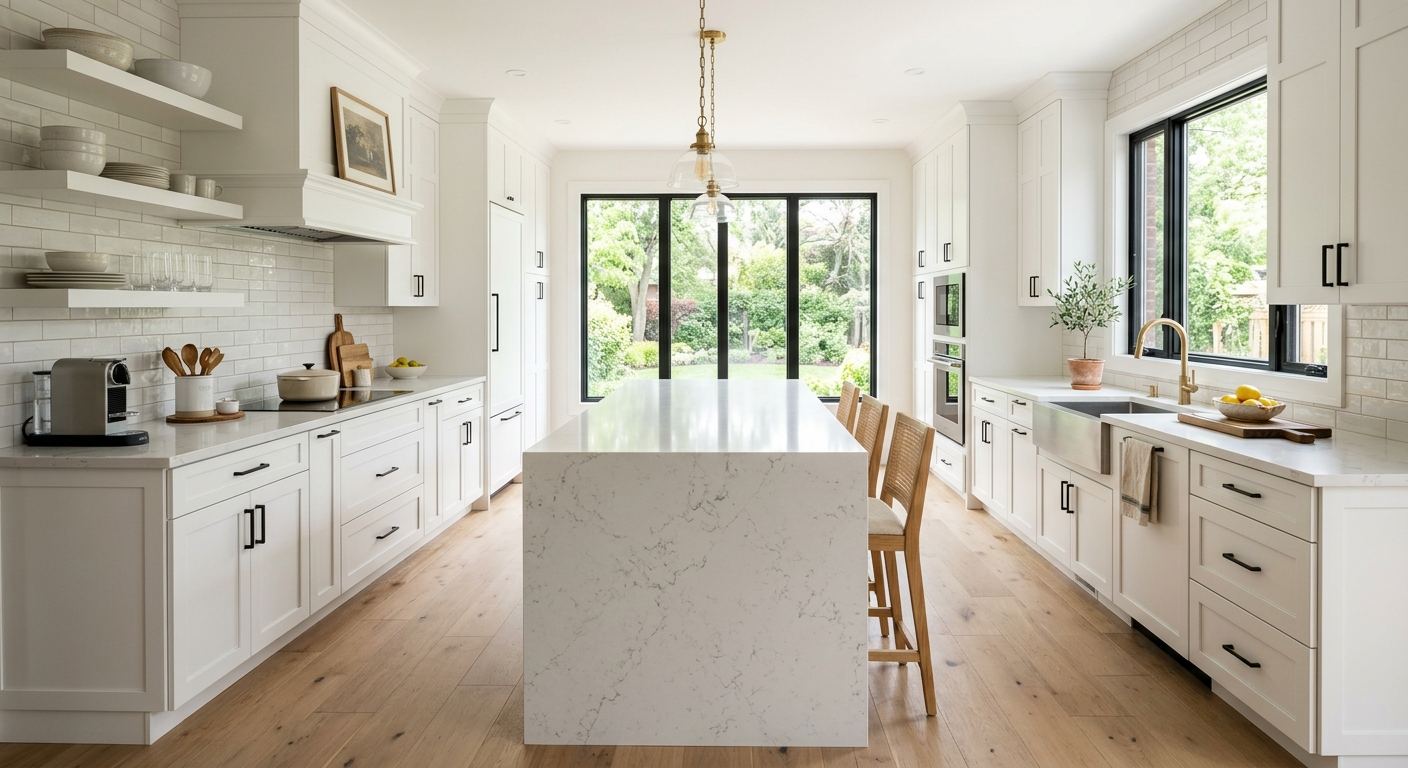
Kitchen renovation options and costs in West End
Kitchen renovation in West End moves fast, and costs can look very different project-to-project even when kitchens are similar. West End’s home market is shaped by household finances and the value owners expect to protect—Lower Mainland–Southwest includes a large, steady population (47,200 people in West End, 2021 Census) and many homeowners budget with resale in mind (Statistics Canada, 2021 Census). In practice, that means the “average” finish level trends higher here than in more affordability-led areas, with more demand for semi-custom cabinetry and stone surfaces rather than purely laminate and stock doors.
In the Lower Mainland–Southwest, climate is less of a driver of kitchen renovation pricing than the local economy—contractors and trades are abundant enough that scheduling is usually a bigger variable than weather. Still, coastal humidity does matter for cabinet installation and finish durability: we plan ventilation (especially around cooking), use proper cabinet sealing and underlayment for flooring transitions, and specify materials that tolerate seasonal moisture swings.
In West End, the trade is especially in demand around the high-density older housing blocks and condo-conversion neighborhoods near Davie Street and Denman Street, where layouts are tight and timelines are strict. For homeowners deciding between a quick refresh and a full rebuild, the simplest way to compare quotes is by renovation tier. Use the table below as a practical starting point, then align your scope (paint vs. new millwork vs. layout changes) with the finish tier you want.
| Renovation Tier |
What's Included |
Typical Duration |
Price Range |
| Cosmetic refresh (paint, hardware, new appliances only) |
Prep and paint (walls/ceiling), new cabinet hardware, swap appliances (no cabinet or countertop replacement), basic caulking and touch-ups |
3–7 days on site |
$8,000–$20,000 |
| Mid-range full renovation (new cabinets, counters, sink, tile) |
New semi-custom or quality-stock cabinets, new countertops, sink and faucet swap, backsplash tile, flooring transitions as needed, standard disposal and prep |
3–6 weeks |
$40,000–$75,000 |
| High-end full renovation (custom cabinets, stone counters, island) |
Fully custom millwork, upgraded stone (often with waterfall edges), island or major layout rework, premium backsplash, upgraded hardware and lighting, expanded electrical/plumbing as required |
6–12 weeks |
$75,000–$120,000 |
| Cabinet refacing only (new doors + drawer fronts, same boxes) |
Remove and replace doors/drawer fronts, new veneer or material wrap, reseal and finish matching, hardware swap; countertops and tile usually stay put |
1–2.5 weeks |
$8,000–$30,000 |
| Countertop swap only (laminate to quartz or stone) |
Remove existing laminate, template/measure, install new countertops, sink cut-out as needed, edge polishing, plumbing reconnections for sink |
5–12 days |
$3,000–$12,000 |
| Backsplash tile installation only |
Surface prep, waterproofing where required, tile supply and install, grout/seal, trim and caulking; assumes no major plumbing/electrical changes |
3–7 days |
$1,500–$6,000 |
Prices are estimates only and vary by project scope, site access and material selection.
What affects the price of kitchen renovation in West End
In West End and across the Lower Mainland–Southwest, quotes for the same “size” kitchen can swing by 30–50% because the real cost drivers are finish tier, labour complexity, and how much the layout and services change—not the weather. In higher-value parts of Metro Vancouver, owners commonly choose semi-custom or custom cabinetry, quartz or stone counters, upgraded hardware, and design-led layouts. That spending is easier to justify because many homeowners expect to recover it on resale. In more modest markets, laminate and stock cabinets dominate because the ROI is easier to defend at a lower total price point. Climate in this region affects the details—humidity management, ventilation, and how finishes perform—but it rarely changes the labour rate the way material and scope do.
Two concrete examples I see often in West End: first, if you move from a mid-range scope (often landing around $40,000–$75,000 for a full renovation) to an island with custom cabinet runs, you’re not just paying for millwork—you’re also paying for electrical (new circuits and under-cabinet lighting), heavier tile/flooring transitions, and more cabinet face frames and fillers. Second, a countertop upgrade can be “simple” or unexpectedly complex: replacing laminate with quartz might land in the $3,000–$12,000 band, but adding a waterfall edge, new sink location, or revised cut-outs for an undermount sink increases fabrication time and labour.
Housing stock and typical ages matter too. Older West End homes often have less accessible shutoffs or tighter chase space, so plumbing and gas routing can add time even when the countertop or cabinets are budget-friendly. These are the differences you feel in your quote, not the coastal forecast.
| Price Factor |
Why It Matters |
Cost Impact |
| Cabinet tier — stock vs. semi-custom vs. fully custom millwork |
Custom widths, drawers, internals, and made-to-fit carcasses drive material and install time |
Stock tends to keep budgets near the lower end of mid-range; semi-custom and custom often push the same kitchen into the next renovation band |
| Countertop material — laminate vs. quartz vs. granite vs. stone |
Fabrication complexity, edge profiles, and material cost vary widely, and stone needs careful templating |
Laminate swap often sits closer to the lower end; quartz and natural stone can add thousands once edges and cut-outs are premium |
| Layout change — wall removal, island add, plumbing/gas move |
Changes affect structural work, service reroutes, inspections, and labour sequencing |
Typically the biggest swing factor—can add significant cost regardless of cabinet finish |
| Appliance package tier — builder vs. mid-range vs. pro-grade |
Professional-grade units require more exact clearances, venting, and sometimes electrical upgrades |
Can move you several thousand dollars higher depending on package and matching |
| Flooring — refinish existing vs. full replacement |
Matching transitions, subfloor prep, and moisture/leveling issues drive labour |
Full replacement increases demo and install time; refinishing can materially reduce scope |
| Backsplash — ceramic tile vs. marble vs. full-height slab |
Large-format stone, full-height walls, and special edging increase precision time |
Tile-only typically stays within the backsplash band; stone slabs can rise quickly |
| Electrical — new circuits for island, under-cabinet lighting |
New circuits/fixtures require licensed work and often permits/inspection coordination |
Often adds cost and time; can be a major driver when adding an island |
| Permit fees and licensed trade requirements |
Permits and inspections add administrative steps plus the cost of licensed trades |
Usually not the largest line item, but it can change the schedule and overall total meaningfully |
Permits & regulations in British Columbia
In British Columbia, many “like-for-like” kitchen updates can be done without a permit, but the moment you touch plumbing, gas, wiring, or structure, the job typically enters permit-and-inspection territory. Cabinet and countertop swaps generally do not require a permit when you’re not moving supply/drain lines, not relocating gas equipment, and not changing load-bearing conditions.
What does typically require a permit in West End (and across BC): moving plumbing supply or drain lines (including changing sink location), relocating a gas stove or altering gas connections, removing or altering a load-bearing wall, adding electrical circuits (for example, new outlets or island receptacles), and upgrading/adding under-cabinet lighting that ties into new wiring. Gas work must be performed by a licensed gas fitter, and electrical work by a licensed electrician. Both are subject to inspection requirements.
Before you sign, confirm permit responsibility in the written contract. As a homeowner, you can verify competency and coverage step-by-step: (1) ask for the contractor’s BC licence details and confirmation of the specific licensed trades used (gas/electrical), then cross-check via official online registries; (2) request a current certificate of insurance (liability) showing adequate coverage for renovation work; (3) verify worker compensation coverage (WSIB/WCB) for the trades involved; and (4) ask for the clearance letter/proof the subcontractors carry the required coverage. A professional contractor should provide these documents without resistance.
Cabinets, countertops and layout decisions in West End
In West End, three decisions determine most of your budget and your long-term satisfaction: (1) cabinet tier, (2) countertop material, and (3) whether you change layout. Cabinet tier sets the foundation for both cost and how “built-in” the kitchen feels. Stock cabinets are fastest and cheapest, semi-custom is the most popular mid-range option because it balances fit and cost, and custom cabinets deliver the best plan for awkward corners and tight West End clearances—but they cost more.
Countertops follow a similar pattern. Laminate is economical and easy to replace, but it’s less forgiving for heat and heavy day-to-day impact. Quartz is a common sweet spot because it’s durable and low-maintenance, and it aligns well with the finish expectations of buyers in the Lower Mainland–Southwest resale market. Natural stone (granite/stone) brings premium appearance and can justify premium budgets when you’re building an island-focused layout.
Layout changes are where value can be real—or where budgets can balloon. Adding an island or opening an interior wall is justified when it improves flow and storage, and when your electrical and plumbing paths can be run efficiently. If the plan requires major relocations (gas/electrical/plumbing), the cost increases regardless of whether you choose laminate or quartz.
Dollar reality check: upgrading a countertop only (for example, laminate to quartz) can often land in the $3,000–$12,000 range, but once you add new sink placement and electrical for an island, you’re typically crossing into a broader renovation scope—often the $40,000–$75,000 tier for a mid-range full refresh with new cabinets and tile. In coastal conditions, we also build in good ventilation and moisture-resistant detailing so cabinets and finishes perform season after season.
| Option |
Durability |
Maintenance |
Best For |
Price Range |
| Stock cabinets (big-box) |
Good everyday durability; limited custom fit can leave more filler and seams |
Wipe clean; touch up minor chips; keep humidity controlled to prevent swelling at seams |
Fast timelines and budget-led updates |
$8,000–$25,000 |
| Semi-custom cabinets (local dealer) |
Strong build quality; better drawer internals and improved fit in irregular spaces |
Low maintenance; periodic hardware tightening; protect edges near sink/dishwasher |
Most West End homeowners targeting a resale-friendly mid-range finish |
$15,000–$45,000 |
| Custom cabinets (local millwork shop) |
Excellent durability; made-to-fit design reduces stress points and misalignment |
Low maintenance; ensure proper sealing and ventilation for coastal humidity |
Complex layouts, premium islands, and design-led renovations |
$35,000–$75,000 |
| Laminate countertop |
Moderate durability; can be sensitive to heat and water at seams |
Simple cleaning; avoid hot pans directly; reseal/repair chips when needed |
Cost-conscious swaps where you want a refreshed look |
$2,500–$6,500 |
| Quartz engineered countertop |
High durability; consistent surface and excellent resistance to everyday staining |
Easy wipe-down; use coasters/boards to reduce scratches; avoid abrasive cleaners |
Busy households and West End resale expectations |
$5,000–$10,000 |
| Granite / natural stone countertop |
Very durable and heat resistant; natural variation adds premium character |
Periodic sealing recommended; wipe up spills promptly |
Premium finishes and traditional stone look |
$6,000–$14,000 |
| Butcher block countertop |
Durable but can be impacted by moisture and edge wear |
Regular oiling and careful drying around sink; use cutting boards |
Warm, timeless style and families who prep food at the counter |
$4,000–$9,000 |
| Marble countertop |
Beautiful but softer than quartz; can etch/stain if not cared for |
Frequent sealing and careful cleaning; avoid acidic products |
Premium design statement where maintenance is acceptable |
$9,000–$18,000 |
How to choose a kitchen renovation contractor in West End
Choosing the right contractor in West End is mostly about documentation and clarity. Start by verifying British Columbia licensing and coverage for the specific trades involved. Ask for proof of liability insurance and confirm the subcontractors carrying out gas work (licensed gas fitter) and electrical work (licensed electrician) are properly credentialed. For worker coverage, ensure the contractor and their trade partners carry WSIB/WCB (or equivalent coverage where applicable), then request proof such as a clearance letter or confirmation documents.
Next, request 2–3 itemised written quotes—not lump sums—so you can compare apples-to-apples. Good quotes break labour and materials out by scope (demo, framing where needed, cabinet install, countertop template/fabrication and install, tile, electrical/plumbing allowances, and disposal). Read the exclusions: ask whether permit pulling is included (and who submits), whether old materials and construction waste disposal are included, and what happens if site conditions change (for example, hidden subfloor rot or outdated shutoffs).
Warranty matters more than many people expect. Confirm the workmanship warranty length, what it covers, and whether it’s transferable if you sell. Also check the product/manufacturer warranty for cabinets, countertops, and fixtures. For payment, never allow more than 10–15% upfront; use progress payments tied to completed milestones, and hold back a portion until closeout and punch-list are finished. Finally, get a written start date and a realistic completion estimate that accounts for countertop fabrication lead times and scheduling of trades.
- Confirm licensed trades used for gas and electrical work in writing
- Request certificate of insurance (liability) and verify dates and coverage limits
- Verify WSIB/WCB coverage with proof/clearance documentation
- Get 2–3 itemised quotes with labour + materials breakdown
- Ask who pulls permits and whether permit fees are included
- Clarify what “disposal” includes (dump fees, hauling, sorting)
- Require a detailed scope: exclusions for floors, drywall repairs, plumbing updates
- Check cabinet warranty terms (door/drawer alignment, finish issues)
- Confirm countertop warranty and fabrication responsibilities
- Set a milestone payment schedule (limit upfront to 10–15%)
- Get a written schedule with start/completion estimate
- Ensure the contract includes a defined change-order process
Red flags in West End: vague “allowances” with no material specs, no clear permit responsibility, pushing large upfront deposits, missing insurance/coverage documents, and a schedule that ignores countertop fabrication lead times—especially when quotes are unusually low relative to typical $40,000–$75,000 mid-range renovation totals.
Frequently asked questions — kitchen renovation in West End
Can I live at home during a kitchen renovation in West End?
Often, yes—many West End homeowners stay in the home during portions of the work, especially for cosmetic refreshes or a counter/backsplash-only scope. With a mid-range full renovation (commonly around $40,000–$75,000 depending on finishes), it’s still possible to live in the home, but expect dust control, restricted kitchen access, and a temporary setup for meals (bar fridge, kettle, and a safe prep area). For larger rebuilds with layout changes, work sequencing and inspection timing can extend disruption. Because West End homes vary in age and access, we plan around plumbing shutoffs, dust containment, and drying time for patching/paint. If you’re doing electrical or moving services, the safest approach is to set expectations with your contractor so you’re not without power or water unexpectedly.
Should I renovate my kitchen before selling in West End?
In most Lower Mainland–Southwest situations, a kitchen refresh can help buyers feel confident—especially when finishes move toward what local shoppers expect (clean lines, modern hardware, and durable counters). However, not every renovation is ROI-positive. If your budget is tight, prioritize high-impact items like cabinet hardware, new countertops, and a well-set backsplash; in terms of price bands, you might stay closer to the countertop or backsplash ranges rather than committing to a full rebuild. If you’re considering a mid-range full renovation (often $40,000–$75,000) or higher-end approach, aim for changes that match your home’s overall value profile and avoid over-customizing if the layout won’t appeal broadly. Your realtor can also guide you by showing comparable listings nearby—West End is competitive, and buyers pay attention to layout, storage, and finish durability in a coastal humidity environment.
What's the most popular kitchen style in West End right now?
Right now, the most common direction we see in West End is a clean, contemporary look with warm neutrals: shaker-style or slab-front cabinet faces in light-to-medium tones, matte hardware, and quartz counters that read “stone-like” without the maintenance burden of natural stone. Many projects also include an island for improved circulation and a better cooking-and-entertaining flow, particularly in homes where the kitchen is the main gathering space. When budgets allow, semi-custom cabinets are a popular choice because they fit more precisely and allow better drawer organization. If you’re aiming for a budget refresh, a less intrusive path—paint, hardware, and new appliances—can give that same modern feel without jumping into a full rebuild band like $75,000–$120,000. In coastal BC, we also choose finishes that handle humidity swings well, especially around sink and dishwasher zones.
How do I know if I need to update my kitchen plumbing in West End?
You usually need plumbing updates if you’re moving the sink location, encountering recurring leaks, dealing with slow drains, or you have shutoff issues that can’t be serviced reliably. If your contractor is planning a countertop or cabinet swap only, you may not need major changes—but reconnections still happen, so it’s smart to inspect the shutoffs and under-sink piping before the new cabinet base is installed. In West End and older homes, shutoffs can be hard to access and some supply lines may be dated; addressing this during renovation prevents “future surprise” after cabinets are closed in. Also, if you plan to add a dishwasher with a revised line layout or add a garbage disposal, those changes can require piping modifications. A good contractor checks shutoffs, waste/drain condition, and venting as part of the pre-start scope and highlights any risks in writing.
What is the difference between a galley and open-concept kitchen?
A galley kitchen is typically a narrow, corridor-style layout with counters on two opposing sides. It often suits smaller footprints and can be efficient for workflow, but it limits seating and can feel closed off. An open-concept kitchen removes barriers to connect the kitchen to living/dining areas, generally improving sightlines and social flow. In West End, the open-concept look is popular, but it’s also more expensive if it involves removing a wall or relocating services—those changes can trigger permits and require careful electrical/plumbing/gas coordination. If you’re staying within a cosmetic or limited renovation scope, you can keep costs more contained; but once you open walls or add an island, you’re usually moving into the mid-range or higher tiers (often $40,000–$75,000 for mid-range full renovations). Your contractor should confirm whether a wall is load-bearing and what services run behind it.
How do I get accurate kitchen renovation quotes in West End?
Accurate quotes come from good scope definition and itemised pricing. Start by getting 2–3 written quotes with labour and materials separated, not lump sums. Provide measurements, photos, and—if possible—plans showing whether you’re changing layout, moving a gas line, or relocating plumbing. Ask explicitly whether the quote includes permit pulling (when required), disposal/haul-away, and allowances for drywall repairs and flooring transitions. In West End, condo-style access and older housing constraints can affect site logistics, so mention parking/loading conditions and any building rules early. For example, if someone quotes you for a mid-range full renovation, compare whether cabinetry is stock vs. semi-custom and whether you’re in the quartz/stone countertop band or closer to laminate-only swaps. Finally, verify contractor coverage and licensed trades for gas/electrical work so your timeline doesn’t derail.