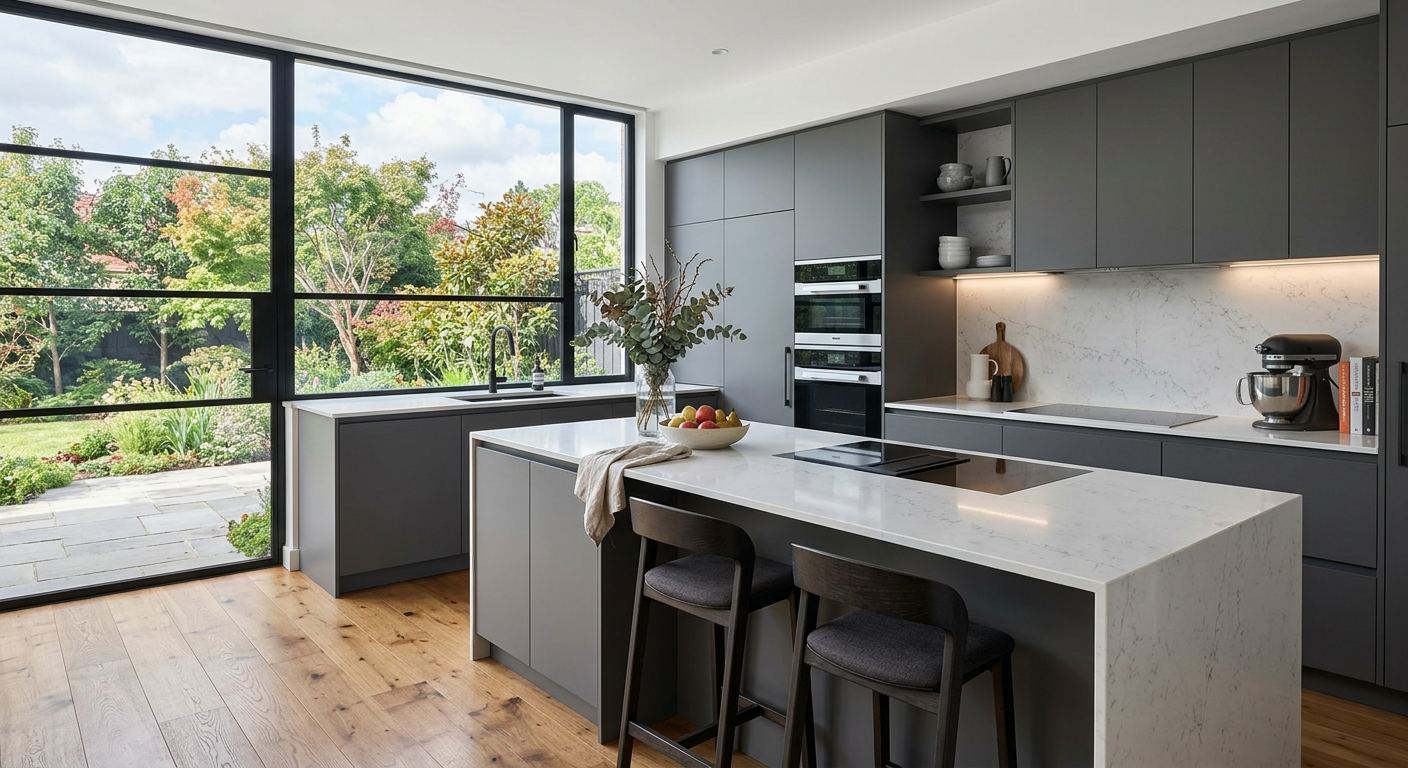
Kitchen renovation options and costs in South Slope
Kitchen renovation in South Slope is shaped as much by buyer expectations and home values as it is by materials. With a South Slope population of 12,782 (Statistics Canada, 2021 Census), the neighbourhood draws steady demand from homeowners upgrading practical, family-facing kitchens—especially in older housing stock where electrical service, subfloors, and plumbing runs often need updating. In the Lower Mainland–Southwest (including Surrey-adjacent buying patterns), homeowners also tend to make choices that help on resale, and that often means stepping up from stock finishes toward semi-custom cabinetry and quartz or stone counters when the budget allows.
Across British Columbia, the biggest cost swings come from the finish tier and the “scope surprises” (hidden damage, uneven walls, outdated wiring, or the cost of rerouting plumbing/gas). The Lower Mainland–Southwest market is less climate-driven than you might expect: costs are usually driven by home value, income, and the finish level that aligns with what buyers will pay. Local contractor availability can help keep labour rates competitive, but peak summer schedules and multi-trade work can still extend timelines—particularly for projects involving island builds, under-cabinet lighting, and cabinet installation packages in dense, older strata-style homes.
In practice, areas where renovations are especially in demand are around the Central City and Fleetwood corridor feel of the South Slope area (where many homes are older and kitchens are commonly due for an update). That’s why you can see the same kitchen size price very differently depending on whether you’re doing a cosmetic refresh or a full rebuild—so the comparison below gives you a practical pricing framework for your quote.
| Renovation Tier |
What's Included |
Typical Duration |
Price Range |
| Cosmetic refresh (paint, hardware, new appliances only) |
Cabinet paint or restain (if applicable), new pulls/handles, appliance swap, minor touch-ups, basic caulking and trim refinishing |
1–3 weeks |
$8,000–$18,000 |
| Mid-range full renovation (new cabinets, counters, sink, tile) |
New semi-custom or quality stock cabinets, quartz or durable laminate counters, new sink/faucet, backsplash tile, flooring patch/replace as needed |
4–8 weeks |
$40,000–$85,000 |
| High-end full renovation (custom cabinets, stone counters, island) |
Fully custom millwork, premium stone counters, island build, elevated hardware and lighting, more complex backsplash (feature wall), upgraded finishes |
8–16 weeks |
$85,000–$120,000 |
| Cabinet refacing only (new doors + drawer fronts, same boxes) |
Door/drawer replacement, new hinges/slides where needed, matching trim, updated hardware, re-caulking and minor refinishing |
2–5 weeks |
$8,000–$35,000 |
| Countertop swap only (laminate to quartz or stone) |
Remove/install counters, new sink cut-out (if changing sink type), seam sealing, edge profile upgrade, backsplash tie-in as needed |
1–2.5 weeks |
$3,000–$12,000 |
| Backsplash tile installation only |
Tile supply and install, layout and levelling, grout/seal, clean caulk lines at countertop and edges |
1–2 weeks |
$1,500–$6,000 |
Prices are estimates only and vary by project scope, site access and material selection.
What affects the price of kitchen renovation in South Slope
In South Slope, the same “looks good on paper” kitchen project can come in 30–50% apart depending on which finishes and systems the quote includes. That gap isn’t usually because of a dramatic British Columbia climate change—it's because Lower Mainland–Southwest pricing is tightly linked to local home values, household income, and the expected resale finish tier. When homeowners in higher-value pockets choose quartz or stone counters and semi-custom cabinetry, they’re often selecting finishes that are easier to recover at resale. In more modest scopes, laminate and stock cabinetry tend to deliver the best return because the investment is kept proportional to the achievable upgrade value.
Layout changes are the most unpredictable cost driver regardless of tier. Removing a wall to open the kitchen, adding an island, or moving a gas line and venting can trigger new framing, electrical updates, and permit requirements—plus additional labour time and inspection coordination. In practice, one “small” change (like relocating the sink or switching to a gas range) can convert a straightforward countertop swap into a full-service renovation.
For concrete South Slope examples: (1) older homes often have out-of-date electrical runs, so adding under-cabinet lighting and a new island circuit can add both labour and materials beyond your initial countertop budget; (2) a backsplash job frequently reveals uneven drywall, increasing tile prep and increasing tile and labour; (3) if your floors are warped or your subfloor is soft, a cabinet install may require patching or partial replacement, pushing the project toward the mid-range full renovation band (around $40,000–$85,000) instead of staying closer to a cabinet/refresh budget.
Even when weather isn’t the primary driver, timing matters: late-season site conditions can slow tile and paint prep. Still, most cost differences come down to scope and finish selection—especially if you’re targeting the high-end full renovation range (up to $85,000–$120,000) with custom millwork and stone.
| Price Factor |
Why It Matters |
Cost Impact |
| Cabinet tier — stock vs. semi-custom vs. fully custom millwork |
Cabinet cost changes dramatically with fit, door/drawer quality, interior options, and whether a shop makes-to-measure parts |
$10,000–$65,000 |
| Countertop material — laminate vs. quartz vs. granite vs. stone |
Material price, edging/seaming complexity, and installation method drive cost; stone also adds weight and template time |
$3,000–$12,000 |
| Layout change — wall removal, island add, plumbing/gas move |
Triggers new structural, electrical, plumbing, and sometimes gas venting work and coordination with inspections |
$5,000–$35,000 |
| Appliance package tier — builder vs. mid-range vs. pro-grade |
Pro-grade brands add premium pricing, ventilation complexity, and fitment requirements |
$2,000–$15,000 |
| Flooring — refinish existing vs. full replacement |
Floor removal affects subfloor, levelling, underlayment, and sometimes moisture mitigation |
$1,500–$12,000 |
| Backsplash — ceramic tile vs. marble vs. full-height slab |
Full-height and premium stone require more layout precision, heavier products, and longer install time |
$1,500–$6,000 |
| Electrical — new circuits for island, under-cabinet lighting |
Labour and material depend on circuit additions, cable runs, and fixture/lighting controls |
$800–$8,500 |
| Permit fees and licensed trade requirements |
Some work requires permits and inspections; licensed trades can affect scheduling and total labour hours |
$500–$5,000 |
Permits & regulations in British Columbia
In British Columbia, not every kitchen change needs a permit, but the line is where trades work turns into plumbing, gas, electrical, or structural. A straightforward countertop swap or cabinet refacing (keeping existing boxes and not relocating services) typically does not require a building permit. Similarly, replacing like-for-like appliances is usually straightforward from a permit standpoint, though your contractor should still confirm manufacturer and venting requirements where relevant.
Where permits and licensed trades do come into play: moving or modifying plumbing supply lines and drain lines; relocating a gas stove or changing gas piping; removing a load-bearing wall (or changes that affect structure); and adding new electrical circuits (for example, island power outlets, dedicated circuits, or significant lighting upgrades). Gas work must be performed by a licensed gas fitter, and electrical work must be done by a licensed electrician—both generally require inspections as part of the process.
To verify a contractor in South Slope before you sign, do it step-by-step: (1) Check the contractor’s trades licensing details online (using the applicable provincial registry resources provided for licensing verification); (2) request a certificate of insurance—confirm liability coverage limits match typical renovation risks; (3) ask for proof of coverage for workplace injury protection (WCB/WorkSafe BC clearance letter or equivalent proof, depending on the business setup). Then make sure permit responsibility is written in your contract—“who pulls permits” should be explicit, not assumed.
Cabinets, countertops and layout decisions in South Slope
The three most consequential decisions in a South Slope kitchen renovation are cabinet tier, countertop material, and whether you change the layout. Start with cabinets: stock is the fastest and least expensive, semi-custom is the most common “best balance” choice for Lower Mainland–Southwest resale expectations, and custom millwork gives the tightest fit and the highest cost. In South Slope, many homes have older framing and slightly out-of-square conditions, so semi-custom and custom options can reduce final gaps and awkward filler strips.
Next, choose countertops. Laminate is budget-friendly and practical, but it’s less resistant to deep staining and heat. Quartz is usually the sweet spot—durable, easy to maintain, and available in many looks that match modern buyers’ expectations. Granite/natural stone offers character and toughness, while still needing sealing habits. Butcher block adds warmth and a different maintenance routine (oil and care), and marble is beautiful but generally higher maintenance in busy kitchens.
Finally, layout changes should be justified by the space gain, not just aesthetics. Removing a wall for open-concept flow or adding an island can make daily life smoother and can align with how buyers picture kitchens in the Lower Mainland–Southwest, but moving plumbing or gas is where costs can jump and timelines stretch.
Example: if you’re deciding between keeping your existing layout and doing a countertop upgrade, a countertop swap (often $3,000–$12,000) is typically a better spend than re-routing plumbing for a sink move. If you want an island, the added electrical/plumbing coordination and framing time can push you from a mid-range plan toward a fuller renovation scope (commonly $40,000–$85,000), especially when you’re adding under-cabinet lighting and new power outlets.
| Option |
Durability |
Maintenance |
Best For |
Price Range |
| Stock cabinets (big-box) |
Good durability for standard use; limited customization and fewer fit adjustments |
Low day-to-day care; touch-up depends on finish type |
Time-sensitive renovations and tighter budgets |
$8,000–$25,000 |
| Semi-custom cabinets (local dealer) |
Very durable with better hardware and interior organization options |
Low; hinges and soft-close parts may require occasional tuning |
Most South Slope mid-range projects aiming for resale-ready quality |
$20,000–$45,000 |
| Custom cabinets (local millwork shop) |
Excellent durability with built-to-fit design and premium construction options |
Low; higher-end finishes are easier to protect with normal care |
When your kitchen is awkwardly sized, or you want a truly tailored layout |
$45,000–$80,000 |
| Laminate countertop |
Moderate durability; seams and edges need careful protection |
Easy day-to-day cleaning; avoid prolonged heat and sharp impacts |
Budget refreshes and rental-friendly upgrades |
$3,000–$6,000 |
| Quartz engineered countertop |
High durability; resistant to staining compared to natural stone |
Low maintenance; wipe-clean and use care with abrasive pads |
Busy family kitchens that want a premium look with practical upkeep |
$6,000–$10,000 |
| Granite / natural stone countertop |
Very durable; natural variations and hardness vary by stone type |
Typically requires periodic sealing; clean up spills promptly |
Homeowners wanting natural character and high-end resale appeal |
$8,000–$12,000 |
| Butcher block countertop |
Durable for prep use; can scratch and needs protection at seams |
Higher maintenance: oiling and regular care to prevent dryness |
Warm, casual kitchens; owners who enjoy maintenance |
$4,500–$9,000 |
| Marble countertop |
Elegant but softer and more prone to staining/etching |
Highest maintenance: careful cleaning, quick spill response, sealing |
Statement kitchens where the look is the priority |
$10,000–$14,000 |
How to choose a kitchen renovation contractor in South Slope
Choosing the right contractor in South Slope is mostly about verification and clarity. In British Columbia, confirm licensing and coverage before work starts: (1) licensing—ensure the contractor’s relevant trades are licensed for the specific scope (gas work for gas-fitters, electrical for electricians); (2) liability insurance—request a certificate of insurance and confirm the contractor’s name matches the quote; (3) workplace injury protection—ask for proof of WorkSafe BC coverage (often provided as a clearance letter or equivalent proof). Don’t rely on “we’re covered” wording; ask to see documents.
For pricing, request 2–3 itemised quotes rather than a single lump sum. You want separate lines for labour and materials: cabinetry supply and install, countertop fabrication and install, plumbing/electrical allowances, tile and prep work, demolition, disposal, and any patching/levelling. Also read the scope for exclusions: is permit pulling included (when required), who pays for inspection fees, and is disposal and drywall/patching waste included? A credible quote will clearly state what’s included and what’s not.
Warranty matters too. Ask for a workmanship warranty length (and what it covers), product/manufacturer warranties (for cabinets, countertops, and appliances), and whether the warranty is transferable if you sell. For payment, use a schedule that keeps you protected: never pay more than 10–15% upfront, and hold back a portion until completion and punch-list items are verified. Finally, insist on a written start date and a realistic completion estimate that matches the trade sequence.
- Confirm licensing for the specific trades being used and match it to the scope.
- Request a certificate of insurance and verify coverage is active.
- Ask for WorkSafe BC clearance proof (or equivalent coverage documentation).
- Use itemised quotes with labour/material breakdown—not lump sums only.
- Confirm whether demolition, hauling, and disposal are included.
- Clarify who pulls permits and who pays inspection-related costs.
- Ask how plumbing/gas and electrical rough-in will be scheduled.
- Check if floor levelling/patching is included for cabinet base alignment.
- Ask about backsplash prep (flat walls, waterproofing where needed).
- Request a written project timeline with key milestones.
- Confirm what “allowances” cover for appliances, fixtures, and tile.
- Get warranty terms in writing for workmanship and products.
Red flags in South Slope include: vague scopes without itemized pricing, refusing to provide proof of insurance or WorkSafe BC coverage, promising exact start dates with no material lead-time plan (especially for cabinets/counters), quoting “all-in” permits responsibility without showing what they include, and asking for large upfront payments beyond 10–15%.
Frequently asked questions — kitchen renovation in South Slope
How much does a kitchen renovation cost in South Slope?
In South Slope and the Lower Mainland–Southwest, kitchen totals usually land in the broad range of $40,000–$120,000 for a full renovation, with the biggest swings coming from cabinetry tier, countertop type, and whether you’re changing the layout. A cosmetic refresh can be much lower, commonly $8,000–$18,000, especially if you’re only painting and swapping hardware and appliances. For many homeowners aiming for a practical upgrade that still sells well, a mid-range full renovation often sits around $40,000–$85,000. The neighbourhood’s older home stock can also add some hidden electrical/plumbing prep, so your first quote should be itemised rather than a single lump sum.
How long does a kitchen renovation take in South Slope?
Timelines in South Slope usually track the renovation tier and how many trades are involved. Cosmetic refreshes are typically 1–3 weeks because they avoid wall and service changes. A mid-range full renovation often takes about 4–8 weeks, while high-end custom projects—especially with islands, stone counters, and custom millwork—can take 8–16 weeks. The Lower Mainland–Southwest market can also affect scheduling: cabinet and countertop lead times, plus coordinating plumbing/gas and electrical rough-ins, can extend the calendar if you order late or change scope after templates are done. Always ask your contractor for a written sequence (demolition → rough-in → cabinet install → counters → tile/final finishes) so you can plan around your household schedule.
Quartz vs granite countertops — which is better?
Both quartz and granite are strong choices in British Columbia kitchens, but they serve slightly different priorities. Quartz is typically lower maintenance: it’s non-porous compared to many natural stones, resists staining well, and is usually quicker to clean day-to-day. Granite/natural stone is also durable and can look exceptional with unique veining, but it generally requires periodic sealing and prompt spill cleanup to protect the surface. In practical budgeting, quartz often fits the “premium but predictable” lane; countertop swaps commonly fall into $6,000–$10,000 depending on size and edge profiles, while granite/stone can trend higher within the $8,000–$12,000 band. The “better” choice usually depends on your maintenance comfort and whether you prefer consistent looks (quartz) or natural character (granite).
Should I reface or replace my cabinets?
Refacing is usually best when the existing cabinet boxes are solid, level, and structurally sound—meaning the frames aren’t sagging, and the interior is worth keeping. It can refresh the look for a fraction of a full cabinet replacement, with refacing commonly landing around $8,000–$35,000. Replacing cabinets is the better option if you need major layout changes, want new internal storage (pantries, pull-outs, upgraded drawer systems), or have issues with water damage, poor alignment, or outdated dimensions. In South Slope’s older housing stock, I often see homeowners choose refacing first if the boxes test well and the doors/drawers are the main issue. But if you’re also updating counters and moving plumbing or electrical, replacement can sometimes be more cost-effective overall because it simplifies finishing and alignment.
Do I need a permit for a kitchen renovation in British Columbia?
Not always. In British Columbia, cabinet and countertop swaps typically do not require permits if you’re not moving services and you’re keeping the work non-structural and like-for-like. What does require permits and licensed trades usually includes moving plumbing supply/drain lines, relocating a gas stove or changing gas piping, removing a load-bearing wall, and adding new electrical circuits (for example, island outlets or significant lighting changes). In South Slope, it’s common for renovations to trigger at least one of these items, so confirm early. Your contractor should tell you what permits are required and include it in the written contract—“we’ll handle it” isn’t enough. Also remember: gas work must be done by a licensed gas fitter and electrical by a licensed electrician, with inspections as part of the process.
What's the ROI on a kitchen renovation?
ROI in the Lower Mainland–Southwest is strongly tied to finish tier and how the upgrade matches buyer expectations for the home’s price point. While you can’t guarantee resale outcomes, the market reward is typically higher when you choose durable, widely appealing upgrades—like quartz counters and semi-custom cabinetry—over purely cosmetic changes. A well-scoped mid-range renovation (often around $40,000–$85,000) can make your home feel “move-in ready,” especially when your layout is functional and finishes look current. If you add complex features (custom millwork, stone counters, island builds) you’re moving toward the upper band ($85,000–$120,000), so the ROI depends more on whether those choices match the style and value level of nearby sales. As a guideline, the safest ROI tends to come from practical improvements (storage, lighting, reliable surfaces) rather than the highest-cost decorative options.