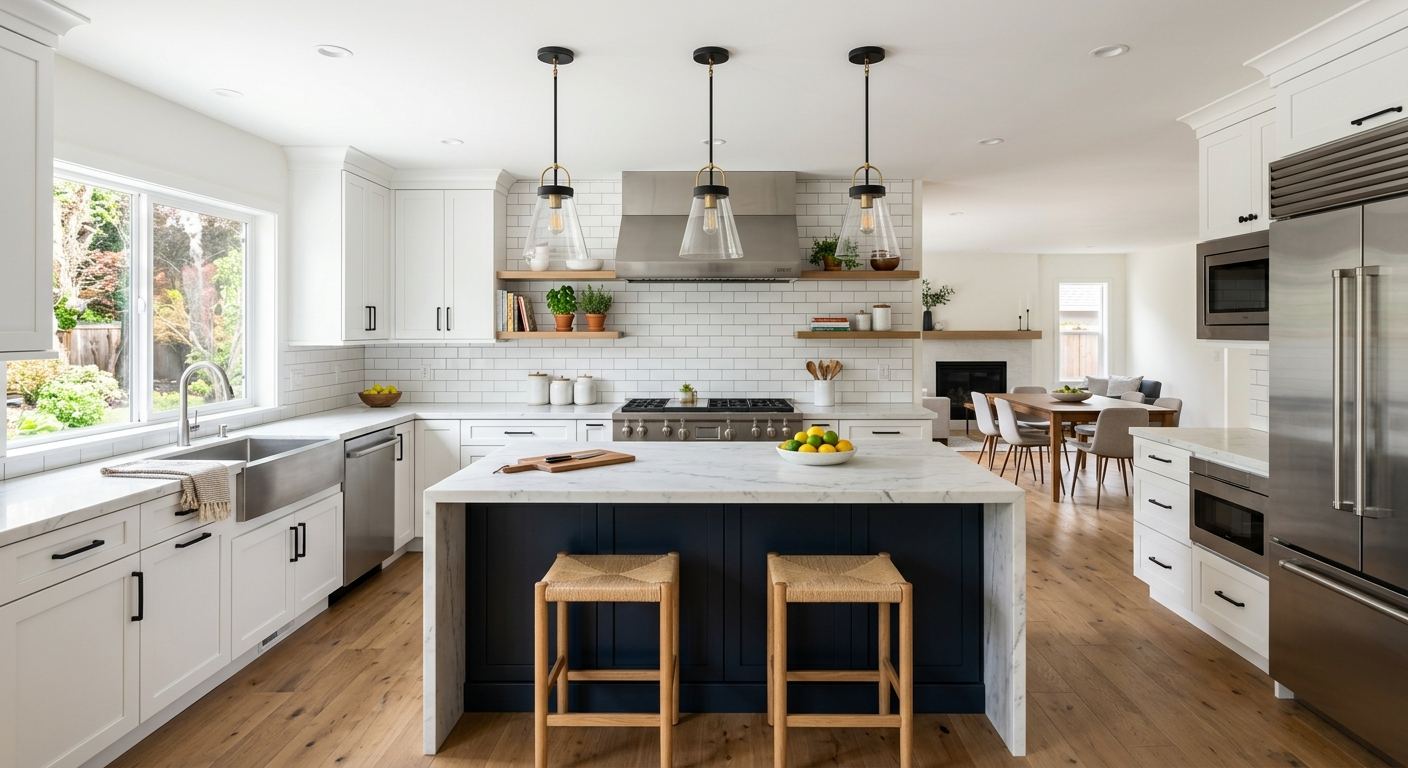
Kitchen renovation options and costs in West Point Grey
Kitchen renovations in West Point Grey typically land in a wide range because the area sits inside the Lower Mainland–Southwest market, where homeowners expect a finish level that matches nearby neighbourhood sales—especially in older, character-leaning streets with more frequent upgrades. While West Point Grey is part of a broader community with a population of 13,065 (Statistics Canada, 2021 Census), kitchen pricing in this part of Vancouver is less about population size and more about local purchasing power and resale expectations. In higher-value Metro Vancouver settings, many owners choose semi-custom cabinetry, quartz or stone counters, and upgraded hardware because the renovation is easier to “place” for buyers. That finish behaviour is more common where household incomes support it (Statistics Canada, 2021 Census).
Climate plays a smaller role in day-to-day costs than market expectations, but coastal humidity can still affect what contractors plan for: you’ll often see tighter cabinet installation details, careful underlayment/floor preparation, and durable countertop sealing schedules. Labour availability is also shaped by steady demand across Vancouver-area neighbourhoods, so timelines can be tighter than in smaller markets. In West Point Grey—particularly around University Endowment Lands and the nearby Wesbrook Village corridor—contractors who can handle detail-heavy cabinetry and stone work are in especially high demand due to ongoing renovation activity and the premium finish standards.
Below is a practical look at typical renovation tiers you’ll see in quotes for West Point Grey projects, from a refresh through full custom rebuilds.
| Renovation Tier |
What's Included |
Typical Duration |
Price Range |
| Cosmetic refresh (paint, hardware, new appliances only) |
Cabinet repaint or minor hardware swap, new appliances (dishwasher/range/fridge as selected), backsplash spot-finish if staying same footprint |
1–2 weeks |
$40,000–$55,000 |
| Mid-range full renovation (new cabinets, counters, sink, tile) |
Semi-custom or quality stock cabinets, new countertop, sink and faucet, backsplash tile, vanity lighting updates, basic flooring replacement or patching as needed |
3–6 weeks |
$65,000–$95,000 |
| High-end full renovation (custom cabinets, stone counters, island) |
Fully custom millwork, quartz/stone upgrade, island build with upgraded hardware, extended backsplash, higher-end appliance package, deeper electrical scope |
6–10 weeks |
$95,000–$140,000 |
| Cabinet refacing only (new doors + drawer fronts, same boxes) |
New veneer/doors/drawer fronts, updated hardware, refinishing of existing boxes where feasible |
2–4 weeks |
$15,000–$38,000 |
| Countertop swap only (laminate to quartz or stone) |
Remove/install existing counters, new quartz or stone, cut-outs for sink and cooktop, basic sealing and joinery |
3–7 days |
$12,000–$30,000 |
| Backsplash tile installation only |
Tile supply/installation, substrate prep, grout and caulk detailing, edge trims as required |
3–5 days |
$2,500–$6,000 |
Prices are estimates only and vary by project scope, site access and material selection.
What affects the price of kitchen renovation in West Point Grey
In the Lower Mainland–Southwest, it’s common to see quotes for the same “size” kitchen vary by 30–50% across British Columbia, even before you change materials. The biggest driver is not weather—it’s home values, household income and the finish tier homeowners choose for resale. In higher-value pockets of Metro Vancouver, owners often default to quartz or stone counters and semi-custom cabinetry because that cost is easier to justify on resale. In more modest markets, laminate and stock cabinets dominate because they deliver a noticeable refresh without pushing the total project budget as high.
Another major swing factor is layout and trade movement: removing a wall, adding an island, changing where plumbing lands, or relocating a gas line can add weeks of planning and rework regardless of whether you’re aiming for a mid-range refresh or a high-end build. For example, a straightforward countertop swap in the $3,000–$12,000 band may stay contained, but a countertop plus plumbing changes can quickly escalate into a mid-range full renovation budget as soon as walls and finishes need to come apart. Conversely, some West Point Grey homes with solid, serviceable cabinet boxes can make refacing a better value—especially when the goal is to keep the renovation closer to a cabinet installation/refacing scope instead of a full rebuild.
Concrete West Point Grey examples: (1) older homes with dated supply/drain runs can force early wall opening to confirm pipe conditions, raising labour and disposal; (2) kitchens with tight ventilation clearances may require duct or fan changes that affect electrical and cabinet soffits; (3) if you choose premium stone with more complex edges and island overhangs, the fabrication and template process can extend scheduling—pushing costs toward the higher end of the $40,000–$120,000 full-renovation band.
| Price Factor |
Why It Matters |
Cost Impact |
| Cabinet tier — stock vs. semi-custom vs. fully custom millwork |
Higher tiers improve fit, storage layouts and build quality, and require more design and fabrication time |
Often the largest swing; can move a project across the mid-range vs. high-end renovation bands |
| Countertop material — laminate vs. quartz vs. granite vs. stone |
Material cost, fabrication complexity, edge profiles and installation tolerances drive totals |
Laminate stays lower; quartz/stone can add significant dollars per linear foot |
| Layout change — wall removal, island add, plumbing/gas move |
Triggers demolition, framing/structural work, inspections, and skilled trade scheduling |
Typically adds the most unpredictability and can shift pricing by tens of thousands |
| Appliance package tier — builder vs. mid-range vs. pro-grade |
Pro-grade brands increase purchase cost and sometimes require electrical/venting upgrades |
Can add cost without improving structure, so tie it to your cooking needs |
| Flooring — refinish existing vs. full replacement |
Waterproofing and matching existing materials can be difficult in older West Point Grey homes |
Refinish is usually cheaper; full replacement increases labour and materials |
| Backsplash — ceramic tile vs. marble vs. full-height slab |
Premium stone requires careful setting, sealing, and heavier handling |
Tile adds moderate cost; full-height slab can push into high-end totals |
| Electrical — new circuits for island, under-cabinet lighting |
Electrical scope depends on outlets, lighting layout, and code-compliant circuit planning |
More circuits and lighting layout changes increase labour and permit time |
| Permit fees and licensed trade requirements |
Work that touches gas, plumbing/drains, or electrical typically needs permits and inspections |
Adds administrative and labour cost; prevents delays due to compliance gaps |
Permits & regulations in British Columbia
In British Columbia, not every cabinet-and-counter change triggers a permit, but certain kitchen alterations absolutely do. Typically, a straightforward cabinet or countertop swap does not require a permit because you’re replacing finish materials without relocating systems. However, if you move plumbing supply or drain lines, relocate a gas appliance (including the stove/range setup and any gas range hood work), remove a load-bearing wall, or add new electrical circuits (for example, dedicated circuits for an island or significant under-cabinet lighting upgrades), you should expect permits and licensed trade involvement.
A practical way to verify compliance for a West Point Grey renovation is step-by-step: (1) ask for the contractor’s business licence and the name of each licensed trade they’ll use; (2) for gas work, confirm the gas fitter is licensed and will arrange the required inspections—gas work must be done by a licensed gas fitter; (3) for electrical, confirm a licensed electrician will complete the work and submit for inspection; (4) verify liability insurance with the exact job address listed on the certificate of insurance; (5) confirm coverage for work through the appropriate workers’ compensation arrangement for their employees (commonly handled through WCB/clearances for the trade). Where to look: use the provincial online licence registries for trade status, and request a current certificate of insurance and any clearance letter your contractor can provide before work begins.
Always confirm in writing who is responsible for permits before you sign—so you don’t pay twice if scope changes late.
Cabinets, countertops and layout decisions in West Point Grey
The three most consequential decisions in a West Point Grey kitchen renovation are cabinet tier, countertop material and whether you change the layout. Cabinet tier sets both the look and the “fit” impact: stock cabinets are fastest and often cheapest, semi-custom is the most common mid-range option in the Lower Mainland–Southwest, and custom millwork is the premium path for tight spaces and built-in storage you can’t get with off-the-shelf boxes. Countertops then determine daily usability and maintenance: laminate is budget-friendly but less heat- and scratch-resistant; quartz is a strong balance of durability and low maintenance; granite/natural stone adds character but typically needs more careful sealing routines; butcher block brings warmth but requires attentive oiling and moisture management; marble is luxurious but generally more sensitive to staining.
Layout decisions are where costs can “jump” quickly. Open-concept wall removal or an island addition can justify higher spend when it creates real space for circulation and seating—especially in older Vancouver homes where the kitchen can feel compartmentalized. But if your wall removal involves structural work, and plumbing/gas relocation is needed, the project often escalates beyond what people expect. As a dollar example: keeping a change limited to countertop swap only can often sit near the $12,000–$30,000 range for a quartz/stone upgrade, while moving sink location plus changing cabinetry run may push you into a mid-range full renovation budget closer to $65,000–$95,000 due to demolition, rerouted lines and additional finish trades.
Coastal humidity in West Point Grey also supports choosing durable, well-installed materials and careful sealing/caulking details, particularly around sink splash zones and near windows. In the Lower Mainland–Southwest resale market, buyers increasingly expect clean quartz/stone work and practical cabinet storage, so prioritize spending where it’s visible every day.
| Option |
Durability |
Maintenance |
Best For |
Price Range |
| Stock cabinets (big-box) |
Good for standard layouts; limited flexibility for out-of-square walls |
Low; hinges and finishes depend on brand quality |
Fast refreshes where you keep the layout close to original |
$8,000–$25,000 |
| Semi-custom cabinets (local dealer) |
Better fit and storage options; durable construction for daily use |
Low to moderate; choose quality hardware and door finishes |
Most West Point Grey remodels aiming for a modern, resale-friendly look |
$20,000–$45,000 |
| Custom cabinets (local millwork shop) |
Highest longevity and tight tolerances; ideal for complex spaces |
Low to moderate; quality finishes stand up well with proper care |
Renovations with islands, unique wall conditions, and built-ins |
$35,000–$70,000 |
| Laminate countertop |
Solid for light-to-moderate use; more susceptible to heat/surface wear |
Simple; protect from cutting and hot pans |
Budget-conscious refreshes where layout stays the same |
$3,000–$8,000 |
| Quartz engineered countertop |
Very durable and consistent; great for active households |
Low; wipe-clean and minimal sealing needs |
Most popular West Point Grey upgrade for a practical premium look |
$8,000–$20,000 |
| Granite / natural stone countertop |
High durability; unique patterning and strong performance |
Moderate; sealing and stain management recommended |
Homeowners who want natural variation and a premium upgrade |
$10,000–$22,000 |
| Butcher block countertop |
Durable but can show dents if not maintained |
Higher—regular oiling and careful moisture control |
Warm, traditional styles and households that handle maintenance |
$7,000–$16,000 |
| Marble countertop |
Beautiful but can be more porous and susceptible to etching/staining |
Higher—needs sealing discipline and cautious daily use |
Statement kitchens where the owner wants luxury and accepts upkeep |
$12,000–$28,000 |
How to choose a kitchen renovation contractor in West Point Grey
Choosing the right contractor in West Point Grey is mostly about verifying credentials, comparing like-for-like scopes, and protecting yourself with clear paperwork. Start with British Columbia licensing: confirm each trade’s licence (gas work by a licensed gas fitter; electrical by a licensed electrician) and ask for proof. Next, check liability insurance—request a certificate of insurance showing coverage limits and the job address or at least the project details. For the contractor’s workforce coverage, ask for confirmation they have workers’ compensation coverage in place (commonly via WCB/clearance documentation). When you can’t reach a clear answer quickly, assume it’s a risk and move on.
Get 2–3 itemised written quotes rather than a single lump sum. You want labour and materials broken down by scope: demo/disposal, cabinetry supply and installation, countertop fabrication/installs, tile, electrical, plumbing/gas (if any), and surface preparation. Read the exclusions: ask what’s not included (removal of old floors, drywall patching, range hood ducting changes, permit pulls, and disposal). Warranty should be specific: workmanship warranty length (for example, cabinet installation and tile set), product/manufacturer warranties (cabinet finish and countertop materials), and whether warranties transfer if you sell the home. Payment schedule matters too—never pay more than 10–15% upfront, and keep a holdback until the job is complete and punch list items are done. Finally, demand a written start date and completion estimate, including what happens if materials arrive late.
- Request BC trade licence numbers for any gas and electrical scopes; confirm they match the trade work on the quote.
- Verify liability insurance with a current certificate of insurance before work starts.
- Ask for workers’ compensation clearance/confirmation (WCB documentation) for the contractor and crews.
- Get an itemised quote separating demo, carpentry, cabinet supply, countertop fabrication/installation, tile, plumbing/gas, and electrical.
- Confirm whether permit pulls and inspection fees are included (and who submits them).
- Clarify disposal: dumpster placement, hauling, and any recycling/landfill fees.
- Confirm who patches and sands drywall after electrical/plumbing rough-ins and what finish level is included.
- Ask about how they protect floors and doorways (especially important in older West Point Grey homes).
- Check countertop and tile templates: ask when measurements occur and how changes are handled.
- Get cabinet installation warranty details in writing (including alignment and hardware performance).
- Agree on a payment schedule tied to milestones, not just calendar dates.
- Ask for a documented punch list process and the timeline for completing it.
Red flags I see in West Point Grey include contractors who won’t provide insurance/licence details upfront, quotes that don’t list whether permits are included when moving plumbing/gas, schedules that ignore material lead times (especially cabinets and stone), and contracts that use broad “allowances” without fixed specs—so costs quietly drift upward.
Frequently asked questions — kitchen renovation in West Point Grey
How do I choose a kitchen contractor in West Point Grey?
Choose a contractor who can prove licensing and coverage, then price your scope like professionals—itemised, not vague. In British Columbia, confirm any gas work is done by a licensed gas fitter and any electrical by a licensed electrician; ask for licence details and inspection responsibility before you sign. For insurance, request a current certificate of liability insurance and verify it lists the project details. Also ask for workers’ compensation documentation for crews (commonly WCB/clearance). Then compare 2–3 quotes with the same baseline: cabinet tier, countertop type, backsplash extent, flooring replacement, and whether permits are required. If one quote is far below the others but includes less scope (like no disposal or no electrical changes), it may look “cheap” now and cost more later.
What order do kitchen renovation steps happen in?
In West Point Grey, a typical sequence starts with a site walkthrough and measurements, then planning for permits (if any), and ordering cabinets/counters early—because lead times drive your schedule. Next is demolition and rough-in: electrical and plumbing/gas rough work (only where your scope requires it), then framing/patching as needed for layout changes. After that, installation moves to cabinets, followed by countertop template and fabrication scheduling. Once counters are installed, backsplash and flooring finish comes next, then trim, painting, and appliance hook-up/commissioning. You’ll want the contractor to confirm when disposal and drywall finishing are included, since skipped prep work can show up later as uneven cabinet alignment or tile cracking. For homeowners, keeping the order tight helps avoid paying for rework.
Can I live at home during a kitchen renovation in West Point Grey?
Often yes, but it depends on your layout and how much demolition is involved. If you’re doing a cosmetic refresh or a countertop swap only, you can usually stay in the home with a temporary cooking plan (microwave, kettle, and a safe prep area). For a mid-range full renovation with cabinet and sink updates, you may be without a functional kitchen for several weeks, which makes at-home living possible only if you can set up a temporary sink/cooking station elsewhere. If your project includes wall removal, moving plumbing, or gas work, expect more disruption and dust control needs. Coastal humidity in the Lower Mainland–Southwest also means contractors should manage drying/ventilation during drywall and paint phases. If you’re unsure, ask for a phased schedule—many contractors can stage demolition so a partial kitchen remains usable.
Should I renovate my kitchen before selling in West Point Grey?
If you’re planning to sell soon, renovate only when the improvements match buyer expectations and your home’s current condition. In West Point Grey, buyers frequently respond to a clean, modern look—especially quartz/stone counters and reliable cabinet storage—because those finishes photograph well and feel “complete.” A cosmetic refresh can help, but it may not address structural issues or outdated plumbing. If your goal is ROI within a near-term sale, aim for a scope that’s visible but not overly complex: cabinet and countertop upgrades, updated backsplash, and modern lighting. If you’re deciding between tiers, a mid-range full renovation often sits in the $65,000–$95,000 band, while high-end custom builds can exceed typical budgets quickly. The best strategy is to match the renovation tier to the rest of your home and the nearby competition—your agent can help benchmark current listings.
What's the most popular kitchen style in West Point Grey right now?
Right now, the most common look I’m seeing in West Point Grey is a modern transitional style: shaker-style or clean slab fronts, a bright-neutral palette, and a durable countertop finish that reads premium in daylight. Quartz is especially popular because it delivers a consistent surface and low maintenance for daily cooking, and it holds up well to the wear patterns common in active Vancouver households. Many projects also include upgraded hardware and a practical island layout, because it works for entertaining while keeping circulation comfortable in tighter older homes. Back splashes tend to be understated—tile that complements the counters without drawing attention away from cabinetry. If you want a “safe” resale bet in the Lower Mainland–Southwest, prioritize quartz counters and semi-custom cabinetry styling over highly niche finishes.
How do I know if I need to update my kitchen plumbing in West Point Grey?
You may need plumbing updates if your renovation changes the sink location, dishwasher position, or venting—movement is what triggers permits and often exposes how old supply/drain lines actually perform. Also, if your current sink drains slowly, shows odours, leaks at connections, or has visible corrosion/staining under the cabinet, it’s usually a sign the lines are aging out. In older West Point Grey homes, the hidden issue is sometimes the condition of shutoff valves and flexible connectors behind the toe-kick area; when cabinets are removed, you find what you couldn’t see before. If you’re staying in the same location, you might only need new shutoffs and supply lines, which can keep costs contained. But if your contractor suspects line issues, budgeting for repair is smarter than discovering the problem after counters are installed—especially when totals for a full renovation can range widely, from the $40,000–$120,000 band depending on what gets uncovered.