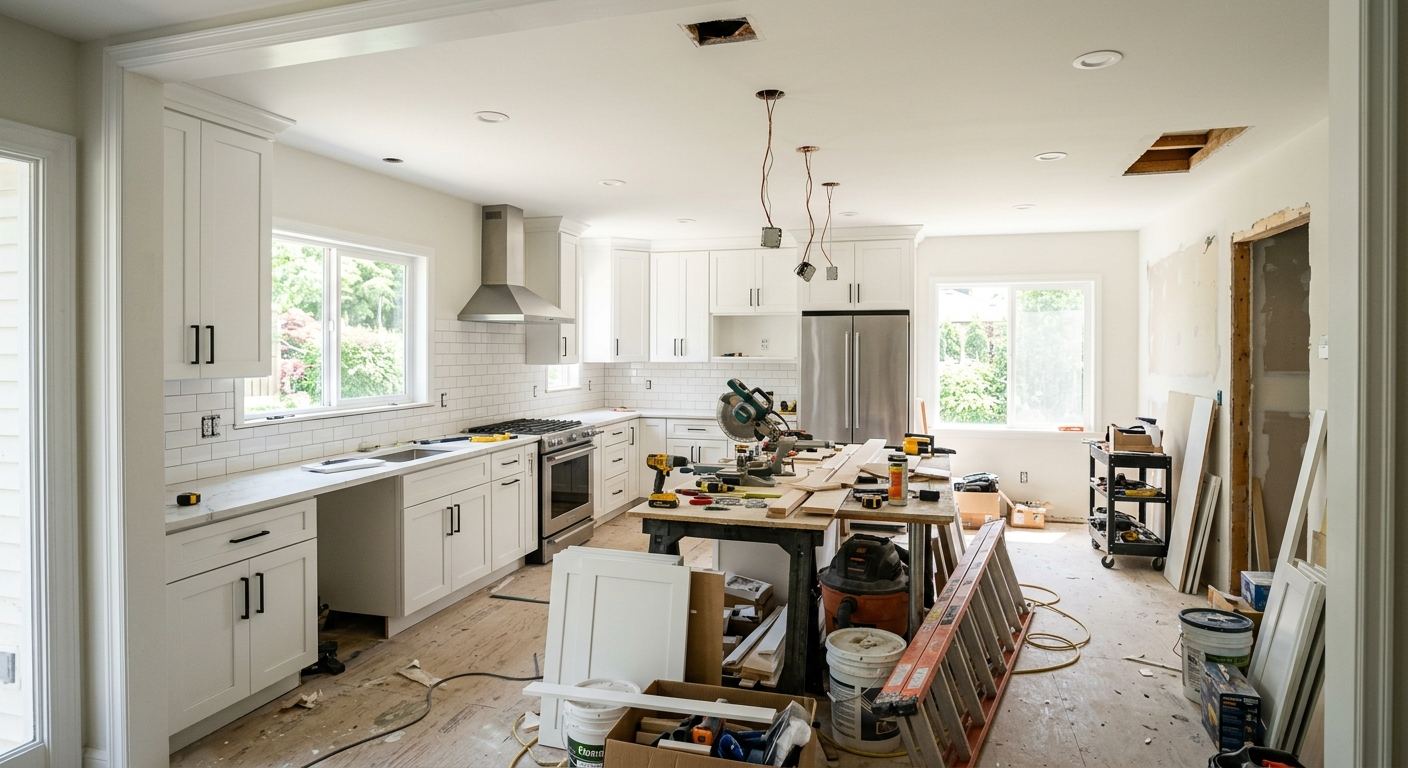
Kitchen renovation options and costs in Wasaga Beach
Kitchen renovation in Wasaga Beach ranges from a simple refresh to a full redesign, and the right choice depends on how much you want to change—and how quickly you want it done. With a median household income of $76,000 (Statistics Canada, 2021 Census), many homeowners plan projects that deliver durable, resale-friendly upgrades without overspending on features that won’t add value. Wasaga Beach also has a strong homeowner base—9,235 homeowner households, with 85.4% of households owning (Statistics Canada, 2021 Census)—so upgrades often prioritize long-term usability rather than short-term cosmetic changes.
In the Kitchener–Waterloo–Barrie economic region, renovation pricing is driven more by home values and finish expectations than by climate. That said, the local housing mix matters: with 23.6% of homes built before 1981 (Statistics Canada, 2021 Census), older wiring, dated plumbing runs, and slightly off-square walls can add labour time and contingency. The market also shapes availability—when demand is steady in areas like the Wasaga Beach core and Five Mile Point, scheduling for cabinet installers and countertop crews can affect timelines and labour rates.
Generally, cabinet work is the biggest swing factor (often the most quoted line item), and countertop selection follows. Because budgets in Ontario’s higher-value pockets tend to default to semi-custom cabinetry and quartz, many “mid-range” projects land closer to the upper end of the band, while stock-and-selective upgrades keep costs lower. Use the tiers below as a starting point, then compare your scope against the examples in the tables.
| Renovation Tier |
What's Included |
Typical Duration |
Price Range |
| Cosmetic refresh (paint, hardware, new appliances only) |
Cabinet paint or repaint, new hardware/pulls, appliance replacement only, minor caulking/trim touch-ups |
1–2 weeks |
$6,000–$15,000 |
| Mid-range full renovation (new cabinets, counters, sink, tile) |
New semi-custom or upgraded stock cabinets, new countertop, new sink/faucet, backsplash tile, updated lighting, tap/drain rework as needed (not major layout) |
4–7 weeks |
$30,000–$60,000 |
| High-end full renovation (custom cabinets, stone counters, island) |
Custom cabinetry, quartz or natural stone counters, island with upgraded lighting, more detailed backsplash (premium tile/stone), sink + dishwasher integration, expanded electrical/plumbing work |
7–12+ weeks |
$65,000–$95,000 |
| Cabinet refacing only (new doors + drawer fronts, same boxes) |
Reface doors/drawer fronts, new hardware, repaint/stain for existing boxes where needed, cabinet interior updates (shelving/pull-outs optional) |
2–4 weeks |
$8,000–$22,000 |
| Countertop swap only (laminate to quartz or stone) |
Remove old top, install new quartz/stone (or upgrade laminate), cut-outs for sink/cooktop, basic countertop caulking & finishing |
1–3 weeks |
$3,000–$12,000 |
| Backsplash tile installation only |
Tile supply/installation (material tier varies), prep and surface sealing, grout/caulk at edges |
3–10 days |
$1,500–$8,000 |
Prices are estimates only and vary by project scope, site access and material selection.
What affects the price of kitchen renovation in Wasaga Beach
It’s common to see quotes for the “same” kitchen reno vary by 30–50% across Ontario, even when homeowners pick similar-looking finishes. The driver isn’t usually climate; it’s the mix of home value and income that steers the finish tier. In higher-value parts of the Kitchener–Waterloo–Barrie region, homeowners often choose quartz or premium stone and semi-custom cabinetry because those upgrades are easier to recoup on resale. In more modest markets, laminate tops and stock cabinets often deliver a stronger cost-to-value ratio—so contractor pricing reflects what buyers actually pay for.
Layout changes are the biggest wildcard regardless of finish level. Removing a wall, adding an island, or moving a gas line or plumbing point can reshape the budget faster than choosing between mid-grade quartz and entry-level stone. In Wasaga Beach specifically, older housing stock (with 23.6% built before 1981) can add labour due to less accessible chase spaces, older shutoffs, or wiring that needs modernization—especially when you add under-cabinet lighting and new circuits.
Concrete examples: (1) If your kitchen currently has a laminate top and you swap to quartz, you’re typically in the countertop swap range (often $1,500–$12,000 for install scope), but adding an island-style edge profile and more complex cut-outs can push the same project toward the upper end. (2) If you start with stock cabinets and upgrade to semi-custom or custom, cabinet installation often becomes the lead line item; cabinet packages are commonly where mid- to upper-budget projects move from $30,000–$60,000 toward $65,000–$95,000 when combined with stone counters and premium lighting. (3) For backsplash, a straightforward tile run costs far less than full-height tile or intricate patterns that require extra layout and wet saw time.
| Price Factor |
Why It Matters |
Cost Impact |
| Cabinet tier — stock vs. semi-custom vs. fully custom millwork |
Higher tiers offer better door/drawer fit, more storage options, and more precise sizing/finish consistency |
$6,000–$25,000 |
| Countertop material — laminate vs. quartz vs. granite vs. stone |
Material cost, fabrication complexity, and edge/undermount details change labour and waste |
$1,500–$12,000 |
| Layout change — wall removal, island add, plumbing/gas move |
Triggers structural review, new rough-in work, and more coordination between trades |
$5,000–$30,000 |
| Appliance package tier — builder vs. mid-range vs. pro-grade |
Different features, finishes, and venting/installation requirements can affect rough-in and trim carpentry |
$2,000–$12,000 |
| Flooring — refinish existing vs. full replacement |
Protecting and matching existing floors can be cheaper than demo and replacement, especially around toe-kicks |
$1,500–$10,000 |
| Backsplash — ceramic tile vs. marble vs. full-height slab |
Premium materials raise material costs; full-height coverage increases labour and leveling/prep |
$1,500–$8,000 |
| Electrical — new circuits for island, under-cabinet lighting |
New circuits require licensed work and inspections; lighting adds wiring, boxes, and finishing |
$800–$6,500 |
| Permit fees and licensed trade requirements |
When permits/inspections apply, the scope expands to include documentation and scheduling time |
$300–$3,500 |
Permits & regulations in Ontario
In Ontario, many “swap-style” kitchen upgrades don’t require a permit—cabinet installation, cabinet refacing, and countertop replacements are typically treated as finish work and usually do not require permits. However, permits and licensed trade involvement are commonly required when you change the building systems. That includes moving plumbing supply or drain lines (for sink, dishwasher, or fridge water), relocating a gas stove or gas-fired appliance, removing a load-bearing wall, or adding new electrical circuits (for an island, additional receptacles, or major lighting upgrades). Gas work must be carried out by a licensed gas fitter, and electrical work must be performed by a licensed electrician; both typically require inspections as part of compliance.
For a homeowner in Wasaga Beach, the best approach is to verify before you sign: first, ask your contractor what permits are required for your exact scope, and confirm whether the contractor will pull them (and include that in the contract). Next, verify licensing by checking the relevant Ontario online registries for the electrician and gas fitter doing the work. Then request certificates of insurance (liability coverage) and proof of worker coverage (WSIB/WCB) for trade crews. Finally, ask for any clearance/inspection documentation you’ll need at the end of the project. Put the responsibility for permits and inspections in writing—because the “who pays and who submits” question is where most disputes happen later.
Cabinets, countertops and layout decisions in Wasaga Beach
In Wasaga Beach, the three most consequential decisions in a kitchen renovation are usually your cabinet tier, your countertop material, and whether you change the layout. (1) Cabinet tier: stock cabinets are fastest and typically the cheapest, semi-custom is the most popular mid-range option because it balances storage, sizing, and cost, and custom cabinetry is the highest-cost route but can achieve a perfect fit, especially with older, slightly irregular rooms. (2) Countertops: laminate is budget-friendly and can look modern with the right colour/edge, quartz is the go-to for durability and low maintenance, granite/natural stone offers variety and premium appeal with more natural movement, and butcher block adds warmth but needs routine sealing and careful care. Marble looks high-end but is more demanding and can be easier to etch.
(3) Layout changes: opening up the space by removing a wall or adding an island can transform how the kitchen functions, but it’s also where costs jump because you may need rough-in revisions, new venting considerations, electrical add-ons, and sometimes structural work. In the Kitchener–Waterloo–Barrie resale market, buyers often expect practical storage, clean lines, and durable surfaces—especially for homes with stronger curb appeal and higher-end finish packages. If you’re renovating for long-term living, you may justify a layout change; if you’re optimizing resale, consider keeping plumbing and major gas points where possible.
A practical example: upgrading from stock cabinets to semi-custom plus quartz often moves you into the mid-range full renovation band (commonly $30,000–$60,000) because cabinetry and countertop are the two largest line items. But if you keep the same layout and only upgrade surfaces, you can avoid many of the “layout” costs that commonly push projects toward the high-end full renovation band ($65,000–$95,000). In other words: spend money where it’s visible every day, and be strategic about moving mechanical lines.
| Option |
Durability |
Maintenance |
Best For |
Price Range |
| Stock cabinets (big-box) |
Good for everyday use; performance depends on installation quality and hardware choice |
Low; clean with non-abrasive products and keep hardware adjusted |
Budget-conscious refresh with quicker lead times |
$6,000–$15,000 |
| Semi-custom cabinets (local dealer) |
Very solid; better fit and more storage options |
Low; occasional hardware tightening recommended |
Most common Wasaga Beach renovations targeting durable resale appeal |
$12,000–$25,000 |
| Custom cabinets (local millwork shop) |
Highest durability and precise fit; ideal for unusual dimensions and premium finishes |
Low; protect finishes from standing water at sinks |
High-end kitchens, custom islands, and perfect alignment needs |
$20,000–$40,000+ |
| Laminate countertop |
Moderate; seams and edges can be vulnerable if poorly installed |
Low; avoid heat exposure and water pooling at seams |
Quick, cost-controlled upgrades when you want a fresh look fast |
$1,500–$4,500 |
| Quartz engineered countertop |
High; resists staining and daily wear very well |
Low; wipe clean and manage hot pots with trivets |
Ontario homeowners wanting durable, maintenance-light stone appearance |
$4,500–$12,000 |
| Granite / natural stone countertop |
High; natural variations add character, but sealer practices matter |
Moderate; periodic sealing and gentle cleaning |
Premium look with natural patterning |
$5,500–$14,000 |
| Butcher block countertop |
High when cared for; can scratch but can be sanded/refinished |
Moderate to high; sealing and routine oiling recommended |
Warm, casual kitchens and homeowners who enjoy upkeep |
$3,500–$9,000 |
| Marble countertop |
Moderate; can etch with acidic spills |
Higher; sealing and careful stain/etch management |
Showpiece, classic-luxury kitchens for careful users |
$7,000–$18,000 |
How to choose a kitchen renovation contractor in Wasaga Beach
Choosing the right contractor in Wasaga Beach is mostly about verifying coverage, getting comparable quotes, and controlling payment risk. Start by confirming Ontario licensing for any regulated trade work: electrical must be done by a licensed electrician, and gas work (if you’re moving a stove or gas range/hood) must be performed by a licensed gas fitter. Ask for their licensing details and check the relevant Ontario online registry entries. Then request proof of liability insurance and proof that workers are covered under WSIB/WCB. A kitchen involves dust, demolition, cutouts, and subcontractors—coverage protects you if an accident happens during cabinet install, countertop templating, or tile work.
Next, get 2–3 itemised written quotes. You want labour and materials broken out (cabinet line items, countertop fabrication/installation, tile labour, electrical/plumbing allowances), not a single “lump sum” with unclear exclusions. Read the scope line-by-line: is permit pulling included if required, who provides demolition and debris/disposal, and what happens if the existing walls are out of square? Ask about warranty terms—workmanship warranty length, manufacturer warranty for cabinets/counters, and whether warranties transfer if you sell. For payment schedule, never pay more than 10–15% upfront; use a holdback until key milestones are complete and punch-list items are signed off. Finally, request a written start date and a completion estimate, with lead-time assumptions for cabinets and countertops.
- Verify the lead contractor’s business details and the subcontractors they will use.
- Confirm liability insurance certificate limits match the project scope.
- Request WSIB/WCB clearance or proof of coverage for workers.
- Get 2–3 itemised quotes with labour and materials listed separately.
- Confirm who is responsible for permits and inspections (if any).
- Check inclusions for demolition, drywall patching, and debris removal.
- Clarify flooring protection, baseboard adjustments, and caulking/trim details.
- Ask about countertop templating timing and what happens if measurement changes.
- Confirm whether backsplash includes waterproofing prep and edge finishing.
- Review warranty: workmanship duration and what voids it.
- Use a milestone payment plan with a holdback until punch-list is complete.
- Ask how they handle hidden conditions (old plumbing, electrical, or out-of-square walls).
Red flags to watch in Wasaga Beach: (1) quotes that are “lowest price” but don’t include disposal/drywall patching or electrical/plumbing allowances; (2) refusal to provide insurance/WSIB proof; (3) no written scope and “we’ll figure it out later” language; (4) requesting large upfront payments (more than 10–15%) without milestones; and (5) vague warranty terms or no mention of who covers countertop fabrication vs installation.
Frequently asked questions — kitchen renovation in Wasaga Beach
What order do kitchen renovation steps happen in?
In Wasaga Beach, a typical renovation sequence starts with planning and measurements, then demolition and rough-in work. First comes the layout sign-off (and cabinet sizing), followed by removal of the old cabinets and finishes. Next, trades complete rough-in work: plumbing supply/drain modifications, electrical for new circuits or island outlets, and ventilation adjustments if applicable. After that, drywall patching and base preparation happens, then cabinets are installed and leveled. Countertop templating is scheduled after cabinets are set, followed by countertop fabrication and installation. Finally, you finish with backsplash tile, flooring touch-ups or full flooring replacement (if included), trim/paint, and appliance hookups. The finishing sequence matters because it prevents damage—especially to stone edges and under-cabinet lighting.
Can I live at home during a kitchen renovation in Wasaga Beach?
Many homeowners do stay in the home during a renovation in Wasaga Beach, especially when the scope is a cosmetic refresh or a mid-range full reno that keeps the layout mostly intact. If you’re doing anything like new cabinets and quartz, you’ll usually need a temporary setup: a microwave, kettle, and fridge access in a separate room, and a safe path around work zones. For full gut renovations or high-end projects with island plumbing/electrical changes, staying put is more disruptive and sometimes harder due to dust control and trade traffic. A practical approach is to schedule demolition early, keep a “clean zone” for meals, and protect floors and doorways. Your contractor should provide daily cleanup and dust containment plans—this is critical for older homes built before 1981.
Should I renovate my kitchen before selling in Wasaga Beach?
If you’re selling in Wasaga Beach, timing depends on your property condition and buyer expectations. Kitchens are a major decision point, and a well-executed renovation can make your home feel updated and move-in ready. A “cost-conscious, resale-friendly” approach often looks like semi-custom or upgraded stock cabinets and quartz counters, staying within a realistic mid-range budget (commonly $30,000–$60,000 for many full renovations). If your goal is to attract more buyers, focus on durable surfaces, modern lighting, and a functional layout while keeping major plumbing and gas points where possible. For older homes, buyers often notice outdated fixtures and awkward circulation, so a layout tweak can be worth it—but avoid expensive changes that don’t show well in photos. Always line up trades so the kitchen is complete before listing photos and staging.
What's the most popular kitchen style in Wasaga Beach right now?
In Wasaga Beach and the broader Kitchener–Waterloo–Barrie market, the most popular direction right now is clean-lined modern farmhouse and contemporary transitional—think shaker-style cabinet doors, warm neutrals, and quartz with subtle veining. Many homeowners choose light or medium-toned cabinetry paired with durable quartz because it reads bright in photos and holds up to everyday use. Hardware is commonly updated to matte black or brushed nickel finishes, and lighting is upgraded with under-cabinet LED strips for a “finished” look. If you’re deciding on budget tier, that style preference is why you often see many projects landing in the mid- to upper ranges of the full renovation bands—people want the look to match higher expectations in resale listings. A well-planned backsplash tile design also plays a big role in that “wow” effect.
How do I know if I need to update my kitchen plumbing in Wasaga Beach?
You may need plumbing updates in Wasaga Beach if you’re moving the sink, dishwasher, fridge water line, or adding a new tap configuration—those moves typically require new connections and can expose old, corroded supply lines. You should also consider updates if you have slow drains, recurring leaks under the sink, low water pressure, or noticeable water discoloration. In homes built before 1981, older shutoffs and drain assemblies can fail when opened, so contractors often recommend inspecting accessible supply lines and drain routing before ordering final finishes. During a renovation, a good contractor will verify shutoff locations, confirm drain slopes, and pressure-test where appropriate. If plumbing isn’t being moved, you can sometimes keep it and budget for “refresh” components, but always plan a contingency for hidden conditions.
What is the difference between a galley and open-concept kitchen?
A galley kitchen is a narrow, efficient layout where counters run along two opposite walls, often with limited sightlines and fewer choices for an island. An open-concept kitchen typically connects the kitchen to a living/dining area, with wider circulation, and often supports an island or breakfast bar. In Wasaga Beach homes—especially those with older layouts—galley kitchens are common, and renovations often focus on improving storage, lighting, and countertop surfaces while keeping the plumbing and electrical routing efficient. Open-concept projects cost more when they require significant changes like wall removal or rerouting mechanical systems. Budget-wise, a galley refresh can stay closer to the lower bands, while open-concept rebuilds—especially with stone counters and upgraded electrical—often move toward mid-range full renovation budgets such as $30,000–$60,000, and sometimes higher.