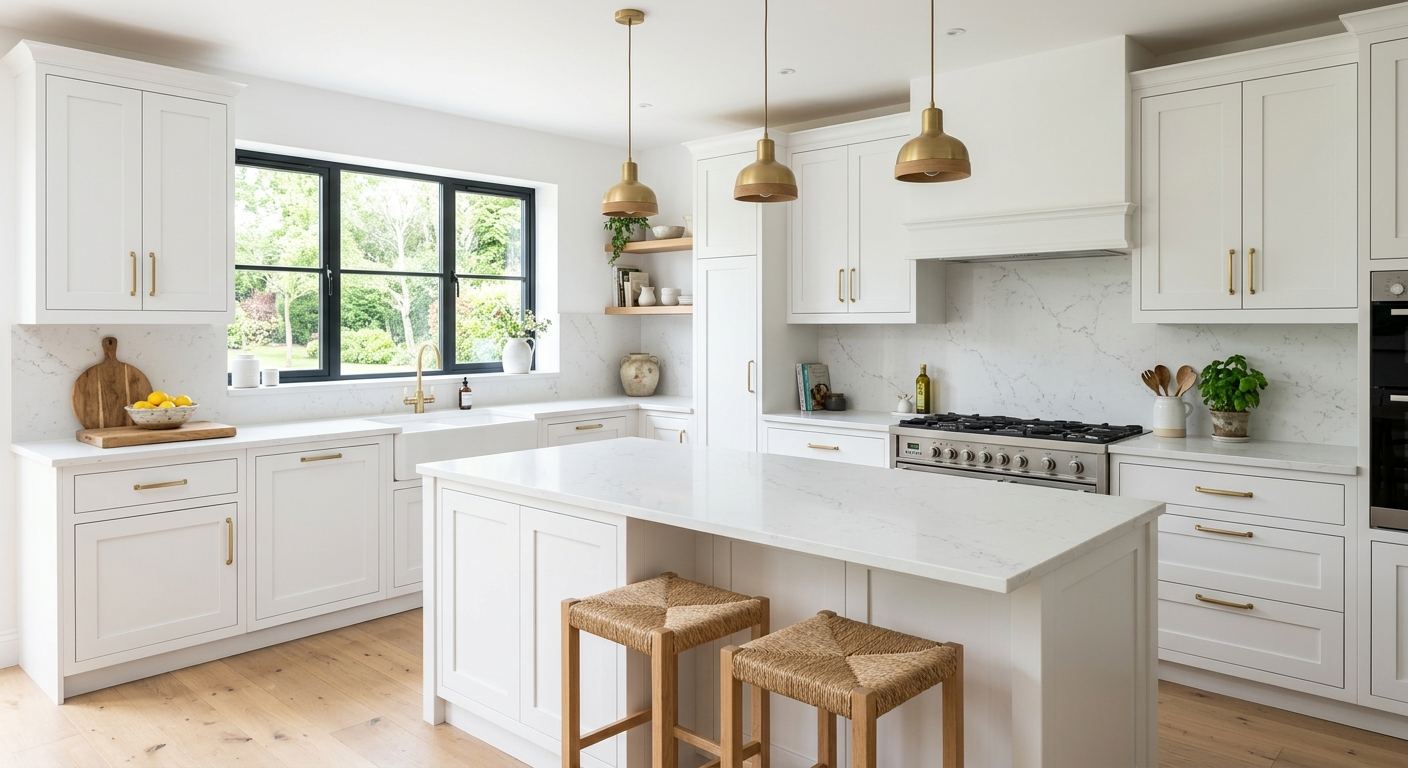
Kitchen renovation options and costs in Concord
Kitchen renovations in Concord, Ontario typically start with choosing a renovation tier—because in the Toronto economic region, budgets track much more closely to local home values and buyer expectations than to weather. Concord is part of the wider Toronto market where homeowners often aim their kitchen spend to match resale demand; with a 2021 population of 8,255 (Statistics Canada, 2021 Census), demand is steady but projects remain selective. Across Ontario, incomes also support a range of finishes, and in higher-value pockets homeowners commonly invest around 8–15% of home value in cabinetry and surfaces, which pulls many renovations toward quartz, upgraded appliances, and semi-custom millwork.
Cost can still feel “climate-driven” on a day-to-day basis: winter freeze–thaw and seasonal humidity swings can expose installation issues (cabinet leveling, caulking, and countertop expansion gaps) and increase attention to proper ventilation and sealing. That said, in the GTA the biggest swing is the finish tier and the amount of work hidden behind cabinets and floors. In Concord’s more renovation-active pocket—near the busier household corridors and established suburban homes where buyers frequently update mid-century kitchens—contractors stay busy with cabinet and countertop packages.
Below is a practical way to compare common options, from a modest refresh to a high-end build. Use this table to sanity-check any quote before you commit to measurements, demo, and ordering.
| Renovation Tier |
What's Included |
Typical Duration |
Price Range |
| Cosmetic refresh (paint, hardware, new appliances only) |
Cabinet paint or refinishing, new pulls/knobs, trim touch-ups, appliance swap (no plumbing/gas relocation), basic caulking and alignment checks |
1–3 weeks |
$25,000–$35,000 |
| Mid-range full renovation (new cabinets, counters, sink, tile) |
New semi-custom or upgraded stock cabinets, quartz or good laminate counters, sink and faucet replacement, backsplash tile, flooring refresh (where included), basic electrical tune-ups as needed |
4–8 weeks |
$45,000–$70,000 |
| High-end full renovation (custom cabinets, stone counters, island) |
Custom millwork, premium quartz/stone (including natural stone options), island cabinetry, upgraded appliance package, full backsplash, potential layout changes, expanded lighting (under-cabinet and/or new circuits) |
8–14 weeks |
$75,000–$90,000 |
| Cabinet refacing only (new doors + drawer fronts, same boxes) |
Door and drawer front replacement, new veneer where applicable, new hardware, re-sealing and fit/finish, existing box verification, limited demo |
2–4 weeks |
$8,000–$25,000 |
| Countertop swap only (laminate to quartz or stone) |
Template and install of new counters, sink cut-in (if replacing sink), backsplash tie-in as defined, removal and disposal of old laminate |
1–3 weeks |
$3,000–$15,000 |
| Backsplash tile installation only |
Surface prep, tile layout and setting, grout/seal where needed, clean-up, trim integration around outlets |
3–7 days |
$2,000–$10,000 |
Prices are estimates only and vary by project scope, site access and material selection.
What affects the price of kitchen renovation in Concord
Two homeowners in Concord can receive quotes that look like different projects even when the desired style and rough scope are similar. That’s because Toronto-area pricing can swing by 30–50% depending on how contractors price labour risk, what they include for changes, and which finish tier you choose. Local home values and household income expectations shape the typical finish tier far more than climate: where buyers expect a “modern-ready” kitchen, homeowners often default to quartz or stone counters and semi-custom cabinetry because those upgrades are easy to recover on resale. In more price-sensitive scenarios, laminate and stock cabinet systems remain common because the budget stays controlled while still improving appearance.
Toronto market demand also affects scheduling and availability. When timelines are tight, cabinet lead times and countertop fabrication slots can compress the schedule; that can add premium costs for expedited installs, especially for island or specialty shapes. In Concord’s established housing stock, older ducting routes and dated subfloors sometimes trigger extra labour when floors aren’t level or walls aren’t square—issues that cost more than the finish difference.
For concrete examples: (1) if your plan includes removing a wall to open the kitchen, the plumbing and wiring path might need re-routing, which can push a job from the $45,000–$70,000 mid-range band toward higher totals even if your cabinets are mid-tier; (2) swapping laminate to quartz can stay closer to the $3,000–$15,000 countertop band, but only if your sink cut-outs match or you avoid moving plumbing.
In short: finish tier drives baseline pricing, while layout and hidden conditions drive the unpredictability—regardless of season.
| Price Factor |
Why It Matters |
Cost Impact |
| Cabinet tier — stock vs. semi-custom vs. fully custom millwork |
Higher tiers involve more design options, better fit, thicker materials, and more labour for installation and scribing |
Small projects can add several thousand dollars; full kitchens can shift you from mid-range into high-end bands (often $15,000+ difference) |
| Countertop material — laminate vs. quartz vs. granite vs. stone |
Material price, fabrication complexity, and edge/profile options change total cost |
Laminate stays at the low end; quartz/stone commonly pushes the install closer to the upper part of the countertop band |
| Layout change — wall removal, island add, plumbing/gas move |
Layout work triggers trades, inspections, patching, and structural or engineering steps when needed |
This is the most unpredictable line item and can overwhelm finish savings (often $10,000+ swing) |
| Appliance package tier — builder vs. mid-range vs. pro-grade |
Electrical draw, ventilation requirements, and build quality differ |
Appliance choices can add thousands and can also force additional electrical or venting changes |
| Flooring — refinish existing vs. full replacement |
Refinishing limits demo; replacement requires subfloor checks and more labour |
Replacing flooring after full cabinet demo can add several thousand dollars |
| Backsplash — ceramic tile vs. marble vs. full-height slab |
Harder materials require more careful templating, setting, and finishing |
Full-height or premium materials can move backsplash work toward the top of the $2,000–$10,000 range |
| Electrical — new circuits for island, under-cabinet lighting |
New circuits require licensed work, load planning, and inspection |
Often adds cost beyond finish allowances, especially if you relocate outlets or add an island |
| Permit fees and licensed trade requirements |
Some changes require permits and inspections; licensed trades can cost more than “handyman-level” labour |
These costs can add a noticeable buffer on top of base renovation pricing |
Permits & regulations in Ontario
For kitchen work in Ontario, not every change needs a permit. Generally, cabinet and countertop swaps that don’t move plumbing or electrical lines typically do not require permits. That’s why many Concord homeowners can refresh appearance—like replacing laminate counters with quartz—without turning it into a permit-heavy job. However, permits commonly come into play when you change the “systems” behind the room.
Work that typically does require permits and licensed trades includes: moving plumbing supply or drain lines (e.g., relocating a sink), relocating gas components (such as the stove/range and certain range-hood setups involving gas), removing a load-bearing wall or doing structural changes, and adding new electrical circuits (commonly for an island, under-cabinet lighting, or relocated major outlets). Electrical and gas work must be performed by the appropriate licensed trades and is subject to inspection.
To verify compliance in Concord before signing, follow a simple step-by-step approach. First, ask your contractor for their Ontario licences and confirm the appropriate license types match the work scope. Next, request a certificate of insurance (liability) and proof they can manage jobsite risk—then confirm WSIB/WCB coverage if they employ workers. Finally, look for a written plan that clearly states who pulls permits and who schedules inspections. The permit responsibility should be explicit in your contract, not assumed.
Cabinets, countertops and layout decisions in Concord
The three most consequential decisions in a Concord kitchen renovation are cabinet tier, countertop material, and whether you change the layout. In the Toronto resale market, these choices affect not just what you enjoy day-to-day, but what future buyers recognize as “value” at a glance. First, choose your cabinet tier: stock cabinets are typically fastest and cheapest, semi-custom is the most popular mid-range path, and custom cabinets deliver the tightest fit and best storage—but at a higher price.
Second, pick countertop material based on durability and maintenance. Laminate is budget-friendly and can look modern when paired with the right edge profiles, while quartz is the workhorse choice for busy households because it resists staining better and needs minimal sealing. Granite/natural stone looks premium but requires more care, and butcher block can add warmth—though it demands periodic oiling and careful drying around spills.
Third, decide if you’re modifying the layout. Open-concept wall removal or adding an island can justify the cost when it improves flow, adds seating, or solves a real storage/working-zone problem. But if your goal is mainly aesthetics, layout changes usually aren’t the best return; they add labour and often plumbing/gas and electrical updates.
Here’s a practical dollar example: if you’re comparing a mid-range kitchen in the $45,000–$70,000 band versus a higher-end approach in the $75,000–$90,000 band, you can often bridge the gap by staying with semi-custom cabinets while upgrading counters to quartz. That choice can deliver the “premium” look without triggering the full cost of custom millwork or major structural work. In Concord’s winter humidity swings, properly installed, well-sealed cabinetry and a countertop that’s set with appropriate expansion details also help prevent future seam issues.
| Option |
Durability |
Maintenance |
Best For |
Price Range |
| Stock cabinets (big-box) |
Good for standard layouts; can be more sensitive to uneven walls if not professionally scribed |
Low day-to-day care; paint/finish depends on product quality |
Fast timelines and budget-first renovations |
$8,000–$18,000 |
| Semi-custom cabinets (local dealer) |
Very durable construction; more options for sizing and storage features |
Low to moderate; hinges and hardware may need adjustment over time |
Most Concord homeowners balancing style and value |
$18,000–$35,000 |
| Custom cabinets (local millwork shop) |
Highest fit and built-for-your-space strength |
Low routine care; benefits from high-quality finishes |
Complex layouts, specialty storage, and showpiece kitchens |
$35,000–$60,000 |
| Laminate countertop |
Resists many daily messes but is more vulnerable to heat and impact than quartz/stone |
Easy cleaning; avoid prolonged heat exposure and aggressive cutting |
Cost-controlled updates with a modern look |
$3,000–$7,000 |
| Quartz engineered countertop |
Highly durable and consistent; generally more resistant to staining than laminate |
Very low maintenance; wipe clean, no sealing for most products |
Busy family kitchens and resale-friendly upgrades |
$7,000–$12,000 |
| Granite / natural stone countertop |
Strong and heat-tolerant, with natural variation |
Often needs periodic sealing; clean spills promptly |
Premium look when you’re willing to maintain stone |
$10,000–$15,000 |
| Butcher block countertop |
Durable for chopping but can dent; sensitive to standing water |
Higher maintenance: regular oiling and careful drying |
Warm, lived-in styles and homeowners who enjoy upkeep |
$6,000–$10,000 |
| Marble countertop |
Beautiful but softer; can scratch and stain more easily than quartz |
Needs sealing and careful use; avoid acids like citrus and vinegar |
Statement kitchens where maintenance is acceptable |
$12,000–$18,000 |
How to choose a kitchen renovation contractor in Concord
Choosing the right contractor is the fastest way to protect your budget in Concord. Start with Ontario licensing and coverage checks. Ask for their Ontario licence documentation for the trades they employ or subcontract (gas work and electrical must be licensed by their respective trades), then request a certificate of insurance showing liability coverage. If they use workers, confirm WSIB/WCB coverage—this matters if anyone is injured on your jobsite. If they can’t provide current proof, that’s a stop sign.
Next, get 2–3 itemised written quotes. The best quotes break labour and materials out separately (cabinet supply, install, countertop fabrication/templating, plumbing/electrical allowances, tile setting, demolition, disposal). Avoid vague lump sums. Read the scope carefully: does the quote include permit pull (when needed), protective floor covering, waste disposal, and countertop template and fabrication coordination? Then review warranties: a workmanship warranty should be written with a clear start/end date, and manufacturer warranties should include whether they’re transferable if you sell your home.
Finally, protect cash flow. A fair payment schedule usually keeps upfront payments around 10–15% maximum, then uses progress payments with a holdback until key milestones—like cabinets installed, countertops sealed, and punch-list items completed—are finished. Get a written start date and completion estimate that includes lead-time realities for cabinets and stone.
- Confirm appropriate Ontario licences for the specific work in your scope (gas, electrical, and any trades involved).
- Verify liability insurance and request the certificate before signing.
- Confirm WSIB/WCB coverage if workers are on site.
- Request a detailed itemised quote (materials, labour, allowances, and demo/disposal).
- Ask who pulls permits and who pays permit fees when plumbing/electrical/gas changes are included.
- Ensure exclusions are clearly stated (e.g., existing floor conditions, subfloor repairs, hidden water damage).
- Confirm countertop templating date responsibility and how changes are handled if dimensions shift.
- Get a written timeline with sequencing (demo, rough-ins, cabinet install, countertop install, finish work).
- Ask about jobsite protection: dust control, floor covering, and outlet protection.
- Require a workmanship warranty in writing and clarify what defects are covered.
- Set a payment schedule with a holdback until completion and punch-list sign-off.
- Clarify disposal and dumpster costs—don’t assume it’s included.
In Concord, red flags I commonly see include: quotes that don’t list allowances clearly, contractors who won’t provide insurance/coverage proof, promises of “no permits needed” when you’re relocating plumbing or adding circuits, refusal to document timelines in writing, and change orders that only arrive after work is already underway.
Frequently asked questions — kitchen renovation in Concord
What’s the most popular kitchen style in Concord right now?
In Concord and the wider Toronto market, the most requested look right now is a clean, modern-transitional style: flat or subtly shiplapped cabinet fronts in warm whites, soft greys, or two-tone combinations, paired with quartz countertops and a simple slab or classic subway backsplash. Homeowners often choose this because it photographs well and holds up as tastes shift—important in a resale-driven area. Most projects land in the practical mid-range when homeowners choose semi-custom cabinets and quartz, rather than fully custom millwork; that typically aligns with budgets in the $45,000–$70,000 band for full renovations. If you’re doing a smaller update, replacing countertops and refreshing hardware can also keep costs controlled and still feel “new.” (Statistics Canada, 2021 Census)
How do I know if I need to update my kitchen plumbing in Concord?
You may need plumbing updates if you have recurring issues (slow drains, leaking under the sink, fluctuating water temperature) or if your shutoff valves are old and hard to access. In older Concord homes, common triggers include questionable pipe routing behind cabinets, aging supply lines, and drainage that’s not venting properly. Another clue is renovation scope: if you plan to relocate a sink, add a dishwasher upgrade, or move plumbing for an island, you’ll likely expose sections of line that can’t be reliably “patched” without creating future access problems. For budgeting, plumbing moves can push costs beyond a cosmetic plan. As a baseline, homeowners who stay in a countertop-focused scope often target the $3,000–$15,000 countertop band, while full renovations with system work are usually closer to mid-range totals like $45,000–$70,000. In Ontario, moving supply/drain lines typically requires permits and licensed plumbing work.
What is the difference between a galley and open-concept kitchen?
A galley kitchen has counters along two parallel walls with a defined walkway, while an open-concept kitchen connects the cooking area to adjacent living spaces with fewer interior walls. In Concord, galley layouts are common in older and compact homes; they work well for efficiency but can feel tight when families want more seating or social space. Open-concept designs often become popular when homeowners add an island or expand sightlines, especially if the kitchen is the social hub. The key cost difference is that open-concept changes frequently involve wall removal, electrical rework, and sometimes plumbing/gas relocation, which can drive the job toward higher totals. If you keep it close to a refresh, you can stay closer to cosmetic pricing, but if you remove a wall or add circuits you’re into a different category of scope. On a major renovation in this market, many projects land in the $45,000–$70,000 range, while more complex builds with islands and upgrades can approach the $75,000–$90,000 band.
How do I get accurate kitchen renovation quotes in Concord?
Accurate quotes start with good measurements and an explicit scope. In Concord, the quickest way to get a reliable number is to schedule a site visit for measurements, then provide the contractor with your must-haves: cabinet tier (stock, semi-custom, custom), countertop material, backsplash expectations, and whether you’re changing plumbing or adding electrical for island lighting. Request 2–3 itemised quotes that break out labour and materials separately, including allowances for tile, demolition, disposal, and any electrical/plumbing work. Ask who pulls permits when required and whether permit costs are included. Make sure the quote states what’s excluded (subfloor repairs, water damage, structural work). If the quote is only a single lump sum with no line items, it’s harder to compare and easier for costs to drift. For a sanity check, compare totals against realistic bands: full kitchen renovations in this region commonly fall within $25,000–$90,000, with many mid-range projects clustering in the $45,000–$70,000 window.
What’s the best countertop material for a busy Concord kitchen?
For most busy Concord households, quartz is the best balance of durability and low maintenance. It resists everyday staining better than many natural options, doesn’t require periodic sealing like granite or marble often does, and it’s forgiving for typical family use. If you’re a heavy-duty cook and want a more “natural” look, granite or natural stone can be excellent, but you need to be comfortable with maintenance and sealing practices. Butcher block is wonderful for warmth and food prep, but it demands consistent oiling and careful drying—standing water can be a problem. Laminate can work for budget-focused updates and looks great when installed well, but it’s generally less resistant to heat and impact. If you want a practical budgeting anchor, countertop-only projects often target the $3,000–$15,000 range, and choosing quartz rather than laminate usually nudges you toward the upper portion of that band depending on size, edge profiles, and sink cut-outs.
How do I add an island to my Concord kitchen?
Adding an island is one of the most rewarding changes, but it’s also one of the scope-heavy ones in Ontario because it can trigger electrical, plumbing, and even permit requirements. Start with spacing: contractors typically plan safe walking clearances and confirm where doors and appliance swings land. Next, decide island function—seating, extra storage, prep surface, or a wet bar. If you want power at the island (e.g., pendant lighting, outlets, under-counter lighting, or built-in charging), that often means new circuits and licensed electrical work. If you want a sink or dishwasher at the island, relocating plumbing supply/drain lines is usually required, along with permits. In Concord, many homeowners keep islands as “dry” prep islands to manage budget, then upgrade appliances and finishes elsewhere. Budget-wise, an island addition is usually part of a full renovation plan rather than a simple refresh, commonly aligning with mid-range totals around the $45,000–$70,000 band or higher when custom cabinetry and stone are involved.