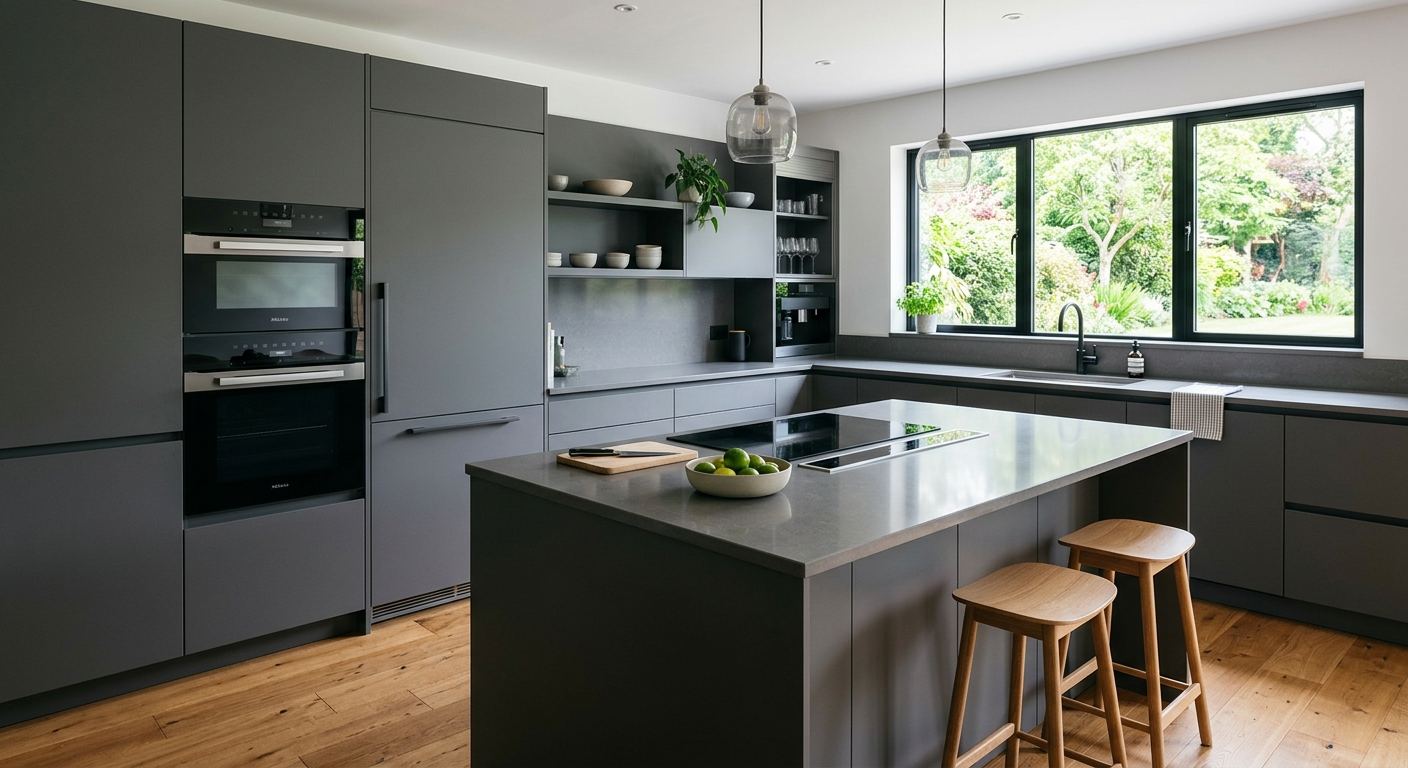
Kitchen renovation options and costs in Forest Hills
Forest Hills homeowners typically see kitchen renovation costs move in step with the broader Toronto market—finish expectations rise as home values and buyer preferences rise. In 2021, Forest Hills had a population of 6,238 (Statistics Canada, 2021 Census), and local homeowners tend to plan upgrades that fit the resale profile for the Toronto economic region. In higher-value pockets around the GTA, it’s common for owners to invest roughly 8–15% of home value into the kitchen through upgrades like custom cabinetry, quartz, or natural stone, because those finishes photograph well and hold up to everyday use. In more price-sensitive areas, many projects stay mid-range with refacing or semi-custom cabinetry and quartz or laminate countertops to balance affordability and resale value.
Toronto-area costs are influenced more by market demand than weather. Labour rates and materials pricing are fairly consistent across the GTA, but supply and scheduling are tighter when multiple projects are stacked into the spring/summer season—exactly when contractors want to book install crews for cabinetry, countertops, and tile work. On the cost side, Ontario’s seasonal humidity swings also matter: if your kitchen has older particleboard sub-surfaces, cabinetry and flooring may need more prep and stabilization before new finishes go in, especially in homes with earlier 1990s–2000s construction.
In Forest Hills, kitchens around the established residential corridors like the Yonge/Thornhill belt see steady demand from homeowners preparing for sale or updating long-used galley layouts. Below are the main renovation options and realistic price ranges, so you can compare quotes apples-to-apples.
| Renovation Tier |
What's Included |
Typical Duration |
Price Range |
| Cosmetic refresh (paint, hardware, new appliances only) |
Cabinet/door paint (if applicable), new hardware, toe-kick touch-ups, appliance swap, minor trim, basic cleaning/caulking |
3–7 days |
$10,000–$22,000 |
| Mid-range full renovation (new cabinets, counters, sink, tile) |
Semi-custom or quality stock cabinets, countertop installation, sink and faucet, backsplash tile, flooring patching, electrical allowance (typical lighting refresh) |
3–5 weeks |
$25,000–$60,000 |
| High-end full renovation (custom cabinets, stone counters, island) |
Fully custom millwork, premium quartz/natural stone, island build-out, upgraded appliance package, full backsplash, upgraded lighting plan, more involved prep/work |
6–10 weeks |
$65,000–$90,000 |
| Cabinet refacing only (new doors + drawer fronts, same boxes) |
Door and drawer-front replacement, new veneer panels (if required), refinish of box faces, new hardware, optional under-cabinet lighting allowance |
1–3 weeks |
$8,000–$35,000 |
| Countertop swap only (laminate to quartz or stone) |
Remove old surface, new countertop template and install, seam planning, sink cut-outs (as applicable), basic caulking/silicone finishing |
3–10 days (plus templating time) |
$3,000–$15,000 |
| Backsplash tile installation only |
Surface prep, tile install, grout/seal, caulking at changes of plane, allowance for minor outlet/switch trimming |
2–5 days |
$2,000–$10,000 |
Prices are estimates only and vary by project scope, site access and material selection.
What affects the price of kitchen renovation in Forest Hills
In Forest Hills, it’s common to see quotes for the “same” kitchen vary by 30–50% across Toronto and Ontario—even before you pick finishes—because contractors price risk, sequencing, and hidden conditions differently. Two projects can look identical on paper, but one includes a plumbing/gas relocation, while the other keeps the existing lines and focuses on a cabinet-and-counter update. Market positioning also matters: in higher-value areas of the Toronto economic region, homeowners often default to quartz or stone and semi-custom cabinetry because the cost is easier to recover on resale. In more budget-conscious pockets, laminate and stock cabinets dominate, since they deliver a meaningful refresh without pushing totals into the high-end bands.
Local home values and typical household income shape what finish tier buyers expect far more than climate does. For example, when budgets move from the mid-range (often around $25,000–$60,000) into the high-end band ($65,000–$90,000), the job typically isn’t just “nicer”—it’s more custom millwork, heavier countertops, better lighting plans, and more labour-intensive detail work like island builds and tighter tolerances around stone.
Concrete Forest Hills conditions that raise cost include older underlayment or subfloor softness that requires extra prep before new flooring and cabinetry can be secured; and kitchens with long-used vents that force drywall cutting and patching to bring duct runs up to a clean, code-friendly finish. Costs can go down when you keep the layout—no wall removal, no gas line moves, and the existing plumbing stays put—because countertop and cabinet sizing becomes simpler and scheduling is smoother.
| Price Factor |
Why It Matters |
Cost Impact |
| Cabinet tier — stock vs. semi-custom vs. fully custom millwork |
Higher tiers use better hardware, better box construction, and more bespoke sizing; custom also means more fabrication time and detailing |
Can shift a job from mid-range into the $65,000+ territory when paired with islands and stone |
| Countertop material — laminate vs. quartz vs. granite vs. stone |
Material thickness, edge profiles, and fabrication complexity drive labour and template time; stone often adds heavier handling and seam planning |
Countertop-only scope can be $3,000–$15,000 depending on material and cut-outs |
| Layout change — wall removal, island add, plumbing/gas move |
Major layout work increases demolition, structural work, permitting likelihood, and coordination between trades |
Typically the biggest unpredictable swing in cost regardless of finish tier |
| Appliance package tier — builder vs. mid-range vs. pro-grade |
Premium brands may require different electrical or ventilation specifications and can increase install labour |
Small appliances can be manageable, but pro-grade sets often push totals upward fast |
| Flooring — refinish existing vs. full replacement |
If floors are removed for cabinet installation or if subfloor prep is required, costs rise; refinishing can preserve existing structure |
Can add meaningful cost when cabinets require full tear-out and re-lay |
| Backsplash — ceramic tile vs. marble vs. full-height slab |
Complex patterns, premium stone, and full-height coverage require more cutting, setting time, and finishing |
Backsplash tile-only can range $2,000–$10,000 depending on height and material |
| Electrical — new circuits for island, under-cabinet lighting |
Adding outlets/lighting typically requires licensed work and more wall opening, patching, and inspection |
Can convert a “refresh” into a higher-cost full renovation workflow |
| Permit fees and licensed trade requirements |
Work involving plumbing/gas/electrical and certain structural changes requires permits, inspections, and certified trades |
Not the largest line item, but it can add cost through coordination and scheduling |
Permits & regulations in Ontario
In Ontario, not all kitchen changes require permits. Straight-forward cabinet and countertop swaps usually don’t need a permit because you’re replacing finishes without altering building services. However, the work that typically does require permits and licensed trades includes moving plumbing supply or drain lines, relocating a gas stove or any gas connection work, removing a load-bearing wall, or adding/altering electrical circuits (for example, new island outlets or significant lighting rewiring). If your range hood is vented and gas is involved, assume you’ll need licensed work and inspections.
Step-by-step for homeowners in Forest Hills: (1) Ask the contractor what permits are required for your exact scope and have them list it in the written contract—don’t rely on verbal assurances. (2) Verify the contractor’s licensing status where applicable and confirm the specific licensed trades they’ll use (gas fitter for gas work; electrician for electrical work). (3) Request a clearance letter or proof documents that match the trade’s requirements for the work being performed. (4) Confirm they carry liability insurance and provide a certificate of insurance before work starts. (5) Verify WSIB/WCB coverage (or the applicable equivalent coverage they use) so you’re not exposed if a worker is injured on site.
Finally, make sure permit responsibility is clearly assigned: who pulls permits, who pays, and who schedules inspections—so there are no surprises late in the project.
Cabinets, countertops and layout decisions in Forest Hills
The three most consequential decisions in a Forest Hills kitchen renovation are cabinet tier, countertop material, and whether you change the layout. In the Toronto resale market, these choices typically determine whether buyers see your kitchen as “updated and modern” or “new but mismatched.” Cabinet tier usually comes first: stock cabinets are the fastest and cheapest option, semi-custom cabinets are the most popular mid-range balance, and custom cabinets deliver the best fit—especially for older homes with out-of-square walls or unusual corners.
Countertops then set the “feel” of the room. Laminate offers good value and easy maintenance, while quartz provides stronger resistance to staining and chipping with minimal upkeep. Granite/natural stone looks high-end and can work beautifully with island seating, but it may require more care depending on the stone finish. Butcher block adds warmth and is practical for light prep, though it needs sealing and maintenance to protect from moisture and day-to-day water exposure. Toronto humidity swings and winter dryness can be hard on poorly prepared bases, so proper cabinet leveling and underlayment prep are important regardless of countertop choice.
Layout changes—like removing a wall for open concept, adding an island, or relocating plumbing/gas—only make sense when the space gain is clear and the circulation works. The cost difference can be justified: for example, choosing quartz instead of laminate might add a few thousand dollars (often within the $3,000–$15,000 countertop install band), but relocating a sink or stove can trigger higher labour and permit-driven coordination that pushes you well beyond a simple refresh. If your goal is resale-ready impact without spiralling costs, keep plumbing where possible and invest where the eye lands: cabinetry fronts, stone selection, and lighting.
| Option |
Durability |
Maintenance |
Best For |
Price Range |
| Stock cabinets (big-box) |
Good for standard sizes; performance depends on installation quality and hardware |
Low—wipe-clean surfaces and periodic hardware tightening |
Fast timelines and cost-controlled renovations |
$8,000–$20,000 |
| Semi-custom cabinets (local dealer) |
Stronger fit and options for specialty storage; better adjustment around real walls |
Low—cleaning plus typical hardware maintenance |
Most Forest Hills projects aiming for strong value and a premium look |
$20,000–$45,000 |
| Custom cabinets (local millwork shop) |
Excellent fit, higher build flexibility, best longevity for unique layouts |
Low—regular cleaning; any moving parts benefit from occasional tuning |
Challenging layouts, islands, and buyers expecting “designer” precision |
$45,000–$75,000 |
| Laminate countertop |
Resists everyday wear but can be more vulnerable to heat and seam damage if abused |
Easy—wipe clean; avoid direct heat and standing water at seams |
Budget-focused renovations that still need a clean, modern surface |
$3,000–$7,000 |
| Quartz engineered countertop |
Very durable against staining and daily impacts; consistent surface |
Low—typical cleaning; no sealing required for most quartz products |
Busy households and resale-ready upgrades in the Toronto market |
$6,000–$12,000 |
| Granite / natural stone countertop |
High durability with natural variation; depends on stone type and finish |
Moderate—may require periodic sealing depending on stone and finish |
Homeowners wanting natural character and a luxury visual |
$8,000–$15,000 |
| Butcher block countertop |
Durable for cutting but needs protection from prolonged moisture |
Higher—regular oiling/sealing and careful cleaning around sinks |
Warm, casual kitchens and homeowners who prep food on the counter |
$4,000–$10,000 |
| Marble countertop |
Luxurious look; can be more susceptible to etching and staining than quartz |
Higher—requires careful cleaning and sealing routines |
Low-traffic kitchens or buyers prioritizing a premium, high-design finish |
$9,000–$15,000 |
How to choose a kitchen renovation contractor in Forest Hills
Choosing the right contractor in Forest Hills comes down to verifying credentials and getting a scope you can actually compare. Start with Ontario coverage checks: request the contractor’s certificate of liability insurance (make sure it covers construction work), and confirm their WSIB/WCB status so you’re protected if someone is injured on the job. For the trades that handle regulated work, ask who their licensed electrician and gas fitter (if applicable) are, and request proof aligned to the work they’ll perform. If a contractor can’t provide documentation promptly, that’s a red flag.
Next, get 2–3 itemised written quotes, not just a total price. You want labour and materials broken out (cabinet supply, install, countertop fabrication/install, tile setting, demo/disposal, electrical allowances, and any plumbing/gas coordination). Read the scope for inclusions and exclusions: disposal included or “by customer”? Permit pull included or extra? Repairs to drywall/paint patching included or add-on? Confirm the warranty details—what’s covered for workmanship, the length of the warranty, and whether the product warranties transfer if you sell the home. Finally, payment scheduling matters: never sign up for a plan that asks for more than 10–15% upfront; hold back a portion until key milestones are complete.
Before work begins, get the start date and a completion estimate in writing with a realistic sequencing plan for demolition, cabinet delivery, countertop templating, and tile/electrical sign-offs.
- Ask for insurance certificates (liability) and confirm jobsite coverage dates.
- Verify WSIB/WCB clearance or coverage documentation before demolition.
- Request names and licence proof for electrician/gas fitter for any regulated work.
- Insist on an itemised quote with labour and materials separated.
- Confirm who pulls permits and who schedules inspections (in writing).
- Clarify disposal: demo debris haul-away, recycling, and any landfill fees.
- Define what’s included in drywall patching and painting touch-ups.
- Get a countertop template-and-install schedule, especially if stone/quartz is chosen.
- Confirm cabinet installation method and how they handle floors that are uneven.
- Review warranty: workmanship length, product warranty terms, and transferability.
- Use a payment schedule with progress payments and a holdback until completion.
- Ensure the quote includes electrical allowances for under-cabinet lighting (if desired).
In Forest Hills, watch for these red flags: (1) quotes that lump “labour and materials” without line items, (2) no written scope on permits/disposal, (3) inability to produce insurance and WSIB/WCB documentation, (4) countertop and cabinet timelines that are missing key steps like templating, and (5) payment requests exceeding 10–15% upfront without a clear contract schedule.
Frequently asked questions — kitchen renovation in Forest Hills
Do I need a permit for a kitchen renovation in Ontario?
In Ontario, a simple cabinet and countertop swap typically doesn’t require a permit because you’re replacing finishes without changing services. Where permits and licensed trades usually come into play is when you move plumbing supply or drain lines, relocate a gas stove or make gas-related changes, remove a load-bearing wall, or add/alter electrical circuits such as new island outlets or significant lighting rewiring. For many Forest Hills homeowners, that means the “refresh” stays permit-light, while layout changes push you into a more regulated workflow. If you’re budgeting a project around mid-range totals (for example, $25,000–$60,000), still expect permit-driven coordination if you change where the sink or stove sits.
What's the ROI on a kitchen renovation?
In the Toronto economic region, kitchens tend to influence resale value more than most renovations because buyers look at layout efficiency and finish quality first. While exact ROI varies by condition and buyer tastes, higher-end finishes chosen in higher-value pockets can recoup more attention at resale. That’s why many homeowners aim the project around realistic bands—mid-range renovations (often $25,000–$60,000) can deliver strong “updated look” impact without overcapitalizing, and high-end builds (roughly $65,000–$90,000) are best aligned with homes already priced for premium buyers. Forest Hills is smaller, but the resale expectations track the wider GTA: quartz/stone and well-fitted cabinetry generally photograph well, and buyers often prioritize storage, lighting, and a functional island over very specific styling.
How do I budget for a kitchen renovation?
A practical way to budget in Forest Hills is to start with your “non-negotiables” and then assign a range to each: cabinetry tier, countertops, and whether you’ll change plumbing/gas. A cosmetic refresh is usually the most affordable path, while a full renovation moves quickly into the $25,000–$90,000 corridor depending on scope. If you’re exploring mid-range full renovations (commonly $25,000–$60,000), include a contingency for layout and trade coordination—unexpected subfloor prep, electrical adjustments, and drywall repair after demolition are common in older housing stock. If you’re aiming for high-end finishes, plan for the upper band (around $65,000–$90,000) and budget additional time for stone templating, cabinet lead times, and tile details.
Can I move my kitchen sink or stove?
Yes, you can move a sink or stove, but the cost and permitting implications are the key trade-offs in Ontario. Moving a sink generally means altering plumbing supply and drain lines, which can require permits and licensed plumbing work depending on the scope. Moving a stove is even more sensitive if gas is involved—gas work must be performed by a licensed gas fitter and inspected. In many GTA kitchens, homeowners who want the “new layout” keep costs down by moving within a limited distance where lines can be rerouted with minimal demo. If your quote lands near $25,000–$60,000, ask how much of that includes plumbing/gas/electrical changes; if the number doesn’t specify those line items, you may see a later increase once demolition reveals the real complexity.
What's the most cost-effective kitchen upgrade?
For many Forest Hills homeowners, the most cost-effective upgrade is a focused cabinet-and-surface improvement rather than a full structural overhaul. Two common value plays are cabinet refacing (new doors and drawer fronts with the existing boxes) and a countertop-only swap. Refacing can deliver a noticeably updated look without the same level of demolition as a full install, and countertop swaps (often priced in the $3,000–$15,000 range) can modernize the entire kitchen instantly—especially when paired with updated hardware and lighting. If you’re aiming to stay efficient, avoid layout changes in the first round: moving plumbing/gas and adding new electrical circuits tends to be where costs become unpredictable. In other words, spend your budget where buyers look first—cabinet fronts, countertop selection, and backsplash cleanliness.
Custom vs stock cabinets — is custom worth it?
Custom cabinets can be worth it if you have a challenging layout, out-of-square walls, a specific island design, or you want seamless storage solutions that stock can’t match. For a straightforward kitchen refresh, stock cabinets are usually the cheapest and fastest, and they can still look great when installed carefully and paired with solid countertops. Semi-custom is often the sweet spot in Forest Hills: it delivers better fit and options than stock without the full fabrication cost of custom millwork. Financially, the decision often hinges on whether you’re already moving into higher renovation bands. If your plan is a mid-range project (around $25,000–$60,000), semi-custom and quartz are frequently the best value. If you’re targeting the higher band ($65,000–$90,000), custom can justify the expense—especially with islands and premium stone.