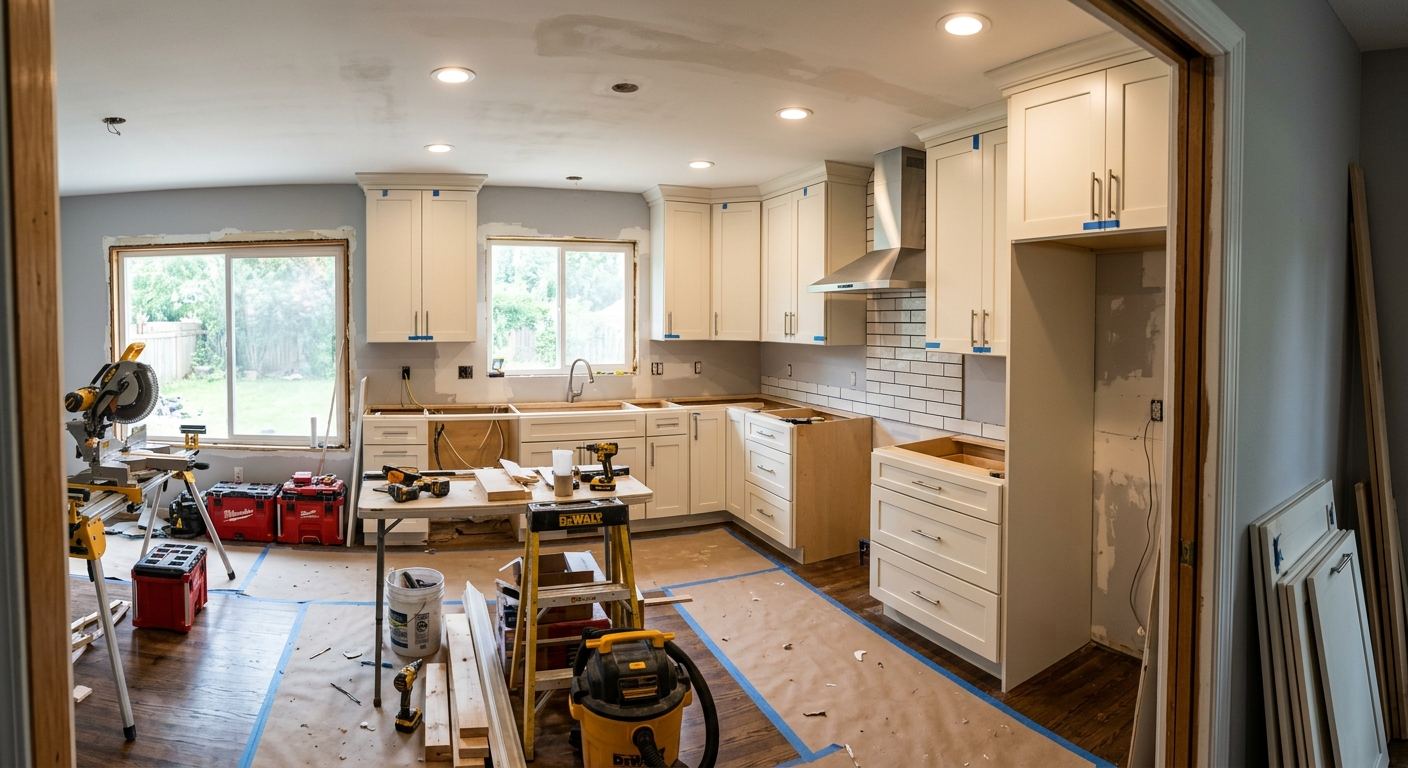
Kitchen renovation options and costs in Ancaster
Ancaster is a popular choice for homeowners who want family-friendly space close to Hamilton, and that typically shows up in kitchen budgets. With a 2021 population of 40,557 (Statistics Canada, 2021 Census), Ancaster has an owner-occupant mix where renovations are usually planned to last—not just to flip. In Hamilton–Niagara Peninsula, the strongest resale neighbourhoods often support upgrades like quartz counters and semi-custom cabinetry, because owners can recover more of the finish cost on resale. That’s less about weather and more about expectations in a higher-value housing market.
On the cost side, the Hamilton–Niagara Peninsula market affects pricing largely through contractor availability and demand: when more homeowners start full renovations in the same season, labour schedules tighten and estimates can move upward. Climate still plays a supporting role—Ancaster winters and indoor humidity swings can highlight older cabinet box sealing, weak caulking at countertop seams, and tired flooring. If you’re in an older home in Westdale-style pockets or near the older residential core close to the downtown, you’ll also see more projects start with minor electrical and ventilation fixes before the new cabinets go in.
To make comparison shopping easier, below are common renovation tiers you’ll see for Ancaster projects. Use them as a baseline, then match the tier to your actual scope (layout changes, appliance level, and countertop selection usually decide where you land).
| Renovation Tier |
What's Included |
Typical Duration |
Price Range |
| Cosmetic refresh (paint, hardware, new appliances only) |
Cabinet paint/stain, new pulls/hinges, appliance swap, minor touch-ups; no cabinet removal |
1–3 weeks |
$7,000 – $18,000 |
| Mid-range full renovation (new cabinets, counters, sink, tile) |
Stock to semi-custom cabinets, quartz counters, backsplash tile, new sink/faucet, disposal, minor layout adjustments |
4–8 weeks |
$35,000 – $65,000 |
| High-end full renovation (custom cabinets, stone counters, island) |
Fully custom millwork, stone counters, detailed backsplash (often upgraded tile), island (electrical/plumbing as needed), premium appliance package |
8–14 weeks |
$70,000 – $105,000+ |
| Cabinet refacing only (new doors + drawer fronts, same boxes) |
Refinished/relined cabinet boxes (if viable), new doors/drawer fronts, updated hardware, lighting add-ons (if desired) |
2–5 weeks |
$12,000 – $28,000 |
| Countertop swap only (laminate to quartz or stone) |
Remove old surface, template, install new quartz/stone, new sink cut-out as needed; backsplash often not included |
1–3 weeks |
$3,500 – $9,000 |
| Backsplash tile installation only |
Tile removal (if needed), prep/leveling, install backsplash, sealant/trim at edges, optional niche/under-cabinet lighting wiring allowance |
1–2 weeks |
$2,500 – $10,000 |
Prices are estimates only and vary by project scope, site access and material selection.
What affects the price of kitchen renovation in Ancaster
In Ancaster and the broader Hamilton–Niagara Peninsula, the same kitchen job can come in 30–50% apart because bids are driven by finish tier, labour availability, and how much hidden work gets uncovered—not by climate alone. Local home values and household purchasing power determine whether homeowners choose laminate/stock solutions or move directly to quartz and semi-custom cabinetry. In higher-value pockets of the Hamilton–Niagara Peninsula, many owners treat the renovation as an investment in resale appeal, so quartz counters and better cabinet boxes are common. In more modest areas or investor units, laminate and simpler stock cabinetry tend to dominate to keep total spend closer to the lower end of the $30,000–$90,000 full renovation band.
Layout change is the most unpredictable cost in every quote, whether you’re aiming for a mid-range full renovation around $35,000–$65,000 or a higher-end build above $70,000. Removing a wall, adding an island, or moving plumbing/gas can require carpentry rework, new subfloor detailing, and additional licensed trade work. In older Ancaster homes, it’s also common to discover outdated venting or undersized electrical runs once cabinets come out—those repairs can add time before anything can be reinstalled.
Concrete examples from Ancaster jobs we see often: (1) a “simple” backsplash-only refresh becomes more expensive when old tile mortar needs full removal and cement board replacement; (2) countertop changes add cost if the existing cabinets are out of level, requiring shimming and re-setting; (3) full renovations can shift upward when the planned island needs a new circuit for under-cabinet lighting and upgraded outlets. On the flip side, choosing a stock cabinet layout with minimal plumbing movement can keep you closer to the mid-range, especially when appliances are swapped without moving gas or electrical positions.
| Price Factor |
Why It Matters |
Cost Impact |
| Cabinet tier — stock vs. semi-custom vs. fully custom millwork |
Determines box quality, door/drawer detail, warranty, and lead times |
Often the biggest swing item after labour; can move a full reno by tens of thousands |
| Countertop material — laminate vs. quartz vs. granite vs. stone |
Material cost and templating complexity; heavier stones may require extra install labour |
May add several thousand dollars on countertops alone |
| Layout change — wall removal, island add, plumbing/gas move |
Impacts framing, finishes, and licensed plumbing/electrical/gas work |
High variability; commonly the driver of the 30–50% quote spread |
| Appliance package tier — builder vs. mid-range vs. pro-grade |
Power/venting requirements and finish integration (panels, trim kits) |
Can shift total spend by $2,000–$10,000+ depending on what’s included |
| Flooring — refinish existing vs. full replacement |
Kitchen traffic plus demo protection; subfloor repairs after removal can be required |
Refinish can save time; full replacement adds material and install costs |
| Backsplash — ceramic tile vs. marble vs. full-height slab |
Material weight, cutting complexity, and moisture/edge detailing |
Can move from a couple thousand to well over $8,000–$10,000+ |
| Electrical — new circuits for island, under-cabinet lighting |
Licensed work, inspections, panel capacity, and outlet placement |
Often adds $1,500–$6,000+ depending on scope |
| Permit fees and licensed trade requirements |
Applies when moving plumbing/gas, adding load-bearing structural work, or changing electrical |
Usually a smaller line item, but it adds time and coordination costs |
Permits & regulations in Ontario
In Ontario, many common kitchen upgrades can be done without pulling a permit—especially finish-only work. For example, swapping cabinets in place, changing countertop surfaces, and replacing a backsplash typically fall under trade work that does not require a municipal permit when you are not altering the rough-in systems.
Permits (and licensed trades with inspections) are usually required when you change the “systems,” not the “surfaces.” The specific work that typically DOES require a permit includes moving plumbing supply or drain lines (sink, dishwasher, or relocating the dishwasher), relocating gas appliances or changing gas piping for a stove/range hood, removing or altering load-bearing walls, adding new electrical circuits (like power for an island), and adding or modifying ventilation where the ducting path changes. Gas work must be performed by a licensed gas fitter, and electrical work by a licensed electrician. Both require inspection before you can close walls or ceilings.
For homeowners in Ancaster, the best verification approach is to ask your contractor for: (1) their business licensing details (where applicable for trade registration), (2) a current certificate of insurance, and (3) proof of WSIB/WCB coverage for workers. Then, confirm product installers’ credentials for gas and electrical directly with the licensed trade. Before signing, make sure the contract clearly states who pulls permits and who pays related fees—because “we’ll handle it” should be written down, not assumed.
Cabinets, countertops and layout decisions in Ancaster
When you’re renovating in Ancaster, three decisions usually make or break both your budget and your day-to-day satisfaction: cabinet tier, countertop material, and layout changes. First, cabinet tier: stock cabinets are the fastest and cheapest; semi-custom is the most popular mid-range option here because you get better fit and more door/drawer style choices; custom cabinets cost more, but they’re built around your exact kitchen dimensions and awkward corners.
Second, countertop material: laminate can be a budget win, but it’s less forgiving for deep cuts and can be more sensitive at seams if water sits. Quartz is usually the sweet spot in the Hamilton–Niagara Peninsula market because it handles busy family use well and offers modern look consistency. Granite and marble look premium and can elevate a move-up property, but they require more thoughtful care and finishing decisions. In Ancaster’s seasonal freeze-thaw climate, well-sealed seams matter—especially around the sink and dishwasher, where moisture is most likely to linger if caulking ages.
Third, layout: opening an inside wall, adding an island, or relocating plumbing/gas can be worth it when the space gain creates real function—like improved traffic flow or seating for family meals. But if you’re not using that space daily, the cost may not pencil out.
Local resale expectations matter. In many mid-range projects (often landing around $35,000–$65,000), buyers commonly expect quartz plus a clean tile backsplash. If you choose to add an island and relocate plumbing, you might see costs climb toward the upper range of the full renovation band—so we typically recommend committing to quartz then, not laminate, to keep the overall finish story coherent.
Dollar example: upgrading from laminate to quartz on a typical full counter footprint often adds a few thousand dollars. If your quote is otherwise a mid-range full renovation, that upgrade can be a better value than spending the same amount on swapping cabinet styles that don’t change function.
| Option |
Durability |
Maintenance |
Best For |
Price Range |
| Stock cabinets (big-box) |
Solid for normal use; limited custom sizing |
Standard cleaning; careful with hinges/hardware alignment |
Budget-focused renos with a straightforward layout |
$5,000 – $15,000 |
| Semi-custom cabinets (local dealer) |
Better internal build and door/drawer variety |
Low; keep seals and soft-close hardware serviced as needed |
Most Ancaster owners aiming for “move-up” appeal |
$12,000 – $28,000 |
| Custom cabinets (local millwork shop) |
High fit and finish; best for complex spaces |
Low; premium hardware and construction support long life |
Strange corners, ceiling-to-floor builds, and premium design intent |
$25,000 – $55,000 |
| Laminate countertop |
Good everyday performance; more vulnerable at seams |
Wipe dry; avoid prolonged standing water |
Investor units or homeowners prioritizing lowest cost |
$1,500 – $4,000 |
| Quartz engineered countertop |
Very durable; consistent surface and colour options |
Low; regular cleaner, avoid abrasive pads |
Family kitchens and resale-ready finishes in the Hamilton–Niagara Peninsula market |
$3,500 – $8,000 |
| Granite / natural stone countertop |
Extremely durable; heat resistant (when sealed properly) |
Periodic sealing and stain-resistance maintenance |
High-end aesthetics for premium renovations and feature islands |
$5,000 – $12,000 |
| Butcher block countertop |
Durable but can scratch; handles wear well |
Oil/seasoning maintenance; protect from long water exposure |
Warm, traditional or cottage-inspired designs |
$2,500 – $7,000 |
| Marble countertop |
Beautiful but softer; can etch with acids |
Higher care needs; seal and wipe spills quickly |
Signature luxe look for kitchens with controlled use |
$7,000 – $15,000+ |
How to choose a kitchen renovation contractor in Ancaster
Choosing the right contractor in Ancaster comes down to credentials you can verify, quotes that show real scope, and contracts that protect you. Start with Ontario licensing verification: confirm that the company and their subcontractors who do electrical and gas work are properly licensed through the relevant Ontario trade licensing/registration channels (ask for licence numbers). Next, verify liability insurance by requesting a certificate of insurance listing the insured trades and coverage limits. For work crews, confirm WSIB/WCB coverage—this matters if someone is injured on-site, because it protects both the workers and you as the homeowner.
Then get 2–3 itemised written quotes, not just a lump sum. You want labour and material lines separated so you can see what’s included: demolition, disposal, countertop templating, installation, flooring protection, and whether site prep is covered. Ask if permits are included and who pays permit fees. A proper quote will also list exclusions such as drywall patching after demo, relocation of venting, or any changes needed if the wall turns out to be structural.
For warranty, look for a workmanship warranty length and confirm whether manufacturer warranties on cabinets, counters, and appliances are included and how claims are handled. Ask if warranties are transferable to a future buyer if you sell your home. On payment scheduling, keep it safe: never pay more than 10–15% upfront; use holdback until completion and final walkthrough.
Finally, insist on a timeline with a start date and completion estimate in writing. Kitchen renovations are coordination-intensive, and a clear plan reduces change-order surprises.
- Ask for WSIB/WCB proof and confirm coverage is active for the project dates.
- Request liability insurance (certificate of insurance) before work begins.
- Confirm electrical work scope is covered by a licensed electrician (and provide licence/permit references when applicable).
- Confirm gas relocation work is covered by a licensed gas fitter (if your range/hood uses gas).
- Get 2–3 itemised quotes: labour, materials, and allowance amounts should be visible.
- Ensure the quote states who pulls permits and who pays permit fees.
- Verify disposal is included (construction debris and packaging removal).
- Ask what’s excluded for demo—e.g., subfloor repairs, drywall patching, and repainting.
- Confirm cabinet lead times and countertop templating dates, especially in busy seasons.
- Check workmanship warranty terms (length and coverage) in writing.
- Use a payment schedule with a small upfront deposit and a holdback until punch list completion.
- Do a walkthrough with your contractor for site access constraints (parking, stairs, appliance delivery paths).
Red flags to watch in Ancaster: contractors who won’t put permit responsibility in writing; quotes that only list a single lump sum without allowances for countertops, tile, or electrical; refusing to provide proof of WSIB/WCB or insurance; asking for a large deposit (more than 20%) before any measurement/ordering; and timelines that ignore cabinet and countertop lead times or don’t include a start date and completion estimate.
Frequently asked questions — kitchen renovation in Ancaster
Can I live at home during a kitchen renovation in Ancaster?
You often can, even in Ancaster, but it depends on how invasive the scope is. A cosmetic refresh or a countertop-only swap usually allows you to keep using the kitchen with minimal disruption, while a full renovation with new cabinets and tile typically requires a temporary setup. The biggest downtime usually occurs during cabinet install, countertop templating/installation, and any plumbing or electrical rough-in where water or power can be temporarily restricted. For many homeowners, the practical approach is to live with a “mini-kitchen” (microwave, kettle, and a couple of hot-plate meals) while appliances are staged elsewhere. If your project is closer to a mid-range full renovation (often in the $35,000–$65,000 band), expect a longer, more disruptive period than a small backsplash job.
Should I renovate my kitchen before selling in Ancaster?
In most Ancaster resale scenarios, a kitchen refresh helps more when it targets high-impact, broadly appealing items—cabinet fronts/boxes, modern counters like quartz, and a clean backsplash. If you’re aiming to sell soon, prioritize what buyers notice during showings, not niche upgrades. Also, match the finish tier to your home’s neighbourhood and buyer segment: Hamilton–Niagara Peninsula buyers in move-up markets often expect quartz rather than laminate, and that can better support resale appeal. That said, if your layout is flawed or there are major electrical/plumbing issues, it’s usually better to address functional problems rather than only surface changes. A well-planned renovation within the $30,000–$90,000 range is often where homeowners can justify updates without overbuilding for the property’s value. Your contractor should help you choose a scope that makes sense for your timeline and budget.
What's the most popular kitchen style in Ancaster right now?
The most common direction we see in Ancaster right now is a bright, modern look that still feels warm: shaker-style or simple slab-look cabinetry, medium to warm neutral colour palettes, quartz counters, and a backsplash that adds texture without being overly busy. Many homeowners choose semi-custom cabinetry to get better hardware alignment and more door/drawer variety while staying closer to mid-range renovation budgets. Quartz has also become the default for full renovations because it reads premium and performs well for everyday cooking. If you’re building toward a higher-value, more customised feel, islands, upgraded lighting, and stone counters are common. For a mid-range full renovation (often $35,000–$65,000), the “safe bet” is a modern cabinet and quartz combo paired with a tidy tile backsplash and practical storage—buyers tend to respond to that combination.
How do I know if I need to update my kitchen plumbing in Ancaster?
Plumbing updates become necessary when you see leaks, slow draining, corrosion, or when you’re moving the sink/dishwasher to a new location. In older Ancaster homes, it’s also common for supply lines and shutoff valves to be dated, and those are easy to improve while the cabinets are out. You’ll also want a plumber/gas fitter review when you’re changing a vented hood arrangement or relocating a gas range (if applicable). A good contractor will inspect rough-in conditions during demo and tell you what’s purely cosmetic versus what impacts safety and performance. If your quote is countertop-only, plumbing typically shouldn’t be changed unless there’s an existing issue. But in a full renovation—especially one with layout changes—plan for the possibility that a small plumbing fix can turn into additional work, affecting your total within the $30,000–$90,000 band.
What is the difference between a galley and open-concept kitchen?
A galley kitchen is a more enclosed, corridor-style layout, with counters and cabinets on two parallel walls. It often works well in older homes or where the room is narrower, but it can limit storage and seating unless you plan carefully. An open-concept kitchen removes barriers to connect the kitchen with living space, improving sightlines and making it easier to entertain. The difference affects renovation scope and cost: open-concept projects can require structural assessment, possible wall removal, and changes to ventilation, electrical outlets, and lighting circuits. That’s why bids can vary widely for the same “new cabinets” request. In Ancaster, if you’re considering opening up space, budget for the most unpredictable portion of a renovation—layout changes—because moving plumbing/gas or adding an island can increase permit/licensed trade involvement even when finishes look similar.
How do I get accurate kitchen renovation quotes in Ancaster?
To get accurate quotes in Ancaster, start by giving contractors the same information: measurements, a clear list of what you want changed (and what stays), and your intended finish tier. Ask for 2–3 itemised quotes that break down labour and materials rather than a single lump sum. Ensure allowances are stated clearly for cabinets, countertops, backsplash tile, disposal, and any electrical/under-cabinet lighting. Confirm whether permits are included in the quote and who is responsible for pulling them when plumbing, gas, or electrical circuits are altered. Also ask for start date and completion estimate in writing, plus lead-time assumptions for cabinets and countertop templating. Finally, verify the contractor’s Ontario insurance and WSIB/WCB coverage so you’re not exposed to risk during demo and install.