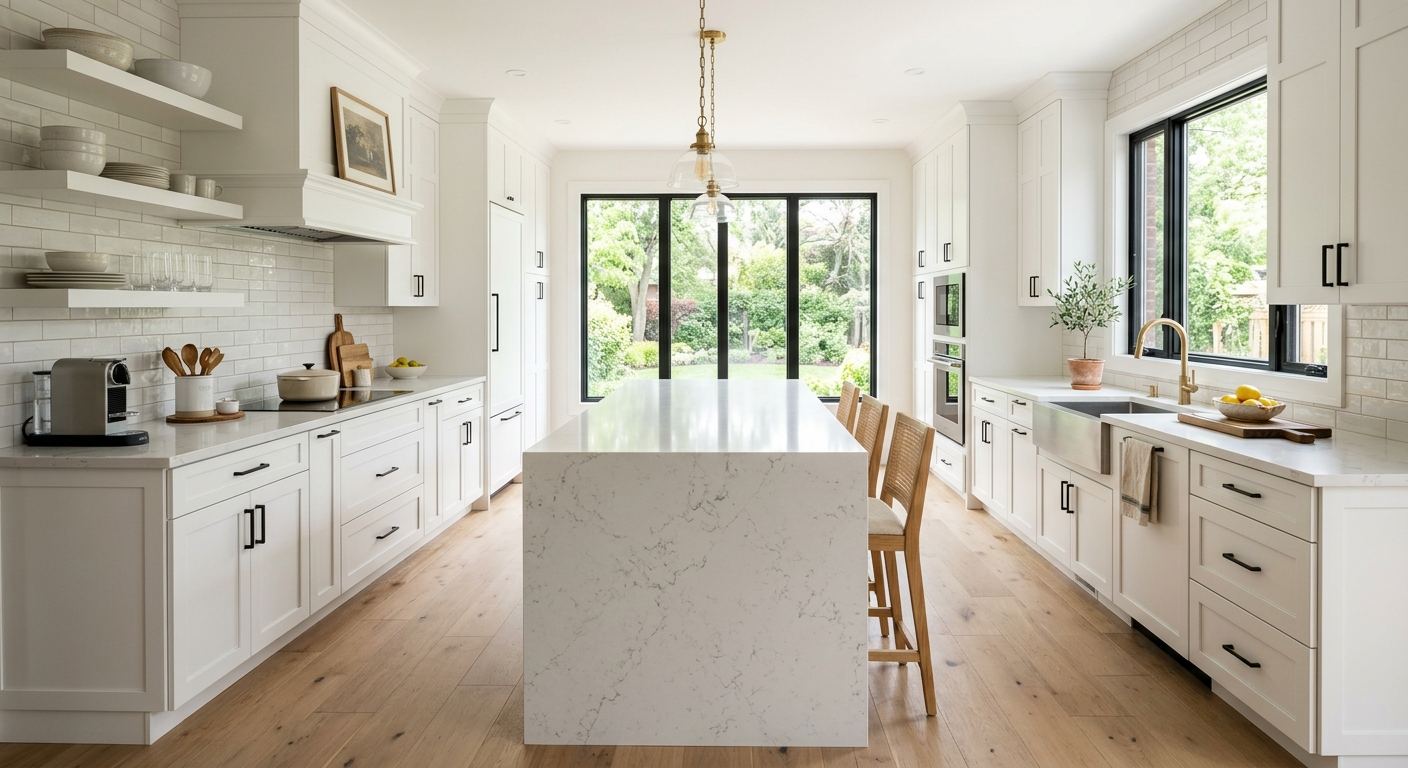
Kitchen renovation options and costs in Cambridge
Kitchen renovations in Cambridge can be done at several price points, but the “best fit” option depends on how much you want to change beyond the visible surfaces. With a median household income of $93,000 (Statistics Canada, 2021 Census), many Cambridge homeowners choose a mid-range refresh that upgrades cabinets and counters without going fully custom. At the same time, Cambridge’s housing mix—where 48.4% of homes were built before 1981 (Statistics Canada, 2021 Census)—means a lot of kitchens have older layouts, dated electrical, and pipe locations that can limit how low the total project cost can go.
In the Kitchener–Waterloo–Barrie economic region, costs track local home values more than climate. Our winters and spring freeze–thaw cycles do affect tile/grout and long-term substrate prep, but the bigger driver is finish expectations: in higher-value pockets of Cambridge, you’ll typically see homeowners move quickly to quartz or premium stone and semi-custom cabinetry because they recover that quality on resale. Contractor availability and labour competition also play a role—during busy renovation seasons, scheduling and coordination time can shift labour pricing and push timelines.
One area where this trade is especially active is the Hespeler neighbourhood corridor, where families often renovate to modernize older homes without losing functional storage. From there, you can choose between a cosmetic refresh, a full mid-range remodel, or a higher-end build—each with different impacts on budget and disruption. Use the ranges below to compare options and then align your scope to your timeline and your comfort with construction changes.
| Renovation Tier |
What's Included |
Typical Duration |
Price Range |
| Cosmetic refresh (paint, hardware, new appliances only) |
Cabinet paint or refinishing, new hardware/pulls, appliance replacement, caulking/touch-up, basic trim and wall patching |
1–3 weeks |
$6,000–$15,000 |
| Mid-range full renovation (new cabinets, counters, sink, tile) |
New semi-custom or stock cabinetry, quartz or entry-level stone counters, sink and tap, backsplash tile, upgraded lighting allowances, disposal re-install |
4–8 weeks |
$30,000–$60,000 |
| High-end full renovation (custom cabinets, stone counters, island) |
Fully custom cabinetry, premium stone (or higher-end quartz), large-format backsplash, island with seating, upgraded ventilation/lighting, more extensive electrical/plumbing coordination |
7–12 weeks |
$60,000–$90,000 |
| Cabinet refacing only (new doors + drawer fronts, same boxes) |
New doors/drawer fronts and hardware, updated trim, matching panel replacements, cosmetic wall/ceiling patching where needed |
2–4 weeks |
$6,000–$20,000 |
| Countertop swap only (laminate to quartz or stone) |
Old countertop removal, new quartz/stone installation, sink cut-out/replace as applicable, backsplash top-surface prep (not full tile) |
3–7 days |
$4,000–$12,000 |
| Backsplash tile installation only |
Surface prep, tile supply/labour allowance, thinset/grout, sealing where required, clean-up and final caulking |
3–10 days |
$1,500–$8,000 |
Prices are estimates only and vary by project scope, site access and material selection.
What affects the price of kitchen renovation in Cambridge
Even when two homeowners in the Kitchener–Waterloo–Barrie region request “the same” kitchen renovation, quotes can vary by 30–50% because the cost is driven by hidden variables: what’s behind the walls, how much plumbing/electrical must be moved, and the cabinetry and countertop tiers chosen. Local home values and household income are a major reason finishes “scale up” in higher-demand pockets—many Cambridge buyers lean toward quartz or stone and semi-custom cabinetry because that quality is easy to justify during resale. In more modest contexts, laminate and stock cabinets often win out because they deliver a clean look without pushing budgets into the upper band.
Layout changes are where unpredictability spikes regardless of finish level. Removing a wall, adding an island, or moving a gas line typically requires more demolition, coordination, and licensed-trade scheduling. For example, a mid-range full renovation that lands around $30,000–$60,000 can jump if your island requires relocating plumbing or adding new circuits; the finishes might still be mid-tier, but the labour and trades add up fast.
In Cambridge, older housing stock built before 1981 (48.4%) often brings dated rough-ins, which can raise costs for patching, subfloor/underlayment corrections, and electrical upgrades. Conversely, if your kitchen has solid existing cabinet boxes and power locations that work for your plan, a cabinet-focused scope (for example, $6,000–$20,000 for refacing) can keep spend controlled. Finally, weather-related moisture issues don’t usually “set the price” by themselves, but they can increase prep labour for tile adhesion and ensure proper substrate condition before grout lines go in.
| Price Factor |
Why It Matters |
Cost Impact |
| Cabinet tier — stock vs. semi-custom vs. fully custom millwork |
Higher tiers add more options for sizes, interiors, finishes, hardware readiness, and tighter tolerances. |
Can account for roughly 30–35% of the full budget; often the biggest cost swing. |
| Countertop material — laminate vs. quartz vs. granite vs. stone |
Material and edging/finish requirements affect both supply and installation time. |
Typically another 10–15% of budget; premium stone increases both material and templating/handling. |
| Layout change — wall removal, island add, plumbing/gas move |
Changes require additional trades, potential permits, and more demolition/restoration work. |
Often drives the largest unpredictable variance; can raise total costs by tens of thousands in complex cases. |
| Appliance package tier — builder vs. mid-range vs. pro-grade |
Pro-grade models may require electrical/venting considerations and premium trim details. |
Can add several thousand dollars and affect cabinet cut-outs and install time. |
| Flooring — refinish existing vs. full replacement |
Some kitchens need careful protection during demo; others need full tear-out for level/surface integrity. |
Small scope may be a few hundred to low-thousands; full replacement adds labour and materials. |
| Backsplash — ceramic tile vs. marble vs. full-height slab |
Large-format and stone backsplashes demand extra precision, sealing, and specialized installation. |
Can move from lower thousands to upper single digits, depending on coverage and material. |
| Electrical — new circuits for island, under-cabinet lighting |
Lighting/extra outlets often require licensed work and planning for switch locations and wiring paths. |
Often adds a meaningful line item; complexity increases with island placement. |
| Permit fees and licensed trade requirements |
Certain work types trigger permits, inspections, and specialized installers. |
Varies by scope; typically increases both cost and schedule due to trade coordination. |
Permits & regulations in Ontario
In Ontario, a straightforward cabinet or countertop swap generally does not require a permit—if you’re replacing like-for-like and not changing the plumbing, gas piping, venting, or the electrical circuit design. That said, permits and inspections are often required when you move the infrastructure. The most common kitchen triggers are: moving plumbing supply or drain lines (sink relocation, dishwasher re-plumbing), relocating gas for the stove or making changes to range hood venting when gas is involved, removing a load-bearing wall, and adding new electrical circuits (for example, separate circuits for an island, new under-cabinet lighting runs, or significant rewiring).
Step-by-step for Cambridge homeowners: first, ask your contractor to list every “like-for-like” versus “changed” item in writing. Next, confirm who is pulling permits for triggered scopes and what inspections are expected before wall closure. Then verify licensing with the right certificates: gas work must be performed by a licensed gas fitter, and electrical work by a licensed electrician; both should provide proof of their certification and workmanship coverage for the specific job. Request a Certificate of Insurance (liability) and proof of WSIB/WCB coverage where applicable, and keep these documents in your renovation file.
Always confirm permit responsibility before signing—“we’ll handle it” should be spelled out in your contract, including what’s included in the project price and what’s not.
Cabinets, countertops and layout decisions in Cambridge
In Cambridge, the three highest-impact decisions in your kitchen renovation are cabinet tier, countertop material, and whether you change the layout. Cabinet tier sets your budget pace and your fit/finish expectations: stock cabinets are typically the fastest and cheapest, semi-custom is the most popular mid-range approach because it balances quality and timing, and custom cabinetry delivers the best storage and end-to-end alignment—at the highest cost.
Countertop material changes both daily use and long-term cost. Laminate is budget-friendly and easier to replace later, but it’s more susceptible to edge wear and heat sensitivity. Quartz engineered tops are a common choice in this region because they’re durable and relatively low-maintenance for busy households. Granite and other natural stones offer a premium look but may require more careful maintenance and sealing routines depending on the stone. Butcher block is warm and forgiving, yet it needs periodic conditioning, and marble is beautiful but more prone to etching—so it’s best when you’re comfortable with extra care.
Layout changes are where the justification has to be real. Opening an interior wall or adding an island can cost significantly more because it often requires new plumbing, gas/electrical coordination, and sometimes permit work. For example, if your baseline project falls in the $30,000–$60,000 mid-range band, keeping plumbing in the same general locations can preserve that range. If you must move a drain line and add electrical for island outlets/lighting, you can push into the upper band (and beyond) even with “mid” finishes.
Because many Cambridge kitchens sit in older homes (48.4% built before 1981), careful planning around existing rough-ins can save money. In the Kitchener–Waterloo–Barrie resale market, buyers often expect clean cabinet fronts and quartz/stone counters at the mid-to-high price points, so prioritize upgrades where they’re most visible—then spend on layout only when the space gain improves how you live.
| Option |
Durability |
Maintenance |
Best For |
Price Range |
| Stock cabinets (big-box) |
Good day-to-day durability; finishes can be less forgiving if not installed perfectly |
Low; protect from standing water and handle impacts carefully |
Timelines that need to be short and budgets that must stay controlled |
$8,000–$18,000 |
| Semi-custom cabinets (local dealer) |
Strong durability with better fit/finish and more storage configurations |
Low; typical wipe-down care |
Most Cambridge homeowners aiming for a modern look with better storage |
$12,000–$25,000 |
| Custom cabinets (local millwork shop) |
Very high durability and excellent alignment for specialty spaces |
Low, but relies on quality installation and proper ventilation |
Homes where you need exact measurements, integrated storage, or unique layouts |
$20,000–$40,000 |
| Laminate countertop |
Moderate; edges and seams need protection |
Wipe clean; avoid prolonged heat and moisture at seams |
Budget-first updates and rentals or short-hold properties |
$1,500–$4,000 |
| Quartz engineered countertop |
High durability; resists staining and everyday wear well |
Low; regular cleaning with non-abrasive products |
Busy households that want a premium look without heavy maintenance |
$3,500–$9,000 |
| Granite / natural stone countertop |
High; strong, heat-tolerant surface |
Moderate; sealing may be needed periodically depending on stone type |
Homeowners who want natural variation and a classic premium finish |
$4,500–$10,500 |
| Butcher block countertop |
Moderate to high when properly maintained; can dent with abuse |
Higher; periodic oil/conditioner and careful moisture management |
Warm, lived-in styles and kitchens used for prep (not just display) |
$3,000–$8,000 |
| Marble countertop |
Moderate; can scratch and etch with acids |
Higher; requires careful cleaning and protective habits |
Statement kitchens where care and maintenance are acceptable |
$6,000–$12,000 |
How to choose a kitchen renovation contractor in Cambridge
Choosing the right contractor in Cambridge starts with verification. Ask for their Ontario business details and licensing where applicable, plus proof of liability insurance and WSIB/WCB coverage. For each trade that will be involved, ensure the right contractor is responsible and insured—gas work should be completed by a licensed gas fitter and electrical work by a licensed electrician. For you as the homeowner, the practical checks are: (1) request and review Certificates of Insurance and WSIB/WCB clearance documents before work begins, (2) confirm the electrician/gas fitter will show their credentials on request, and (3) keep copies for your records so you’re covered if something changes mid-project.
Next, request 2–3 itemised written quotes instead of one lump sum. A good quote breaks labour and materials, clarifies allowances (cabinet hardware, lighting, disposal, tile setting products), and specifies whether disposal, floor protection, and site clean-up are included. Read the scope carefully: what’s excluded, who pulls permits if required, and when inspections are scheduled. Warranty matters too—verify workmanship warranty length, product manufacturer warranty coverage, and whether warranties are transferable if you sell your home.
Finally, manage cash flow. Never pay more than 10–15% upfront; keep a holdback until the job is complete and you’ve received final walkthrough sign-off and any close-out documents. Get a start date and a realistic completion estimate in writing so you can plan around school and work schedules.
- Use itemised quotes with labour and materials line items (not “kitchen package” only).
- Confirm cabinet tier and countertop material names exactly (including thickness/finish details).
- Ask who is responsible for permit pulls and whether they’re included in the quote price.
- Require a written start date, milestone dates, and a completion target.
- Check insurance and WSIB/WCB coverage before demolition.
- Ask for a disposal/recycling and jobsite protection plan (floor protection, dust control).
- Verify what electrical/plumbing changes are included (outlets, under-cabinet lighting, venting).
- Clarify backsplash scope (tile coverage height, outlets count, returns, and caulking type).
- Get a clear warranty schedule: workmanship, manufacturer warranties, and exclusions.
- Review the payment schedule in the contract (target 10–15% upfront; holdback at completion).
- Confirm lead times for cabinets and stone/quartz templating so the schedule is realistic.
- Ask for references from similar Cambridge projects, ideally with photos of final installs.
In Cambridge, red flags often look like this: (1) quotes that omit disposal, patching, or electrical allowance details; (2) “no problem, we don’t need permits” language when you’re moving plumbing/gas or adding circuits; (3) asking for large upfront deposits (beyond 10–15%); (4) vague warranties with no workmanship terms; and (5) no proof of insurance/WSIB/WCB coverage when requested.
Frequently asked questions — kitchen renovation in Cambridge
How do I choose a kitchen contractor in Cambridge?
Start by comparing itemised quotes from at least 2–3 contractors and make sure the scope is truly comparable (cabinet tier, countertop material, backsplash coverage, electrical/plumbing changes). In Cambridge, kitchen projects frequently touch dated rough-ins in older homes, so ask how they handle electrical upgrades and substrate prep. Verify the contractor’s liability insurance and confirm WSIB/WCB coverage documentation before work starts, and request credentials for licensed trades (gas/electrical) when applicable. A trustworthy contractor should also provide a workmanship warranty and clearly identify exclusions. As a reality check, if one quote lands far below the region’s typical full-renovation band (for example, $25,000–$90,000), it often indicates different materials, missing scope, or limited allowances.
What order do kitchen renovation steps happen in?
In most Cambridge renovations, the sequence is planned to reduce rework and protect finishes. First comes measurement/template (especially for countertops and some cabinetry), then demolition and rough-in adjustments. If you’re moving plumbing or adding electrical circuits, licensed trades usually complete that rough-in stage before walls are closed. Next, cabinet installation happens (or cabinetry layout is locked in), then countertop templating and installation. After that, you’ll typically see backsplash tile, flooring transitions/finish work, painting/touch-ups, and final appliance and hardware installs. Because quartz/stone templating has lead time, scheduling matters—your contractor should provide milestone dates so you don’t end up waiting on stone while the rest of the kitchen is ready.
Can I live at home during a kitchen renovation in Cambridge?
Many homeowners in Cambridge do live at home during renovation, but it depends on scope. Cosmetic refreshes and small countertop swaps are usually manageable with minimal disruption. A mid-range full renovation (often in the $30,000–$60,000 range) can still be workable if the contractor sequences work to keep at least one functional prep area and preserves safe access routes. For high-end builds with islands and more extensive electrical/plumbing coordination (often in the $60,000–$90,000 range), living on-site is still possible, but expect dust control, limited kitchen access, and potentially temporary hookups for cooking and dishwashing. Ask your contractor about floor protection, dust mitigation, daily cleanup, and whether there’s a plan for temporary power and water during the rough-in phase.
Should I renovate my kitchen before selling in Cambridge?
Often, yes—when the update targets what buyers can immediately see. In Cambridge, many homes have older kitchens, and the most visible upgrades (fresh cabinetry, modern counters like quartz, and updated lighting) tend to improve buyer confidence. If you’re planning to sell soon, avoid structural changes unless the layout is truly limiting, because moving plumbing/gas and adding circuits can add time and complexity. A “safe” approach is frequently a mid-range renovation that lands within the typical budget band (for example, $30,000–$60,000), focusing on durable, buyer-friendly finishes. If your plan includes an island or moving major utilities, speak with your contractor about resale expectations and how quickly the work can be completed—timelines can matter as much as design.
What's the most popular kitchen style in Cambridge right now?
In Cambridge and the broader Kitchener–Waterloo–Barrie region, the most requested look is typically modern transitional: clean shaker-style cabinet fronts, warm neutrals or soft greys, and lighter, brighter countertop pairings—often quartz. Homeowners also commonly want better lighting over work zones, and an updated backsplash that reaches a visually consistent height rather than a patchwork approach. The exact style shifts by neighbourhood and buyer profile, but the “safe” combination is usually: durable cabinet finishes, quartz countertops, and a backsplash that ties into flooring and paint tones. If you’re planning a high-end build, that style often extends to fully custom millwork and premium stone details; for a mid-range renovation, semi-custom cabinets with quartz commonly deliver the strongest value-per-dollar.
How do I know if I need to update my kitchen plumbing in Cambridge?
You may need plumbing updates if your existing rough-in is outdated, leaking, poorly vented, or configured in a way that limits your planned layout. Cambridge homes built before 1981 (48.4% of dwellings were built that early) often have older pipe materials, limited shutoffs, or undersized venting that becomes a problem once you relocate a sink, dishwasher, or add a new island. The best way to confirm is to have your contractor and plumber assess under-sink valves, drain condition, dishwasher hook-ups, and any signs of corrosion or slow drains. If you’re staying in the same spot, you might only need targeted upgrades (like new shutoffs). If you’re moving plumbing supply/drain lines, budget for added labour and expect permits and licensed trade involvement when required.