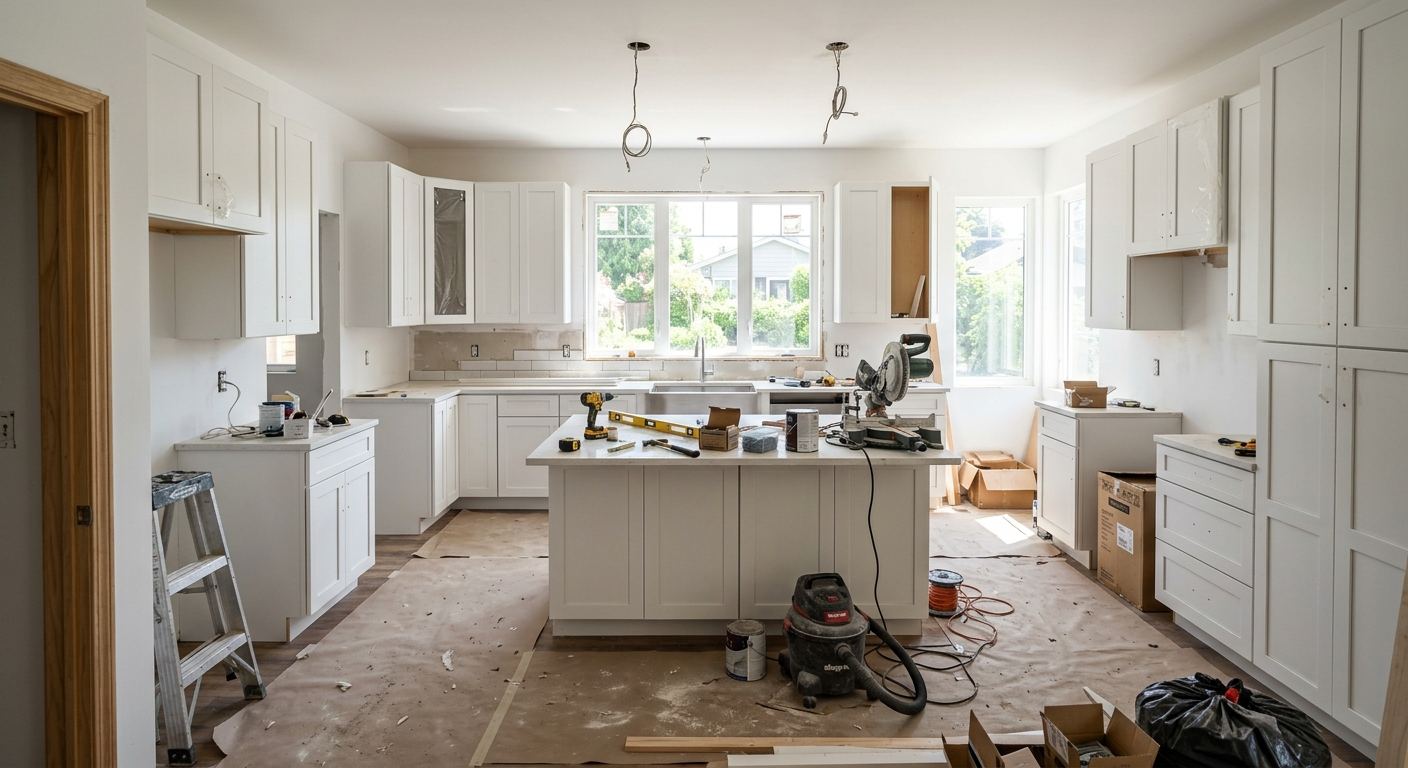
Kitchen renovation options and costs in Angus
Angus homeowners typically choose between a quick cosmetic refresh and a full kitchen renovation based on how long they plan to stay in the home and what buyers will expect in the Toronto-area resale market. With a population of 10,269 in Angus (Statistics Canada, 2021 Census), projects are steady year-round, and contractor scheduling is usually strongest in late spring through early fall. Cost expectations also track household buying power: when nearby economic pockets support higher-end finishes, many homeowners spend closer to 8–15% of their home value on the kitchen, pushing budgets toward quartz or natural stone and semi-custom cabinetry instead of basic options. In practical terms, that means the same “family-sized” kitchen can land anywhere from the mid-$20k range for modest refreshes up to $80k+ for larger, custom builds.
In the Toronto economic region, kitchen budgets are driven far more by local home values and household incomes than by weather. That said, local winters still influence how we approach materials and installation: proper ventilation, stable interior humidity, and careful sealing around sinks and backsplashes help prevent premature wear and moisture-related call-backs. If your home is older (common in parts of the Angus area), expect additional labour for leveling subfloors and patching drywall before new cabinets go in—another reason quotes can vary.
Cabinet-and-counter work is especially in demand around Angus’s community hubs where families are upgrading for resale and for accessibility. Next, here’s a clear comparison of renovation tiers and what they usually include.
| Renovation Tier |
What's Included |
Typical Duration |
Price Range |
| Cosmetic refresh (paint, hardware, new appliances only) |
Cabinet paint or stain (no cabinet box changes), new hardware, wall paint, fixture updates, appliance swap, basic cleanup |
3–7 days |
$8,000–$20,000 |
| Mid-range full renovation (new cabinets, counters, sink, tile) |
New semi-custom cabinets, quartz or good laminate counters, new sink + tap, backsplash tile, flooring patch/refresh, disposal hookup, lighting refresh (no major rewiring) |
2–4 weeks |
$25,000–$60,000 |
| High-end full renovation (custom cabinets, stone counters, island) |
Fully custom millwork, upgraded stone or premium quartz counters, island build, upgraded appliance package, full backsplash/trim, more extensive electrical and plumbing support, coordinated finishing |
4–8 weeks |
$65,000–$90,000 |
| Cabinet refacing only (new doors + drawer fronts, same boxes) |
Refacing doors/drawers, new hardware, veneer prep, stain/paint on visible surfaces, limited countertop or backsplash adjustments |
1–2 weeks |
$8,000–$35,000 |
| Countertop swap only (laminate to quartz or stone) |
Remove old tops (and any cutouts), install new quartz/stone, reseal edges, update sink opening where needed, basic backsplash tie-in (optional) |
2–5 days |
$3,000–$15,000 |
| Backsplash tile installation only |
Remove/prepare existing surface, tile layout and installation, grout and sealing, caulking at edges, optional under-cabinet lighting tie-in (if electrical included) |
2–7 days |
$2,000–$10,000 |
Prices are estimates only and vary by project scope, site access and material selection.
What affects the price of kitchen renovation in Angus
Across Toronto and the wider Ontario market, the same kitchen scope can land 30–50% apart because quotes reflect how homeowners choose to spend—finish tier, design complexity, and how much “invisible work” is required once walls open. In Angus, local home values and household incomes strongly influence the finish level far more than climate does. In higher-value pockets of the Toronto region, homeowners often default to quartz or natural stone and semi-custom cabinetry because the kitchen cost is easier to justify on resale; in more price-sensitive projects, laminate tops and stock or refaced cabinets keep the work in the low–mid bands (and protect resale value without overspending).
Layout changes are the biggest unpredictable driver regardless of finish tier. Removing a wall, adding an island, or moving plumbing/gas typically adds labour and coordination time because trades need to schedule around rough-ins, inspections and final cabinetry. In many Angus homes, where older framing and plumbing runs aren’t always square to modern cabinet standards, expect extra levelling, shimming and drywall patching before you can install new cabinets cleanly.
Concrete examples we see locally: (1) if you’re upgrading from laminate to quartz, the countertop installation portion may fit the $3,000–$15,000 range, but adding an island with electrical can push the overall project toward the higher $65,000–$90,000 band; (2) if your existing cabinets are sound and you reface instead of replacing, cabinetry budget may stay closer to $8,000–$35,000 versus full cabinet replacement that commonly feeds into the mid-range $25,000–$60,000 full renovation band. Seasonal temperature swings also matter: after winter, kitchens can have lower indoor humidity, so we plan for curing times for adhesives, caulks and paint to reduce long-term seam cracking near sinks and backsplashes.
| Price Factor |
Why It Matters |
Cost Impact |
| Cabinet tier — stock vs. semi-custom vs. fully custom millwork |
Material quality, door styles, internal organization, fit-and-finish, and lead times |
Can swing the job by thousands; custom millwork is typically the biggest cabinet premium |
| Countertop material — laminate vs. quartz vs. granite vs. stone |
Material cost, fabrication complexity, edge profiles, and sink/cooktop cut-outs |
Laminate is lowest-cost; quartz and natural stone add both material and template/fabrication time |
| Layout change — wall removal, island add, plumbing/gas move |
More demolition, framing, rough-ins, coordination and potential inspections |
Often the largest “surprise” cost increase, even when finishes stay mid-range |
| Appliance package tier — builder vs. mid-range vs. pro-grade |
Ventilation, electrical requirements, dimensions and installation complexity |
Upgrades can add material and labour; pro packages may require more electrical coordination |
| Flooring — refinish existing vs. full replacement |
Subfloor condition, matching patterns, and removal/refit time |
Partial patching is cheaper; full replacement adds labour, underlayment and disposal |
| Backsplash — ceramic tile vs. marble vs. full-height slab |
Weight, cutting patterns, sealing requirements and surface prep |
Full-height and premium stone increase labour and material cost |
| Electrical — new circuits for island, under-cabinet lighting |
Licensed work, new wiring routes, and safe outlet placement |
Can add several thousand depending on run length and how many circuits/fixtures |
| Permit fees and licensed trade requirements |
Costs for permits/inspections and scheduling licensed trades |
Usually modest but can meaningfully affect timeline and coordination |
Permits & regulations in Ontario
In Ontario, a straightforward cabinet/fixture refresh typically doesn’t require permits. Cabinet and countertop swaps—when you’re keeping the existing layout and not altering plumbing or gas lines—are usually treated as non-structural work. That said, permits do come into play when you’re changing services or altering the building structure. If your Angus kitchen plan includes moving supply or drain lines, relocating a gas stove or changing where the range hood vents, removing a load-bearing wall, or adding new electrical circuits (common with island lighting or additional outlets), you should expect permit involvement and licensed trade inspections. Gas work must be completed by a licensed gas fitter, and electrical work must be done by a licensed electrician—both need inspections after rough-in and/or at completion.
Before signing in Angus, verify responsibility in writing: confirm who pulls permits (contractor vs. homeowner), what trades are booked, and which inspection stages are included. To verify Ontario licensing and coverage, you can: (1) check contractor credentials and trade licences through the relevant online registry listings used for Ontario trades; (2) ask for a certificate of insurance and verify it includes liability coverage and the project address; and (3) request WSIB/WCB coverage documentation (or a clearance letter) so you’re not assuming risk if a worker is injured. These steps are especially important on kitchens that involve demolition and service relocation, because the number of scheduled inspections and staged rough-ins can directly affect your completion date.
Cabinets, countertops and layout decisions in Angus
For an Angus kitchen renovation, three decisions determine most of your outcome: (1) cabinet tier, (2) countertop material, and (3) layout changes. Cabinet tier sets your budget and your daily function. Stock cabinets are the fastest and cheapest to install, but the fewer sizes and limited custom options can create awkward fills in older Angus homes that aren’t perfectly square. Semi-custom cabinets are usually the best balance for Ontario resale: you get better storage planning and more door style options while still keeping the project in the mid-range $25,000–$60,000 band for many full renovations. Custom cabinets cost more, but they shine when you need unusual dimensions, integrated appliances, or a truly tailored island.
Countertop choice impacts both durability and maintenance. Laminate is a budget-friendly option, but it’s more sensitive to seam edges and heat. Quartz is the practical sweet spot for most Toronto-region buyers: it resists staining and wiping it clean is straightforward for busy households. Granite or natural stone adds premium look but may require more care around sealing, and it can cost toward the higher end of countertop swaps. Layout changes are where value gets either earned or wasted: opening an older wall or adding an island can justify cost when it improves flow and creates usable seating; however, moving plumbing or gas lines adds rough-in complexity and usually pushes you toward the higher $65,000–$90,000 tier for full, custom builds.
Dollar example: if you upgrade cabinets from stock to semi-custom and keep the footprint the same, you might spend incrementally and still stay in the $25,000–$60,000 full renovation range; but switching to a large stone island top plus electrical and plumbing changes often turns “incremental upgrades” into a full high-end rework.
| Option |
Durability |
Maintenance |
Best For |
Price Range |
| Stock cabinets (big-box) |
Good for standard sizes; hinges and finishes vary by brand |
Low day-to-day upkeep; touch-ups as needed at edges |
Fast turnaround, tight budgets, straightforward layouts |
$8,000–$25,000 |
| Semi-custom cabinets (local dealer) |
Very strong for most households; better internal organization |
Easy cleaning; finishes hold up well when installed on flat substrate |
Most Ontario resale-focused renovations |
$15,000–$45,000 |
| Custom cabinets (local millwork shop) |
Highest fit and longevity; ideal for irregular spaces |
Low upkeep; premium hardware typically included |
Unique layouts, built-ins, and full custom islands |
$30,000–$70,000 |
| Laminate countertop |
Solid for daily use; can chip at impact points |
Wipe clean; protect seams and avoid excessive heat |
Budget-conscious upgrades and rentals |
$3,000–$6,000 |
| Quartz engineered countertop |
Very durable; resists staining and everyday wear |
Low maintenance; clean with non-abrasive products |
Toronto-area buyers who want a “no-fuss” upgrade |
$6,000–$12,000 |
| Granite / natural stone countertop |
Hard and scratch-resistant; variety in natural movement |
Seal on schedule; wipe spills promptly |
Premium look and signature stone selections |
$8,000–$15,000 |
| Butcher block countertop |
Good impact resistance; can mark without care |
Oil and protect regularly; avoid soaking |
Warm style and light use patterns |
$5,000–$10,000 |
| Marble countertop |
Beautiful but more porous; can be more sensitive to staining |
Requires sealing and careful cleaning practices |
High-end aesthetic kitchens with disciplined maintenance |
$10,000–$18,000 |
How to choose a kitchen renovation contractor in Angus
Choosing the right contractor in Angus is less about flashy photos and more about proof: Ontario licensing, clear insurance, and a detailed, itemised quote. Start by verifying Ontario trade licensing where applicable, then ask for liability insurance documentation for the contractor and any subcontractors. For worker protection, request WSIB/WCB clearance—either through a clearance letter or proof of coverage—so you’re not exposed if a worker is injured on your site. A reputable kitchen renovator will provide these documents quickly and without pressure.
Next, get 2–3 written quotes that break down labour and materials instead of one lump sum. You want to see line items for demolition, cabinet installation, countertop templating and install, backsplash tile, plumbing/electrical components, disposal, and any drywall patching. Read the scope carefully: confirm what’s excluded (old cabinet removal, floor protection, leveling, drywall finishing), whether permits are included, who pulls them, and whether disposal and site cleanup are part of the contract. Ask about warranties: there should be a workmanship warranty (often 1–2 years), plus the manufacturer’s product warranty; confirm if warranties are transferable if you sell the home. Finally, insist on a sensible payment schedule—never more than 10–15% upfront, and use a holdback until the job is fully complete and punch-list items are addressed. Get a written start date and completion estimate, not just “during the season.”
- Confirm Ontario licensing for any trades involved (gas/electrical) and request proof up front.
- Request liability insurance certificate with project address listed.
- Obtain WSIB/WCB coverage proof or clearance letter.
- Demand itemised quotes (labour, materials, disposal, drywall/patching, protection).
- Clarify permit responsibility and whether permit fees are included.
- Confirm who schedules inspections and how delays affect your timeline.
- Verify countertop templating and fabrication lead times in writing.
- Check if demolition includes hauling/disposal and floor protection.
- Ask who handles small electrical/plumbing changes tied to new appliances.
- Review warranty terms for workmanship and product and whether they’re transferable.
- Agree on payment milestones tied to measurable stages (rough-in complete, cabinetry set, final finishes).
- Get a written change-order process so surprises are documented and priced transparently.
Concrete red flags in Angus: contractors who won’t provide insurance/WSIB documentation, quotes that don’t specify permit responsibilities, “all-in” pricing with no line items for cabinets/countertops, refusing to list timelines for templating and fabrication, and pushing for large upfront payments beyond 10–15%.
Frequently asked questions — kitchen renovation in Angus
How much does a kitchen renovation cost in Angus?
In Angus, most full kitchen projects land in the $25,000–$90,000 range depending on cabinet tier, countertop choice, and how much you change the layout. If you’re doing a modest refresh with new appliances and paint, budgets can be much lower, but most homeowners who change cabinets and countertops are typically planning around the mid-range $25,000–$60,000 band. Angus sits in the Toronto economic region, where many owners invest a larger share of home value into the kitchen when they choose upgraded finishes like quartz or natural stone. Also, older housing stock can add preparation costs (levelling and drywall patching) before cabinets go in. (Statistics Canada, 2021 Census)
How long does a kitchen renovation take in Angus?
Typical timelines in Angus depend on lead times for cabinets and countertops and whether you’re moving plumbing or electrical. Cosmetic refreshes are often completed in about 3–7 days. Mid-range full renovations commonly take 2–4 weeks from demolition through install, while higher-end custom work usually runs 4–8 weeks due to custom millwork and stone fabrication scheduling. If permits and inspections are required, plan extra buffer time for rough-in approvals and re-inspection. Winter conditions don’t change the amount of work, but they can affect curing and interior finishing stability—so we coordinate painting/sealants with proper indoor conditions. Your contractor should provide a written schedule that includes cabinet delivery and countertop templating dates.
Quartz vs granite countertops — which is better?
Quartz is usually the “best fit” for most homeowners in Ontario because it’s very consistent in appearance and is low-maintenance: it doesn’t need sealing the way many natural stones do, and it resists staining from everyday cooking. Granite and other natural stones have premium visual variation and can look stunning in Toronto-area homes, but they may require periodic sealing and careful cleaning to keep them looking their best. In Angus, the better choice often comes down to your lifestyle and how much maintenance you want, not just cost. If you’re aiming to stay in the practical mid-range, quartz commonly fits within the $6,000–$12,000 countertop installation band, while granite/natural stone often sits closer to the $8,000–$15,000 range.
Should I reface or replace my cabinets?
Refacing is a smart choice when your cabinet boxes are solid, aligned, and not water-damaged—often the case in homes where the doors/drawers have simply aged out. It’s usually faster and can reduce costs because you keep the box structure; cabinet refacing typically fits within the $8,000–$35,000 band depending on door styles, hardware, and any needed adjustments. Replacing cabinets is better when boxes are out of square, bottoms are swollen, or you want major storage redesign (pull-outs, appliance garages, custom corner solutions) that refacing can’t deliver. For Angus homeowners targeting resale in the Toronto market, semi-custom replacement is often the sweet spot—while refacing is an excellent way to refresh appearance without turning the project into a full rebuild.
Do I need a permit for a kitchen renovation in Ontario?
Often, simple swaps like replacing cabinets and countertops without changing services typically don’t require a permit. However, in Ontario, permits are commonly required when you move plumbing supply or drain lines, relocate gas (for example a stove or vented range hood with gas), remove a load-bearing wall, or add electrical circuits (common with new island outlets or under-cabinet lighting). In those cases, the work must be performed by the right licensed trades—gas fitting by a licensed gas fitter and electrical by a licensed electrician—and inspections follow rough-in and/or completion. For Angus homeowners, the key is confirming in your contract who will pull permits and who is responsible for approvals, because that should be spelled out in writing before work starts.
What's the ROI on a kitchen renovation?
ROI in Angus depends heavily on whether you choose a buyer-friendly finish tier without overcapitalizing for the neighborhood’s expectations. In the Toronto economic region, homeowners often invest roughly 8–15% of home value into the kitchen when they choose higher-end finishes, and that tends to perform better at resale because the updates match what buyers look for—like quartz counters, upgraded hardware, and functional storage. If you stay mid-range—such as a renovation in the $25,000–$60,000 band with solid layout and durable materials—you’re more likely to capture value relative to cost because you’re not pricing the home beyond what typical buyers can justify. ROI drops when changes are overly niche (or when layout/service moves are done without a strong space-use payoff).