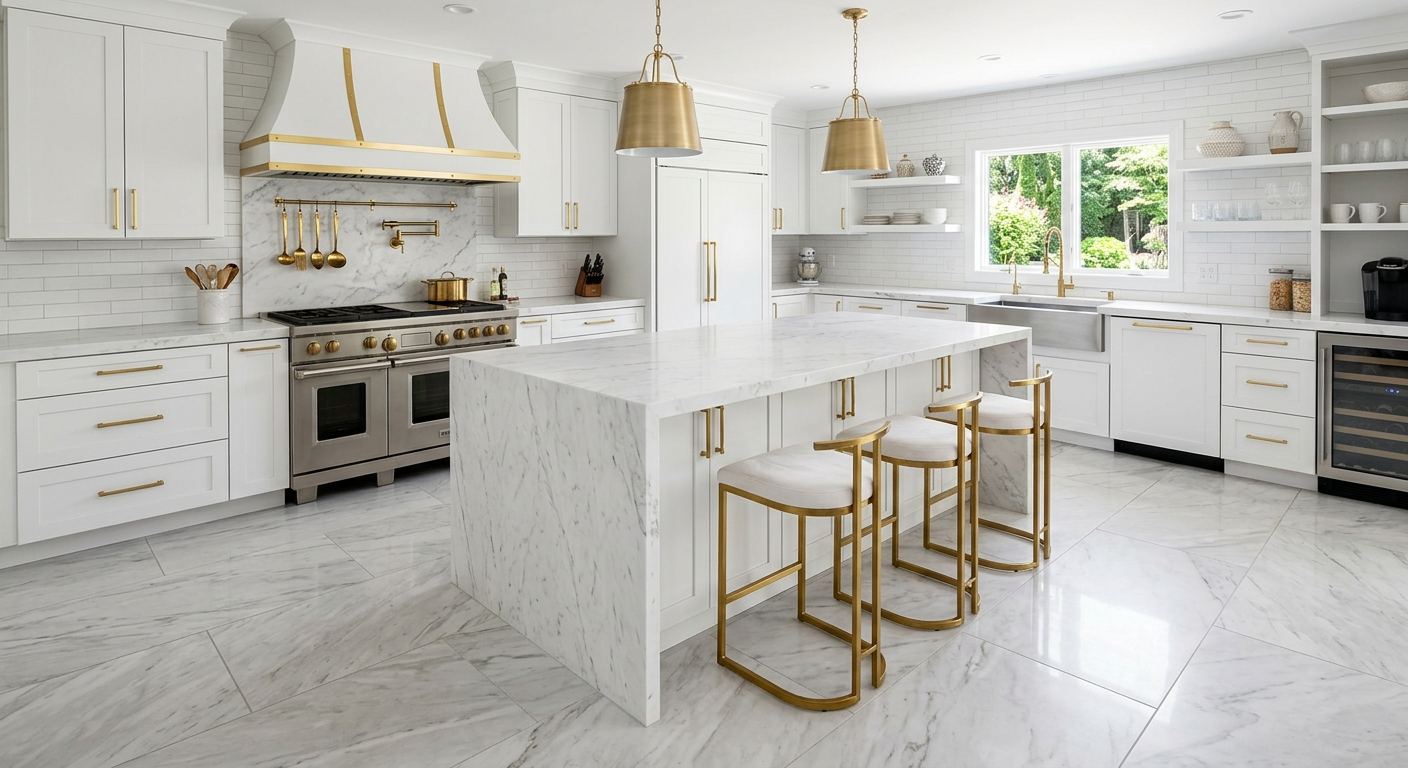
Kitchen renovation options and costs in Wellesley
Wellesley homeowners typically see kitchen-renovation decisions start with budget, not “trend.” With a median household income of $119,000 (Statistics Canada, 2021 Census), many families have the capacity to target a mid-range update with quartz counters and upgraded lighting, while still keeping resale expectations aligned with the Kitchener–Waterloo–Barrie market. Wellesley also has an older housing base—44.1% of homes were built before 1981 (Statistics Canada, 2021 Census)—so it’s common to budget for electrical refreshes, aging shut-offs, and floor-to-wall alignment issues before you ever pick a cabinet colour.
In the Kitchener–Waterloo–Barrie economic region, pricing is driven more by finish tier and contractor availability than by climate alone. Even though we deal with wet winters and indoor humidity swings, kitchen costs track local home values and buyer expectations: in higher-value pockets around Waterloo, Kitchener, Guelph and parts of Barrie/Cambridge, customers often default to semi-custom or custom cabinetry and quartz or premium stone, which moves budgets into the mid- to upper bands. In more modest homes closer to stock/refresh projects, laminate and stock cabinetry keep total spend lower. Labour is also a factor—once plumbing, electrical, and tiling are included, labour often becomes 30–50% of the full project.
In Wellesley itself, trade demand is especially steady on the more established residential streets near the core, where older kitchens frequently need layout tweaks and venting coordination. From there, most homeowners choose between cosmetic refreshes, mid-range full renos, or full custom work—so the right next step is to compare typical cost tiers in the table below.
| Renovation Tier |
What's Included |
Typical Duration |
Price Range |
| Cosmetic refresh (paint, hardware, new appliances only) |
Cabinet paint or repaint, new pulls/hinges, appliance swap, touch-up caulking, basic countertop cleaning/seal (no new counters), optional minor lighting refresh |
1–2 weeks |
$6,000–$15,000 |
| Mid-range full renovation (new cabinets, counters, sink, tile) |
Stock or semi-custom cabinets, quartz or entry-level stone counters, sink and faucet, backsplash tile, flooring patching, disposal connection, updated under-cabinet lighting (typical), standard electrical/plumbing connections |
4–8 weeks |
$30,000–$65,000 |
| High-end full renovation (custom cabinets, stone counters, island) |
Custom millwork or premium semi-custom cabinets, premium quartz/granite/stone counters, island buildout (structure + finishes), upgraded lighting plan (often additional circuits), full backsplash treatment, coordinated plumbing/gas relocation if needed |
8–14 weeks |
$65,000–$90,000 |
| Cabinet refacing only (new doors + drawer fronts, same boxes) |
Door/drawer replacement, new hardware, new crown/trim details, veneer or surface upgrade, labour to prepare and align panels, reuse existing box footprint |
2–5 weeks |
$8,000–$22,000 |
| Countertop swap only (laminate to quartz or stone) |
Remove laminate/old surface, template and install new quartz/stone, seam placement to fit existing layout, sink and faucet re-install (or replacement as specified) |
1–3 weeks |
$3,000–$12,000 |
| Backsplash tile installation only |
Tile supply and install (ceramic or similar), prep and waterproofing where required, grout/seal, trim at edges, allow for outlet cut-ins |
3–7 days |
$1,500–$8,000 |
Prices are estimates only and vary by project scope, site access and material selection.
What affects the price of kitchen renovation in Wellesley
Even when homeowners in Wellesley ask for the “same kitchen,” quotes can land 30–50% apart across the Kitchener–Waterloo–Barrie region and Ontario because labour complexity, finish tier, and hidden conditions change how contractors price risk. Cabinets are the anchor cost (often roughly 30–35% of the budget), but the real swings usually come from what’s happening behind the scenes: older plumbing or wiring, walls that aren’t square, and the amount of layout change you’re asking for. In the Kitchener–Waterloo–Barrie market, local home values and a median household income of $119,000 (Statistics Canada, 2021 Census) push many buyers toward quartz or stone and semi-custom cabinetry, because the investment is more easily recovered when the home is listed. In more modest markets, laminate and stock cabinetry dominate since ROI is more about affordability than premium upgrades.
Layout decisions are the biggest unpredictable variable regardless of finish. Removing a wall, adding an island, or moving a gas line/plumbing run changes framing, venting/ducting coordination, and electrical routing—so you may see a simple cabinet-and-counter job move from the $30,000–$65,000 band toward the $65,000–$90,000 range once trades stack up. Housing age also matters: with 44.1% of Wellesley homes built before 1981 (Statistics Canada, 2021 Census), it’s common to encounter dated subfloors and older breaker panels that trigger additional labour for safe electrical tie-ins before new under-cabinet lighting or island outlets can be installed.
Two concrete Wellesley examples I see often: (1) a “countertop swap only” becomes $8,000+ when the sink opening needs reshaping and the faucet footprint doesn’t match the new stone pattern, and (2) an “island add” can stay near the mid-range if it’s built on existing chase/utility locations, but it climbs quickly when we must move supply, drain, or gas.
| Price Factor |
Why It Matters |
Cost Impact |
| Cabinet tier — stock vs. semi-custom vs. fully custom millwork |
Higher-tier cabinetry costs more in materials, door/drawer customization, and shop/installation time |
- Stock: lower end of cabinet budgets
- Semi-custom: typical mid-range spend
- Fully custom: pushes projects toward high-end
|
| Countertop material — laminate vs. quartz vs. granite vs. stone |
Material price, edge complexity, and labour for templating/installation vary widely |
- Laminate: best value
- Quartz: mid-to-upper material + premium look
- Granite/stone: higher material and fabrication
|
| Layout change — wall removal, island add, plumbing/gas move |
Triggers structural framing, trades coordination, and additional inspections/approvals |
- Minimal change: stays nearer $30,000–$65,000
- Major change: often approaches $65,000–$90,000
|
| Appliance package tier — builder vs. mid-range vs. pro-grade |
Different cut-outs, voltage needs, and ventilation requirements affect labour and parts |
- Builder: lowest install complexity
- Mid-range: balanced value
- Pro-grade: higher cost and more venting/electrical coordination
|
| Flooring — refinish existing vs. full replacement |
If the subfloor is uneven or damaged, removal and re-laying adds labour and materials |
- Refinish: cheapest and fastest
- Replace: increases schedule and total budget
|
| Backsplash — ceramic tile vs. marble vs. full-height slab |
Slab work and high-surface-area detailing add fabrication, levelling, and sealing time |
- Ceramic: controlled budget
- Marble/slab: higher material and labour
|
| Electrical — new circuits for island, under-cabinet lighting |
More outlets, dedicated circuits, and lighting runs increase trade time and system changes |
- Simple swap: lower electrical spend
- New island + lighting: higher cost and longer lead times
|
| Permit fees and licensed trade requirements |
Permits and licensed work increase administrative steps, scheduling, and compliance costs |
- May add cost and timeline when required
- Usually required for plumbing/gas/electrical scope expansion
|
Permits & regulations in Ontario
In Ontario, a straight cabinet or countertop swap usually doesn’t require a building permit. Replacing cabinet doors/boxes (like refacing that doesn’t change plumbing or electrical), swapping a countertop, and installing a backsplash are typically permit-free. Where permits and licensed trades start is when the scope touches the home’s services or structure. Moving plumbing supply or drain lines, relocating gas (including the stove/range area and gas-connected components), removing a load-bearing wall, adding or moving electrical circuits, and any work that changes how the home is supported or serviced generally requires permits and inspections.
For Wellesley homeowners, the verification process should be practical. Step 1: confirm the contractor is properly licensed for the trades they’re claiming to do (or that they subcontract licensed trades). Step 2: request a certificate of insurance (liability) and make sure it’s current and includes kitchen renovation-type work. Step 3: obtain evidence of WSIB/WCB coverage for workers who will be on site—don’t accept “we don’t have employees” without documentation if the company is using labour. Step 4: check for clearance letters or proof of good standing when provided. Step 5: ask the contractor to specify in writing who pulls permits (and who pays permit fees), because it belongs in the contract—especially when your layout includes an island, new outlets, or any gas venting/line work.
If a contractor won’t clearly outline who is licensed, who is insured, and who is pulling permits for service moves, that’s a major scheduling and compliance risk.
Cabinets, countertops and layout decisions in Wellesley
Three decisions typically drive your Wellesley kitchen renovation more than anything else: (1) cabinet tier, (2) countertop material, and (3) whether you change the layout. Cabinet tier affects speed and budget immediately: stock cabinets are the fastest and cheapest; semi-custom is usually the best balance for Wellesley buyers (better storage options, more style choices); custom millwork is the highest cost but can fit odd angles and creates a “built-in” feel that reads premium on resale. For countertops, laminate can be a cost saver, quartz offers strong durability with low maintenance, and granite/stone bring a unique, natural look—while butcher block is warm and forgiving but needs disciplined sealing and care.
Layout changes are where you get true value—or true regret—depending on the space gain. An island addition can be justified when it improves work flow and adds seating/storage, but it becomes expensive if it requires plumbing/gas relocation or significant electrical changes for island outlets and lighting. In the Kitchener–Waterloo–Barrie market, buyers expect clean lines, modern hardware, and quartz or premium-looking counters at mid- to upper price points, so chasing “layout wow” without upgrading surfaces can sometimes backfire on perceived value.
Here’s a realistic money example: if you start with a mid-range full renovation budget around $30,000–$65,000, choosing quartz instead of laminate is often the difference between a “solid update” and a renovation that photographs like a higher-tier project. But adding an island that requires moving plumbing and electrical can push you into the $65,000–$90,000 range faster than most homeowners expect—especially in older homes (44.1% pre-1981). If your utility locations are already well placed, the cost jump can be modest; if not, the framing and trade coordination dominate the budget.
| Option |
Durability |
Maintenance |
Best For |
Price Range |
| Stock cabinets (big-box) |
Good everyday durability; standard finishes vary by brand |
Low maintenance; careful cleaning around seams |
Fast timelines, straightforward layouts, budget-focused renovations |
$8,000–$18,000 |
| Semi-custom cabinets (local dealer) |
Very durable; improved hardware and fit options |
Low to moderate; wipe spills promptly |
Most Wellesley renovations aiming for strong resale value and better storage |
$15,000–$28,000 |
| Custom cabinets (local millwork shop) |
Excellent fit and finish; best for unique spaces |
Low maintenance; built to last with quality hardware |
Irregular layouts, premium styling, “like-new” high-value upgrades |
$25,000–$45,000+ |
| Laminate countertop |
Decent resistance, but edges/seams are more vulnerable |
Easy daily cleaning; avoid prolonged water at seams |
Smaller budgets, rental-friendly value, quick refreshes |
$1,500–$4,500 |
| Quartz engineered countertop |
High durability; resists staining better than many surfaces |
Low maintenance; no sealing required for typical quartz |
Busy kitchens that need a premium look with practical care |
$4,500–$10,000 |
| Granite / natural stone countertop |
Very durable; natural variations add uniqueness |
Moderate maintenance; typically benefits from periodic sealing |
Homeowners wanting natural character and higher-tier aesthetics |
$6,500–$12,000 |
| Butcher block countertop |
Durable with proper care; can scratch and dent |
Higher care; regular oiling and quick cleaning |
Casual warmth, family kitchens, homeowners willing to maintain |
$3,500–$8,000 |
| Marble countertop |
Beautiful but softer; more susceptible to etching/stains |
Higher maintenance; requires disciplined cleaning and protection |
Design-forward kitchens where homeowners treat counters gently |
$7,500–$14,000 |
How to choose a kitchen renovation contractor in Wellesley
Choosing the right contractor in Wellesley comes down to proof and clarity—not sales pace. Start with Ontario licensing: ask which licensed trades are responsible for electrical, gas-related work, and any plumbing moves. How to check: look for the trade’s online registry entry (or provide a licence number they can match), and confirm the company name matches the job contract. Next, request liability insurance documentation (certificate of insurance) showing coverage limits appropriate for renovation work. For worker coverage, ask for WSIB/WCB clearance documentation—then read it. If the paperwork is outdated or missing, treat that as a red flag.
Get 2–3 itemised written quotes that separate labour and materials. You want line items for demolition, cabinet supply, cabinet install, countertop template/fabrication, plumbing/electrical components, tile, paint, and disposal. Avoid “lump sum only” quoting because it hides scope gaps like whether permits are included and whether old materials disposal is part of the package. Verify warranty details: workmanship warranty length (for example, cabinet installation/tile/grout), manufacturer product warranty, and whether warranties are transferable if you sell the home.
Payment schedule matters. Never sign up for large upfront payments—limit deposits to about 10–15% and keep a holdback until completion and punch-list items are done. Finally, insist on a written start date and a realistic completion estimate, including lead times for cabinets and countertops; stock cabinetry can turn faster, while custom or premium stone often drives schedule more than labour.
- Provide licence proof/number for the trades doing gas/electrical/plumbing work
- Share current liability insurance certificate before work starts
- Confirm WSIB/WCB clearance or equivalent worker coverage documentation
- Use an itemised quote with labour + materials breakdown (no vague allowances)
- Spell out what’s included: permits, inspections, protection of floors, and disposal
- List exclusions clearly (range/hood ducting, faucet/sink replacements, specialty tile cuts)
- Confirm countertop responsibility: template appointment, seam placement, edge profile
- Verify cabinet delivery timeline and what happens if items arrive late
- Write warranty terms: workmanship duration and product/manufacturer warranty details
- Use a staged payment schedule with a 10–15% upfront cap and completion holdback
- Include a written demolition-to-install sequence and access requirements (parking, permits for on-street work)
- Provide a signed contract that states permit responsibility and scope changes process
Red flags I see in Wellesley: “all permits included” but no detail of who pulls them; a quote that doesn’t separate labour from materials; refusing to provide insurance/WSIB documentation; asking for more than 20% upfront without a clear deposit schedule; and vague countertop language (“we install what you buy”) that doesn’t define template, seam layout, or warranty coverage.
Frequently asked questions — kitchen renovation in Wellesley
What's the best countertop material for a busy Wellesley kitchen?
For a busy Wellesley household, quartz is usually the best balance of durability and everyday practicality. It resists staining better than many surfaces, holds up well to regular cooking, and doesn’t need periodic sealing like granite or natural stone. If you’re aiming for a mid-range full renovation, quartz often helps you land in the typical $30,000–$65,000 band without the higher maintenance costs that come with some natural options. Wellesley’s kitchen airflow can shift seasonally (wet winters and indoor heating), so surfaces that don’t require routine sealing tend to be easier to keep looking “new.” If you want natural character, granite can work great too—just plan for sealing and more careful cleaning.
How do I add an island to my Wellesley kitchen?
Adding an island in Wellesley usually starts with checking whether your existing plumbing, gas (if applicable), and electrical routes can support the island. If you keep the island near existing utility chases, costs can stay more predictable. If you need to add new circuits for island outlets/lighting, or move plumbing/drain lines, the job shifts from a “finish renovation” to a multi-trade buildout, which commonly pushes budgets toward the higher end—often nearer the $65,000–$90,000 range for full renovations. In older homes (many pre-1981), subfloor and framing conditions can also affect how easily the island base is built and leveled. Plan for detailed layout drawings and ask your contractor what services are moving before you pick finishes.
How much does a kitchen renovation cost in Wellesley?
Kitchen renovation costs in Wellesley typically follow the broader Kitchener–Waterloo–Barrie pricing bands driven by finish tier and scope. A cosmetic refresh (paint, hardware, new appliances only) often starts around $6,000–$15,000. A mid-range full renovation—new cabinets and counters, plus a sink and tile—commonly lands in the $30,000–$65,000 range. If you want custom cabinetry, premium stone, and an island with service coordination, budgets often move into the $65,000–$90,000 band. It’s common for cabinet supply/installation to be the biggest line item (roughly 30–35% of the budget), with countertops around 10–15%, and labour rising as plumbing/electrical/finishing trades stack up. The fastest way to tighten your number is itemised quoting and clear decisions early on cabinet tier and countertop material.
How long does a kitchen renovation take in Wellesley?
Timelines in Wellesley depend on whether you’re doing a refresh, a full renovation, or changes that require trade coordination. Cosmetic updates usually take about 1–2 weeks. Mid-range full renovations typically take around 4–8 weeks, assuming cabinet and countertop lead times align and utilities don’t require major changes. High-end projects with custom millwork and island builds often take 8–14 weeks because of shop fabrication time and additional trade sequencing (electrical, plumbing, and detailed finishing). Older homes built before 1981 can add a few days for leveling, electrical catch-up, or access repairs. Ask your contractor to provide a written start date, completion estimate, and a realistic lead-time plan for cabinets and stone so you can plan around family schedules.
Quartz vs granite countertops — which is better?
“Better” depends on how you live with your counters. Quartz is often the better everyday choice for busy Wellesley kitchens: it’s durable, consistent in appearance, and generally requires less routine care than natural stone. Granite is extremely hard and beautiful, but it’s a natural product that may need periodic sealing and can vary visually from slab to slab. If you want low-maintenance performance to support frequent cooking, quartz usually fits best within the quartz-driven mid-tier budgets (often seen in countertop installation ranges like $4,500–$10,000). If you love natural movement and don’t mind a bit more maintenance, granite can be worth the trade-off, especially in renovations aiming for premium aesthetics. Either way, insist on correct templating and seam planning so you don’t get surprises after installation.
Should I reface or replace my cabinets?
If your cabinet boxes are still solid, refacing can be the best value—especially when you want a major visual upgrade without the demolition dust and schedule of a full replacement. Refacing is also often a good fit for layouts that are already working well (no need to relocate plumbing/electrical). Replace is usually the better option when boxes are sagging, water-damaged, or when you want a new internal configuration (like deeper drawers, specialty storage, or significant size changes). In practice, many homeowners in Wellesley choose refacing to sit around the $8,000–$22,000 range, then invest any savings into upgraded counters or lighting. The key is an honest assessment: if the boxes are compromised, “saving money” with refacing can lead to failure points later and reduce the overall resale appeal.