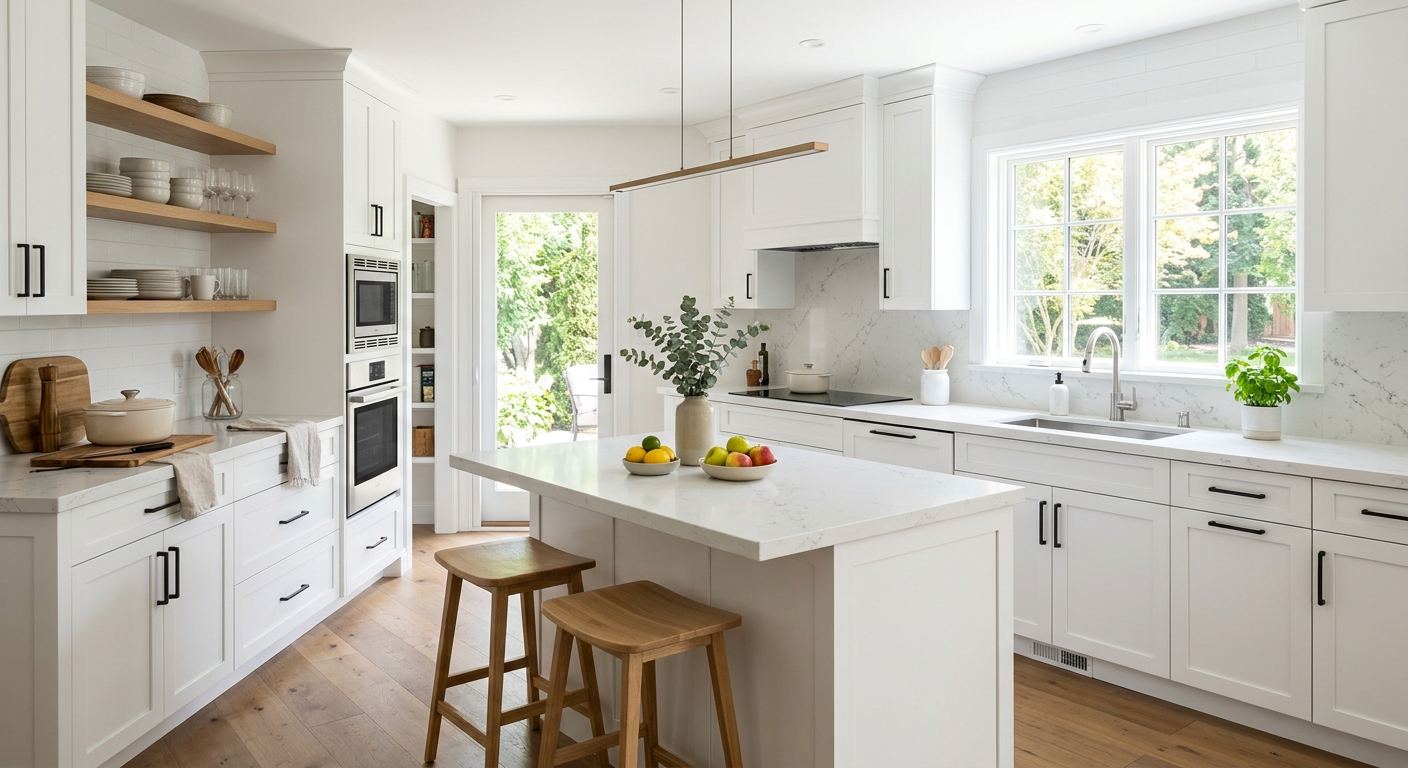
Kitchen renovation options and costs in Popcorn House
Kitchen renovation in Popcorn House is less about “weatherproofing” and more about what Toronto buyers will pay for the finished look. With a population of 7,889 (Statistics Canada, 2021 Census), Popcorn House homeowners are often renovating to match the resale expectations of the surrounding Toronto housing market—where better finishes and smoother workflows sell. In the Toronto economic region, finish choices frequently track local household spending power: higher-value pockets tend to push homeowners toward quartz or natural stone and more bespoke cabinetry, while more price-sensitive areas lean on stock or refaced cabinets with laminate or value quartz. That’s why two “same size kitchen” quotes can land far apart even when the demolition and carpentry crew costs are similar.
In the GTA, costs are shaped more by market pricing and contractor availability than by climate extremes. Ontario’s freeze–thaw cycles and seasonal humidity swings can still affect wood products, caulking, and countertop installation details—especially around sinks and exterior-facing walls—but those effects usually show up as installation care and longer curing/settling time, not as major budget inflation by themselves. Where jobs get busier is in older, higher-occupancy neighbourhood pockets around Etobicoke/central Toronto style housing stock, because homeowners often want updates that photograph well and hold up to frequent use.
Below is a practical way to compare renovation tiers in Popcorn House, so you can map your design decisions to a realistic budget before you request quotes.
| Renovation Tier |
What's Included |
Typical Duration |
Price Range |
| Cosmetic refresh (paint, hardware, new appliances only) |
Cabinet paint/colour refresh, hardware swaps, new fridge/range/dishwasher, minor caulk/trim, basic cleaning/deep detail |
1–2 weeks |
$8,000–$20,000 |
| Mid-range full renovation (new cabinets, counters, sink, tile) |
Semi-custom or quality stock cabinets, countertop install, new sink & faucet, backsplash tile, flooring refresh where needed, electrical tweaks |
3–6 weeks |
$25,000–$60,000 |
| High-end full renovation (custom cabinets, stone counters, island) |
Custom millwork, premium quartz or natural stone, island build, upgraded appliance package, full backsplash, enhanced lighting plan |
6–12 weeks |
$70,000–$90,000+ |
| Cabinet refacing only (new doors + drawer fronts, same boxes) |
Reface materials, new doors/drawers/trim, update hardware, adjust hinges/soft-close where applicable |
1–3 weeks |
$8,000–$35,000 |
| Countertop swap only (laminate to quartz or stone) |
Remove old counters, install new material, reconnect sink/cooktop where applicable, basic sealing and finishing |
2–5 days |
$3,000–$15,000 |
| Backsplash tile installation only |
Surface prep, tile supply/installation, grout, trim/edge finishing, allow for outlets |
3–7 days |
$2,000–$10,000 |
Prices are estimates only and vary by project scope, site access and material selection.
What affects the price of kitchen renovation in Popcorn House
In Toronto and across Ontario, quotes for the same kitchen can vary by 30–50% because “kitchen renovation” isn’t one standardized product—it’s a bundle of trades, finish tiers, and risk decisions. The biggest driver isn’t the calendar weather; it’s how much of your budget goes into cabinetry and countertops, plus how complicated your layout and services become. In higher-value Toronto pockets, homeowners often budget like they’re protecting resale value, commonly allocating enough to justify quartz or stone and semi-custom cabinetry—sometimes aligning to an overall project plan in the mid-range to high-end bands such as $25,000–$60,000 or $70,000–$90,000+. In more price-sensitive areas, stock cabinets and laminate or budget-friendly quartz keep totals closer to the low–mid range.
Two concrete Popcorn House examples that shift cost fast: (1) older home service locations—if the supply shutoff or shutoff routing is awkward, plumbing “small moves” turn into added labour and wall patching; that can push you from countertop-focused work into a mid-range renovation allowance. (2) floor-to-wall unevenness—seasonal humidity and settling can leave cabinets out of square, which increases labour for shimming, custom trim returns, and longer install time. Even when material choice stays the same, these on-site realities can add hours or require rework.
Layout changes are the most unpredictable cost regardless of finish tier. Removing a wall, adding an island, or moving a gas line or vent location typically changes the scope more than selecting between laminate and quartz. If you’re planning a service shift, it’s often more cost-effective to pair it with the cabinet and countertop upgrades you already want—so you don’t pay to open walls twice.
| Price Factor |
Why It Matters |
Cost Impact |
| Cabinet tier — stock vs. semi-custom vs. fully custom millwork |
Different lead times, tolerances, and build quality change labour, material usage, and adjustment time |
Low to high; custom often moves a project into high-end totals |
| Countertop material — laminate vs. quartz vs. granite vs. stone |
Material cost, edge profiles, and fabrication complexity drive both price and installation time |
Low (laminate) to high (stone); also affects sink/cooktop cutout difficulty |
| Layout change — wall removal, island add, plumbing/gas move |
Opening walls, modifying structure, and rerouting services multiply trade coordination needs |
Often the largest swing factor; can add significant contingency to any tier |
| Appliance package tier — builder vs. mid-range vs. pro-grade |
Measurements, electrical requirements, and ventilation specs vary across tiers |
Moderate; can become high if ventilation and rough-ins must change |
| Flooring — refinish existing vs. full replacement |
Kitchen renovations can reveal subfloor damage; replacing spreads cost beyond the cabinet area |
Low to moderate; full replacement typically adds cost and schedule time |
| Backsplash — ceramic tile vs. marble vs. full-height slab |
Premium materials increase labour for precision cuts, sealing, and alignment |
Moderate; can move “tile-only” work from budget to premium |
| Electrical — new circuits for island, under-cabinet lighting |
More fixtures and new circuits require licensed work and coordination with cabinetry |
Low to moderate; can escalate when moving outlet locations |
| Permit fees and licensed trade requirements |
Work that affects plumbing, gas, structure, or electrical circuits triggers permit/inspection and scheduling |
Usually moderate per project; impacts timeline and contractor availability |
Permits & regulations in Ontario
In Ontario, many “like-for-like” finish swaps don’t require permits. Typically, cabinet and countertop swaps alone do not need a permit—if you’re not changing the location of plumbing, venting, gas lines, load-bearing structure, or electrical circuits. For example, replacing countertops (even with quartz), installing a new backsplash, swapping cabinet doors/sections, or exchanging fixtures in the same spot are usually treated as renovation finish work.
Where permits do come into play is when you change services or structure. Moving plumbing supply or drain lines, relocating a gas stove connection or changing a gas range/hood vent setup, removing a load-bearing wall, and adding new electrical circuits (like powering an island receptacle or running new dedicated lighting circuits) generally require permits and the corresponding licensed trades. Gas work must be completed by a licensed gas fitter, and electrical work must be completed by a licensed electrician—both typically require inspections.
To verify before work starts in Popcorn House, ask for three things in writing: (1) the contractor’s licence information (where applicable), (2) proof of liability insurance and (3) proof of WSIB/WCB coverage (or valid exemption if they’re structured that way). You can also confirm coverage by checking their certificate of insurance for project wording and limits, and request a clearance letter for WSIB/WCB where required. Finally, confirm who is pulling permits—responsibility belongs in the contract, not in a handshake.
Cabinets, countertops and layout decisions in Popcorn House
Your three most consequential decisions in a Popcorn House kitchen renovation are: cabinet tier, countertop material, and whether to change layout. In Toronto’s resale market, buyers expect clean lines, durable surfaces, and updated hardware and lighting—so choosing the right “tier” for your budget usually matters more than chasing one expensive item while compromising the rest.
First, cabinets: stock gets you the fastest lead time and lowest cost; semi-custom is the most popular mid-range because it balances fit with upgrades like soft-close drawers; custom millwork is best when you need exact sizing around older walls, awkward alcoves, or a layout that needs built-in solutions. Second, countertops: laminate is budget-friendly and holds up for daily use, but it’s more sensitive to heat and can be less forgiving if you’re rough on the surface. Quartz gives a strong middle ground—consistent look, strong stain resistance, and a lower maintenance routine than many natural stones. Granite/natural stone adds character and heat resistance but needs sealing as recommended by the stone supplier. Butcher block can be beautiful in Ontario homes, yet it demands regular oiling and careful care during humidity swings around sink areas.
Third, layout: an open-concept wall removal or an island addition can be justified when it improves traffic flow and seating—especially in homes where the kitchen feels cut off or cramped. However, if you’re moving plumbing/gas/electrical, the cost risk increases regardless of countertop choice. As a practical example, upgrading from laminate to quartz might fit inside a $3,000–$15,000 countertop installation band, while adding an island plus service adjustments can push a full kitchen plan toward the $25,000–$60,000 range or higher—so it’s worth confirming layout changes early to avoid paying for repeated demolition.
| Option |
Durability |
Maintenance |
Best For |
Price Range |
| Stock cabinets (big-box) |
Good everyday durability; limited custom fit |
Standard cleaning; relies on proper leveling at install |
Fast timelines and cost-controlled refreshes |
$8,000–$25,000 |
| Semi-custom cabinets (local dealer) |
Excellent daily durability; better fit and options |
Standard cleaning; soft-close options reduce wear |
Most Popcorn House homeowners aiming for strong resale appeal |
$20,000–$45,000 |
| Custom cabinets (local millwork shop) |
Highest build tolerances; best for awkward spaces |
Standard cleaning; tailored hardware and finishes |
Complex layouts, built-ins, and premium style cohesion |
$40,000–$70,000+ |
| Laminate countertop |
Moderate; avoid heat and impact at seams |
Wipe clean; watch edges around sink for moisture |
Budget-focused renovations |
$3,000–$7,000 |
| Quartz engineered countertop |
High; great resistance to stains and everyday wear |
Wipe clean; minimal sealing needs |
Balanced value in Toronto resale markets |
$7,000–$15,000 |
| Granite / natural stone countertop |
High; strong resistance to heat and scratches |
Periodic sealing; careful maintenance around edges |
Owners wanting natural variation and premium curb appeal |
$9,000–$18,000 |
| Butcher block countertop |
Moderate to high with proper care; can dent |
Frequent oiling and gentle cleaning habits required |
Warm, farmhouse-style kitchens and light cooking routines |
$4,000–$10,000 |
| Marble countertop |
Moderate; more prone to etching/staining than quartz |
Higher upkeep; requires protection and prompt spill cleanup |
Statement kitchens with careful usage |
$10,000–$20,000+ |
How to choose a kitchen renovation contractor in Popcorn House
Choosing a kitchen renovation contractor in Ontario is mostly about proving they can handle licensed work safely and deliver trades that coordinate smoothly. Start with licensing and coverage. For electrical and gas-related scopes, confirm the work will be performed by the appropriate licensed trades (ask who holds the licence and request proof). For general contractor coverage, request a current certificate of liability insurance and verify it lists the project address and includes adequate limits for renovations. For WSIB/WCB, ask for clearance/coverage proof (or exemption documentation where applicable) and ensure it’s current—this protects you if a worker is injured on site.
Next, get 2–3 itemised written quotes—labour and materials broken out line-by-line, not a single lump sum. Scope clarity prevents budget surprises in a kitchen where you might uncover subfloor damage or outdated electrical behind a wall. Read the quote carefully for exclusions: permit pull included or not, disposal/dump fees, countertop removal and protection, appliance disconnect/reconnect responsibilities, and who pays if tolerances require additional labour at install. Warranty terms matter too: ask for the workmanship warranty length and whether product warranties are direct from the manufacturer and whether they transfer to you.
Payment should follow good risk management. Never pay more than 10–15% upfront; use a schedule that ties payments to milestones (demo complete, framing/cabinet build verified, countertops installed, final punch complete). Also get a start date and completion estimate in writing—kitchens often run into schedule delays if ordering and site protection aren’t planned.
- Confirm the contractor’s insurance certificate is current and matches the project address.
- Ask for WSIB/WCB clearance or proof of coverage before any work begins.
- Request licence details for any gas or electrical scope and confirm inspections responsibility.
- Get 2–3 itemised quotes with labour and material breakdowns (not just a total).
- Verify what’s included: demolition, debris removal, disposal/dump fees.
- Check whether permits (if needed) are pulled by the contractor or by you.
- Confirm appliance disconnect/reconnect and any required electrical rough-in scope.
- Review countertop and cabinet tolerances—who pays if measurements are off.
- Ask about lead times for cabinets/stone and how schedule changes are handled.
- Get workmanship warranty details in writing (and what voids it).
- Use a payment schedule with milestone-based payments and a final holdback.
- Require a written start date and a realistic completion target.
Concrete red flags to watch for in Popcorn House: vague “all-in” pricing with no scope line items, refusing to provide proof of liability insurance or WSIB/WCB coverage, promising a start date without addressing material lead times, leaving permits as an afterthought when plumbing/gas/electrical changes are involved, and asking for large upfront deposits beyond 10–15% without tying progress to milestones.
Frequently asked questions — kitchen renovation in Popcorn House
How much does a kitchen renovation cost in Popcorn House?
In Popcorn House, a typical full kitchen renovation commonly lands anywhere from $25,000–$90,000, depending mostly on cabinet tier, countertop choice, and whether you’re changing layout or moving plumbing/gas/electrical. If you’re doing a cosmetic refresh, you might keep it lower with paint, hardware, and appliance swaps, but most homeowners looking for a true “new kitchen” budget for the mid-range band around $25,000–$60,000. In higher-value Toronto-style finish expectations, custom cabinetry and stone counters can push totals into the $70,000–$90,000+ territory. Popcorn House’s housing stock also matters—older homes can reveal subfloor or wiring surprises, which is why reputable contractors include clear allowances and contingencies.
How long does a kitchen renovation take in Popcorn House?
Timelines in Ontario depend on scope and material lead times more than weather. Cosmetic refresh projects are often 1–2 weeks because cabinets may not be rebuilt and there’s less trade coordination. A mid-range full renovation usually runs about 3–6 weeks when cabinets and countertops are ready on schedule. High-end builds with custom millwork and premium stone often stretch to 6–12 weeks. The biggest scheduling risk comes from layout changes that require permit/inspection windows for electrical or plumbing/gas moves. Ask your contractor for a start date, a target completion date, and a written plan for cabinet/stone ordering—so you’re not waiting mid-job when walls are open.
Quartz vs granite countertops — which is better?
Quartz is often the better “low-maintenance performance” choice for most Popcorn House homeowners. It resists staining and doesn’t usually require the same sealing routine as natural stone. Granite/natural stone offers unique variation and strong heat resistance, but it typically needs periodic sealing and careful maintenance around groutlines and edges, especially near sinks. In a resale-focused Toronto market, both can look premium; the practical difference is lifestyle: if you want consistent appearance and easier upkeep, quartz is a strong match. If you want natural character and you’re willing to follow maintenance steps, granite is excellent. Cost-wise, either can land within the common countertop installation band of $3,000–$15,000 for many projects, with premium stone often pushing toward the upper end.
Should I reface or replace my cabinets?
Refacing is usually the right move when your cabinet boxes are structurally sound—no sagging, swelling from moisture, or major damage—and you mainly want a new door/drawer style. It’s often faster and can be significantly cheaper than full replacement, with typical cabinet refacing budgets around $8,000–$35,000. Full replacement makes more sense when boxes are uneven, poorly laid out, or you want major changes like moving cabinet widths, relocating pull-outs, or correcting a layout problem. In Popcorn House/area renovations, many homeowners choose refacing to capture the “updated look” while keeping the plumbing and electrical footprint stable, reducing permit-driven schedule risks.
Do I need a permit for a kitchen renovation in Ontario?
Often, like-for-like cabinet and countertop swaps do not require permits in Ontario. However, permits are typically required when you change the layout in ways that affect regulated systems—moving plumbing supply or drain lines, relocating gas connections (including stove setups), removing a load-bearing wall, or adding new electrical circuits. Gas work must be done by a licensed gas fitter and electrical by a licensed electrician, with inspections tied to that work. Before you sign anything, confirm in the written contract who is responsible for pulling permits and arranging inspections. For your own verification in Popcorn House, ask to see proof of licence and insurance for relevant trades, and request a copy of the permit plan where applicable.
What's the ROI on a kitchen renovation?
ROI depends on the finish tier you choose and whether the renovation aligns with what Toronto-area buyers expect. In higher-value pockets of the Toronto economic region, homeowners commonly invest more of their property value into the kitchen—often around 8–15%—because buyers are more willing to pay for upgraded cabinetry and premium countertops. In more price-sensitive areas, ROI tends to be stronger when you balance updates with affordability: semi-custom or refaced cabinets plus quartz or good laminate, and selective layout changes rather than full structural work. The safest strategy for Popcorn House is to spend where it shows on day one—cabinet fronts/door style, durable countertops, lighting, and a clean backsplash—while keeping risky service moves (plumbing/gas relocation) tightly scoped. Your contractor should help you choose finishes that fit within realistic project bands such as $25,000–$60,000 or $70,000–$90,000+.