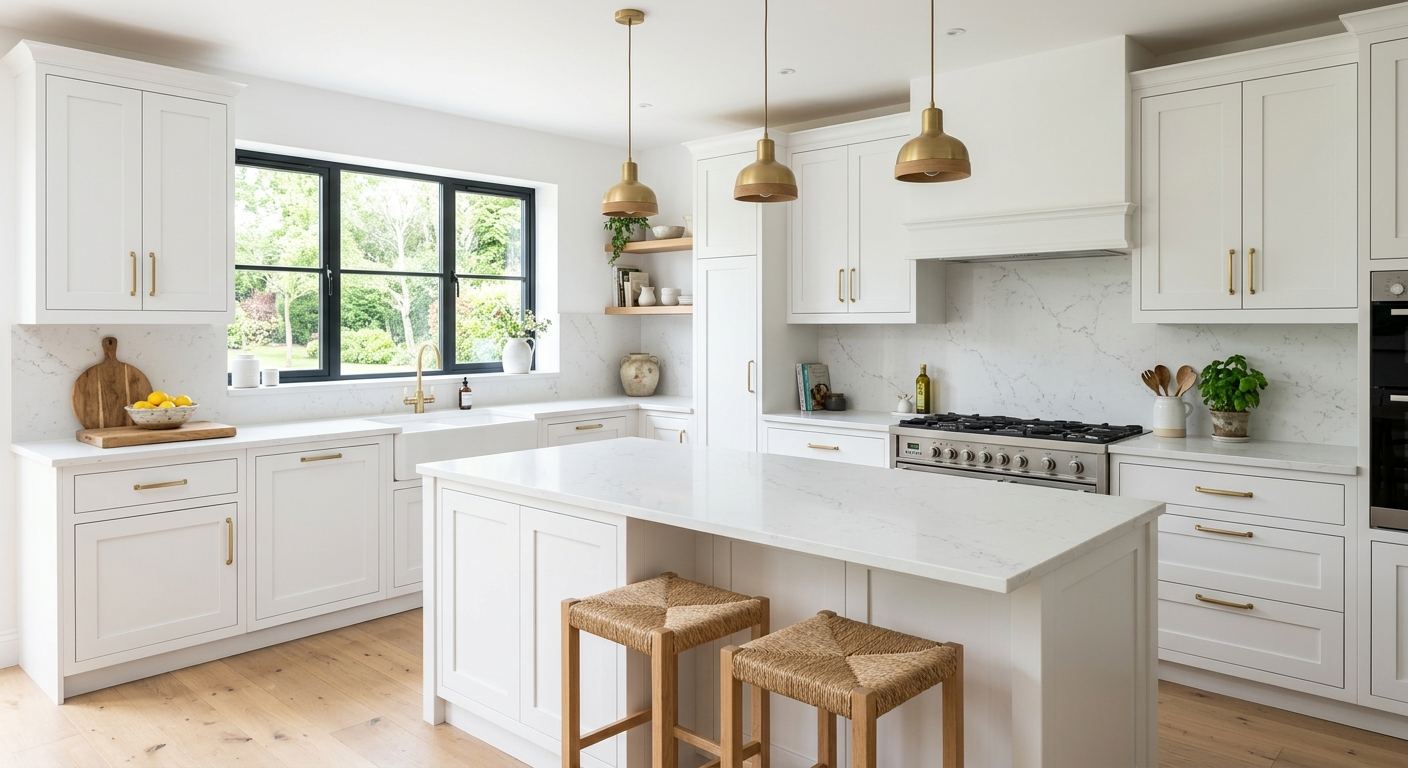
Kitchen renovation options and costs in Collingwood
Collingwood homeowners typically start their kitchen project with one of three goals: refreshing finishes, upgrading materials, or changing the way the kitchen functions. With a population of 24,811 and median household income of $82,000 (Statistics Canada, 2021 Census), many households in town target a renovation that looks “current” without over-capitalizing. That’s why you’ll see a lot of mid-range projects combining semi-custom cabinetry with quartz counters—especially in neighbourhoods where older homes are common and buyers still want modern storage and lighting. Collingwood’s housing stock skews older: 39.8% of homes were built before 1981 (Statistics Canada, 2021 Census), which often means dated plumbing/electrical, uneven floor levels, and cabinet layouts that were designed for smaller appliance footprints.
In the broader Kitchener–Waterloo–Barrie economic region, kitchen budgets largely follow household incomes and local home values—finish expectations rise with resale confidence. Climate matters, but less than many people think: Collingwood’s seasonal humidity swings and freeze–thaw weather don’t usually change labour rates the way market demand does; they mainly affect installation details like sealing, caulking, and how carefully floors are prepped before new cabinetry is set. Trade availability is also a factor. When contractors are busy with larger renovations across Barrie and the south Georgian Bay corridor, appointment wait times and labour quotes can climb.
One area where we commonly see strong demand is the Collingwood “South End” near the commercial core—older detached homes there often get renovated to attract family buyers with more functional storage and brighter workspaces. From that starting point, it’s easier to compare options side-by-side, so here are the typical tiers most Collingwood homeowners budget for.
| Renovation Tier |
What's Included |
Typical Duration |
Price Range |
| Cosmetic refresh (paint, hardware, new appliances only) |
Paint and prep, new pulls/knobs, backsplash touch-up (if applicable), appliance swap (range, fridge, dishwasher), basic caulking and trim adjustments |
3–7 days |
$3,500–$9,000 |
| Mid-range full renovation (new cabinets, counters, sink, tile) |
Semi-custom or high-quality stock cabinets, countertop (quartz or laminate), new undermount sink + faucet, backsplash tile, new or refreshed lighting fixtures, standard plumbing reconnects |
3–6 weeks |
$30,000–$65,000 |
| High-end full renovation (custom cabinets, stone counters, island) |
Custom cabinetry, premium stone (quartz “designer” slabs or natural stone), island with upgraded lighting, full-height backsplash options, upgraded electrical for under-cabinet and island circuits, more layout work |
6–12 weeks |
$65,000–$95,000 |
| Cabinet refacing only (new doors + drawer fronts, same boxes) |
New doors/drawer fronts, new hardware, optional lighting upgrades, sanding/finishing where needed, countertop may be preserved if in good condition |
1–3 weeks |
$6,000–$22,000 |
| Countertop swap only (laminate to quartz or stone) |
Remove existing laminate, install quartz/stone, new sink cut-out as required, faucet re-seal, backsplash depends on scope (often minimal) |
3–10 days |
$4,500–$14,000 |
| Backsplash tile installation only |
Prep and install tile backsplash, caulking and grout sealing, minor outlet fit adjustments, optional extended backsplash (e.g., up to uppers or full-height) |
2–5 days |
$1,500–$8,000 |
Prices are estimates only and vary by project scope, site access and material selection.
What affects the price of kitchen renovation in Collingwood
In Collingwood, you can see quote differences of 30–50% for what looks like the “same kitchen” because contractors price uncertainty: how much demolition reveals, how complex the trade work becomes, and what finish level the household expects for resale. Across the Kitchener–Waterloo–Barrie economic region, local home values and household income influence the typical finish tier far more than climate conditions. In higher-value areas, homeowners often default to quartz or stone counters and semi-custom cabinetry because the upgrade is easier to recoup when the kitchen is marketed to family buyers. In more modest areas, budgets more often align with stock cabinets, selective refacing, and laminate or entry-level quartz to control total spend.
Layout changes are the biggest cost wildcard regardless of finish. Removing a wall, adding an island, or moving a gas line (or even just relocating a stove and hood) tends to drive labour and permit effort higher than swapping cabinet doors. For example, an island addition commonly shifts budgets toward the $30,000–$65,000 mid-range band when it’s “light” (no major drain/gas relocation), while a full rework of plumbing and electrical can push the project toward the $65,000–$95,000 high-end band even if the cabinet line isn’t the most expensive.
In Collingwood, two practical conditions raise costs more than people expect. First, homes built before 1981 are more likely to have older shutoffs, undersized supply runs, and outdated wiring—fixes can add days before cabinets go in. Second, older floors and uneven subfloors can require extra levelling before installation, especially for large-format tile and countertop support. If site access is tight (common in established detached neighbourhoods), demolition and haul-away can also add labour time, which affects overall pricing.
| Price Factor |
Why It Matters |
Cost Impact |
| Cabinet tier — stock vs. semi-custom vs. fully custom millwork |
Higher tiers offer better storage planning, better finishes, and more options for drawers, panels, and specialty units |
Often shifts the full renovation by roughly 20–40% (largest line item, frequently ~30–35% of budget) |
| Countertop material — laminate vs. quartz vs. granite vs. stone |
Material price and fabrication complexity change installation time and cut quality requirements |
Commonly adds or subtracts thousands; countertop install typically $1,500–$12,000 depending on material and sink edges |
| Layout change — wall removal, island add, plumbing/gas move |
Structural, mechanical, and permitting work increases uncertainty and sequencing complexity |
Can swing a project by 10–30% even before you upgrade finishes |
| Appliance package tier — builder vs. mid-range vs. pro-grade |
Ventilation requirements, trim kits, and electrical specs differ by model |
Appliance choices can add $2,000–$10,000+ but also trigger extra electrical/venting work |
| Flooring — refinish existing vs. full replacement |
Cable/underlayment adjustments and floor leveling influence cabinet base setting and tile transitions |
Often adds $3,000–$12,000 depending on whether floors are replaced and how level they are |
| Backsplash — ceramic tile vs. marble vs. full-height slab |
Higher-end stone needs better substrate prep, sealing, and more careful templating |
Can range from $1,500–$8,000 for tile installation alone |
| Electrical — new circuits for island, under-cabinet lighting |
Adding circuits for receptacles/lighting requires a licensed electrician and careful load planning |
Often adds several hundred to a few thousand; larger changes can be more |
| Permit fees and licensed trade requirements |
Permits and inspections impact scheduling and require licensed professionals for specific scopes |
Typically modest in direct fees, but labour/time impacts can add meaningful cost |
Permits & regulations in Ontario
In Ontario, straightforward cabinet and countertop swaps generally do not require permits. If you’re keeping the plumbing in the same locations and replacing cabinets/counters only, most projects proceed without municipal permits. However, permits and licensed trades are required when you change the systems—not just the finishes. Specifically, moving plumbing supply or drain lines, relocating a gas stove or any gas-fired appliance, removing a load-bearing wall, or adding new electrical circuits can trigger permit requirements and inspections.
Step one for Collingwood homeowners: confirm scope boundaries with your contractor in writing. Step two: verify the trades. Gas work must be performed by a licensed gas fitter, and electrical work must be done by a licensed electrician—both require inspections when permits apply. Step three: ask for proof of compliance and documentation. Before work starts, request (and keep a copy of) the contractor’s liability insurance certificate and WSIB/WCB clearance letter (where applicable), plus the permit number/inspection plan if your scope includes any of the “systems” items.
To verify licences in Ontario, you can check the relevant provincial licence registries for the business/trades involved, and you can cross-reference their certificate details with the job scope. Always ensure the contract clearly states who pulls permits, who pays the fees, and who schedules inspections. That’s where many budget surprises are prevented.
Cabinets, countertops and layout decisions in Collingwood
The three most consequential decisions in a Collingwood kitchen renovation are cabinet tier, countertop material, and whether you change the layout. First, cabinet tier: stock cabinets are the fastest and cheapest path, but storage planning is more limited. Semi-custom (often the sweet spot locally) gives better drawer and pantry options while keeping timelines manageable. Custom cabinetry costs more, but it shines when you have odd wall lengths, specific appliance needs, or you want a built-in island and pantry system that fits your space perfectly.
Second, countertop material. Laminate is budget-friendly and durable for normal household use, but it’s less ideal for heavy heat exposure and it can show wear at seams over time. Quartz is usually the best balance of appearance and low maintenance; it resists staining and doesn’t require sealing like natural stone. Granite and other natural stones offer unique patterns and a premium look, but they typically involve more sealing and care. Butcher block can be stunning and warmer for family kitchens, but it needs regular oiling and mindful cleaning—important in homes with busy winter cooking routines and frequent wet-mop cleanups.
Third, layout changes. Opening up with a wall removal or adding an island can justify the cost when it improves flow and increases usable counter space. In older homes (39.8% built before 1981 in Collingwood area, Statistics Canada, 2021 Census), the hidden issue is often not the layout itself—it’s the plumbing/gas/electrical behind it. For a concrete example: upgrading from laminate to quartz alone might be a few thousand dollars, but moving a sink from one exterior wall to another can require cutting floors, rerouting drains, and rework that pushes the project toward the mid- to upper-range budgets.
In the Kitchener–Waterloo–Barrie resale market, buyers tend to expect bright under-cabinet lighting, clean cabinet lines, and a durable countertop finish—so align your spending where it shows most daily: drawers, lighting, and the work surface.
| Option |
Durability |
Maintenance |
Best For |
Price Range |
| Stock cabinets (big-box) |
Good everyday durability; hinges/finishes vary by line |
Low routine care; limited scope for specialty storage |
Value-focused renovations with minimal design changes |
$6,000–$14,000 |
| Semi-custom cabinets (local dealer) |
Very good durability with better drawer options and finishing control |
Low to moderate; depends on hardware and finish |
Most Collingwood mid-range projects seeking better storage and fit |
$14,000–$30,000 |
| Custom cabinets (local millwork shop) |
Excellent durability; tailored construction and joinery |
Low; longer-term care depends on finish |
Odd layouts, built-ins, and high-end island/pantry systems |
$25,000–$55,000 |
| Laminate countertop |
Decent durability for daily use; sensitive to burns at edges and heavy heat |
Wipe clean; avoid prolonged moisture at seams |
Budget renovations or rentals where aesthetics matter most |
$1,500–$4,500 |
| Quartz engineered countertop |
Highly durable; great stain and scratch resistance for active households |
Low maintenance; no sealing required |
Busy kitchens needing a clean, modern look with minimal upkeep |
$3,500–$10,000 |
| Granite / natural stone countertop |
Very durable with natural heat tolerance; varies by stone type |
Periodic sealing and careful cleaning |
Premium look buyers who want natural variation |
$5,000–$12,000 |
| Butcher block countertop |
Durable for chopping; can scar—repairable with sanding/oiling |
Requires regular oiling and immediate wipe-downs |
Family kitchens that want warmth and a more lived-in finish |
$2,500–$7,500 |
| Marble countertop |
Premium but softer; can etch or stain more easily than quartz |
Higher maintenance; needs protection and careful cleaning |
Low-traffic showpiece kitchens or higher-end styling choices |
$7,000–$14,000 |
How to choose a kitchen renovation contractor in Collingwood
Choosing the right contractor in Collingwood is mostly about verifying proof and aligning expectations before demolition. Start with Ontario licensing and coverage: ask for the contractor’s liability insurance certificate and evidence of WSIB/WCB coverage (or clearance documentation where applicable). For trades, confirm the specific licensed roles for your scope—gas work must be done by a licensed gas fitter, and electrical by a licensed electrician. How to check: request certificates during the quote stage, look for matching business/trade names, and verify the licence status through Ontario’s online licence registries for the relevant trade/contractor.
Next, get 2–3 itemised written quotes, not lump sums. A proper kitchen quote breaks down labour and materials (cabinets, counter supply/fabrication, tile/backsplash, plumbing/electrical allowances, disposal, and any drywall/patching). Read the scope line by line: what’s excluded (framing corrections, subfloor leveling, permit fees, dust control), who pulls permits if required, and what exactly is included for disposal. Also review warranty terms: workmanship warranty length, product/manufacturer warranty details, and whether the warranty transfers if you sell the home.
Payment schedule matters. Never pay more than 10–15% upfront; hold back a portion until key milestones are complete (often cabinet installation and final finish). Insist on a clear start date and an estimated completion timeline in writing, including a process for change orders.
- Confirm their Ontario business details and the name on the insurance matches their legal entity.
- Verify WSIB/WCB clearance documentation before work begins.
- For any gas/electrical/plumbing changes, ensure only licensed trades touch the systems.
- Get an itemised quote separating labour vs. materials and allowances.
- Ask who supplies and installs cabinets, counters, and tile—no assumptions.
- Clarify whether disposal and jobsite cleanup are included.
- Confirm permit responsibility and inspection scheduling for any “systems” changes.
- Review the warranty: workmanship length, what it covers, and exclusions.
- Make sure the contract includes a change-order process and pricing method.
- Require an explicit start date and a milestone-based schedule.
- Check for evidence of recent similar kitchens in the Collingwood area (photos + references).
- Ask who handles missing parts backorders and how timeline impacts are communicated.
Red flags we commonly see in Collingwood: contractors who won’t provide itemised labour/materials quotes, who refuse to discuss permits and licensed trade responsibilities, who ask for large deposits up front, who provide only a vague timeline (“a few weeks”), or who don’t give a written warranty and change-order terms.
Frequently asked questions — kitchen renovation in Collingwood
Should I renovate my kitchen before selling in Collingwood?
In most Collingwood home sales, a kitchen refresh that improves cleanliness, lighting, and storage can help show the home at its best—but timing and budget matter. With median household income around $82,000 (Statistics Canada, 2021 Census), many buyers in town still respond strongly to practical upgrades rather than “every feature possible.” If your cabinets are structurally sound, consider a refacing or a mid-range full renovation approach that keeps you in the $30,000–$65,000 range. If you’re contemplating a full custom kitchen, be cautious: it can land in the $65,000–$95,000 band, which may not be fully recovered depending on buyer expectations. Also, older homes (39.8% built before 1981, Statistics Canada, 2021 Census) may require plumbing/electrical fixes—if you leave these until after buyers move in, you can lose momentum and negotiation leverage.
What's the most popular kitchen style in Collingwood right now?
Right now, the most requested look in Collingwood is clean-lined, contemporary transitional: shaker-style cabinet fronts (often matte or satin finishes), brighter colour temperatures in lighting, and simple hardware. Many homeowners choose semi-custom cabinets because it’s the best match between modern storage and cost control. Countertops are typically quartz for the easy maintenance, with quartz-like colours (warm whites, light greys, and nature-inspired patterns) doing well in family homes. We also see a continued preference for functional islands and open work zones, but that depends on the house layout. In older Collingwood dwellings, open-concept changes can involve permit triggers and licensed trade work, so the style trend usually appears first through finishes—then, if needed, through layout upgrades.
How do I know if I need to update my kitchen plumbing in Collingwood?
Look for red flags during inspection: slow drains, recurring under-sink leaks, water staining around supply lines, or inconsistent hot water temperature at the sink. In Collingwood, the housing stock is older on average (39.8% of homes built before 1981, Statistics Canada, 2021 Census), so it’s common to find dated shutoffs, older drain assemblies, and fittings that aren’t aligned with newer faucet and dishwasher connections. Plumbing may also need updates when you change the sink location, replace a garbage disposal, or add a dishwasher with different drainage requirements. If your quote stays at a simple cabinet/counter swap level, plumbing updates might not be included—ask your contractor for a contingency allowance. When you do need a reroute, the added cost can move your budget beyond a countertop-only plan and into a broader renovation scope.
What is the difference between a galley and open-concept kitchen?
A galley kitchen is a narrow, corridor-style layout where counters run along parallel walls. It’s efficient for cooking but can feel closed off, and it often makes island additions difficult without major reconfiguration. An open-concept kitchen combines the cooking area with a living/dining space, which can improve sightlines and social flow—often a priority in family homes. However, in Ontario (including Collingwood), opening up can trigger permitting when you remove a load-bearing wall, and it can require coordination across electrical and HVAC before the remodel proceeds. That’s why some homeowners keep their budget in the mid-range by upgrading cabinets and countertops while leaving the layout intact, rather than expanding into a renovation tier that includes wall removal and system relocation.
How do I get accurate kitchen renovation quotes in Collingwood?
Accurate quotes start with scope clarity and good documentation. Provide your contractor with kitchen measurements, photos, and your preferred finish tier (stock vs. semi-custom vs. custom) and countertop material (laminate, quartz, or natural stone). Get 2–3 itemised quotes that separate labour and materials—especially allowances for electrical, plumbing reconnects, backsplash, and disposal. Ask explicitly: are permits included, who pulls them, and what work requires licensed trades in your plan? In Collingwood, many price swings come from older home conditions—uneven floors, outdated wiring, or hidden supply/drain issues—so request an allowance for discovery or a pre-demolition walk-through. If you’re targeting a typical mid-range renovation budget, ask whether the quote lands in the $30,000–$65,000 band or the broader $65,000–$95,000 range based on actual layout changes.
What's the best countertop material for a busy Collingwood kitchen?
For most busy Collingwood households, quartz is the best all-round choice: it resists stains and daily scuffs, doesn’t require sealing, and typically holds up well to the winter baking rhythm and frequent cleanups. If you want the lowest initial cost, laminate can work for a refresh, but it’s more sensitive around seams and to heat exposure—so it’s usually a better fit when you’re keeping to a shorter scope. Natural stone (granite or other stone) gives premium look and durability, but it often needs more care like periodic sealing, and marble can etch or stain more readily. Price-wise, quartz countertop installations commonly fall within the $3,500–$10,000 range depending on thickness, edges, and cut complexity, while higher-end natural stone typically trends higher. Your best option also depends on whether you’re changing the sink cut-outs and backsplash plan at the same time.