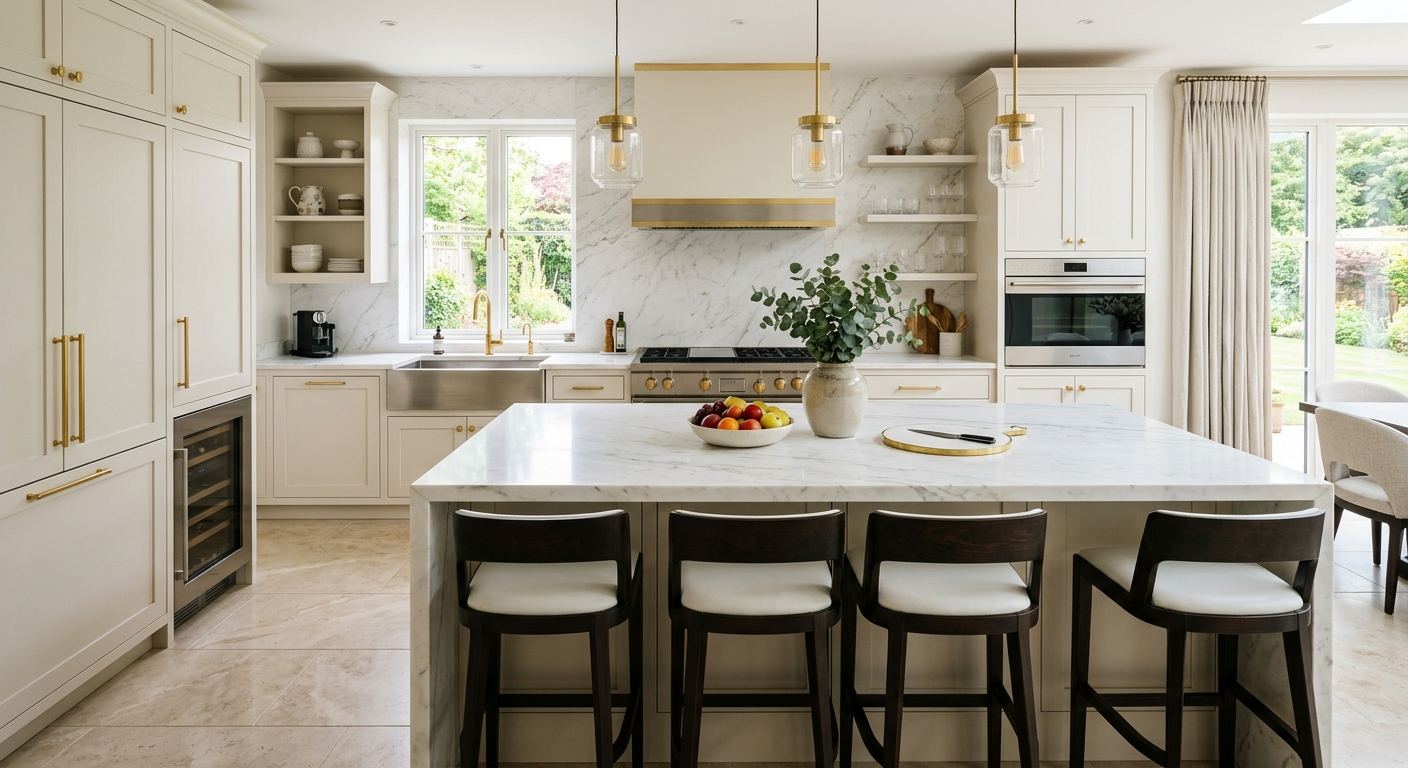
Kitchen renovation options and costs in Kitchener
Kitchener homeowners renovating their kitchens usually feel the budget pressure first in cabinetry and finishes. With a median household income of about $87,000 (Statistics Canada, 2021 Census), many projects land in the practical “mid-range” zone—new cabinetry and upgraded surfaces—rather than trying to match the top-end custom homes all at once. You’re also working in a housing mix where 48.6% of homes were built before 1981 (Statistics Canada, 2021 Census). That older stock often means more original rough-ins, different cabinet depths, and sometimes tricky venting or wiring paths, which affects labour and material waste.
In the Kitchener–Waterloo–Barrie economic region, renovation budgets track local home values and buyer expectations much more than climate alone. The Greater Kitchener area has a lot of homeowners planning renovations for resale; in higher-value neighbourhoods, people tend to choose quartz or premium stone and semi-custom cabinetry because it’s easier to justify on resale. Contractor availability also plays a role: peak-season schedules (late spring through early fall) can tighten lead times for install crews and stone templating, pushing some projects toward “phased” decisions to keep timelines realistic.
Demand is especially strong around family-oriented neighbourhoods with lots of pre-2000 housing stock—Waterloo Avenue/Bridgeport area and parts of Huron Village—where renovations are common and cabinet measurements must be adapted to older room layouts. With those local realities in mind, here’s how common options typically price out so you can compare quotes apples-to-apples.
| Renovation Tier |
What's Included |
Typical Duration |
Price Range |
| Cosmetic refresh (paint, hardware, new appliances only) |
Paint, new cabinet hardware, appliance swap (no plumbing/electrical relocation), basic clean-up and reinstallation |
3–7 days |
$6,000–$18,000 |
| Mid-range full renovation (new cabinets, counters, sink, tile) |
New semi-custom or upgraded stock cabinets, quartz or laminate counters, sink and faucet, backsplash tile, updated lighting (no major layout changes) |
2–4 weeks |
$30,000–$70,000 |
| High-end full renovation (custom cabinets, stone counters, island) |
Fully custom cabinetry, stone counters (granite/engineered stone premium), island (often with electrical), upgraded backsplash, sink + faucet upgrade, detailed finishing |
4–8 weeks |
$60,000–$110,000 |
| Cabinet refacing only (new doors + drawer fronts, same boxes) |
Door/drawer front replacement, hardware, matching refinishing or laminate overlay, simple cabinet repainting where applicable |
1–2 weeks |
$6,000–$25,000 |
| Countertop swap only (laminate to quartz or stone) |
Remove existing counters, templating, install new quartz/stone, basic sink cut-out adjustments (no plumbing relocation) |
4–10 days |
$3,500–$18,000 |
| Backsplash tile installation only |
Tile supply and install (backsplash area only), surface prep, grout and sealing where required, caulking at edges |
2–5 days |
$1,500–$8,000 |
Prices are estimates only and vary by project scope, site access and material selection.
What affects the price of kitchen renovation in Kitchener
In Kitchener–Waterloo–Barrie, it’s common to see the same “kitchen renovation” quoted 30–50% apart. The biggest driver isn’t climate—it’s how your cabinet and countertop choices line up with local buyer expectations and the province’s labour-and-material market. Kitchener’s median household income is about $87,000 (Statistics Canada, 2021 Census), which influences how often homeowners choose semi-custom cabinetry and quartz rather than sticking to entry-level surfaces. In higher-value neighbourhoods, homeowners frequently budget for quartz or stone and semi-custom millwork because those materials hold up and tend to be easier to recover when selling.
Layout changes are the cost wildcard regardless of finish. Removing a wall for an open-concept look, adding an island, or moving a gas line or plumbing run typically requires extra labour, trade coordination and sometimes permit steps—so the quote can swing hard even when cabinets and countertops are the same tier. As for the role of home age: with 48.6% of homes built before 1981 (Statistics Canada, 2021 Census), older framing and rough openings can require more labour to make everything line up cleanly, and that often shows up as cabinet-shim time, patching, and longer install windows.
Concrete examples from local projects: (1) a like-for-like cabinet replacement with laminate counters may sit in the lower end of a full renovation budget (for example, mid-range projects around $30,000–$70,000), while (2) adding an island and running electrical plus new under-cabinet lighting frequently pushes the project toward the upper mid-range. Another common swing: upgrading from laminate to quartz can move a countertop-only portion from roughly the lower countertop band to the upper end, and once you’re already doing templating, many homeowners choose to upgrade—because mobilization costs don’t drop just because the material price does.
| Price Factor |
Why It Matters |
Cost Impact |
| Cabinet tier — stock vs. semi-custom vs. fully custom millwork |
Determines material quality, door styles, storage options (soft-close, pull-outs), tolerances and fit |
$8,000–$45,000 |
| Countertop material — laminate vs. quartz vs. granite vs. stone |
Material cost, thickness/edge profiles, and templating complexity affect total installed price |
$1,500–$12,000 |
| Layout change — wall removal, island add, plumbing/gas move |
Increases trades coordination, repair drywall work, and possible permit steps |
$5,000–$25,000 |
| Appliance package tier — builder vs. mid-range vs. pro-grade |
Drastically affects unit pricing and sometimes venting/clearance requirements |
$1,500–$12,000 |
| Flooring — refinish existing vs. full replacement |
Old subfloors, transitions, and matching finishes can add labour and materials |
$1,000–$8,000 |
| Backsplash — ceramic tile vs. marble vs. full-height slab |
Installation time and substrate prep rise with format size and stone weight |
$1,500–$8,000 |
| Electrical — new circuits for island, under-cabinet lighting |
New circuits drive licensed electrical work, inspection and material costs |
$800–$6,000 |
| Permit fees and licensed trade requirements |
Moving plumbing/gas, removing load-bearing walls, or adding electrical often triggers permits |
$300–$4,000 |
Permits & regulations in Ontario
In Ontario, not every kitchen change requires a permit, but several common “upgrade” moves do. Cabinet and countertop swaps typically do not require permits by themselves. That includes replacing doors/fronts, repainting cabinets, installing a new sink where plumbing stays in the same location, and swapping counter materials where the base plumbing and gas connections aren’t being relocated.
Work that usually does require permits and licensed trades includes: moving plumbing supply or drain lines (for a new sink location or dishwasher relocation), relocating a gas stove or any gas-related components, and removing a load-bearing wall to open up the room. Adding electrical circuits—especially for an island with new receptacles, adding additional under-cabinet lighting that requires new wiring paths, or upgrading service capacity—typically involves permits and licensed electrical work. Gas work must be performed by a licensed gas fitter, and electrical work by a licensed electrician, with inspections required as applicable.
To verify properly in Kitchener, ask for: (1) the contractor’s Ontario licence/registration details (as required for their trade), (2) certificate of insurance showing liability coverage, and (3) confirmation of WSIB/WCB coverage (or equivalent clearance documentation where applicable). Request copies, then confirm dates and coverage limits. Finally, make sure the contract clearly states who pulls permits and who is responsible for inspection sign-off.
Cabinets, countertops and layout decisions in Kitchener
When you’re planning a kitchen renovation in Kitchener, the biggest wins usually come from three decisions: (1) cabinet tier, (2) countertop material, and (3) layout changes. These choices also affect resale appeal in the Kitchener–Waterloo–Barrie market, where buyers often look for durable surfaces, clean lines, and storage that fits modern cooking habits.
Cabinet tier: stock cabinets are the fastest path with the lowest cost, while semi-custom is the most popular mid-range route because it balances better storage and finishes with a predictable install schedule. Custom cabinets cost more but can be worth it when you have awkward dimensions, want ceiling-height storage, or need specialized organizers.
Countertops: laminate is budget-friendly and easy to replace, but quartz is the common upgrade because it resists stains and stands up to daily use with less hassle. Granite/natural stone offers variety and a premium look, while butcher block adds warmth but needs more maintenance to stay looking great. Marble is beautiful and high-end, but it’s more susceptible to etching and requires careful sealing habits.
Layout changes are where costs jump. If you remove a wall or add an island, you’re paying for the trades coordination and any rework of electrical, plumbing, or gas. That cost is justified when the space gain solves a functional problem—like creating clear circulation or better seating—rather than just making the kitchen “look bigger.” For example, moving from a mid-range kitchen budget around $30,000–$70,000 to an island-plus-upgrades scenario can push you toward the upper range because of electrical and potentially plumbing/gas adjustments, even if cabinet and countertop tiers stay similar.
| Option |
Durability |
Maintenance |
Best For |
Price Range |
| Stock cabinets (big-box) |
Good for everyday use; best when standard sizes fit your room |
Low—routine cleaning only |
Fast timelines and tighter budgets |
$8,000–$18,000 |
| Semi-custom cabinets (local dealer) |
Very solid build quality with better storage options |
Low—keep hinges aligned and clean surfaces |
Most Kitchener mid-range reno targets |
$15,000–$30,000 |
| Custom cabinets (local millwork shop) |
Highest fit and finish; ideal for irregular spaces |
Low—durable coatings and long service life |
Max storage, perfect layout fit, premium resale appeal |
$25,000–$60,000 |
| Laminate countertop |
Moderate; can chip or bubble if edges/seams fail |
Low to moderate—avoid hot pans and sharp impacts |
Budget-first projects and rental-friendly renovations |
$1,500–$4,500 |
| Quartz engineered countertop |
High; resists stains and daily wear well |
Low—typical wipe-down with mild cleaner |
Most popular upgrade for resale in Ontario |
$3,500–$10,500 |
| Granite / natural stone countertop |
High; durable but varies by slab and finish |
Moderate—periodic sealing and careful stain prevention |
Premium look without the “engineered” feel |
$6,000–$12,000 |
| Butcher block countertop |
Good with proper oiling; can scratch but repairable |
Moderate to high—regular oiling and protection |
Warm, traditional kitchens where you want function |
$3,000–$8,500 |
| Marble countertop |
High beauty, but softer surface than quartz |
Moderate—sealed, wipe spills quickly, avoid etching acids |
Showpiece kitchens and lower “hard use” households |
$7,000–$14,000 |
How to choose a kitchen renovation contractor in Kitchener
Start by verifying licensing and coverage, because kitchen renovations in Kitchener often involve multiple trades. Ask for: (1) proof of Ontario registration/licensing for each trade involved (or a clear statement of who is licensed for the specific work), (2) certificate of liability insurance with the dates and limits clearly shown, and (3) WSIB/WCB coverage confirmation or a clearance letter. Don’t accept “we’ll get it later”—request the documents before signing, and make sure the contractor’s name matches the documents.
For pricing, get 2–3 itemised written quotes. You want a labour + materials breakdown (cabinet supply, install, counter fabrication/templating, plumbing/electrical line items, demolition, drywall patching, disposal). Avoid quotes that only show a lump sum—those hide the decisions that drive cost later. Read the scope carefully: confirm what’s included for permit pulling (if needed), disposal, protection of floors/fixtures, and how they handle unexpected issues found behind older walls or cabinets.
Warranty matters too. Ask for workmanship warranty length and what it covers, plus manufacturer warranties on cabinets and countertops. Also confirm whether any warranties are transferable if you sell the home.
Payment schedule: never pay more than 10–15% upfront, and use milestone payments tied to completed stages. Hold back a portion until key wrap-up items are finished. For timeline, get the start date and an estimated completion window in writing, including lead-time assumptions for cabinets and stone.
- Ask which exact trades are doing the plumbing/gas/electrical and request their licence details.
- Verify liability insurance and request a fresh COI before work begins.
- Confirm WSIB/WCB coverage (or clearance letter) for each relevant trade.
- Get itemised pricing for cabinets, countertop templating/fabrication, installation, and finishing.
- Ensure the quote states disposal, drywall patching, and floor protection responsibilities.
- Confirm whether permits (when required) are pulled by the contractor or by you.
- Ask how changes are priced (change orders) and require written approval before extra work.
- Request proof of past kitchen renovations in the Kitchener area and references you can call.
- Review the warranty terms in writing: workmanship duration and what resets after repairs.
- Use a realistic payment schedule with a holdback until completion and punch-list sign-off.
- Get demolition-to-install sequencing in writing so you’re not left waiting on trades.
- Ask who coordinates inspections if your scope includes permitted plumbing/electrical/gas.
Concrete red flags I see in Kitchener: (1) quotes that won’t itemise labour vs materials, (2) “no permits needed” claims even when moving plumbing or gas, (3) refusal to provide insurance/WSIB/WCB proof, (4) very large upfront deposits beyond 15% without milestones, and (5) vague start dates with no cabinet/stone lead-time assumptions. If you hit any of these, pause and ask for clarity in writing.
Frequently asked questions — kitchen renovation in Kitchener
Can I live at home during a kitchen renovation in Kitchener?
Often yes, and many Kitchener homeowners do live at home during portions of the project, especially for cosmetic refreshes, cabinet swaps, and countertop-only work. For a full renovation, living on site is more comfortable when the crew can stage demolition in phases (for example, one side first) and you have a temporary cooking setup. If your scope includes moving plumbing or adding an island with new electrical, expect short periods where the kitchen isn’t fully usable, but those windows are usually manageable with an alternate sink/hot plate arrangement in a nearby room. If your home is older (many in Kitchener are), wall openings can take longer, so plan for brief dust-control barriers. Budgets for full renos typically start around $25,000–$90,000, and the smaller the scope, the easier it is to stay put.
Should I renovate my kitchen before selling in Kitchener?
In Kitchener, it usually helps to renovate before selling if the kitchen is visually dated or functionally limiting, but it should be targeted to what buyers here expect. With a median household income around $87,000 (Statistics Canada, 2021 Census), many buyers respond best to mid-range finishes: clean cabinetry, durable countertops, and updated lighting. In many neighbourhoods, quartz counters and semi-custom or upgraded stock cabinets are a safer “appeal-per-dollar” choice than making a high-end custom change if your home value range doesn’t support it. If your current layout is badly inefficient, a layout change can justify the cost more than upgrading materials alone. Practically, consider a project budget in the $30,000–$70,000 mid-range band for many homes; if you’re going high-end (often $60,000–$90,000+), make sure the rest of the home’s finishes can carry the premium. Your realtor can help align scope with resale expectations.
What's the most popular kitchen style in Kitchener right now?
Based on what we see in Kitchener and the broader Waterloo–Barrie market, the most popular direction is a modern, warm look: shaker-style or simple flat-panel cabinetry, light-to-medium tones, and quartz countertops with subtle veining. Many homeowners pair that with practical upgrades like soft-close hardware, pull-out pantry storage, and under-cabinet LED lighting—because they read as “clean and updated” to buyers. You’ll also notice that a lot of homes are renovated to match the existing architecture: in older homes built pre-1981, renovations often blend newer cabinetry with familiar room proportions, rather than going extremely stylized. Climate-wise, Kitchener homes deal with seasonal humidity changes, so surfaces that wipe easily and resist staining (like quartz) are popular. If you’re budgeting, these trends commonly fit the mid-range full renovation range of $30,000–$70,000.
How do I know if I need to update my kitchen plumbing in Kitchener?
You’ll usually need to update plumbing if you’re moving fixtures, if there are signs of failure, or if you’re dealing with older rough-ins. In Kitchener’s older housing stock (48.6% built before 1981, Statistics Canada, 2021 Census), supply shut-offs, drain alignment, and venting may not match today’s common installation methods. Red flags include persistent leaks under the sink, slow drainage, repeated disposal jams due to improper pitch, water hammer, corrosion at connections, or under-sink cabinets that smell musty after normal use. If you’re keeping the sink and dishwasher in the same locations, a simple swap may not require major changes, but when you relocate plumbing lines for a new sink or island, you should budget for pipe runs and licensed trade work. Because plumbing relocation can affect permits and trade scheduling, it’s one of the biggest quote variables regardless of countertop tier (even if you’re within $25,000–$90,000 full kitchen budgets).
What is the difference between a galley and open-concept kitchen?
A galley kitchen is a narrow layout with counters on two parallel walls, which often works well in smaller homes or where space is limited. It can be very efficient for cooking because everything is close together, but it limits dining space and social interaction. An open-concept kitchen removes or reduces barriers to connect the kitchen to living/dining areas, which can improve sightlines and make entertaining easier—especially for family life. In Kitchener, open-concept renovations are popular, but they can be costlier because removing a wall (particularly a load-bearing one) may involve permits, engineering/structural steps, and more dust-control planning. If you choose an island in an open-concept layout, it also often drives new electrical and sometimes plumbing/gas reroutes. Because these moves affect labour unpredictably, it’s common to see open-concept projects land in higher tiers within $30,000–$70,000 or even $60,000–$90,000+ depending on scope.
How do I get accurate kitchen renovation quotes in Kitchener?
To get accurate quotes in Kitchener, provide consistent scope details so contractors price the same job. Start by choosing a cabinet tier and countertop material (or at least a close target), then decide whether you’re changing layout: keep sink where it is, or move it? Add an island? Upgrade lighting and add under-cabinet LEDs? Moving plumbing supply/drain or gas (if applicable) and adding new electrical circuits usually affects permitting and licensed trade work. Ask for 2–3 itemised written quotes showing labour and materials separately, not just a total. Confirm what’s included: demolition, disposal, drywall patching, backsplash/tile scope, and whether permits are pulled by the contractor. Finally, request the schedule in writing (start date and estimated completion) and document warranty terms. Using a realistic budget band—like $25,000–$90,000 for a full kitchen—helps keep the comparison fair.