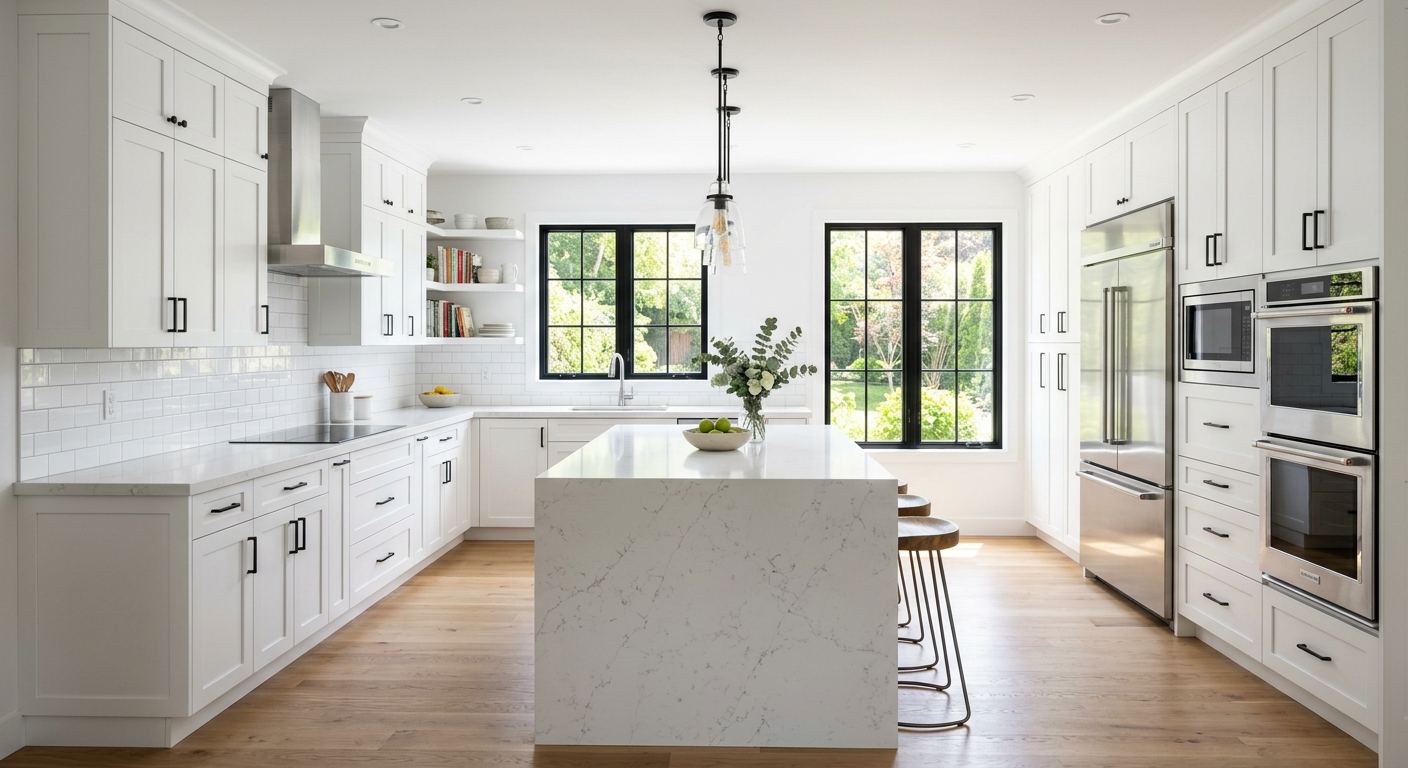
Kitchen renovation options and costs in Hamilton
Kitchen renovation in Hamilton is largely driven by what homeowners expect to see in their homes, resale goals, and the finish tier that fits the neighbourhood. In Hamilton, where homeowner households are the majority (93.9% of households own), many projects get scoped around long-term enjoyment rather than “just fixing up.” That’s also why median household income in the region can support mid- to high-tier materials—Hamilton’s median household income is listed at $106,000 (Statistics Canada, 2021 Census). In higher-value pockets like Stoney Creek and parts of Ancaster, you’ll often see owners choosing quartz or natural stone counters and semi-custom cabinetry because buyers notice material quality at showings.
Across the Muskoka–Kawarthas corridor, the climate and market dynamics affect practical costs, even when the kitchen footprint is similar. Seasonal humidity swings can be harder on poorly detailed tile lines and wood trim, so installers typically allocate more time to prep, waterproofing, and proper caulking around sinks and backsplash edges. Also, cottage- and lake-adjacent demand can tighten contractor schedules in peak months, and supply logistics can add small premiums when deliveries stack up. One more driver: the housing stock—54.6% of homes built before 1981—means older plumbing runs, uneven walls, and panelled soffits that often require extra labour to bring everything flat and square.
Below is a realistic comparison of common Hamilton kitchen scopes, with typical durations and price bands. Use this table to line up your quote with the right renovation tier before you start comparing contractor line-items.
| Renovation Tier |
What's Included |
Typical Duration |
Price Range |
| Cosmetic refresh (paint, hardware, new appliances only) |
Cabinet paint or new hardware, faucet swap, appliance-only change, minor trim touch-ups |
1–3 weeks |
$13,000–$20,000 |
| Mid-range full renovation (new cabinets, counters, sink, tile) |
New semi-custom or upgraded stock cabinets, quartz or laminate counters, sink, backsplash tile, basic lighting updates |
4–7 weeks |
$25,000–$55,000 |
| High-end full renovation (custom cabinets, stone counters, island) |
Fully custom millwork, stone or premium quartz counters, island build, upgraded appliance package, full backsplash, extensive electrical |
7–12 weeks |
$70,000–$110,000 |
| Cabinet refacing only (new doors + drawer fronts, same boxes) |
Replace doors/drawers, new mouldings, rework some hinges, re-finish exterior faces; counters typically left as-is |
2–4 weeks |
$8,000–$30,000 |
| Countertop swap only (laminate to quartz or stone) |
Remove existing top, new quartz/stone template + install, basic sink cut-outs (same sink type) |
1–2 weeks |
$3,000–$15,000 |
| Backsplash tile installation only |
Demo (light), waterproofing prep, tile supply/setting, grout/seal, final caulking at edges |
1–2 weeks |
$2,500–$12,000 |
Prices are estimates only and vary by project scope, site access and material selection.
What affects the price of kitchen renovation in Hamilton
Quotes for the same kitchen scope can vary by 30–50% across the Muskoka–Kawarthas region and Ontario because contractors price risk and complexity differently—not just materials. In practice, the biggest levers are the local “finish expectations” tied to home values and household income, plus how much your plan changes layout, services, and finishes. When homeowners in higher-value markets lean toward quartz or stone counters and semi-custom cabinetry, the renovation cost is often easier to justify on resale; in more modest-income areas, laminate and stock cabinets are more common to keep spend near the practical budget. In Hamilton specifically, with a median household income of $106,000 (Statistics Canada, 2021 Census), many renovations land in the mid-range full renovation band (often $25,000–$55,000) when families want meaningful upgrades but still need predictable scheduling and trade availability.
Climate is rarely the main driver, but Ontario’s freeze-thaw cycles and seasonal humidity can influence workmanship costs. For example, older Hamilton homes (54.6% built before 1981) frequently have out-of-square walls and older subfloors; that adds labour for shimming, patching, and prep before tile or cabinet installation. Also, when a kitchen includes a new island with more countertop seams or longer runs for plumbing, the template, sealing, and countertop support work increases—moving you closer to the $70,000–$110,000 tier for high-end full renovations.
Two practical examples from Hamilton: (1) a wall removal that reveals old knob-and-tube routes can add hours for safe disconnect planning and remediation before new drywall is installed; (2) moving a gas range or adding under-cabinet lighting usually tightens the schedule because electrician and gas fitter coordination becomes a critical path item. Those service moves can swing your quote more than changing from mid-grade to premium hardware.
| Price Factor |
Why It Matters |
Cost Impact |
| Cabinet tier — stock vs. semi-custom vs. fully custom millwork |
Pricing is driven by material thickness, soft-close mechanisms, door styles, and build time |
Commonly shifts the budget by $10,000–$35,000 on full renovations |
| Countertop material — laminate vs. quartz vs. granite vs. stone |
Material cost plus template/installation complexity (heavier tops need stronger substrate) |
Typical swing of $2,000–$12,000 depending on size and finish |
| Layout change — wall removal, island add, plumbing/gas move |
These require demolition, framing, re-routing services, and often additional inspections |
Can add $8,000–$25,000 even with similar cabinet tiers |
| Appliance package tier — builder vs. mid-range vs. pro-grade |
Pro-grade appliances can require different venting, trim kits, and stronger electrical |
Often changes spend by $3,000–$15,000 |
| Flooring — refinish existing vs. full replacement |
Prep time, subfloor correction, and new underlayment vary widely by existing condition |
Typical swing of $1,500–$8,000 |
| Backsplash — ceramic tile vs. marble vs. full-height slab |
Porous stone needs sealing; full-height surfaces require more waterproofing and material |
Commonly $2,500–$12,000 impact on total project cost |
| Electrical — new circuits for island, under-cabinet lighting |
Labour and permit-linked inspection scheduling can extend timelines |
Often $800–$5,000+ |
| Permit fees and licensed trade requirements |
Where permits apply, timelines and admin work increase even if the finish tier stays the same |
Can add $300–$2,500+ plus scheduling coordination |
Permits & regulations in Ontario
In Ontario, many kitchen upgrades do not require a permit—specifically, cabinet and countertop swaps that do not move plumbing, gas, or electrical work are typically treated as finishes. That includes replacing existing cabinets with similar layouts, swapping laminate to quartz, and installing a new backsplash where no electrical additions are required. However, permits and licensed trades usually come into play when you change a kitchen’s services or structure: moving plumbing supply or drain lines, relocating a gas stove/range, running new gas connections (including some hood setups with gas), removing or altering a load-bearing wall, and adding electrical circuits for an island, new receptacles, or major lighting upgrades.
For Hamilton homeowners, the safest approach is to verify the work scope before signing. Step one: ask your contractor to list every “permit-likely” item in writing (plumbing/gas/electrical/structural). Step two: confirm the licensed trade credentials for each scope—gas work must be completed by a licensed gas fitter, and electrical work by a licensed electrician, both subject to inspection requirements. Step three: request documentation: a current certificate of insurance naming you as an interested party where applicable, plus WSIB/WCB clearance or coverage proof from workers involved. Finally, verify who is responsible for pulling permits—your contract should explicitly state whether the contractor includes permit costs, booking inspections, and compliance paperwork. Always tie these responsibilities to the written scope, not a verbal assurance.
Cabinets, countertops and layout decisions in Hamilton
In a Hamilton kitchen renovation, the three decisions that most affect both your budget and your satisfaction are: (1) cabinet tier, (2) countertop material, and (3) whether you change layout. Cabinet tier is about fit and build speed. Stock cabinets (big-box) are fastest and cheapest, but options can be limited in corner solutions, heights, and door profiles. Semi-custom cabinets (a local dealer) usually hit the sweet spot: better storage and more flexibility in styles while still controlling labour time. Fully custom cabinets (local millwork shops) offer the best fit for older Hamilton homes with out-of-square walls and unusual dimensions, but the cost is the highest.
Countertops follow a similar logic. Laminate is budget-friendly and easy to replace later, but it’s less forgiving of heavy impact and can be more sensitive around seams. Quartz is the most popular upgrade because it’s durable, low-maintenance, and performs well in Ontario’s humidity swings when properly sealed at edges. Granite/natural stone looks premium and resists everyday wear, but it demands periodic sealing. Butcher block can add warmth and works well in family kitchens; maintenance is higher because it needs periodic oiling and careful moisture management. Marble looks upscale but is softer and requires extra care against etching.
Layout is the cost wildcard. Open-concept wall removal and adding an island can be justified when it improves traffic flow and resale appeal, but plumbing/gas relocation is where budgets jump unpredictably. For example, if your plan is mainly cosmetic and you keep existing plumbing, you can often stay in the mid-range $25,000–$55,000 band. If you move plumbing to an island and upgrade counters to high-end stone, it’s easier to drift toward the $70,000–$110,000 tier—especially in older homes built before 1981 where service runs may need more correction.
| Option |
Durability |
Maintenance |
Best For |
Price Range |
| Stock cabinets (big-box) |
Good daily durability; hinges and shelves depend on the specific line |
Low; keep hardware tightened and clean with non-abrasives |
Fast turnarounds, simple layouts, tighter budgets |
$8,000–$25,000 |
| Semi-custom cabinets (local dealer) |
High durability with upgrades to hardware and better door/box fit |
Low to moderate; occasional hardware adjustment |
Most Hamilton renovations aiming for better storage and style |
$20,000–$45,000 |
| Custom cabinets (local millwork shop) |
Excellent durability; built to your measurements and usage patterns |
Low; requires proper installation and sealing around moisture areas |
Challenging dimensions in older homes and unique storage needs |
$35,000–$75,000 |
| Laminate countertop |
Moderate durability; susceptible to chips and moisture at seams if poorly sealed |
Low day-to-day; avoid prolonged standing water at edges |
Budget-conscious refreshes where you keep layout simple |
$3,000–$7,000 |
| Quartz engineered countertop |
Very durable; resistant to staining and everyday wear |
Low; wipe clean, protect from extreme heat on seams and hot pads |
Ontario households wanting a “set and forget” upgrade |
$6,000–$14,000 |
| Granite / natural stone countertop |
High durability; natural hardness varies by stone type |
Moderate; requires periodic sealing and careful stain management |
Premium look with strong performance for busy families |
$8,000–$18,000 |
| Butcher block countertop |
Durable but can dent; depends on thickness and edge finish |
Moderate to high; oiling and moisture control needed, especially near sinks |
Warm, casual kitchens with attentive maintenance habits |
$5,000–$12,000 |
| Marble countertop |
Moderate; more prone to scratching and etching from acidic foods |
Higher; sealing and careful cleaning required |
Low-traffic showpiece areas and buyers who value premium aesthetics |
$10,000–$22,000 |
How to choose a kitchen renovation contractor in Hamilton
Choosing a Hamilton kitchen contractor is mostly about checking three things: licence/compliance, financial protection, and clarity of scope. First, verify Ontario licensing for the trades involved: a licensed electrician for electrical work and a licensed gas fitter for any gas-related changes. Ask for their licence numbers and check credentials through the appropriate Ontario online registries. Second, request proof of liability insurance and WSIB/WCB coverage—either clearance paperwork or documentation showing active coverage for the workers who will be on-site. Don’t accept a general “we’re insured” statement; ask to see certificates before work begins.
Next, insist on 2–3 itemised written quotes. You want a breakdown that separates labour and key materials (cabinet supply, countertop fabrication/install, tile labour, electrical/plumbing allowances) rather than a single lump sum. Read exclusions carefully: who handles permit pulls, disposal, protection of floors/counters, and any patching/drywall corrections after demo? Confirm the warranty: workmanship length (often different from product warranties), whether manufacturer warranties apply to what you’re buying, and if warranties are transferable if you sell the home. For payments, never go beyond about 10–15% upfront; hold back a portion until the job is complete and punch list items are resolved. Finally, get the timeline in writing with an estimated start date and completion window.
- Confirm which permits (if any) your scope requires and who pulls them.
- Verify liability insurance limits and request a certificate of insurance.
- Confirm WSIB/WCB clearance or active coverage for workers on-site.
- Require a detailed allowance list for cabinets, countertops, tile, and appliances.
- Ask whether demolition and disposal are included (and what “disposal” covers).
- Check for floor and door protection plans during demolition and cabinet installs.
- Review the contract for change-order process and pricing method.
- Ensure electrical/plumbing/gas work is itemised and scheduled as separate line items.
- Ask how they handle older-home issues (out-of-square walls, old wiring/plumbing).
- Verify countertop templating timing and who pays for remakes if measurement errors occur.
- Look for a written start date, milestones, and a realistic completion estimate.
- Confirm warranty terms for workmanship and whether product warranties transfer on sale.
Red flags I commonly see in Hamilton kitchen projects: contractors who won’t provide WSIB/WCB proof or insurance documentation; quotes that lump everything into one number with no line-item scope; missing details on permits/disposal/patching after demo; “too-good-to-be-true” pricing that suggests corners on cabinet installation or countertop support; and payment schedules that demand large upfront deposits (well beyond 10–15%) without a clear materials plan.
Frequently asked questions — kitchen renovation in Hamilton
Do I need a permit for a kitchen renovation in Ontario?
In Ontario, many kitchen renovations don’t require a permit—typically cabinet and countertop swaps that don’t change plumbing, gas, or electrical. If you’re only repainting, replacing hardware, swapping appliances, or installing backsplash without adding electrical circuits, permits are often not required. However, in Hamilton, permits usually become part of the job when you move plumbing supply/drain lines, relocate a gas stove, remove a load-bearing wall, or add electrical circuits (for example, extra receptacles for an island or new under-cabinet lighting runs). Gas work must be done by a licensed gas fitter, and electrical by a licensed electrician, with inspections as required. Before you sign, ask your contractor to list every work item that triggers permitting and spell out in writing who is responsible for pulling permits and booking inspections.
What's the ROI on a kitchen renovation?
ROI varies by scope, but in Hamilton you can think of ROI in two layers: resale appeal and everyday cost recovery through durability. A kitchen that looks dated (builder-grade counters, mismatched cabinet lines, poor lighting) can reduce buyer confidence, especially in owner-occupied neighbourhoods where many households plan to stay for years. For ROI planning, it’s more realistic to target kitchens in the mid-range renovation band (often around $25,000–$55,000) with quartz counters and a functional layout before paying for fully custom millwork. Premium stone and custom islands can raise perceived value, but ROI is highest when the changes are practical (better storage, lighting, and a layout that “works”). If you’re only doing cosmetic updates, expect less payback than a project with new cabinetry and counters—buyers notice real materials. Your best ROI usually comes from balancing finish tier with layout changes you truly need.
How do I budget for a kitchen renovation?
Budgeting in Hamilton starts with choosing the renovation tier and then building a “knowns and unknowns” allowance. Start by deciding whether you want a cosmetic refresh, a mid-range full renovation, or a high-end build. For example, many homeowners planning a complete refresh with new cabinets and counters end up around $25,000–$55,000, while high-end projects with stone counters and an island commonly move into $70,000–$110,000. Next, set aside contingency for older housing conditions—54.6% of Hamilton homes were built before 1981 (Statistics Canada, 2021 Census), and that can mean out-of-square walls, older service routes, or unexpected patching after demo. Finally, separate your budget into line items: cabinets (often the largest category), counters, tile/backsplash, labour, and any electrical/plumbing/gas work. A well-itemised quote reduces surprises, especially if you’re changing layout or adding new lighting.
Can I move my kitchen sink or stove?
Yes, you can move a kitchen sink or stove in Hamilton, but it’s one of the most cost-sensitive changes. Moving a sink typically means rerouting drain and water supply lines, plus careful venting considerations—this is often where permits and licensed plumbing work become mandatory. Moving a stove can involve electrical changes and, if it’s a gas range, relocating gas connections requires a licensed gas fitter and inspections. The labour and schedule impacts can be significant because contractors need to coordinate trades, protect surrounding finishes, and plan subfloor/cabinet modifications before drywall closes up. If you’re trying to control cost, the most economical approach is usually to keep plumbing “in the same zone” (same general location) and adjust cabinet framing around it. If you do move the sink or stove for layout reasons (like creating a functional island), plan for it to be a major budget swing regardless of whether you choose laminate or quartz.
What's the most cost-effective kitchen upgrade?
The most cost-effective upgrades are usually the ones that create visible impact without major demolition. In Hamilton kitchens, many homeowners get strong results by upgrading lighting (especially under-cabinet LED), adding a backsplash, and updating cabinet hardware—those changes are often far less disruptive than moving plumbing or changing floor layouts. If you want a “big visual shift” while staying predictable, a countertop swap can also be cost-effective—countertop installation alone often falls around $3,000–$15,000 depending on material and size. If your cabinets are structurally fine, cabinet refacing can be another economical path—commonly $8,000–$30,000—because you keep the boxes and only replace faces. That said, the biggest long-term satisfaction usually comes from pairing a countertop upgrade with functional improvements (like soft-close drawers and better storage), not just surface changes. If you’re aiming for a total renovation, mid-range scopes ($25,000–$55,000) can deliver better “value per day” than piecemeal work.
Custom vs stock cabinets — is custom worth it?
Custom cabinets can be worth it in Hamilton when your kitchen has challenging dimensions, older-home quirks, or you want a built-in solution that stock lines can’t match. Because 54.6% of homes in Hamilton were built before 1981 (Statistics Canada, 2021 Census), it’s common to encounter out-of-square walls, unusual ceiling heights, and older service lines that make “standard” layouts harder to execute cleanly. Semi-custom often delivers the best balance for many homeowners: more style and storage flexibility than stock, without the full cost of fully custom millwork. Stock cabinets are typically the most budget-friendly and fastest, but you may pay later through reduced storage or compromises around corners and appliance trim. If you’re considering a total project, remember that cabinetry and labour make up a large portion of cost, so moving from semi-custom to fully custom can push you toward the high-end renovation band (often $70,000–$110,000). In most cases, custom is worth it only when fit and function are your priority—not just aesthetics.