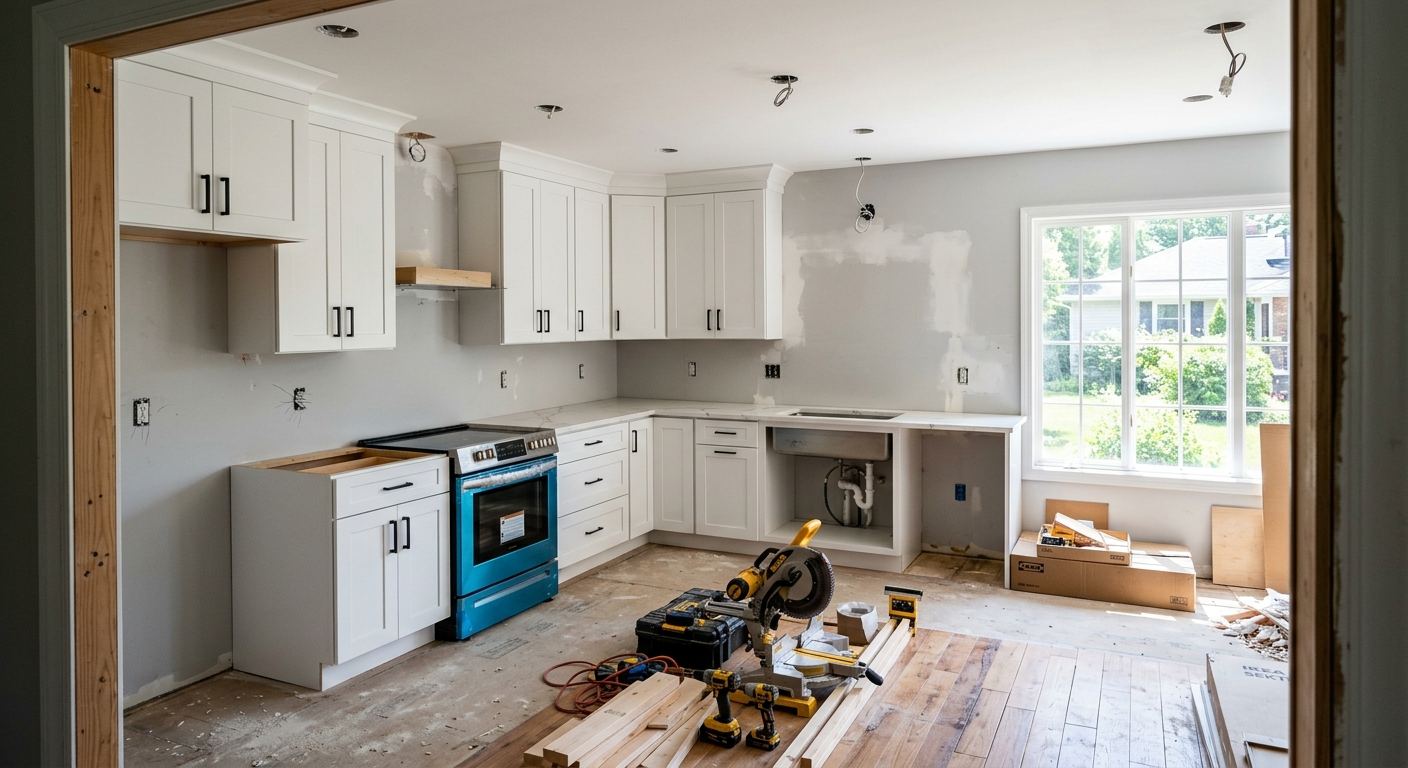
Kitchen renovation options and costs in Delhi
Delhi, Ontario homeowners typically start with three big questions: what can we keep, what do we replace, and what will it cost? With Delhi’s small population base of 5,344 (Statistics Canada, 2021 Census), there’s less “competition by saturation” than in larger GTA pockets—so well-run trades and cabinet shops can get booked quickly during spring and early summer. In the Toronto economic region, kitchen spend tends to move with local housing value and household purchasing power; even though Delhi itself is smaller, the Toronto resale market strongly influences finish expectations (think quartz, upgraded appliances, and cleaner cabinet detailing). In higher-value areas across the GTA, many owners effectively justify kitchen spend as a larger share of their home value—often targeting an 8%–15% level—while more cost-sensitive projects stay mid-range with refacing or semi-custom builds and laminate or quartz counters.
Costs in Delhi also reflect GTA contractor availability more than weather. Ontario’s seasonal freeze–thaw isn’t a direct line-item “climate surcharge,” but it affects schedules: flooring and tile installs can get delayed by site conditions, and drying time for subfloors matters if your home is older. Labour and material pricing are broadly uniform across the Toronto region, yet higher-value demand skews averages upward because more homes get premium cabinetry and stone. If you’re in the central Delhi area near main retail corridors, trades tend to be in especially high demand because access and parking constraints can influence site logistics for deliveries and crews. Once you’ve picked your scope, the next step is comparing renovation tiers in a realistic budget range.
| Renovation Tier |
What's Included |
Typical Duration |
Price Range |
| Cosmetic refresh (paint, hardware, new appliances only) |
Cabinet paint or repaint, new pulls/knobs, backsplash spot repair or small accent, swap-in appliances (no plumbing/gas relocation) |
3–7 days |
$25,000–$30,000 |
| Mid-range full renovation (new cabinets, counters, sink, tile) |
New semi-custom cabinets, quartz or good laminate counters, sink + faucet, backsplash tile, under-cabinet lighting (if selected), flooring refinishing or replacement (as scoped) |
3–5 weeks |
$35,000–$65,000 |
| High-end full renovation (custom cabinets, stone counters, island) |
Fully custom millwork, natural stone/quartz premium, island with cabinetry, upgraded plumbing/electrical, full-height backsplash or feature tile, appliance package with pro-grade options |
6–10 weeks |
$70,000–$90,000 |
| Cabinet refacing only (new doors + drawer fronts, same boxes) |
Door/drawer replacement, new end panels, new hardware, simple trim refresh; counters and appliances usually not included |
1–3 weeks |
$10,000–$28,000 |
| Countertop swap only (laminate to quartz or stone) |
Remove and replace counters, new sink cutout as needed, basic seam and finishing work; no cabinet rework unless required for fit |
4–10 days |
$3,500–$15,000 |
| Backsplash tile installation only |
Tile removal (if needed), surface prep, tile install, grouting, caulking; does not include cabinet or countertop replacement |
2–7 days |
$2,000–$10,000 |
Prices are estimates only and vary by project scope, site access and material selection.
What affects the price of kitchen renovation in Delhi
In Ontario, two contractors can price the “same” kitchen very differently—often by 30–50%—because the quote isn’t just finishes; it’s risk, labour sequencing, and how much underlying work is discovered once walls open. In the Toronto economic region, kitchen spending is driven far more by local home values and household income expectations than by climate. That’s why, in higher-value pockets, homeowners more often default to quartz or stone counters and semi-custom cabinetry: the cost is easier to recover at resale because buyers expect that look and durability. In more price-sensitive areas of Brampton and outer Mississauga, laminate and stock or refaced cabinetry still dominate, since they deliver strong ROI without pushing the project into “custom build” territory.
In Delhi specifically, a few local-condition examples commonly move the needle. First, older homes with dated subflooring can force floor prep and additional labour before tile sets—adding days even if you’re staying in a $35,000–$65,000 mid-range scope. Second, kitchens with poor ventilation or early wear around the sink area can uncover substructure water staining, which raises demo and replacement costs even when your countertop plan stays within a $3,500–$15,000 band. Third, if your layout calls for moving a gas line or significantly rerouting plumbing, that unpredictability can push a remodel from the lower end of the $25,000–$90,000 full-renovation bands into the higher end due to licensed-trade coordination and inspection scheduling. The “big-ticket” uncertainty is layout work—removing a wall, adding an island, or moving plumbing/gas—regardless of finish tier.
| Price Factor |
Why It Matters |
Cost Impact |
| Cabinet tier — stock vs. semi-custom vs. fully custom millwork |
Higher tiers increase material cost, customization, and labour for perfect fit, especially around uneven walls |
~$8,000–$40,000 difference depending on scope |
| Countertop material — laminate vs. quartz vs. granite vs. stone |
Material and fabrication complexity drive cost; seam count and edges affect labour too |
~$3,000–$15,000+ |
| Layout change — wall removal, island add, plumbing/gas move |
These create new framing, rework of services, and higher inspection/coordination risk |
Often the largest swing factor: can add $10,000–$25,000+ |
| Appliance package tier — builder vs. mid-range vs. pro-grade |
Pricing differences include installation requirements and sometimes power/venting upgrades |
~$2,000–$12,000 |
| Flooring — refinish existing vs. full replacement |
Kitchen tile/laminate selection affects prep time; replacement exposes subfloor conditions |
~$1,500–$8,000 |
| Backsplash — ceramic tile vs. marble vs. full-height slab |
Premium stone needs more precise levelling, cutting, and finishing |
~$2,000–$10,000 |
| Electrical — new circuits for island, under-cabinet lighting |
Additional circuits require licensed work, wire runs, and inspection coordination |
~$1,000–$6,000+ |
| Permit fees and licensed trade requirements |
Some kitchen work triggers permits and inspections; administrative and schedule costs add up |
~$500–$5,000+ |
Permits & regulations in Ontario
In Ontario, a straightforward cabinet and countertop swap typically does not require a permit—so if you’re keeping the layout and not touching plumbing, gas, structural elements, or adding new electrical circuits, you can often proceed with standard contractor scheduling. However, moving plumbing supply or drain lines, relocating gas for a stove/range, removing a load-bearing wall, or adding electrical circuits (for example, dedicated lines for an island or new hood/lighting circuits) usually requires permits and licensed trades. Gas work must be performed by a licensed gas fitter, and electrical by a licensed electrician; both require inspections where applicable. The key for Delhi homeowners is to confirm which scope items trigger permits before work starts, and to ensure that responsibility is clearly written into your contract.
Here’s how to verify a contractor properly, step-by-step. First, ask for their Ontario licensing details (their relevant trade registrations where applicable) and check the contractor’s references on certification documentation provided at quoting. Second, request a certificate of insurance (liability) naming the proper insured party, and confirm it covers renovations at occupied dwellings if you’re living at home. Third, ask about WSIB/WCB coverage: you should receive proof of coverage or a clearance letter showing the contractor meets Ontario requirements. Keep copies of these documents for your records, and don’t rely on “we’ll handle it” explanations—have the contractor spell out who pulls permits for what work (if any) and when inspections will occur.
Cabinets, countertops and layout decisions in Delhi
When you renovate a kitchen in Delhi, three decisions do most of the heavy lifting: (1) cabinet tier, (2) countertop material, and (3) layout changes. These choices matter because they affect not only how your kitchen looks today, but also how it performs through Ontario’s seasonal swings and how it appraises for Toronto-area buyers who shop for “clean, durable, modern” surfaces. For cabinets, stock options are the fastest and cheapest, semi-custom is the popular balance, and custom millwork is your best fit if your walls and angles are irregular or you want a precise storage system. For countertops, laminate can be a smart budget play, while quartz and natural stone are favored because they resist daily wear and wipe-clean routines—important in busy households and when resale expectations pull you toward premium finishes.
Layout is where dollars can jump quickly. Opening up with a wall removal, adding an island, or relocating plumbing/gas can justify itself when the space gain fixes real bottlenecks: poor traffic flow, cramped landing zones, or limited prep space. The Toronto resale market tends to value functional open sightlines and practical islands; that’s why these upgrades often align with higher finish tiers. As a concrete example, upgrading from laminate to quartz might add a few thousand dollars, but it’s usually easier to justify than a full plumbing relocation—because quartz upgrades fit within the countertop swap range of about $3,500–$15,000, while service moves can push you into a larger full-renovation budget band ($35,000–$65,000 or higher) due to licensed work and coordination.
Seasonal considerations also show up in execution: expect more time for drying and prep when flooring underlayers need attention, particularly in older homes—so planning for schedule buffers helps your budget stay closer to the quote.
| Option |
Durability |
Maintenance |
Best For |
Price Range |
| Stock cabinets (big-box) |
Good everyday durability; limited adjustment if walls are out of square |
Easy care with standard cleaners; hardware upgrades refresh the look quickly |
Quick timelines and budget-first renovations |
$8,000–$20,000 |
| Semi-custom cabinets (local dealer) |
Strong durability; better fit options and more layout flexibility |
Maintain finishes per manufacturer; well-sealed interiors handle moisture better |
Most Delhi renovations aiming for a mid-range resale-friendly upgrade |
$20,000–$40,000 |
| Custom cabinets (local millwork shop) |
Excellent durability; tailored construction to your space |
Maintain like fine cabinetry; hinges/soft-close components are serviceable |
Historic/awkward layouts, high-end storage systems, premium finishes |
$40,000–$70,000 |
| Laminate countertop |
Decent resistance to scratches; can be vulnerable at seams and heat points |
Wipe clean; use cutting boards and trivets to extend life |
Cost-conscious refreshes where cabinets and layout get the focus |
$3,500–$7,500 |
| Quartz engineered countertop |
Very durable for daily kitchen wear; consistent look with fewer concerns about staining |
Low maintenance; avoid abrasive cleaners and heavy impacts |
Best blend of durability and resale appeal in Toronto-influenced markets |
$8,000–$15,000 |
| Granite / natural stone countertop |
Highly durable; natural variety adds character but requires correct installation |
Usually needs periodic sealing depending on stone type |
High-end looks and statement kitchens with premium finishes |
$10,000–$18,000 |
| Butcher block countertop |
Durable with proper care; can show wear and marks over time |
Oil/routine maintenance; protect from standing water |
Family-friendly kitchens seeking warmth and a lived-in aesthetic |
$6,000–$12,000 |
| Marble countertop |
Beautiful and premium; more sensitive to etching/staining without disciplined care |
Requires sealing and careful cleaning habits |
Luxury kitchens where the homeowner accepts higher upkeep |
$12,000–$22,000 |
How to choose a kitchen renovation contractor in Delhi
Choosing the right contractor in Delhi, Ontario starts with checking three things: licensing (where relevant), liability insurance, and WSIB/WCB coverage. First, ask your prospective contractor for the relevant Ontario trade registrations for the work they themselves perform (and confirmation that licensed trades will handle electrical and gas where needed). Next, request a certificate of insurance—liability should be current, and ideally should list the job address or at least confirm it covers renovation work. Finally, confirm WSIB/WCB coverage: you should be able to get proof of coverage and/or a clearance letter. If they can’t provide documentation promptly, treat it as a red flag.
Then get 2–3 itemised written quotes, not lump sums. A good quote breaks down labour and materials and shows allowance ranges for cabinets, counters, tile, and appliances. Read the scope line by line: what’s included for demolition, disposal, drywall repair, permit fees, and whether you’re getting “like-for-like” replacement or upgrades. Warranty matters too: you should receive a workmanship warranty length, plus the product/manufacturer warranty terms, and whether warranties are transferable if you sell your home. For payments, keep it conservative—never more than 10–15% upfront; use holdbacks tied to completed milestones and sign-off on close-out items.
Finally, lock in schedule expectations: request a start date and a completion estimate in writing, plus how the contractor handles delays tied to countertop fabrication or cabinet lead times.
- Verify proof of liability insurance and confirm it’s current.
- Confirm WSIB/WCB coverage with proof or a clearance letter.
- Ask which permits (if any) are required and who will pull them.
- Confirm licensed electrician/gas fitter will be used for any related work.
- Get 2–3 itemised quotes with labour and materials separated.
- Check allowances (cabinets, countertops, tile) and whether they’re realistic.
- Ensure disposal/dump fees are included or listed as a separate line item.
- Confirm demolition includes protecting floors and doorways during the demo.
- Ask about drywall patching, painting scope, and trim finishing.
- Clarify what happens if the countertop template reveals cabinet alignment issues.
- Request warranty details in writing: workmanship + manufacturer + transferability.
- Use a milestone payment schedule with a final holdback until complete.
In Delhi, watch for red flags such as: (1) refusing to provide insurance or WSIB/WCB documentation, (2) quoting only a lump sum with no breakdown or allowances, (3) promising “no permits needed” without reviewing electrical/plumbing/gas scope, (4) vague warranty language, and (5) asking for large deposits (well above 10–15%) before demolition even starts.
Frequently asked questions — kitchen renovation in Delhi
How do I choose a kitchen contractor in Delhi?
Start by confirming documentation: liability insurance and WSIB/WCB coverage (proof or a clearance letter). In Ontario, kitchens often involve licensed trades when electrical circuits are added or when gas/venting is touched, so ask the contractor how they coordinate licensed work and inspections. Then request 2–3 itemised quotes with labour and materials broken out, including allowances for cabinets, countertops, and tile. For budgeting, use realistic bands like a full kitchen renovation often landing in the $25,000–$90,000 range in the Toronto economic region, while cabinet refacing is commonly far lower. Finally, compare who is willing to explain the scope line-by-line—good contractors welcome scrutiny and put responsibilities (permits, disposal, timelines) into the contract.
What order do kitchen renovation steps happen in?
Typically, we confirm measurements and finalize selections first, then schedule demolition. The usual sequence is: protect the home (floors/doorways), remove existing cabinets/counters, and complete rough trades (electrical/plumbing/gas) as required for your scope. Next is subfloor and wall prep (drywall patching, framing adjustments), then install base cabinets and verify alignment for countertops. After cabinets are set, countertops get templated and fabricated off-site; once delivered, counters are installed and sealed as needed. Flooring and tile usually follow cabinet placement depending on the design, then backsplash tile and trim details come last. Appliances go in near close-out. This sequencing helps prevent rework—especially important for Ontario homes where drying time and subfloor conditions can affect tile and cabinet fitting.
Can I live at home during a kitchen renovation in Delhi?
Many Delhi homeowners do live at home, especially when the scope is limited (like refacing, backsplash, or a countertop swap). For mid-range full renovations, you may live with a partial kitchen setup—microwave, kettle, and a temporary sink—while the main area is under construction. For larger projects that include layout changes and permits, plan on at least a period where the kitchen is fully functional only for storage and essential prep. The renovation team should protect dust pathways and cover HVAC returns to limit particulates. Also, consider schedule impacts: countertop lead times and tile curing can stretch day-to-day disruption. If you’re targeting a budget like $35,000–$65,000 for a full renovation, discuss a realistic “usable kitchen” timeline so you can plan meals and cleaning.
Should I renovate my kitchen before selling in Delhi?
Often, yes—if your kitchen is dated, cramped, or visually tired. A renovation can improve buyer confidence, particularly when finishes align with Toronto-area expectations: clean cabinetry, durable counters, and a practical layout. That said, you shouldn’t overspend on purely cosmetic upgrades if major systems are failing or if layout constraints remain. A smart approach is to prioritize high-impact changes that buyers notice first: cabinet fronts/doors, a countertop refresh (quartz often being a popular durability upgrade), and a backsplash. In a Delhi-to-Toronto market context, projects commonly range from mid-range ($35,000–$65,000) up to high-end ($70,000–$90,000), but “value” comes from matching the finish tier to your home’s price point. Discuss your selling timeline with your contractor so decisions align with resale prep, not open-ended renovations.
What's the most popular kitchen style in Delhi right now?
In Delhi, the most requested style mirrors what’s selling well across the Toronto economic region: modern transitional kitchens—think shaker-style cabinetry, neutral wall tones, and quartz-look counters or mid-tone quartz patterns. Homeowners also increasingly ask for functional upgrades like under-cabinet lighting, a clean backsplash line, and better drawer storage, because those features photograph well and feel practical day-to-day. Island layouts are popular when the room allows it, but many kitchens stay more efficient with a peninsula if space is tight. Finish choices often track budgets: if you’re in a mid-range build, semi-custom cabinets and quartz typically lead; if you’re keeping costs controlled, refacing plus a countertop upgrade can deliver a similar “new kitchen” effect. Even a backsplash-only project can modernize the look quickly without the disruption of full demo.
How do I know if I need to update my kitchen plumbing in Delhi?
You may need plumbing updates if you see leaks under the sink, persistent low water pressure, corrosion or discolouration at shut-offs, or drainage that smells/backs up. Older Ontario homes can also have hidden issues—like supply lines near the back of cabinets—that don’t show until counters and cabinets are removed. You should update plumbing when you’re moving fixtures (sink relocation) or when your renovation adds dishwasher, upgrades taps, or changes the waste configuration. If your plan includes moving plumbing/gas lines, remember that it typically triggers permits and licensed work in Ontario, and it can materially change the cost beyond a simple countertop swap. As a budgeting anchor, a countertop swap alone may sit around $3,500–$15,000, but plumbing reroutes often push projects into higher full-renovation budgets due to inspection and coordination.