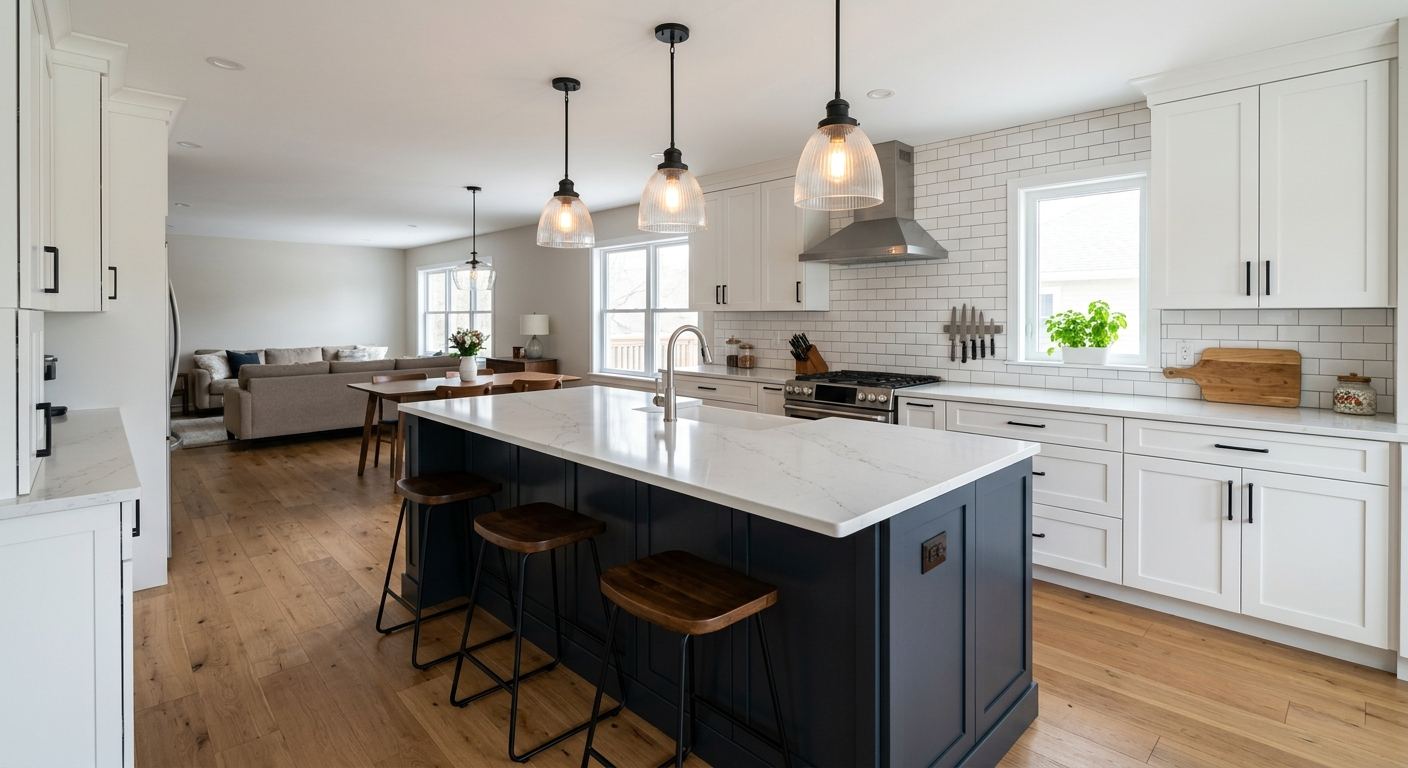
Kitchen renovation options and costs in Hillcrest Village
In Hillcrest Village, Ontario, kitchen renovations are one of the most visible upgrades you can make—and the cost tends to track what local buyers will pay for a finished, move-in-ready home. With a population of 16,934 (Statistics Canada, 2021 Census), this is a stable community where many homeowners renovate with resale value in mind, especially as Toronto-area home values rise. In the broader Toronto economic region, renovations also tend to reflect household purchasing power: in higher-value pockets, owners more often choose custom cabinetry and quartz or natural stone because they can better justify the investment on resale.
Toronto-market dynamics shape costs more than weather. We don’t see the kind of extreme, freeze-thaw basement damage that drives major structural kitchen add-ons in northern climates, but humidity and cold winters still matter for long-term performance—especially for caulking, grout, under-sink protection, and subfloor prep. Availability can also influence pricing: during peak renovation seasons, scheduling labour for cabinet installation, tile work, and electrical upgrades can tighten, pushing crews to higher-demand dates.
In Hillcrest Village, trade demand is particularly strong around the plazas and main collector roads where condos and family homes cluster, and where homeowners commonly refresh kitchen finishes ahead of listing or upgrading growing families’ layouts. If you’re comparing options, the fastest way to align expectations is to look at renovation tiers side-by-side—then match scope to your budget.
| Renovation Tier |
What's Included |
Typical Duration |
Price Range |
| Cosmetic refresh (paint, hardware, new appliances only) |
Paint, new cabinet hardware, caulking/trim touch-ups, appliance installation (no plumbing/gas relocation), basic deep clean |
3–7 days |
$8,000–$18,000 |
| Mid-range full renovation (new cabinets, counters, sink, tile) |
Semi-custom or quality stock cabinets, quartz or good laminate counters, sink + faucet, backsplash tile, floor tile/underlayment where needed, disposal hookup |
3–5 weeks |
$25,000–$60,000 |
| High-end full renovation (custom cabinets, stone counters, island) |
Custom cabinetry, premium quartz or natural stone, island build with upgraded lighting, full-height backsplash option, upgraded appliance package, more extensive plumbing/electrical coordination |
6–10 weeks |
$65,000–$90,000 |
| Cabinet refacing only (new doors + drawer fronts, same boxes) |
Refacing on existing cabinet boxes, new doors/drawer fronts, new pulls/handles, optional interior upgrades (shelves/organizers) |
2–4 weeks |
$10,000–$35,000 |
| Countertop swap only (laminate to quartz or stone) |
Removal of existing top, template + install, sink/cooktop cut-outs as applicable (no major cabinet modifications) |
1–2 weeks |
$3,000–$15,000 |
| Backsplash tile installation only |
Tile supply and install (ceramic/stone), grout/caulk details, edge finishing, removal of existing backsplash (if needed) |
1–3 weeks |
$2,000–$10,000 |
Prices are estimates only and vary by project scope, site access and material selection.
What affects the price of kitchen renovation in Hillcrest Village
Even for the “same” kitchen, two Toronto-area homeowners can receive quotes that differ by 30–50%. That gap usually comes down to finish tier choices, labour availability, and how much your scope changes once we open walls—rather than climate. In Hillcrest Village and the wider Toronto economic region, local home values and household incomes shape what finish levels clients select: in higher-value areas, people commonly default to quartz or stone counters and semi-custom cabinetry because the renovation cost is often easier to recover on resale. Where budgets are more price-sensitive, laminate tops and stock or refaced cabinets dominate, keeping totals in the $25,000–$60,000 mid-range for many full renovations.
Layout changes are the most unpredictable cost driver regardless of finish. Removing a wall, adding an island, or moving plumbing/gas lines forces trades to rework framing, subfloor, and mechanical runs. For example, an island addition can turn a mid-range kitchen into a high-end one when electrical outlets and lighting are upgraded, and when structural considerations require extra carpentry.
Concrete Hillcrest Village examples that move the price: (1) older homes often have uneven subfloors—if we need extensive levelling before tile, tile labour and underlayment rise quickly; (2) if your current cabinet boxes are out of square, refacing may still require fillers and re-trimming, narrowing the savings; (3) if you’re swapping laminate for quartz, you may also need new supports or modified overhangs to meet stone weight requirements. Toronto’s housing stock also means many kitchens start with smaller footprints; when you expand open sightlines, costs rise even if finishes stay mid-range.
| Price Factor |
Why It Matters |
Cost Impact |
| Cabinet tier — stock vs. semi-custom vs. fully custom millwork |
Tier affects materials quality, door/drawer construction, adjustability, and how well the layout fits without fillers |
Can swing the project by roughly $10,000–$30,000+ |
| Countertop material — laminate vs. quartz vs. granite vs. stone |
Material cost, templating complexity, seam layout, and installation method drive total pricing |
Typically adds $3,000–$15,000 for countertops alone |
| Layout change — wall removal, island add, plumbing/gas move |
Forces framing, drywall, mechanical reroutes, and coordination between trades |
Often the largest unpredictable jump; can add $5,000–$25,000+ |
| Appliance package tier — builder vs. mid-range vs. pro-grade |
Pro-grade units cost more and may require different clearances, ventilation, or electrical needs |
Can vary by $2,000–$12,000+ depending on brands/features |
| Flooring — refinish existing vs. full replacement |
Matching existing floors can be easy or nearly impossible depending on wear, thickness, and subfloor |
May add $2,000–$8,000+ |
| Backsplash — ceramic tile vs. marble vs. full-height slab |
Premium stone tile increases cutting, waste, and finishing time |
Often $2,000–$10,000 based on coverage |
| Electrical — new circuits for island, under-cabinet lighting |
New circuits and a dedicated lighting plan increase electrical scope and scheduling |
Commonly adds $1,000–$6,000+ |
| Permit fees and licensed trade requirements |
Certain changes trigger permits and inspections, plus added coordination and documentation |
Usually a few hundred to a few thousand dollars, plus scheduling |
Permits & regulations in Ontario
In Ontario, cabinet and countertop swaps typically do not require a permit. If you’re replacing cabinet boxes/doors, installing new counters, or updating finishes like tile, that work generally stays in the “no permit” category because it doesn’t alter a building’s core services or structure.
Permits and licensed trade involvement are usually required when the scope touches plumbing, gas, structural walls, or electrical circuits. Common examples of work that typically needs permits: moving plumbing supply or drain lines (sink relocation, new dishwasher routing), relocating a gas stove or making changes related to gas appliances/venting, removing or altering a load-bearing wall (or other structural changes), and adding electrical circuits (for example, island outlets, under-cabinet lighting with new wiring, or substantial panel updates). Gas work must be completed by a licensed gas fitter, and electrical work must be completed by a licensed electrician, each followed by inspections.
To verify a contractor in Hillcrest Village, ask for: (1) their Ontario licence details where applicable for the trades they manage or sub-contract; (2) a current certificate of insurance and confirm liability coverage limits; and (3) WSIB/WCB clearance (or proof of coverage/eligibility). Then check the paperwork dates, match the company name to the invoice, and ensure the contract clearly states who pulls permits and pays permit fees. Confirm responsibility in writing before you sign—“we’ll handle it” isn’t enough.
Cabinets, countertops and layout decisions in Hillcrest Village
Your three most consequential decisions in a Hillcrest Village kitchen renovation are cabinet tier, countertop material, and whether you’ll change the layout (open-concept wall removal, island addition, or moving plumbing/gas). These choices drive both the feel of the kitchen and the resale-appropriate buyer expectations in the Toronto market.
1) Cabinet tier: Stock cabinets are the fastest and cheapest path, but they can leave small compromises in fit. Semi-custom cabinets are the most popular mid-range choice because they balance better door styles and improved sizing without reaching custom millwork pricing. Custom cabinets deliver the best end-to-end fit, but they also raise labour time for bespoke modifications—especially in older homes with out-of-square walls.
2) Countertop material: Laminate can be a budget-friendly option, but it’s more vulnerable to heat and can show wear at seams. Quartz offers a strong durability-to-maintenance balance, while granite/natural stone adds visual depth but can require more careful sealing practices depending on stone. Butcher block is warm and forgiving, yet it needs ongoing oiling and must be protected near sinks.
3) Layout changes: Opening an adjacent wall or adding an island often makes the renovation “feel” larger, but it’s justified only when the space gain improves daily traffic flow. Moving plumbing/gas is where costs can jump into the higher-end band because the work requires coordination and often permit processes.
For a practical dollar example: if you’re already in the mid-range $25,000–$60,000 zone, upgrading laminate to quartz may add only part of your total budget—often within the countertop swap band (commonly $3,000–$15,000). If, however, you pair the upgrade with a sink relocation plus new circuits, that combination can push the same project toward the $65,000–$90,000 high-end range due to the added labour and coordination, even when cabinet finishes stay mid-range.
| Option |
Durability |
Maintenance |
Best For |
Price Range |
| Stock cabinets (big-box) |
Good daily durability; fit varies by home |
Wipe clean; tighten hardware as needed |
Fast timelines and lean budgets |
$8,000–$20,000 |
| Semi-custom cabinets (local dealer) |
Very good durability; better sizing and options |
Standard cabinet cleaning; manage moisture near sink |
Most Hillcrest Village renovations targeting resale appeal |
$15,000–$35,000 |
| Custom cabinets (local millwork shop) |
Excellent build quality; tailored fit |
Standard care; more finish-specific products may be recommended |
Unique layouts, premium styles, and best-in-fit results |
$30,000–$60,000+ |
| Laminate countertop |
Moderate; can chip or blister if abused |
Clean with non-abrasive products; protect from heat |
Budget-conscious upgrades and rental-style durability |
$3,000–$7,000 |
| Quartz engineered countertop |
High; very resistant to staining and wear |
Easy care; avoid cutting directly if you want to preserve surface |
Families wanting low-maintenance, modern looks |
$6,000–$12,000 |
| Granite / natural stone countertop |
High; varies by slab hardness and finish |
Seal depending on stone and usage; clean carefully |
Homeowners wanting natural variation and premium appearance |
$8,000–$15,000 |
| Butcher block countertop |
Good for daily prep; can dent if heavily used |
Needs regular oiling/conditioning and careful water control |
Warm, cottage-modern kitchens and food-prep focused spaces |
$5,000–$10,000 |
| Marble countertop |
Beautiful but softer; can etch and stain with harsh contact |
More careful cleaning; prompt wipe-down of acids and oils |
Low-heat, lower-spill lifestyle kitchens |
$10,000–$18,000+ |
How to choose a kitchen renovation contractor in Hillcrest Village
Choosing the right contractor protects your budget and reduces surprises—especially in a market where kitchens often involve multiple trades. In Ontario, verify licensing and coverage first: ask whether they hold the appropriate Ontario registration for the work they perform or manage, and request proof of liability insurance with clear coverage limits. For workplace protection, confirm WSIB/WCB coverage (or provide their clearance/coverage documentation). Then confirm that their subcontractors are properly insured and licensed for gas and electrical work, where required.
Next, get 2–3 itemised written quotes. You want a breakdown that separates labour and materials (and ideally includes line items for demolition, cabinet install, countertop install, tile, plumbing/electrical allowances, disposal, and permits if applicable). Avoid lump-sum quotes that don’t show what’s included—kitchen projects regularly expand once walls open, and a clear scope is what keeps change orders fair. Read exclusions too: disposal included or not, patching/paint scope, floor repair responsibility, and whether permit pull is included.
Warranty matters. Confirm workmanship warranty length and what it covers (for example, cabinet installation alignment, tile crack checks, caulking performance). Also verify the manufacturer’s warranty on cabinets/stone appliances, and whether it’s transferable if you sell your home. For payment schedule, never pay more than 10–15% upfront; hold back a portion until key milestones are complete. Finally, get a start date and a completion estimate in writing—timing affects your ability to manage appliances, flooring transitions, and temporary kitchen use.
- Provide proof of insurance (liability) and WSIB/WCB clearance or coverage documentation.
- List the exact trades they use for electrical and gas where required.
- Use itemised quotes with labour and materials separated, not a single lump sum.
- Spell out who pulls permits and pays fees (and what triggers permits on your scope).
- Confirm disposal and drywall/hardwood patching responsibilities.
- Include start date, milestones, and a realistic completion estimate.
- Show cabinet lead times and countertop templating/install scheduling.
- Define tolerances for cabinet alignment, countertop overhangs, and tile layout.
- Request a written warranty for workmanship and product warranty details.
- Use a payment schedule with no more than 10–15% upfront.
- Have a written change-order process with pre-agreed hourly labour rates.
- Walk through protection plans for floors, stairs, and nearby finishes.
Red flags in Hillcrest Village: (1) quotes that exclude electrical/plumbing allowances without explaining why; (2) no written scope or vague “as needed” line items; (3) insisting on large upfront deposits beyond 10–15%; (4) reluctance to provide insurance and WSIB/WCB proof; and (5) promising start dates without confirming cabinet/countertop lead times.
Frequently asked questions — kitchen renovation in Hillcrest Village
Should I reface or replace my cabinets?
In Hillcrest Village, refacing is often the smarter choice when your cabinet boxes are structurally sound: doors and drawer fronts wear out first, but warped or water-damaged boxes can’t be “fixed” by refacing. A cabinet refacing project commonly sits in the $10,000–$35,000 range, and it’s typically faster than a full replacement. Replacement is the better move if your layout is awkward, you need more storage reconfiguration, or you’re dealing with boxes that are out of square—issues that are common in older Toronto housing stock. If you’re planning a change that requires electrical/plumbing updates or layout moves, replacing can also simplify the work. A site visit lets us assess box condition, toe-kick issues, and whether fillers will create a clean, modern finish.
Do I need a permit for a kitchen renovation in Ontario?
For most cabinet and countertop swaps in Ontario, permits are typically not required. In Hillcrest Village, homeowners often start with a refresh—new paint, hardware, or even replacing countertops—without permit work. However, permits generally become necessary when the renovation includes changes to plumbing supply or drain lines, relocating a gas stove or related gas venting, removing or altering a load-bearing wall, or adding electrical circuits (for example, island outlets or new under-cabinet lighting with new wiring). Gas work must be performed by a licensed gas fitter, and electrical work by a licensed electrician, each followed by inspections. The key is responsibility: confirm in your contract who pulls permits and pays fees, because a “we’ll take care of it” statement should be backed by documentation.
What's the ROI on a kitchen renovation?
Kitchen renovation ROI is heavily tied to your local buyer expectations in the Toronto market. In higher-value neighbourhoods around the GTA, homeowners often spend a larger share of home value—commonly in the 8–15% range—because buyers expect premium finishes like quartz and semi-custom cabinetry. In more budget-focused areas, renovations still improve appeal, but buyers may favour solid basics and clean layout changes over the most expensive materials. For Hillcrest Village homeowners, ROI is usually strongest when the renovation improves daily function (storage, lighting, traffic flow) and keeps finish selections within resale-friendly tiers. If your project reaches the high-end full renovation band ($65,000–$90,000), ROI depends on whether the upgrade aligns with what comparable homes nearby are offering. A contractor who understands your target buyer profile can help you prioritize.
How do I budget for a kitchen renovation?
A practical budget approach in Hillcrest Village is to start with a target tier, then add realistic allowances for the “unknowns” we only discover after demolition. Many full renovations in the Toronto region fall from mid-range $25,000–$60,000 into the higher-end $65,000–$90,000 bracket, depending on cabinet tier, countertop material, and whether you change the layout. For a first-pass budget, decide on cabinets (stock vs. semi-custom vs. custom), pick your countertop material, and then determine if you’re moving sink, stove, or adding an island—those layout moves are where costs jump. Also budget for electrical scope and proper tile underlayment if your floor needs levelling. Get itemised quotes with labour and materials line items so you can compare apples-to-apples and plan for change orders.
Can I move my kitchen sink or stove?
Yes, you can move a kitchen sink or stove in Hillcrest Village, but the scope and cost change dramatically based on how far the fixtures move and what’s behind the walls. Moving a sink typically involves rerouting drain and supply plumbing, and it often triggers the need for permits and licensed plumbing-related coordination. If you’re moving a stove, gas relocation must be handled by a licensed gas fitter, and that work needs careful planning around ventilation and inspections. Even when you stay within the same general footprint, moving these fixtures can require additional framing, drywall repairs, and sometimes subfloor work to protect against moisture—important in Toronto’s seasonal humidity swings. If you want to keep costs closer to mid-range kitchen refreshes, consider adjusting layout using existing rough-ins where possible.
What's the most cost-effective kitchen upgrade?
For most Hillcrest Village homeowners, the most cost-effective upgrade is the one that maximizes visible impact while limiting “hidden” work behind walls. Often, that’s upgrading countertops and hardware, or adding a backsplash that ties the room together. A countertop swap (for example, laminate to quartz) commonly falls within $3,000–$15,000, and it can transform the look without the disruption of a full cabinet demo. Another strong value option is cabinet refacing, typically $10,000–$35,000, when your boxes are in good condition. If your goal is resale appeal, pairing new hardware with fresh paint and good lighting can also be high impact at low cost. The most cost-effective choice depends on whether your layout and cabinet boxes are still functional—so the first question is what’s worn versus what’s structurally worth keeping.