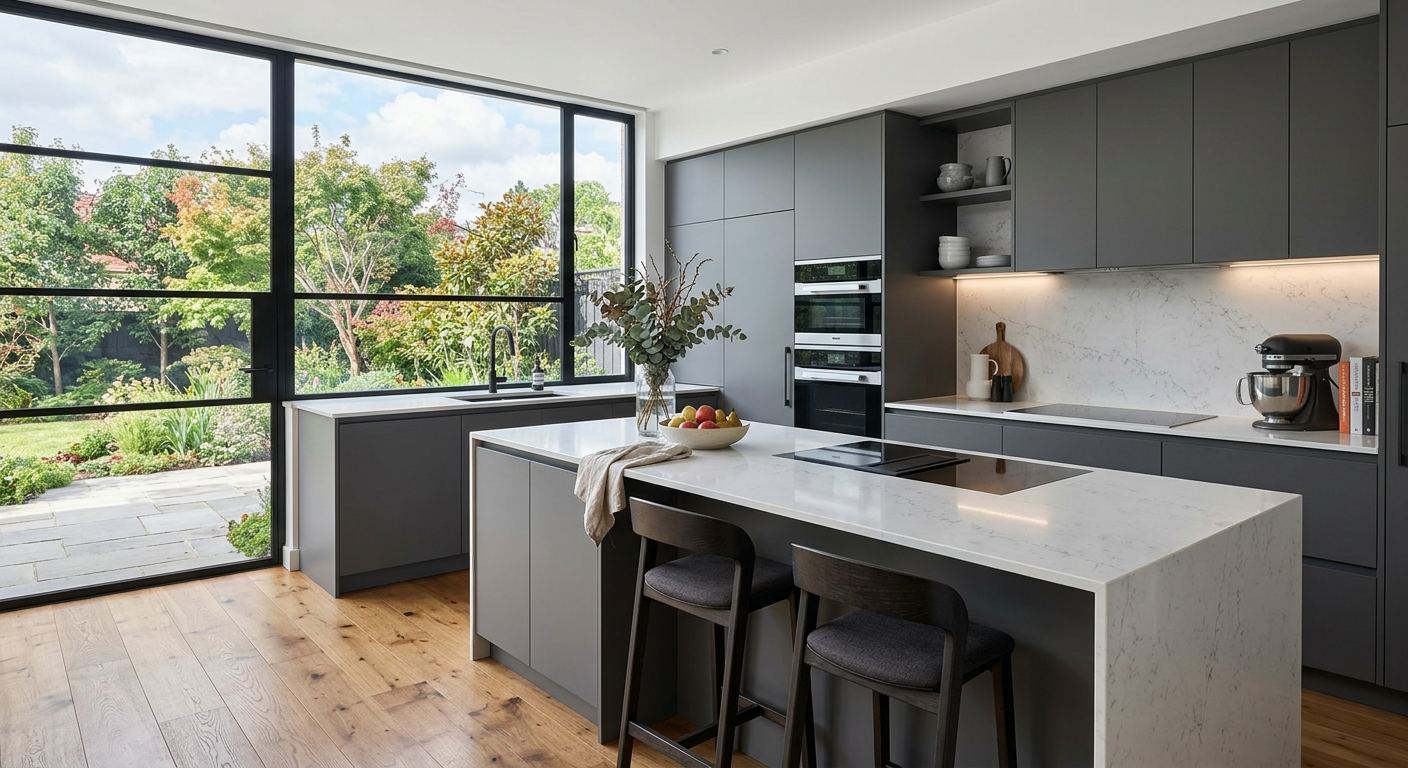
Kitchen renovation options and costs in Lang's Farm
In Lang's Farm, kitchen renovations typically come down to budget, but the finish choices are strongly influenced by the local Toronto housing market. With a 2021 population of 5,347 in the community area (Statistics Canada, 2021 Census), most homeowners are balancing long-term livability with resale expectations rather than short-term trends. In the Toronto economic region, higher-value pockets often drive owners toward quartz or natural stone counters and more built-to-fit cabinetry, because renovation spend can align with what buyers expect. In practical terms, many projects land around the region’s “mid-range” refresh level (roughly $25,000–$45,000) or move into “high-end” territory (often $60,000–$90,000+) when layout work or premium finishes are involved.
Toronto pricing is also shaped by demand cycles: contractor availability and scheduling can tighten when spring and summer trades ramp up, which affects labour components and lead times for specialty items. Ontario’s heating season is long, so kitchens see more indoor humidity swings—this matters for backsplash installations, caulking/trim detailing, and the way cabinets are conditioned before install. That said, climate is not the main driver of quote differences; market value and household income are. We also see strong demand around the urban-commuter corridor—particularly near Vaughan and Markham—where buyers are more likely to pay for upgraded materials that hold up visually for years.
Below is a practical comparison of common renovation tiers to help you map your scope to a realistic budget before contractors refine the numbers.
| Renovation Tier |
What's Included |
Typical Duration |
Price Range |
| Cosmetic refresh (paint, hardware, new appliances only) |
New hardware, cabinet paint/finish, appliance swap (no layout changes), minor caulking, basic cleaning, disposal coordination |
5–10 business days |
$8,000–$18,000 |
| Mid-range full renovation (new cabinets, counters, sink, tile) |
Semi-custom or quality stock cabinets, quartz or laminate counters, new sink and faucet, backsplash tile, selected lighting (no major rewire), flooring top-up as needed |
3–6 weeks |
$25,000–$55,000 |
| High-end full renovation (custom cabinets, stone counters, island) |
Custom millwork, premium quartz/stone counters, island with upgraded lighting, full-height or statement backsplash, sink placement changes, upgraded appliance package, allowance for structural/plumbing changes |
6–10 weeks |
$60,000–$90,000 |
| Cabinet refacing only (new doors + drawer fronts, same boxes) |
Door/drawer replacement, new veneer finish, re-hardware, fresh caulking and touch-ups, optional new backsplash under existing conditions |
1–3 weeks |
$8,000–$35,000 |
| Countertop swap only (laminate to quartz or stone) |
Remove and dispose old top, install new countertop, cut-outs for sink/cooktop, new seam work as required, basic reseal and trim finishing |
2–5 business days |
$3,000–$15,000 |
| Backsplash tile installation only |
Surface prep, tile supply/installation, grout/seal, edge detailing, caulking around outlets |
3–7 business days |
$2,000–$10,000 |
Prices are estimates only and vary by project scope, site access and material selection.
What affects the price of kitchen renovation in Lang's Farm
In Lang's Farm and across the wider Toronto economic region, you can see the same kitchen renovation quoted 30–50% apart. The reason is usually not “weather” but the mix of finish tier, labour availability, and how much hidden work is uncovered once we open walls. In higher-priced areas of Vaughan and Markham, homeowners more often invest a larger share of property value into the kitchen, and that pushes choices toward custom cabinetry and quartz/stone. In more price-sensitive pockets (parts of Brampton and outer Mississauga), many owners prioritize resale value and stretch budgets by using semi-custom or refaced cabinets plus good-quality quartz or laminate.
Local home value and household spending capacity shape the finish tier far more than Ontario climate. That’s why many projects move between the $25,000–$90,000 full-reno band depending on materials and whether the design includes an island and layout moves. For example, a kitchen with laminate counters may stay near the mid-range, while the same footprint with quartz or stone and upgraded cabinet interiors can jump quickly. Layout changes are the biggest wildcard: removing a wall, adding an island, or moving a gas line or plumbing almost always increases cost regardless of finish level, because it adds licensed trade time, patching, and structural detailing.
Concrete Lang’s Farm examples I see on site: (1) older homes often hide water staining behind backsplashes or under sinks, which can mean subfloor repair before new cabinets go in; (2) if you’re upgrading lighting under wall cabinets, we sometimes need additional electrical runs and a cleaner chase path; and (3) when replacing countertops, tight tolerances around window sashes and older cabinet reveals can add labour to get seams and overhangs right. Even if the Toronto region’s seasonal temperature swings don’t directly “raise” prices, the long heating season means faster drying time for patching and careful sealing details around tile, grout and countertop transitions.
| Price Factor |
Why It Matters |
Cost Impact |
| Cabinet tier — stock vs. semi-custom vs. fully custom millwork |
Custom sizing, interior features (drawers, organizers), and build quality change labour and material cost materially |
$12,000–$55,000 |
| Countertop material — laminate vs. quartz vs. granite vs. stone |
Material pricing, fabrication complexity, seam count, and edge profiles drive totals |
$3,000–$25,000 |
| Layout change — wall removal, island add, plumbing/gas move |
Triggers structural, plumbing/gas, and electrical work plus more demo and patching |
$5,000–$30,000 |
| Appliance package tier — builder vs. mid-range vs. pro-grade |
Stainless grade, ventilation requirements, warranties, and dimensions affect install time |
$2,500–$12,000 |
| Flooring — refinish existing vs. full replacement |
Kitchen renovations often uncover subfloor issues; replacing flooring can expand the scope |
$1,500–$10,000 |
| Backsplash — ceramic tile vs. marble vs. full-height slab |
Tile labour is very detail-driven; natural stone requires more prep and sealing |
$2,000–$18,000 |
| Electrical — new circuits for island, under-cabinet lighting |
Additional circuits and fixture specs require licensed work and inspection-ready setup |
$500–$6,000 |
| Permit fees and licensed trade requirements |
Work involving plumbing, gas, electrical, or structural changes can require permits and inspections |
$300–$3,500 |
Permits & regulations in Ontario
For Ontario homeowners in Lang's Farm: a straightforward cabinet or countertop swap typically does not require a permit. That includes replacing doors, drawer fronts, or installing new cabinets in the same locations, as well as installing new countertops over the existing support and keeping plumbing/gas connections where they are. However, permits and licensed trades come into play when you change how the kitchen is built or serviced.
Work that usually requires permits and inspections includes: moving plumbing supply or drain lines (sink locations), relocating a gas stove or range hood where gas is involved, removing a load-bearing wall or modifying structural beams/columns, and adding new electrical circuits (for example, new island receptacles or hardwired ventilation). Gas work must be completed by a licensed gas fitter, and electrical work must be done by a licensed electrician—both require inspection arrangements.
Step-by-step verification you can do before signing: (1) ask the contractor for their licence numbers and proof of trades qualification; (2) request a current certificate of liability insurance and confirm it covers renovation work; (3) ask for evidence of WSIB/WCB coverage—then verify the clearance letter/documentation they provide; and (4) keep everything in writing in your contract, including who pulls permits and who pays. If the contractor can’t clearly state responsibility for permits and inspections, that’s a scope and risk problem—not a scheduling inconvenience.
Cabinets, countertops and layout decisions in Lang's Farm
When homeowners in Lang's Farm ask what matters most, I point to three decisions that set both look and long-term value: (1) cabinet tier, (2) countertop material, and (3) whether you change the layout. Toronto buyers typically expect clean lines, durable surfaces, and good functionality. Stock cabinets are the fastest path to a refreshed look, semi-custom is the sweet spot for most mid-range renos, and custom cabinetry is where you get the best fit for irregular walls, ceiling lines, and walk-in pantry planning. For countertops, laminate is budget-friendly but less forgiving for impact and heat; quartz is a strong all-around choice for busy households; and natural stone (granite/stone/marble) brings visual luxury but needs more mindful care.
Layout is where cost can justify itself. Opening an interior wall or adding an island can improve sightlines and usable work space, but moving plumbing or gas lines is where bills can jump even if your finish tier stays modest. In a region where many renovations are aimed at resale alignment, an island and upgraded ventilation often read as “complete” to buyers. Conversely, changing plumbing for a minor cosmetic benefit rarely pencils out.
Climate-wise, Ontario’s long heating season affects how homes expand/contract and how quickly materials settle—especially around tile grout lines and sealant joints—so proper installation sequencing matters. A concrete example: if you’re choosing between laminate and quartz on a mid-range job, the upgrade is often one of the most value-stable moves. Moving from a countertop-only approach in the $3,000–$15,000 band to a full renovation that lands around $25,000–$55,000 is usually justified when you’re also upgrading cabinets and opening access for daily use. Marble may impress, but it’s not my first pick for families who do a lot of cooking without using mats and quick cleanup.
| Option |
Durability |
Maintenance |
Best For |
Price Range |
| Stock cabinets (big-box) |
Good for standard layouts; limited flexibility for odd dimensions |
Simple care; hinges/hardware wear depends on use |
Budget refreshes where speed matters |
$8,000–$20,000 |
| Semi-custom cabinets (local dealer) |
Strong build; more sizes and interior options for organization |
Routine cleaning; upgrade hinges and organizers for longevity |
Most Lang's Farm renovations targeting resale appeal |
$15,000–$40,000 |
| Custom cabinets (local millwork shop) |
Highest fit and durability for complex spaces |
Finishes still need standard care; hardware selection is critical |
Irregular walls, ceiling heights, and premium storage layouts |
$30,000–$70,000 |
| Laminate countertop |
Moderate impact resistance; can chip at edges if abused |
Keep heat and sharp impacts controlled; avoid standing water at seams |
Cost-sensitive updates and rental-style budgets |
$3,000–$8,000 |
| Quartz engineered countertop |
High durability; consistent performance for daily cooking |
Wipe clean; low need for sealing compared to natural stone |
Most Ontario families who want premium look with practical care |
$6,000–$15,000 |
| Granite / natural stone countertop |
Very durable; heat-tolerant surface |
Sealing and stain management may be needed depending on stone |
Premium upgrades where you want natural variation |
$8,000–$20,000 |
| Butcher block countertop |
Good durability if oiled and cared for; sensitive to standing moisture |
Regular oiling and sanding refinishes over time |
Casual/heritage looks and homeowners who cook and maintain |
$4,500–$12,000 |
| Marble countertop |
Beautiful but can be more prone to etching/staining |
Higher maintenance; quick wipe-down and gentle cleaners required |
Low-traffic kitchens or display-forward designs |
$10,000–$25,000 |
How to choose a kitchen renovation contractor in Lang's Farm
Choosing the right kitchen contractor in Lang's Farm starts with verifying Ontario compliance and operational readiness, not just the lowest number. First, confirm licensing requirements where applicable: ask for proof that any gas work is done by a licensed gas fitter and that electrical work will be performed by a licensed electrician. Then verify liability insurance—request a certificate of insurance and make sure the renovation work is covered. For worker protection, request evidence of WSIB/WCB coverage and confirm the clearance documentation they provide is current.
Get 2–3 itemised written quotes that break out labour and materials rather than a single lump sum. You want line items for demolition, cabinet installation, countertop fabrication and template, tile/backsplash labour, electrical allowances, disposal, and any drywall repairs. Read the scope carefully: ask whether permits are included and who pulls them, whether disposal and dumpster fees are included, and what happens if hidden water damage is discovered under an old sink or behind older backsplashes. A strong contractor also lists exclusions (for example, relocating plumbing versus keeping connections as-is) so you can compare “apples to apples.”
Warranty matters too. Ask for workmanship warranty length, product/manufacturer warranties, and whether warranties transfer if you sell your home. For payment schedule, never let them ask for more than about 10–15% upfront; hold a portion back until completion and final adjustments. Finally, insist on a start date and completion estimate in writing, including lead-time assumptions for cabinets and countertops.
- Ask for licence proof for gas and electrical work (where applicable).
- Request a current certificate of liability insurance (ask to confirm coverage for renovation).
- Get WSIB/WCB clearance documentation and verify it’s not expired.
- Demand itemised quotes: labour, materials, disposal, and allowances separated.
- Confirm who is responsible for permits and inspections in writing.
- Check the schedule: cabinet and countertop lead times included or stated as “allowances.”
- Clarify disposal: dumpster, dump fees, and packaging waste handling.
- Verify warranty: workmanship duration and manufacturer warranty terms.
- Ask whether the warranty is transferable to future owners.
- Use a payment schedule with 10–15% maximum upfront and a holdback at completion.
- Confirm site protection and dust control (tarps/plastic barriers, floor protection).
- Review inclusions/exclusions for plumbing/gas/electrical scope and any drywall patching.
Red flags I commonly see in kitchen bids in Lang's Farm: contractors who won’t provide insurance/WSIB documentation, “all-in” lump sums with no allowance details, vague scopes that don’t state who pulls permits, change-order practices that charge for basic clarifications, and unusually short timelines that ignore countertop fabrication and cabinet lead times.
Frequently asked questions — kitchen renovation in Lang's Farm
Custom vs stock cabinets — is custom worth it?
In Lang's Farm (and across Ontario), custom cabinets are worth it when your kitchen layout is hard to standardize—think uneven walls, awkward corners, or a strong need for specific storage (pantry pull-outs, integrated appliance garages, or extra-deep drawers). If your footprint is straightforward and you mainly want an updated look, semi-custom often delivers the best value: you get better fit and more interior options than stock without paying the full custom premium. Custom is also a good match if you’re already budgeting for a higher-end full renovation where stone counters and a more deliberate island layout push the project into the $60,000–$90,000+ range. If your goal is a refresh closer to the $25,000–$55,000 mid-range, stock or semi-custom is usually the smarter ROI move.
How do I choose a kitchen contractor in Lang's Farm?
Start by confirming Ontario compliance and job-readiness. Ask every contractor for: (1) proof of liability insurance, (2) current WSIB/WCB coverage documentation, and (3) licence information for any gas or electrical work (gas fitter for gas tasks, electrician for electrical tasks). Then compare itemised quotes so you can see labour, materials, disposal, and allowances separately—no “mystery numbers.” For Lang's Farm kitchens, also confirm who pulls permits when you move plumbing, relocate gas, add electrical circuits, or remove a load-bearing wall. Finally, check workmanship warranty details and what’s included if hidden issues are found under old sinks or behind dated tile. A professional quote should feel complete, not optimistic.
What order do kitchen renovation steps happen in?
A typical sequence in Ontario begins with design finalization and measurements, then demolition, and then rough-in work. After demo, we complete plumbing/electrical/gas changes (if included in the scope) with licensed trades and inspections as required. Next comes drywall/patching and surface prep, followed by cabinet installation. Once boxes and uppers are secured and level, we template and fabricate countertops, then install countertops and sink/cooktop cut-outs. Only after countertops are in place do we finish backsplash and final trim/casing so you get clean, consistent transitions. Appliances and final hardware follow at the end. If you’re doing a countertop swap only, timing is tighter—often a few days—while a mid-range full renovation with new cabinetry and tile can take several weeks due to cabinet lead times and countertop fabrication.
Can I live at home during a kitchen renovation in Lang's Farm?
Often yes, but it depends on scope. For cosmetic refreshes—paint, hardware, and new appliances—many homeowners remain in the home with minimal disruption. For a mid-range full renovation, you can usually stay in place if you set up a temporary food station (microwave, kettle, mini-fridge) and arrange access to the main sink elsewhere. When you’re moving plumbing, adding an island, or replacing cabinets and countertops, the kitchen work zone can be non-functional for weeks. In those cases, we plan dust control and protect floors and vents, and we confirm where water shutoffs and electrical isolation will happen. If your project is moving toward a high-end build with layout changes, expect longer periods without full kitchen use. Your contract should outline working hours, protection steps, and how daily access is maintained.
Should I renovate my kitchen before selling in Lang's Farm?
Sometimes, but the best timing is when the renovation aligns with buyer expectations for your immediate neighbourhood and price point. In the Toronto economic region, buyers often respond to durable, updated materials—quartz or good countertops, clean cabinet styles, and an island or improved flow where the footprint supports it. If your kitchen is dated but structurally sound, a focused upgrade (new cabinets/counters and a well-finished backsplash) can be a better play than a full rebuild. A common budget range for updates that make a meaningful visual impact is the $25,000–$55,000 mid-range band. If your home is already priced for higher finishes and your renovations can land in the $60,000–$90,000+ high-end category, you may be able to justify the spend with premium materials and layout improvements that buyers consider “move-in ready.” The key is avoiding over-improvement versus the home values in your area.
What's the most popular kitchen style in Lang's Farm right now?
While “style” varies by household, the most requested look in Lang's Farm and the wider Toronto region right now is a modern transitional kitchen: flat-panel or subtle shaker cabinets, neutral tones (warm whites, greige, and soft greys), and durable countertops like quartz. Many homeowners also pair that with an island for better function and include upgraded lighting under cabinets or within the island for a clean, bright workspace. Backsplash trends lean toward large-format tile or stone-look surfaces that read premium without making daily maintenance difficult. If you want the highest-impact upgrade within a realistic budget, focusing on cabinet presentation and countertop selection is usually where buyers notice first—especially when your project sits in the mid-range $25,000–$55,000 band. For higher-end jobs, owners often step into custom cabinetry and stone counters to match the premium market expectation.