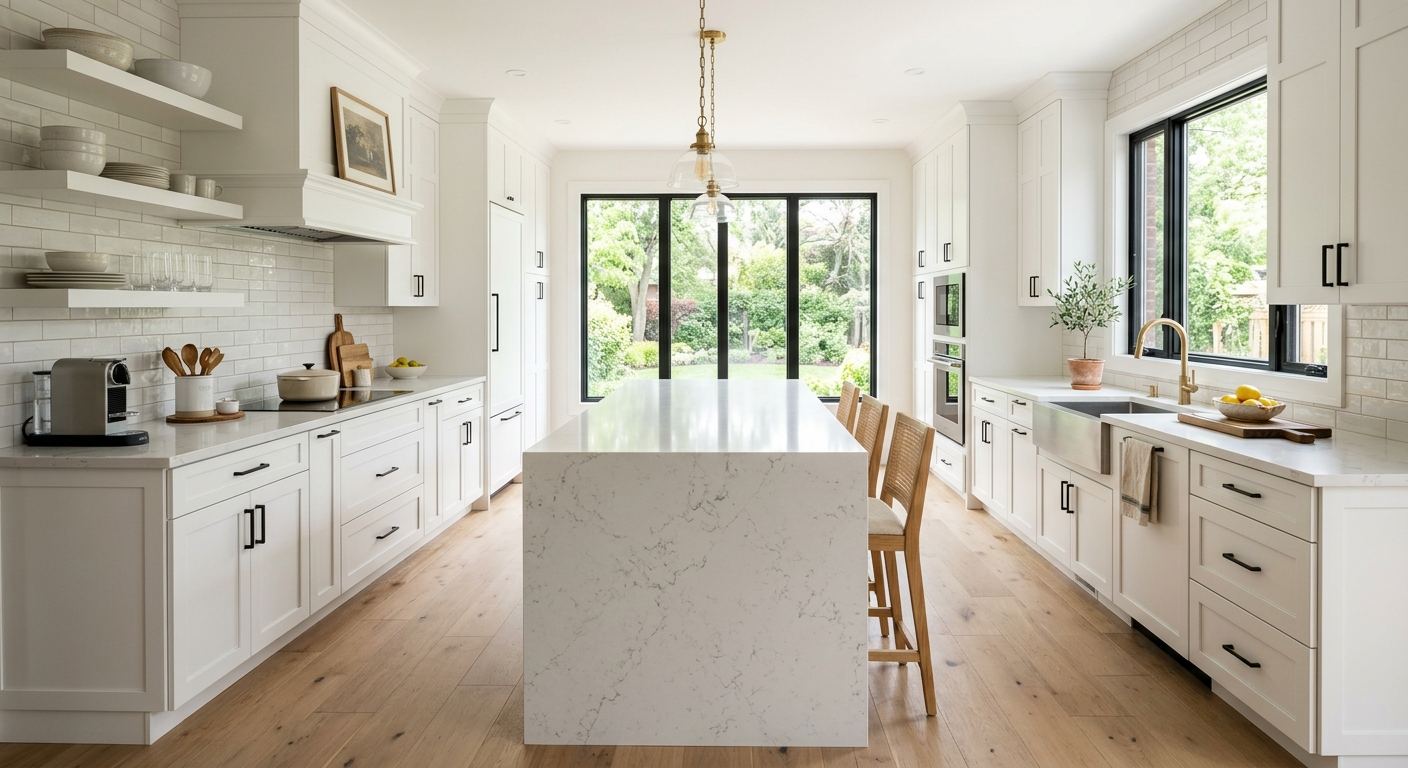
Kitchen renovation options and costs in West End
In West End, Ontario, kitchen renovations typically fall into one of six paths depending on how much you’re changing beyond the visible surfaces. Because the Toronto area tends to support higher finish expectations, many homeowners choose upgrades that align with local housing economics—especially in a neighbourhood like Parkdale where older homes are common and residents often renovate to modernize resale value. In the GTA, projects in higher-value pockets often skew toward custom cabinetry and premium surfaces; that’s consistent with how Ontario households plan spending around housing affordability and lifetime value. Locally, the profile shows a population of 4,142 in the Statistics Canada area reference (Statistics Canada, 2021 Census), and that kind of established residential base usually means steady contractor availability for scheduling, but it can also mean quicker material lead times when multiple reno crews are active.
Toronto costs are also influenced by market demand rather than weather. We do see colder, humid-to-freezing transitions that can affect drying times for finishes and the handling of adhesives, caulks, and sealants, but the bigger driver of price is still scope: finish tier, layout changes, and whether plumbing or electrical needs to be moved. A modest refresh might stay within the low–mid band, while a high-end build with an island and stone counters will push budgets toward the regional upper ranges. Use the table below to compare options, durations, and realistic budget targets for West End kitchens.
| Renovation Tier |
What's Included |
Typical Duration |
Price Range |
| Cosmetic refresh (paint, hardware, new appliances only) |
Cabinet paint or trim touch-ups, new pulls/knobs, appliance swap (range/fridge/dishwasher), minor caulking and alignment |
3–7 days |
$8,000–$18,000 |
| Mid-range full renovation (new cabinets, counters, sink, tile) |
New semi-custom or quality stock cabinets, quartz or laminate counters, sink + faucet, backsplash tile, new flooring prep/patching, basic lighting updates |
3–5 weeks |
$25,000–$60,000 |
| High-end full renovation (custom cabinets, stone counters, island) |
Fully custom millwork, natural stone or premium quartz countertops, island with upgraded power, enhanced backsplash (often full-height), under-cabinet lighting, higher-end appliances |
6–10 weeks |
$65,000–$90,000 |
| Cabinet refacing only (new doors + drawer fronts, same boxes) |
Door/drawer replacement, new drawer boxes/rollers where needed, new hardware, surface prep and finishing, backsplash tie-in as required |
1–3 weeks |
$8,000–$28,000 |
| Countertop swap only (laminate to quartz or stone) |
Remove existing tops, install new countertop and seams, sink cut-out and plumbing reconnect basics, polishing/seam treatment |
3–7 days |
$3,000–$15,000 |
| Backsplash tile installation only |
Tile supply + install, surface prep, grout/sealant, caulk details at countertops/cabinets |
2–5 days |
$2,000–$10,000 |
Prices are estimates only and vary by project scope, site access and material selection.
What affects the price of kitchen renovation in West End
In West End and across the Toronto economic region, two homeowners can receive quotes for “the same” kitchen renovation that differ by 30–50% because the allowance items are rarely identical. Some proposals include demo and disposal, electrical rough-ins, permit work, appliance installation, and flooring patching; others treat those as extras. The most powerful cost drivers are local housing economics (which influence finish tier) and layout changes (which influence labour and trade coordination). In higher-value Toronto pockets, many homeowners default to quartz or stone counters and semi-custom cabinetry because the upgrade is easy to justify on resale. In more price-sensitive GTA areas, laminate and stock cabinets are still common, keeping the project nearer the low–mid range while protecting resale value. This difference in finish strategy, not weather, is why budgets swing so much.
In West End specifically, older housing stock often includes original subfloors, out-of-level cabinets, and dated electrical panels tucked into tight cavities. Those conditions can raise labour time even if your finish tier stays modest. For example, if your current layout requires moving a sink drain or changing the supply line path, you’ll see costs jump faster than if you simply upgrade hardware or backsplash. Conversely, swapping laminate to quartz might stay within the $3,000–$15,000 countertop band when your existing base and sink cut-outs are compatible and your plumbing doesn’t move. Another common cost reducer: staying with stock cabinet dimensions where possible, so you avoid custom framing and extra cabinetry millwork. Meanwhile, adding an island or moving a gas line (where applicable) is usually the most unpredictable part of any quote, often pushing projects toward the $80k+ zone when multiple trades and infrastructure updates are required.
| Price Factor |
Why It Matters |
Cost Impact |
| Cabinet tier — stock vs. semi-custom vs. fully custom millwork |
Pricing changes with materials, door styles, internal features, and how much custom framing is required |
Can swing a full kitchen by the largest margin; stock keeps costs in the lower-mid range, custom pushes higher-end budgets |
| Countertop material — laminate vs. quartz vs. granite vs. stone |
Material cost, fabrication complexity (edges/seams), and installation time vary significantly |
Countertops alone can run from the low band to premium stone pricing; seam-heavy layouts increase labour |
| Layout change — wall removal, island add, plumbing/gas move |
Changing services (drain/supply/gas/electrical) drives demolition, patching, and licensed trade work |
Often the main source of a 30–50% quote spread even when finishes stay similar |
| Appliance package tier — builder vs. mid-range vs. pro-grade |
Energy efficiency, venting requirements, and rough-in needs differ by appliance family |
Can add several thousand dollars; pro-grade brands also increase install coordination time |
| Flooring — refinish existing vs. full replacement |
Protected or reused flooring lowers demo time; mismatched heights can require more underlayment/work |
Small refreshes may keep flooring minimal; full replacement can push budgets upward |
| Backsplash — ceramic tile vs. marble vs. full-height slab |
Tile patterning, specialty materials, and full-height coverage change both labour and material waste |
Typically a few thousand dollars range; marble/slab and full-height installs cost more |
| Electrical — new circuits for island, under-cabinet lighting |
New circuits and fixture wiring require certified electricians and inspection scheduling |
Can add noticeable labour and materials, especially if panel capacity or wiring paths are tight |
| Permit fees and licensed trade requirements |
Permits, inspections, and trade coordination influence project timing and overhead |
Varies by scope; complex service moves typically increase both cost and schedule risk |
Permits & regulations in Ontario
In Ontario, many common kitchen updates do not require permits—especially straightforward swaps like cabinet and countertop replacements when you’re not changing the plumbing, gas, or electrical infrastructure. If you’re only replacing existing cabinets with like-for-like boxes, swapping countertops, installing a new backsplash, or changing fixtures where supply connections remain in the same location, contractors typically handle it as a renovation without permit pulls. The rules change quickly when you alter systems: moving plumbing supply or drain lines usually triggers permit requirements, relocating a gas appliance (stove) or making changes to a range hood setup that involves gas work requires a licensed gas fitter and inspections, and removing a load-bearing wall typically requires permits plus an engineered approach where applicable. Adding new electrical circuits—for example, dedicated power for an island, new under-cabinet lighting wiring runs, or relocating outlets—usually requires a permit and licensed electrical work.
For West End homeowners, verify three things step-by-step before signing: (1) the contractor’s Ontario licence/registration status (where applicable for the trade), (2) liability insurance, and (3) WSIB/WCB coverage for workers. Ask for a copy of their certificate of insurance (include policy limits), plus a clearance letter or proof of coverage showing their workers are protected. Then, confirm that any licensed gas/electrical subcontractors provide their own proof of licensing and will coordinate inspections. Also confirm in the written contract who is pulling permits and who pays permit fees—this should be spelled out clearly, not implied.
Cabinets, countertops and layout decisions in West End
Your three most consequential decisions in a West End kitchen renovation are cabinet tier, countertop material, and layout. Cabinet tier affects both the look and the fit: stock units are fastest and lowest cost but can look “standard” in tight Toronto layouts; semi-custom is usually the sweet spot for most homeowners because it balances upgrades with manageable lead times; custom cabinetry offers the best fit in older homes with out-of-square walls and ceiling soffits, but it’s the highest cost. Countertops then determine durability and daily maintenance. Laminate is budget-friendly and easy to replace, quartz is the popular performance choice for busy households, and granite/stone add a premium, natural pattern but require more consideration around sealing and surface selection.
Finally, layout changes are where Toronto budgets become unpredictable. Removing a wall can create the open-concept feel buyers expect, but it comes with trade coordination and potential structural approvals. Adding an island can improve workflow in narrow West End kitchens, yet it often forces electrical (and sometimes plumbing) planning and can add substantial cost. If you want a concrete example: upgrading from laminate to quartz might fit within the $3,000–$15,000 countertop swap band when you keep the same footprint and seam strategy. But if you add an island and need new power plus longer countertop runs, you’ll usually move beyond a simple “swap” mindset and toward a full renovation budget (often $25,000–$90,000 depending on cabinet tier and whether you’re moving services).
Because our homes cycle through humid summers and cold winters, it’s smart to choose materials and sealants that tolerate seasonal movement. In practice, the best long-term value comes from a cabinet tier and countertop combination that match your layout complexity and your household’s cleaning habits—then adding only the layout moves that create real, usable space.
| Option |
Durability |
Maintenance |
Best For |
Price Range |
| Stock cabinets (big-box) |
Solid for everyday use; performance depends on door/drawer hardware and installation quality |
Low—clean with mild products; touch up minor nicks with matching products |
Budget-first refreshes and quick turnarounds |
$8,000–$25,000 |
| Semi-custom cabinets (local dealer) |
Better door/drawer options and fit; strong value for daily wear |
Low—same care as standard finishes; hardware upgrades help longevity |
Most West End renovations aiming for a modern look without custom pricing |
$20,000–$45,000 |
| Custom cabinets (local millwork shop) |
Best fit and materials; handles irregular spaces and specialty storage |
Low to moderate—premium finishes last, but hardware choice matters |
Challenging older-home layouts and high-end design goals |
$35,000–$70,000 |
| Laminate countertop |
Good for light use; can chip if impacts hit edges or if joints are poorly sealed |
Easy—wipe clean; avoid harsh abrasives near seams/edges |
Cost-conscious updates and resale-friendly upgrades |
$3,000–$8,000 |
| Quartz engineered countertop |
High—resists staining and most everyday damage; consistent performance |
Low—routine cleaning with non-abrasive products |
Busy families who want a “set and forget” surface |
$6,000–$15,000 |
| Granite / natural stone countertop |
Very durable; depends on stone choice and edge fabrication |
Moderate—sealing schedule varies by stone; avoid staining agents |
Premium look with natural movement and unique patterning |
$8,000–$18,000 |
| Butcher block countertop |
Durable with proper care; can show dents/scratches over time |
Moderate—oil regularly and use cutting boards |
Casual, warm kitchens and households that enjoy maintenance |
$5,000–$12,000 |
| Marble countertop |
Premium but softer than quartz; can etch with acids |
Higher—requires careful cleaning and periodic sealing |
Statement kitchens where appearance is the priority |
$10,000–$22,000 |
How to choose a kitchen renovation contractor in West End
Choosing the right contractor in West End is mostly about verification and clarity. Start by verifying Ontario licensing/registration where applicable, then confirm liability insurance (request the certificate of insurance and ensure it matches your project address) and proof of WSIB/WCB coverage for their workers. If they can’t provide documents quickly, that’s a meaningful risk signal. Next, get 2–3 itemised written quotes that separate labour and materials—don’t accept a “lump sum” without specifying demo/disposal, cabinetry install, countertop fabrication, plumbing/electrical allowances, flooring patching, and any permit-related labour. Reading the scope carefully matters: ask what’s excluded (e.g., subfloor repairs, drywall replacement, old countertop disposal, appliance installation, leveling/shimming, or any structural/engineered items).
Warranty should be explicit. Ask for workmanship warranty length and what it covers, plus the manufacturer warranty on cabinets, countertops, and appliances. Confirm whether the warranty is transferable to you if you sell. For payments, use a staged schedule: keep upfront deposits to no more than 10–15%, and set a holdback tied to completion and punch-list items. Finally, get a start date and completion estimate in writing, including key dependencies like cabinet lead times and countertop fabrication slots. In a busy GTA market, timeline management is part of quality.
- Ask for WSIB/WCB clearance proof and confirm worker coverage applies to your job site.
- Request liability insurance certificate and verify policy limits are appropriate for renovations.
- Get 2–3 itemised quotes with line-by-line labour and material breakdowns.
- Confirm whether demolition and disposal are included (dump fees, haul-away, recycling/landfill).
- Verify permit responsibility in the contract (who pulls permits and who pays fees).
- Check that licensed trades (gas/electrical/plumbing) are specified for any service changes.
- Review cabinet installation details: shimming/leveling approach and mounting method.
- Confirm countertop template, seam strategy, and who handles sink cut-outs and reconnections.
- Ensure flooring scope is clear: patching, underlayment, or full replacement.
- Ask about backsplash scope: surface prep, waterproofing behind tile (as applicable), grout type.
- Get warranty terms in writing, including workmanship start date and length.
- Use a payment schedule with holdback until punch-list completion and cleanup standards are met.
Common West End red flags include: quotes that don’t list disposal and patching scope, vague allowances for cabinets/counters that shift after demolition, missing proof of WSIB/WCB or insurance, pressure to pay large deposits early, and no clear written timeline (especially when cabinets and countertops have lead times).
Frequently asked questions — kitchen renovation in West End
What is the difference between a galley and open-concept kitchen?
In West End (and across Ontario), a galley kitchen is a layout with counters on two parallel walls, often creating a highly efficient work triangle but limited open space. An open-concept kitchen removes barriers between the kitchen and living/dining areas, giving you sightlines and easier entertaining. Cost-wise, open-concept projects usually carry higher risk because wall removal can trigger permits and licensed trade involvement, plus you may need electrical rework for lighting and outlets. If you keep plumbing/gas in place, budgets can stay closer to mid-range totals; if you relocate services, it can push a job toward full-renovation pricing in the $25,000–$90,000 band.
How do I get accurate kitchen renovation quotes in West End?
To get accurate quotes in West End, provide consistent information: a floor plan, your appliance list (or desired package tier), photos, and whether you plan to move plumbing, gas, or electrical. Ask for itemised labour and materials (not a single lump sum) so you can compare apples-to-apples across contractors. Confirm what’s included for demo/disposal, drywall patching, and whether permits are included in the price. A reliable contractor will also confirm cabinet dimensions, countertop overhangs, and backsplash coverage before quoting. If the scope is “unknown,” quotes can vary by 30–50% because allowances change after demolition.
What's the best countertop material for a busy West End kitchen?
For most busy households in West End, quartz is the top practical choice: it’s durable, resists staining, and typically needs only routine cleaning with non-abrasive products. Laminate is the budget-friendly option, but it can be more vulnerable at seams and edges over time, particularly with heavy daily use. Natural stone like granite looks premium and offers strong durability, but marble and some stones require more careful maintenance (sealing schedules, protection from acidic spills). In pricing terms, quartz often aligns with the $6,000–$15,000 countertop band for typical installs, while laminate projects are usually lower—useful if you’re keeping the renovation closer to the modest refresh end.
How do I add an island to my West End kitchen?
Adding an island starts with spacing and circulation: you need enough clearance for comfortable traffic in a typical Toronto home. Then you plan services. If you’re only adding seating and storage, you may be able to keep plumbing in place, but you’ll still likely need electrical for pendant lights or outlets. If you want a sink or dishwasher in the island, relocating plumbing supply/drain lines typically increases complexity and may require permits and licensed trades. Expect the budget to move beyond a simple countertop swap and into a full renovation mindset depending on cabinet tier and whether you’re changing layout walls. Your contractor should provide a drawing showing power locations and countertop support before fabrication.
How much does a kitchen renovation cost in West End?
In West End, realistic full-kitchen budgets commonly land from the mid-$20k range to the upper $80k+ range depending on scope and finish tier. A mid-range full renovation (new cabinets, counters, sink, and tile) is often around $25,000–$60,000, while high-end builds with custom cabinetry, stone counters, and an island commonly move into the $65,000–$90,000 territory. If you’re not replacing everything, you can reduce cost: cabinet refacing typically falls in the $8,000–$35,000 band, and a countertop swap might be $3,000–$15,000. The largest swings usually come from moving plumbing/electrical/gas and from choosing custom millwork versus semi-custom or stock.
How long does a kitchen renovation take in West End?
Timing depends on scope and material lead times, which are generally consistent across the GTA market. A cosmetic refresh can often be completed in about 3–7 days. A mid-range full renovation usually takes around 3–5 weeks, while high-end projects with custom cabinetry and an island often run 6–10 weeks. Countertop swaps can be as quick as 3–7 days, and backsplash tile-only installs are commonly 2–5 days. Where delays happen most often is countertop fabrication slot availability and cabinet lead times, plus inspection scheduling when electrical or plumbing permits are required. Build a buffer into your timeline and make sure the contract confirms start/completion dates and trade availability.