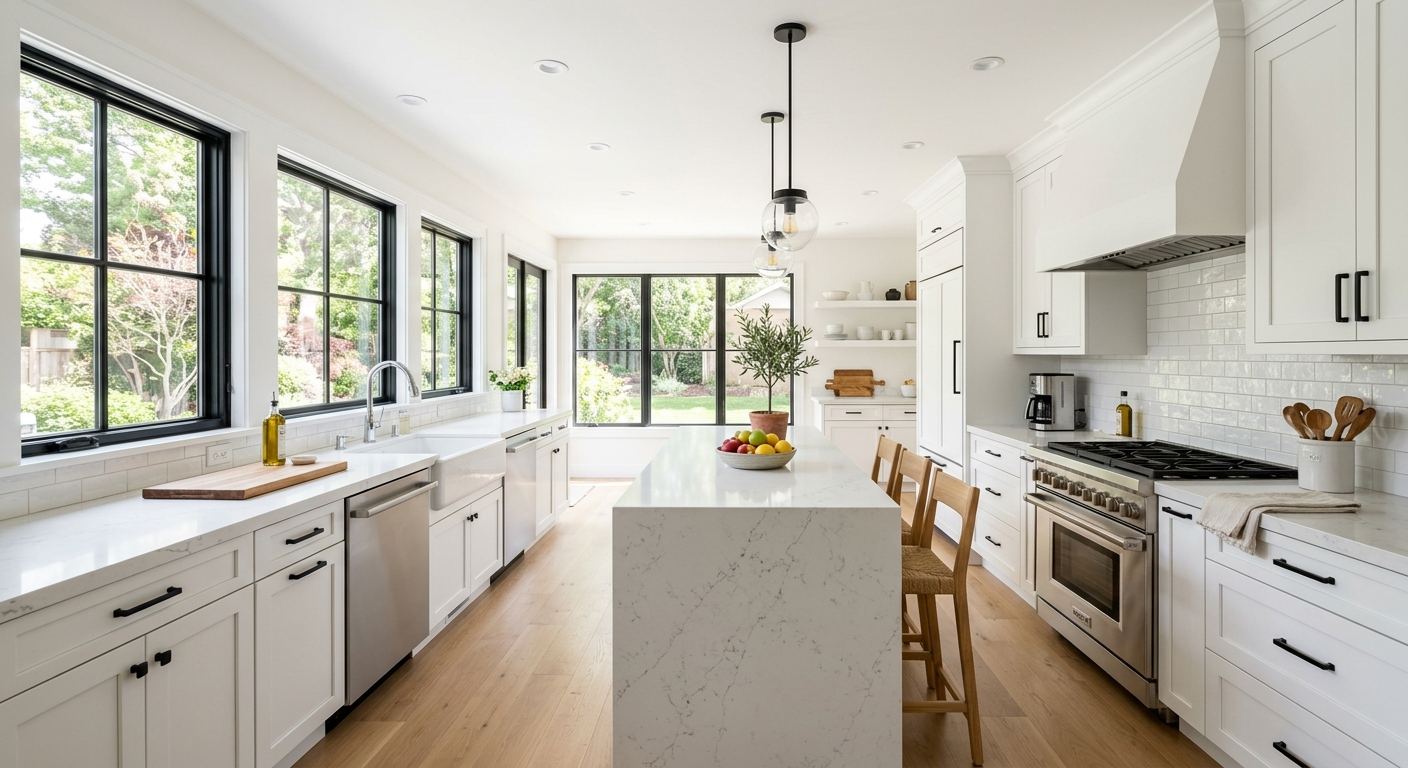
Kitchen renovation options and costs in Emo
Emo homeowners usually choose between a cosmetic refresh, a mid-range full renovation, or a higher-end upgrade—mainly based on what buyers expect and how much they want to spend upfront. With a small town population of 1,204 and about 355 homeowner households (Statistics Canada, 2021 Census), most projects are owner-driven and tend to focus on durable, easy-maintenance finishes that hold value. The median household income in the area sits around $94,000 (Statistics Canada, 2021 Census), which is why many renovations land in the basic-to-mid Ontario cost bands rather than jumping straight to top-tier custom millwork.
In Northwestern Ontario, renovation budgets track local home values and incomes more than cold-weather construction details. Still, the region’s winter conditions matter in the background: contractors need to plan for longer drying/curing times for tile and adhesives, and ventilation and air-sealing work often comes up during electrical and cabinetry installs. Trade availability also affects schedules—good cabinet and countertop lead times can move your completion date, even when labour is ready. In Emo, we also see extra demand around the main residential areas off the highway and in older neighbourhoods where homes built before 1981 make up 54.3% of the housing stock (Statistics Canada, 2021 Census).
To help you compare apples-to-apples, use the tiers below as a realistic starting point for pricing and timing—then we’ll fine-tune scope based on your layout and material selections.
| Renovation Tier |
What's Included |
Typical Duration |
Price Range |
| Cosmetic refresh (paint, hardware, new appliances only) |
Cabinet paint or refinishing, new hardware, lighting refresh (swap-in fixtures), appliance package, minor touch-ups |
1–3 weeks |
$5,000–$15,000 |
| Mid-range full renovation (new cabinets, counters, sink, tile) |
Semi-custom or quality stock cabinets, new countertop, sink and faucet, backsplash tile, new flooring treatment (if needed), plumbing/electrical tie-ins |
4–8 weeks |
$30,000–$60,000 |
| High-end full renovation (custom cabinets, stone counters, island) |
Custom cabinetry, upgraded stone counters, island fabrication/installation, enhanced lighting (including under-cabinet), larger-format tile or feature backsplash |
7–12 weeks |
$60,000–$90,000 |
| Cabinet refacing only (new doors + drawer fronts, same boxes) |
Door/drawer replacement, new hardware, touch-up paint to boxes, backsplash allowance (optional add-on) |
2–5 weeks |
$6,000–$22,000 |
| Countertop swap only (laminate to quartz or stone) |
Remove and replace existing countertop, new sink cut-out if needed, basic sealing/support checks, disposal and install labour |
1–3 weeks |
$2,500–$12,000 |
| Backsplash tile installation only |
Tile supply (basic to premium depending on selection), install, grout/seal, edge finishing and clean-up |
1–2 weeks |
$1,500–$8,000 |
Prices are estimates only and vary by project scope, site access and material selection.
What affects the price of kitchen renovation in Emo
Even when two Emo homeowners request the same end result, quotes can swing by 30–50% across Northwestern Ontario and the wider province. The big reason isn’t climate—it’s scope, finish tier, and how much of the job involves trades that require scheduling and permits. In higher-value pockets of Northwestern Ontario (where homeowners are more likely to recover costs on resale), people often default to quartz or natural stone counters and semi-custom cabinetry because buyers notice those upgrades quickly. In more modestly priced homes, laminate or entry-level quartz with stock cabinets is a common way to control both material and install costs, while keeping layout changes minimal. That’s why the same “full reno” label can land anywhere from the basic band around $30,000–$60,000 up to the upper tier near $60,000–$90,000.
In Emo specifically, several local conditions push pricing up or down. Homes built before 1981 (54.3% of local housing stock, Statistics Canada, 2021 Census) tend to have older electrical runs and dated plumbing configurations, so adding an island or moving a sink often triggers additional labour and sometimes uncovered repair work once cabinets come off. Also, winter delivery and installation planning matters: if you’re installing large-format tile or quartz, scheduling around cold indoor conditions can affect cure times and crew sequencing.
Concrete examples: (1) If you add an island, expect unpredictability from electrical and plumbing tie-ins more than from cabinet style. (2) If your current base cabinets are out of square (common in older homes), labour for shimming/levelling can rise even with stock cabinets. (3) If you go from laminate to quartz, the countertop jump is usually straightforward—while stone upgrades and complex edge profiles are where the real variance shows up.
| Price Factor |
Why It Matters |
Cost Impact |
| Cabinet tier — stock vs. semi-custom vs. fully custom millwork |
Different build quality, sizes, internal organization, and lead times; custom also demands more shop labour and fit-up time. |
$6,000–$35,000 |
| Countertop material — laminate vs. quartz vs. granite vs. stone |
Material price per square foot and fabrication complexity; premium edges, cut-outs, and seams increase cost. |
$2,500–$12,000 |
| Layout change — wall removal, island add, plumbing/gas move |
Remodelling the services is labour-intensive and may require permits, inspections, and more coordination between trades. |
$5,000–$25,000 |
| Appliance package tier — builder vs. mid-range vs. pro-grade |
Oven/range, ventilation, and specialty features affect both purchase price and electrical/plumbing rough-in complexity. |
$3,000–$15,000 |
| Flooring — refinish existing vs. full replacement |
Tile under cabinets/around new island footprints can add labour, and older subfloors may need prep work. |
$1,500–$8,000 |
| Backsplash — ceramic tile vs. marble vs. full-height slab |
Premium materials, larger panels, and full-height installs increase measuring, cutting, and installation time. |
$1,500–$8,000 |
| Electrical — new circuits for island, under-cabinet lighting |
Adding outlets, upgrading lighting circuits, and integrating power into islands drives labour and parts costs. |
$1,000–$7,000 |
| Permit fees and licensed trade requirements |
When plumbing, gas, structural, or electrical scope triggers permits, you pay for compliance and inspection scheduling. |
$500–$5,000 |
Permits & regulations in Ontario
In Ontario, most straightforward cosmetic swaps don’t need permits—like painting cabinets, swapping hardware, replacing like-for-like countertops, or installing a new backsplash on existing surfaces. Cabinet and countertop swaps typically don’t require permits because you’re not changing plumbing or gas infrastructure. However, permits and licensed trades become part of the project if you move systems or change building elements.
Work that does typically require permits (and usually inspections) includes: moving plumbing supply or drain lines (sink relocation, dishwasher relocation, adding a second sink), relocating gas components such as a stove/range or range hood connected to gas, removing a load-bearing wall (or doing structural modifications), and adding new electrical circuits or major upgrades (for example, wiring an island with multiple outlets or under-cabinet lighting that changes circuit capacity). Gas work must be done by a licensed gas fitter, and electrical work by a licensed electrician; both generally need inspection sign-offs before you proceed to finishes.
Step-by-step verification for Emo homeowners: (1) Ask your contractor for their licence numbers and confirm them using the Ontario public registries. (2) Request a certificate of insurance (liability) and verify the coverage matches your project type. (3) For contractor coverage and protection, ask about clearance documentation/WSIB/WCB coverage (or exemption if applicable) and keep copies in your contract package. (4) Confirm in writing who pulls permits and who pays fees—permit responsibility must be clearly stated before you sign.
Cabinets, countertops and layout decisions in Emo
The three biggest decisions in any Emo kitchen renovation are (1) cabinet tier, (2) countertop material, and (3) layout changes. These choices drive both your feel-at-first look and your long-term cost, especially in older housing where surfaces and substructure can be less predictable. For cabinets, stock is the fastest and cheapest option, semi-custom is the sweet spot for fit and organization, and custom gives you the best layout-specific fit—but at a higher price and usually longer lead time. For countertops, laminate is budget-friendly and easy to maintain day-to-day, quartz offers consistent performance, granite/natural stone brings character, and butcher block adds warmth but needs more attention to sealing.
Layout is where budgets jump beyond finish selection. If you remove a wall for open-concept flow, add an island, or relocate plumbing/gas for a new sink or cooktop, you’re paying for demolition, re-framing, electrical, plumbing tie-ins, and potential permits—regardless of whether you choose laminate or quartz. In Northwestern Ontario, that’s particularly important because many homes were built before 1981; once cabinets come out, you often uncover older electrical or uneven floors that add prep time.
When is it justified by the space gain? A simple example: upgrading from a mid-tier laminate countertop to quartz may add some cost, but it usually stays within a predictable band for install. By comparison, adding an island with power and relocating a sink can push your project toward the higher full-renovation range because the service work is what changes the labour demand. That’s why many homeowners aim for a mid-range build when they want quartz and updated tile, then reserve the biggest layout changes for the high-end tier when the room size supports it.
| Option |
Durability |
Maintenance |
Best For |
Price Range |
| Stock cabinets (big-box) |
Good day-to-day durability; limited sizing can require compromises in fit. |
Basic cleaning; touch-ups depend on finish quality. |
Fast renovations that prioritize budget control and timeline. |
$6,000–$16,000 |
| Semi-custom cabinets (local dealer) |
Very durable with more size options, better internal organization and hardware choices. |
Minimal; wipe down as usual, keep moisture away from edges. |
Most Emo renos aiming for a balanced look and practical storage. |
$16,000–$28,000 |
| Custom cabinets (local millwork shop) |
Excellent fit and finish; designed to your exact room conditions. |
More care to maintain premium finishes, but still straightforward. |
Uneven/older layouts, high-end storage needs, and premium resale presentation. |
$28,000–$45,000 |
| Laminate countertop |
Decent for normal use; seams and edges are the usual weak points. |
Easy daily cleaning; avoid prolonged standing water at seams. |
Budget-focused refresh where you keep the layout mostly unchanged. |
$2,500–$5,500 |
| Quartz engineered countertop |
Very durable and consistent; resists staining better than most natural options. |
Low maintenance; wipe and keep it dry around cut edges. |
Most mid-range full renovations that want a premium look without extra upkeep. |
$4,500–$10,000 |
| Granite / natural stone countertop |
Durable; unique pattern and hardness vary by stone type. |
Often benefits from periodic sealing; clean spills promptly. |
Homeowners who want natural visual character and premium resale appeal. |
$7,000–$12,000 |
| Butcher block countertop |
Strong but can scratch; sensitive to heat and moisture at seams. |
Regular oiling and careful drying—especially in winter humidity swings. |
Warm, casual kitchens and people who don’t mind light upkeep. |
$4,000–$9,000 |
| Marble countertop |
Beautiful but softer; can etch/stain if not protected. |
Higher maintenance—use proper cleaners and seal appropriately. |
Premium kitchens where homeowners want a luxury look and careful care. |
$8,000–$14,000 |
How to choose a kitchen renovation contractor in Emo
Choosing the right contractor in Ontario starts with checking credentials and coverage, not just the price. For Ontario licensing, ask for their licence details and then confirm them in the provincial licensing listings (for the relevant trade categories, especially electrical and gas if your scope includes them). Next, request a certificate of liability insurance and verify the coverage dates and project limits. For coverage related to workers, ask about WSIB/WCB status—get documentation or clearance information, not verbal assurances. Keep copies with your contract so you’re protected if something goes wrong.
For quotes, get 2–3 itemised estimates that separate labour and materials (cabinets, counters, tile, electrical/plumbing tie-ins, disposal). Don’t accept only a lump-sum number with vague line items. Read the scope line by line: what’s excluded (old floor prep, subfloor repairs, drywall patching), whether disposal is included, and whether permits are included or billed separately. Warranty matters too—confirm the workmanship warranty length, whether product warranties are provided by the manufacturer, and if any warranty is transferable if you sell. Payment schedule should be controlled: never pay more than 10–15% upfront, and hold back a final portion until the job is fully complete and the punch list is signed off. Finally, ask for a written start date and completion estimate based on material lead times; in Emo, cabinet and countertop scheduling can be the critical path.
- Confirm Ontario licence for any subcontracted trades (electrical, gas) that your plan includes.
- Request proof of liability insurance before work starts; verify coverage limits.
- Ask for WSIB/WCB documentation/clearance details and keep it in your contract file.
- Get 2–3 itemised quotes with labour and materials broken out, not just totals.
- Ensure the quote specifies which cabinet tier and countertop grade you’re paying for.
- Confirm whether permit pulling is included and who is responsible if permits are required.
- Ask whether demolition, debris removal, and disposal are included.
- Check if electrical/plumbing rough-in and inspections are included in the pricing.
- Verify warranty terms: workmanship duration, exclusions, and how claims are handled.
- Review payment schedule: target 10–15% maximum upfront and a holdback until completion.
- Ask for a written timeline with milestones for demo, cabinet install, countertop templating, and final finishes.
- Make sure the contract includes change-order rules and how extras are priced if conditions change.
Red flags we commonly see in Emo: contractors who won’t provide insurance or licence numbers, quotes that aren’t itemised (no line items for cabinets/counters/tile), “guarantees” that don’t mention warranty in writing, schedules that ignore countertop templating lead times, and requests for large upfront deposits (well beyond 10–15%) or no formal contract/change-order process.
Frequently asked questions — kitchen renovation in Emo
How do I add an island to my Emo kitchen?
Adding an island in Emo usually comes down to whether you need power and plumbing. If you want outlets, under-cabinet lighting, or a range hood plan that changes the electrical load, you’re typically looking at an electrical scope that may require a permit and a licensed electrician. If the island includes a sink or you relocate a gas cooktop, that’s a bigger project—moving plumbing supplies/drains or relocating gas requires permits and licensed trades, plus inspections. Cost-wise, most island additions get priced based on services and finishes, not just the cabinet box. A mid-range full renovation in Emo commonly sits around $30,000–$60,000, while projects that include meaningful layout/service changes can trend toward $60,000–$90,000.
How much does a kitchen renovation cost in Emo?
In Emo, kitchen renovation cost usually aligns with the provincial “basic to mid-range” Ontario bands, then rises with finish tier and whether you change the layout. For a starting reference, a full kitchen renovation is commonly budgeted in the $30,000–$90,000 range. If you’re keeping the layout and focusing on a cosmetic-to-light refresh, you may be closer to the lower end—while a high-end approach (custom cabinets, stone counters, island) pushes you toward the top tier. In older housing—54.3% of local homes were built before 1981 (Statistics Canada, 2021 Census)—expect occasional added labour for leveling, drywall patching, and unexpected electrical/plumbing updates once cabinets come out. That’s why two similar kitchens can land 30–50% apart: the “hidden” variability is usually layout and service work.
How long does a kitchen renovation take in Emo?
Timelines in Emo depend mostly on cabinet and countertop lead times, plus whether you’re doing electrical/plumbing work that needs inspections. A cosmetic refresh can be fast—often 1–3 weeks—because you’re mostly painting, swapping hardware, and setting new appliances. A mid-range full renovation typically takes 4–8 weeks when materials are ordered promptly and the scope is mostly surface-level. If you add an island, change services, or choose custom cabinetry/stone counters, you should plan for 7–12 weeks. Winter scheduling also matters: colder indoor conditions can slow curing and finishing work, especially for tile setting and adhesives. If you’re shopping right now, book your consultation early so you can lock down cabinet orders and countertop templating dates, which are usually the critical path.
Quartz vs granite countertops — which is better?
Quartz and granite both look great, but “better” depends on how you cook and how hands-on you want to be with maintenance. Quartz is engineered for consistency and typically resists staining and everyday wear very well, which is why many homeowners in Ontario choose it for a durable, low-maintenance kitchen upgrade. Granite is a natural stone with unique veining and character; it’s tough but often benefits from sealing and prompt cleaning to protect against staining, depending on the stone. In Emo’s renovation budgets, quartz usually fits the predictable mid-range install pricing, while natural stone can move you toward the higher end—especially with larger slabs, premium edges, and additional cut-outs. If you want a straightforward upgrade from laminate, quartz is often the easiest “value-per-look” choice within the $4,500–$10,000 style band; granite commonly sits closer to the upper spectrum around $7,000–$12,000.
Should I reface or replace my cabinets?
Refacing is usually the smart move when your existing cabinet boxes are structurally sound, the layout is staying put, and you mainly want a refreshed look. You get new doors and drawer fronts at a lower cost and usually a shorter timeline. Replacement is the better option when boxes are damaged, the frame is out of square, or you want to change the layout/storage system (like adding pull-outs, deeper drawers, or changing sizes for an island concept). In Emo’s older housing stock (54.3% built before 1981, Statistics Canada, 2021 Census), refacing can be limited if the boxes have moisture issues or severe wear behind the scenes. Price-wise, cabinet refacing commonly lands around $6,000–$22,000, while replacing cabinets as part of a full mid-range renovation often sits within $30,000–$60,000 depending on countertop/tile scope.
Do I need a permit for a kitchen renovation in Ontario?
In Ontario, many kitchen renos don’t require a permit—like swapping countertops, installing a backsplash, or replacing appliances—because you aren’t altering the building systems. But permits are typically required when you move plumbing supply/drain lines, relocate gas appliances or gas-connected components, remove or alter load-bearing walls, or add new electrical circuits (for example, wiring outlets/lighting for an island). In practice in Emo, the permit decision usually comes down to service scope, not finish choices. Gas work must be done by a licensed gas fitter, and electrical by a licensed electrician; both require inspections in many scenarios before you close up walls and complete finishes. Before signing, confirm in writing who pulls the permits and whether they’re included in the quote—permit responsibility should be clearly stated in your contract.