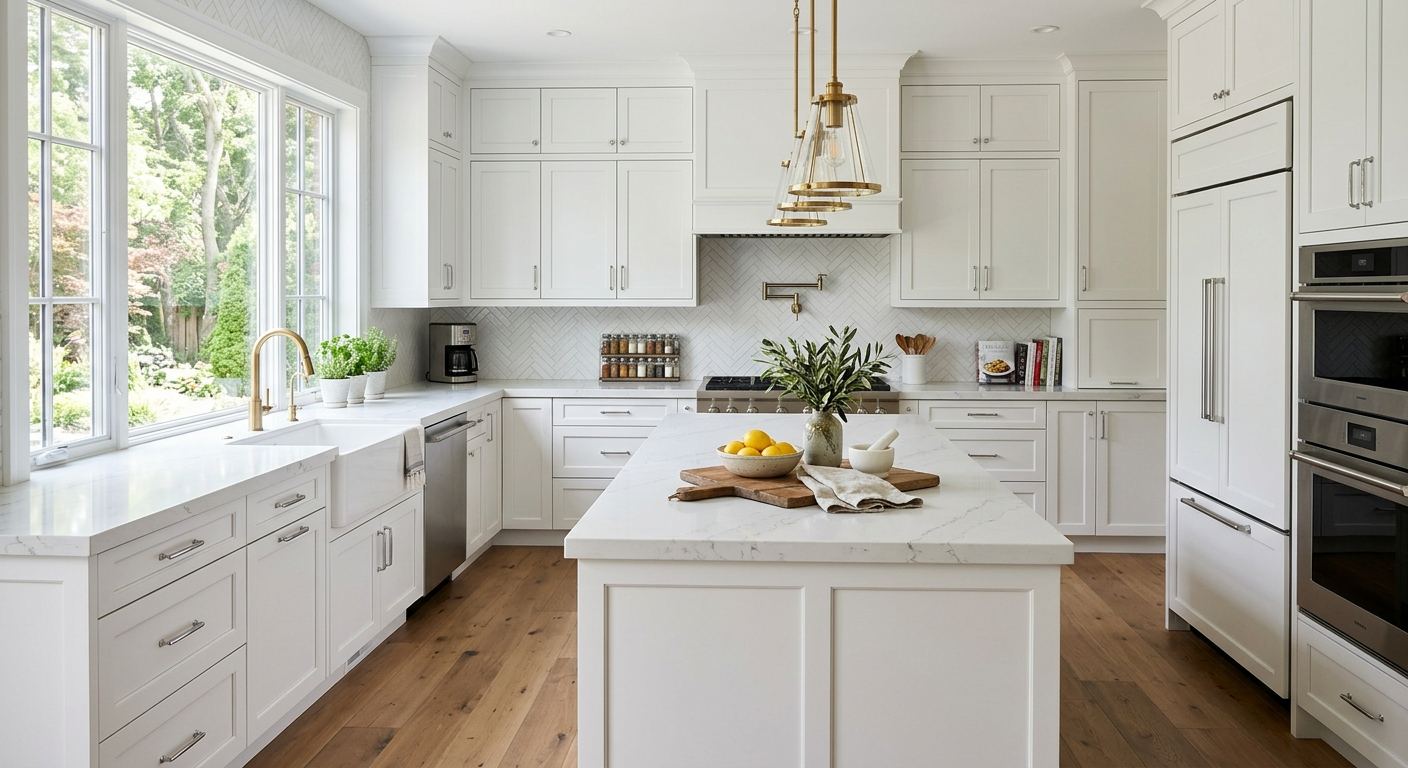
Kitchen renovation options and costs in Eastbridge
Kitchen renovations in Eastbridge typically follow the broader Toronto economic region pattern: the local housing market and household buying expectations influence what homeowners want to spend. With a population of 6,840 in 2021 (Statistics Canada, 2021 Census), many homeowners are focused on practical updates that still read “updated” to future buyers. In higher-value pockets of the GTA, it’s common for owners to invest a larger share of the home value into the kitchen—often around 8% to 15%—which nudges choices toward semi-custom or custom cabinetry, quartz, upgraded hardware, and more substantial appliance packages.
In Toronto-area projects, the biggest cost swings usually aren’t driven by climate. Eastbridge does see freeze-thaw cycles and seasonal humidity that can affect caulking, grout, and long-term sealing—so we pay special attention to countertop support, backsplash sealing, and moisture-tolerant finishes. Contractor availability and material lead times can be seasonal and market-driven, especially when many homeowners schedule renovations to finish before school-year and holiday selling periods. Also, kitchen projects in older housing stock often require additional time for electrical corrections, plumbing tie-ins, and wall condition checks, which changes the labour estimate even when the finishes look similar.
In Eastbridge, the trade is especially in demand around the established residential areas where homeowners are preparing homes for resale and improving traffic-flow between living and dining spaces. From there, the budget path usually splits into cosmetic refreshes, mid-range full renovations, and high-end custom builds—so next, use the table below to compare typical scopes and realistic price bands.
| Renovation Tier |
What's Included |
Typical Duration |
Price Range |
| Cosmetic refresh (paint, hardware, new appliances only) |
Paint, new cabinet hardware, appliance swap (no plumbing/gas moves), backsplash touch-ups (if applicable) |
3–7 days |
$6,000–$20,000 |
| Mid-range full renovation (new cabinets, counters, sink, tile) |
Cabinet installation (stock/semi-custom), new countertops, sink swap, backsplash tile, disposal/dishwasher tie-ins, basic electrical adjustments |
2–4 weeks |
$25,000–$60,000 |
| High-end full renovation (custom cabinets, stone counters, island) |
Custom millwork, quartz or natural stone counters, island build, upgraded appliance package, full backsplash, enhanced lighting and trim details |
4–8 weeks |
$60,000–$90,000+ |
| Cabinet refacing only (new doors + drawer fronts, same boxes) |
Refacing veneer/laminate, new door/drawer fronts, new hardware, matching trim (no structural moves) |
1–2 weeks |
$8,000–$35,000 |
| Countertop swap only (laminate to quartz or stone) |
Remove existing top, new quartz/stone or laminate replacement, edge profile changes, sink cut-out adjustments (as needed) |
3–7 days |
$5,000–$15,000 |
| Backsplash tile installation only |
Demo (as needed), layout, tile supply and install, sealing/grout, finish trim around outlets |
2–5 days |
$2,000–$10,000 |
Prices are estimates only and vary by project scope, site access and material selection.
What affects the price of kitchen renovation in Eastbridge
In Eastbridge and the wider Toronto economic region, quotes for the “same” kitchen can swing by 30% to 50% because contractors price different hidden conditions and different finish expectations. Even when the cabinet layout and square footage look identical, local choices in real estate-focused areas often push homeowners toward more premium tiers—custom millwork and quartz or stone—because buyers tend to notice countertops, cabinet fronts, and how seamless the backsplash looks. On the flip side, when the goal is resale value on a tighter budget, many homeowners choose stock or refacing approaches and pair them with solid mid-range countertops, keeping the project anchored to more predictable ranges like $25,000–$60,000 for a mid-range full renovation or $8,000–$35,000 for cabinet refacing-only.
Local home value and household income shape the finish tier far more than climate. In higher-value Toronto pockets, homeowners often default to quartz or natural stone because the visual impact reads as “renovated” and the cost is easier to recover at resale. In more price-sensitive areas, laminate and stock cabinets still dominate, because they reduce labour intensity and keep the ROI stronger. Meanwhile, layout changes add the most unpredictability regardless of finish tier—removing a wall, adding an island, or moving a gas line or plumbing can trigger extra demolition, new rough-in work, and drywall/electrical patching.
Concrete examples we see in Eastbridge: (1) older kitchens may have undersized electrical runs, so adding under-cabinet lighting and an island circuit can add labour even if you “only” change cabinets; (2) exterior-wall kitchens often have more temperature swings that make proper insulation behind tile and reliable sealing around the sink critical—if ignored, grout issues show up sooner; (3) if you’re installing a quartz top over an older cabinet box without correcting for level, the installer’s time increases to prevent lippage or stress cracks. These variables determine whether your job lands closer to the $25,000–$90,000 full-kitchen range or stays mid-range by keeping plumbing and layout stable.
| Price Factor |
Why It Matters |
Cost Impact |
| Cabinet tier — stock vs. semi-custom vs. fully custom millwork |
Higher-end systems cost more in materials and labour time for fitting, hinges, and specialty mouldings |
~+$5,000 to +$30,000 depending on tier |
| Countertop material — laminate vs. quartz vs. granite vs. stone |
Premium slabs are heavier and require more precise templating/support and often higher install charges |
~+$3,000 to +$15,000+ |
| Layout change — wall removal, island add, plumbing/gas move |
Rough-in work, structural checks, patching, and inspections increase both labour and schedule risk |
~+$5,000 to +$25,000+ |
| Appliance package tier — builder vs. mid-range vs. pro-grade |
Pro-grade units can require different clearances, ventilation, and sometimes electrical upgrades |
~+$1,500 to +$12,000+ |
| Flooring — refinish existing vs. full replacement |
Keeping existing reduces demo/dust and makes timing tighter; replacing adds subfloor and installation work |
~+$500 to +$6,000 |
| Backsplash — ceramic tile vs. marble vs. full-height slab |
Full-height and natural stone increase cutting complexity, sealing needs, and material waste |
~+$1,000 to +$8,000+ |
| Electrical — new circuits for island, under-cabinet lighting |
Adding circuits, dedicated breakers, and code-compliant receptacle placement drives licensed work |
~+$800 to +$5,000+ |
| Permit fees and licensed trade requirements |
When plumbing, gas, structural changes, or electrical additions are involved, licensing/permits add cost and time |
~+$500 to +$4,000+ |
Permits & regulations in Ontario
In Ontario, a straightforward cabinet and countertop swap typically does not require a permit because you’re finishing surfaces and replacing fixtures without altering building services. However, permits and licensed trades become necessary when the work affects plumbing/drain lines, gas, electrical circuits, or structure. In practical terms for an Eastbridge kitchen, the work that usually does NOT require a permit includes: painting, replacing cabinet doors and drawer fronts (refacing), installing new cabinets on existing locations, swapping countertops, installing a backsplash, and replacing a plug-in appliance that doesn’t require changes to gas plumbing or electrical circuits.
The work that does typically require permits includes: moving a sink’s water supply or drain location, relocating a range hood tied to a gas or changing the venting path, relocating plumbing shutoffs, moving a gas stove or range, removing or modifying a load-bearing wall, adding new or upgraded electrical circuits (for example, under-cabinet lighting with new wiring, an island receptacle circuit, or upgrading service capacity), and any other work that changes how services are routed through the home.
Step-by-step for homeowners: (1) ask for the contractor’s Ontario licence information where applicable and confirm trade coverage; (2) request a certificate of insurance (liability) and check the policy is current and includes the project address; (3) ask how they handle WSIB/WCB (or equivalent clearance) and request proof of coverage/clearance letter; (4) verify that the licensed trades involved (gas fitter and electrician, when used) are the ones pulling permits and scheduling inspections. Confirm permit responsibility in writing before the work starts—don’t assume it’s “automatic.”
Cabinets, countertops and layout decisions in Eastbridge
The three most consequential decisions in an Eastbridge kitchen renovation are the cabinet tier, the countertop material, and whether you change the layout. Start with cabinets: stock units are typically the fastest and cheapest because they’re designed for standardized sizing and fewer custom adjustments. Semi-custom cabinets—popular in Toronto-area renovations—balance better styling options and fit with predictable lead times. Custom cabinets are the highest cost, but they shine when you want perfect ceiling-to-floor integration, specialty storage, or an island built to your exact workflow.
Next, countertops. Laminate can deliver a clean look for less, and it’s budget-friendly to replace later, but it’s less resilient to heat and heavy impact over time. Quartz is the most common “sweet spot” in this region because it’s durable and low-maintenance, and it tends to hold up well through the province’s seasonal freeze-thaw and humidity swings. Granite and other natural stones are beautiful and durable, but they require periodic sealing and careful attention to installation support. Butcher block can add warmth, but it needs sealing and consistent care to avoid swelling around the sink zone; marble is a luxury option and is more sensitive to staining and etching if you’re not disciplined with maintenance.
Finally, layout. Removing an open-concept wall or adding an island can be justified when it improves real daily circulation—especially in family homes. But if the goal is primarily cosmetic, keeping plumbing and gas where they are can protect your budget; layout changes are where costs can jump quickly. For a specific example: upgrading from laminate to quartz might add several thousand dollars, but it’s often still easier to justify than moving plumbing or re-routing a gas line, which can push you into major full-renovation territory.
| Option |
Durability |
Maintenance |
Best For |
Price Range |
| Stock cabinets (big-box) |
Good for standard measurements; can be less flexible for odd angles or ceiling heights |
Low day-to-day maintenance; hinges and alignment depend on installation quality |
Time-sensitive refreshes and budget-focused renovations |
$8,000–$25,000 |
| Semi-custom cabinets (local dealer) |
Very durable build with more options for storage and styling |
Low maintenance; benefits from proper mounting and careful leveling |
Most Toronto-area homeowners who want an updated look without custom pricing |
$15,000–$45,000 |
| Custom cabinets (local millwork shop) |
Best fit and strongest integration for unique spaces |
Low maintenance, but requires high-quality workmanship for long-term stability |
Complex layouts, ceiling-to-floor details, and premium resale appeal |
$30,000–$70,000+ |
| Laminate countertop |
Moderate; can scratch and is less heat-tolerant than engineered stone |
Easy everyday cleaning; avoid hot pans and cut directly on boards only |
Cost-controlled refreshes where appearance matters most |
$3,000–$8,000 |
| Quartz engineered countertop |
High; resistant to staining and everyday impact |
Low maintenance; wipe clean and reseal is typically not required |
Busy households wanting a “premium look” with minimal upkeep |
$5,000–$12,000 |
| Granite / natural stone countertop |
High; durable but varies by slab and requires proper support |
Needs sealing and careful spill handling |
Homeowners prioritizing natural variation and traditional luxury |
$7,000–$15,000 |
| Butcher block countertop |
Moderate to high; can dent but can be sanded/refinished |
Regular oiling; protect edges near sink and backsplash |
Warm, casual kitchens where upkeep is part of the lifestyle |
$4,500–$10,000 |
| Marble countertop |
Moderate; softer and more prone to etching from acids |
Requires discipline and periodic sealing |
Low-traffic, design-forward kitchens |
$8,000–$15,000+ |
How to choose a kitchen renovation contractor in Eastbridge
Choosing the right kitchen renovator in Ontario is less about the brochure photos and more about proof: licensing where applicable, liability insurance, and WSIB/WCB coverage so you’re not left holding the bag if something goes wrong. Start by asking for their certificate of insurance (liability) and confirming it lists your project address. Next, request documentation for WSIB/WCB clearance or coverage (coverage practices vary by employer, so ask for the specific clearance/coverage proof they provide for Ontario jobs). When gas work or electrical alterations are part of your plan, the licensed trades should be the ones doing the permitted work and inspections—so confirm who they subcontract, and request their relevant licence/insurance details too.
Get 2–3 itemised written quotes rather than one lump sum. You want a breakdown that separates labour, cabinets, countertops, tile, demolition, electrical/gas/plumbing allowances, and disposal. Read the scope carefully: does the quote include permit pull and inspection fees where required? Is demolition and debris removal included? What’s excluded (for example, patching drywall, subfloor repairs, or updating undersized electrical)? Warranty matters—ask for the workmanship warranty length, what’s covered, and whether it’s transferable if you sell the home. Finally, manage cash flow: avoid paying more than about 10–15% upfront, and hold a portion until completion and closeout documentation are provided. A written start date and completion estimate is essential for scheduling.
- Itemised quote with labour, materials, permits (if needed) and disposal clearly listed
- Proof of current liability insurance and project-specific coverage
- WSIB/WCB coverage/clearance letter requested and reviewed
- Written scope showing what’s included/excluded (drywall patching, electrical permits, plumbing rework)
- Schedule plan: start date, milestone dates, and realistic completion estimate
- Manufacturer warranty details for cabinets/countertops and how defects are handled
- Workmanship warranty length and what “service call” includes
- Payment schedule capped at ~10–15% deposit; holdback until closeout
- Site protection and dust control plan included in the proposal
- Confirm who pulls permits and who attends inspections
- Clear allowances for electrical/plumbing work where exact scope can’t be confirmed upfront
- Communication plan: who you contact during demo, rough-in, and finish stages
In Eastbridge, red flags I see most often are contractors who (1) won’t provide a written, itemised scope; (2) ask for large deposits up front without a contract and schedule; (3) “assume” permits are included without specifying responsibility; (4) can’t produce insurance/WSIB/WCB proof; and (5) give vague timelines that don’t match typical cabinet and countertop lead times.
Frequently asked questions — kitchen renovation in Eastbridge
Do I need a permit for a kitchen renovation in Ontario?
In Ontario, a typical cabinet-and-countertop swap with no changes to plumbing, gas, electrical, or structure usually does not require a permit. In Eastbridge, you’re more likely to need permits when you move a sink’s drain/supply lines, relocate a gas stove/range or venting, remove a load-bearing wall, or add/modify electrical circuits (for example, new island receptacles or significant under-cabinet lighting wiring). Gas work must be done by a licensed gas fitter, and electrical work must be done by a licensed electrician, with inspections as required. Always confirm in writing who pulls the permit, who schedules inspections, and which trades are responsible—don’t rely on verbal assurances.
What's the ROI on a kitchen renovation?
ROI varies by neighbourhood, finish tier, and how much of the renovation is “seen” by buyers—especially countertops, cabinet fronts, and overall layout. In higher-value Toronto-area pockets, homeowners often lean into premium materials because the kitchen is a major driver of buyer confidence, and projects may be closer to that 8% to 15% of home value investment mindset. On budgets closer to mid-range, many owners target a look that reads current without overbuilding: staying in the $25,000–$60,000 range for a full mid-tier renovation tends to balance cost and buyer appeal better than overspending on custom upgrades that don’t match the home’s market. A good contractor will align your selections with local resale expectations rather than chasing the highest-end option.
How do I budget for a kitchen renovation?
Budgeting in Eastbridge works best by starting with the tier you want, then adding realistic allowances for the “unknowns” common in older homes—electrical corrections, plumbing tie-ins, and subfloor or wall repairs once cabinets come out. For planning, many GTA kitchens land anywhere from mid-$20k refreshes to $80k+ for larger custom builds, with the practical full-renovation backbone commonly falling in the $25,000–$90,000 range. If you’re trying to control cost, keep plumbing/gas and major layout fixed and focus on cabinet tier and countertops. If you’re doing cabinet refacing, plan for a range like $8,000–$35,000, then decide whether a countertop swap (often $3,000–$15,000) is the bigger “wow” for your specific space.
Can I move my kitchen sink or stove?
Yes, you can move a sink or stove, but whether it’s worth it is the key question. Moving a sink usually means changing water supply and drain routing, which often triggers permits and licensed plumbing work in Ontario. Moving a stove (especially if it’s gas) can require a licensed gas fitter and additional permitting/venting considerations. The labour and patching complexity rises because walls, floors, and sometimes cabinets must be opened for rough-in, then re-finished after inspections. Many homeowners in Eastbridge choose to move only the sink slightly within the same service run to manage risk. If you’re aiming for the $25,000–$60,000 mid-range band, limiting plumbing movement is often what keeps the budget predictable.
What's the most cost-effective kitchen upgrade?
The most cost-effective upgrade is usually the one that delivers the biggest visible change with the least structural work. In many Ontario kitchens, cabinet refacing can be a strong value because you get new doors, drawer fronts, and a refreshed look without removing everything—commonly priced around $8,000–$35,000. If your cabinet boxes are in good shape, refacing plus new hardware and a targeted backsplash update often beats a full gut renovation on cost. Another high-impact option is upgrading countertops to quartz; a countertop-only project often sits in the $3,000–$15,000 range, and quartz typically delivers a premium look with low maintenance. The true best “value” depends on whether your current layout is already functional—if circulation is poor, a modest layout change may be worth more than expensive finishes.
Custom vs stock cabinets — is custom worth it?
Custom cabinets can be worth it when your kitchen has unusual dimensions, ceiling height challenges, or you want specific storage solutions that stock or semi-custom can’t match. In Eastbridge and the Toronto region, custom millwork is typically priced at the high end—pushing many full kitchens toward the upper range, and custom cabinetry itself can move you away from budget bands quickly. If your goal is a strong resale-ready look, semi-custom is often the practical compromise: it upgrades style and fit without the full custom premium. Stock cabinets are best when speed and affordability matter, especially for cosmetic or mid-range refreshes. In general, if you can keep plumbing and major layout stable, upgrading cabinets from stock to semi-custom (and choosing quartz) can deliver more buyer appeal per dollar than jumping straight to fully custom—unless your space truly demands it.