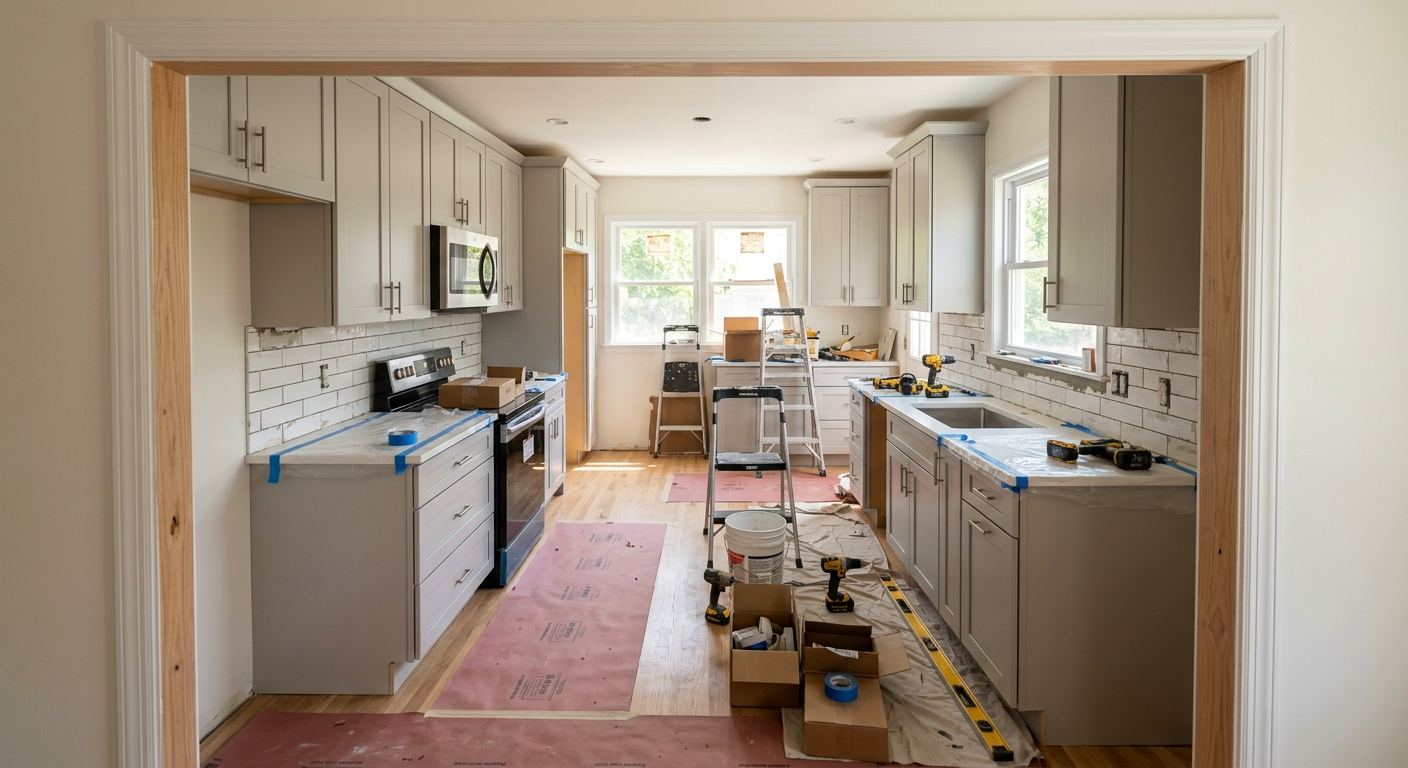
Kitchen renovation options and costs in Fort Erie
Fort Erie homeowners usually have a clear starting point: whether they’re doing a quick refresh or a full remodel that better matches how they’ll live in a home that’s often older—62.1% of local dwellings were built before 1981. With a median household income of $76,000 (Statistics Canada, 2021 Census), many renovations here land in the “mid-range full” tier because it’s the sweet spot between getting durable finishes and keeping the project recoverable on resale. In practice, kitchen budgets across the Hamilton–Niagara Peninsula track more closely with local home values and household income than with weather. That means the Niagara region’s seasonal temperature swings and humidity mainly affect installation details (subfloor readiness, ventilation, and material acclimation), not the overall cost ladder.
In neighbourhoods such as Crystal Beach (and the broader Fort Erie lakeshore area), contractor demand is especially steady because there are lots of move-in projects and owner updates connected to cottage-style living. Labour availability and scheduling can also tighten at peak season along the peninsula, which is why quotes can shift even when finishes look similar.
Below is a practical way to compare tiers when you’re getting quotes—especially useful when one contractor includes more demolition, flooring patching, or electrical scope than another. Use the table to anchor your expectations, then talk through what’s truly “in” each tier before you sign.
| Renovation Tier |
What's Included |
Typical Duration |
Price Range |
| Cosmetic refresh (paint, hardware, new appliances only) |
Paint, hardware swap, minor cabinet adjustments, new appliances, basic appliance hookups |
3–7 days |
$6,000–$15,000 |
| Mid-range full renovation (new cabinets, counters, sink, tile) |
New semi-custom cabinets, quartz counters, sink + faucet, backsplash tile, wall/ceiling paint, disposal hookup, minor layout tweaks, countertop templating and installation |
3–6 weeks |
$30,000–$60,000 |
| High-end full renovation (custom cabinets, stone counters, island) |
Fully custom cabinetry, granite or other natural stone, full-height or premium backsplash, island fabrication/installation, upgraded lighting plan, upgraded appliance package, flooring replacement as needed, more complex trim and details |
6–10 weeks |
$75,000–$110,000 |
| Cabinet refacing only (new doors + drawer fronts, same boxes) |
Refacing, new doors/drawer fronts, new pulls, internal upgrades where possible (some hardware), preparation and finishing, re-leveling where required |
2–5 weeks |
$10,000–$25,000 |
| Countertop swap only (laminate to quartz or stone) |
Removal and install of new countertop, sink cut-out and reseal, undermount or drop-in sink adjustments, backsplash top trim allowance |
1–3 weeks |
$3,500–$8,000 |
| Backsplash tile installation only |
Tile removal (if needed), surface prep, tile supply and install, grouting, caulking transitions, countertop-side and wall-side finish |
5–12 days |
$2,000–$10,000 |
Prices are estimates only and vary by project scope, site access and material selection.
What affects the price of kitchen renovation in Fort Erie
Across the Hamilton–Niagara Peninsula, the same “kitchen refresh” can land 30–50% apart because quotes reflect differences in product tier, labour scope, and how much hidden work each contractor includes—especially demolition, wall repairs, subfloor prep, and electrical/plumbing adjustments. Fort Erie sits inside a market where homeowners often choose finishes based on what fits a typical move-up expectation, not on weather. That’s why local home values and the $76,000 median household income (Statistics Canada, 2021 Census) push many projects toward quartz and semi-custom cabinetry rather than basic laminate and builder-grade options.
In higher-value neighbourhood pockets along the peninsula, quartz has largely become the default for full renovations, and semi-custom cabinetry is common because the cost is easier to recover on resale. When owners choose fully custom millwork and premium appliances, budgets climb quickly—often into ranges you’d associate with high-end projects. By contrast, more modest upgrades lean on component work like refacing and countertop swaps, which can keep costs closer to the mid bands (for example, a countertop swap often sits around the $1,500–$8,000 band, and full renovations commonly start near $30,000).
Local conditions still matter, just in smaller ways. Fort Erie’s older housing stock (62.1% pre-1981) means contractors frequently discover dated electrical runs, out-of-square walls, or subfloor irregularities that require patching before cabinets can sit flush. Also, late-summer humidity and winter dry heat affect how some installers schedule—materials acclimate and adhesives cure properly—so timeline can shift even when material pricing doesn’t. The biggest unpredictable swing, however, is layout: removing a wall, adding an island, or moving a gas line can change both labour hours and permit-related requirements regardless of finish tier.
| Price Factor |
Why It Matters |
Cost Impact |
| Cabinet tier — stock vs. semi-custom vs. fully custom millwork |
Determines material quality, fit/finish, interior options (organizers), and how much time it takes to adjust for out-of-square framing |
- Stock: often keeps budgets near entry levels
- Semi-custom: typical mid-range full renovations
- Custom: raises cost and timelines
|
| Countertop material — laminate vs. quartz vs. granite vs. stone |
Material pricing, fabrication complexity, and edge profiles; natural stone can require more templating and careful handling |
- Laminate: lowest material cost
- Quartz: common mid-tier upgrade
- Granite/stone: premium and often higher install cost
|
| Layout change — wall removal, island add, plumbing/gas move |
Changes demolition scope, inspection steps, and the number of trades involved (carpentry, plumbing, gas or electrical) |
- Minor tweaks: smaller impact
- Wall removal/island: biggest variable in the quote
- Plumbing/gas moves: adds permitting and labour risk
|
| Appliance package tier — builder vs. mid-range vs. pro-grade |
Influences electrical/gas readiness, trim allowances, ventilation requirements, and warranty expectations |
- Builder-grade: easier, often fewer upgrades
- Mid-range: common in $30,000–$60,000 projects
- Pro-grade: pushes budgets higher
|
| Flooring — refinish existing vs. full replacement |
New cabinets need a level base; older subfloors can require more prep and sometimes full flooring replacement |
- Refinish: lowers cost
- Replacement: more prep but cleaner end result
|
| Backsplash — ceramic tile vs. marble vs. full-height slab |
Determines material weight, labour intensity, and whether the installation needs additional structural backing |
- Ceramic: more accessible
- Marble/slab: higher material and install complexity
|
| Electrical — new circuits for island, under-cabinet lighting |
Requires licensed electricians and sometimes panel changes; increases coordination time |
- Adding circuits/lighting: typical driver of quote variance
|
| Permit fees and licensed trade requirements |
When plumbing/gas/electrical scope changes, permits and inspections can add both direct fees and scheduling delays |
- Pure swaps typically minimal
- Moves/structural changes increase cost and time
|
Permits & regulations in Ontario
In Ontario, a straightforward kitchen swap—like replacing cabinets in the same locations, swapping countertops, or installing a new backsplash—usually doesn’t require a permit. However, the moment you change plumbing supply/drain routing, move or add a gas appliance connection, remove a load-bearing wall, or add/alter electrical circuits, permits and licensed trades are typically required. In Fort Erie renovations, the biggest permit triggers I see are: relocating a sink that changes drain and vent runs, moving the dishwasher location (new plumbing connections), changing the range location or venting, relocating a gas line, and adding electrical for an island (extra outlets, dedicated countertop circuit, or under-cabinet lighting with new wiring). If you’re considering removing a wall to open up the kitchen, that often becomes structural work—handled with inspections and engineered requirements as needed.
To verify your contractor before signing, ask for (1) their Ontario licence/registration as applicable, (2) liability insurance, and (3) WSIB/WCB coverage documentation. Then check: look up licence/registration online through Ontario’s relevant registry resources, review the certificate of insurance for active coverage and matching business name, and confirm WSIB/WCB account status (a clearance letter or coverage proof is commonly provided for legitimate contractors). Make sure permit responsibility is spelled out in the written contract—who pulls the permit, who schedules inspections, and what’s included in the quoted price.
Cabinets, countertops and layout decisions in Fort Erie
The three decisions that most strongly shape your Fort Erie kitchen outcome are: (1) cabinet tier, (2) countertop material, and (3) layout changes. For cabinet tier, stock cabinets are fastest and cheapest because they’re designed around standard dimensions and assembly tolerances. Semi-custom cabinets are the most popular in the Hamilton–Niagara Peninsula because they balance price with better door styles, more interior options, and easier adjustments on older homes—important when walls or floors aren’t perfectly level (a common reality in pre-1981 builds, which make up 62.1% of local dwellings). Custom cabinets deliver the best fit and storage but come with longer lead times and higher labour for detailing.
On countertops, laminate is the lowest-cost choice but can be more sensitive to heat and seam performance over time. Quartz is a top “value durable” option—low maintenance, consistent colour, and typically a smoother experience for busy families. Granite/natural stone looks premium and ages well, but it’s a more hands-on material choice (sealing routines and variation). Quartz often lands in the mid-range of kitchen budgets, while granite/stone commonly pushes projects upward.
Layout is where ROI gets real. If you add an island or open an existing wall, you’re paying for carpentry changes plus plumbing/gas/electrical coordination. That can be justified if you gain real circulation space and storage—especially in a compact older kitchen. For example, keeping cabinetry as-is while you do a countertop upgrade and good lighting might keep your project closer to the $30,000–$60,000 full-reno band only if the scope stays moderate; but changing plumbing for a new sink location can rapidly move the job toward the higher end of full renovation pricing.
| Option |
Durability |
Maintenance |
Best For |
Price Range |
| Stock cabinets (big-box) |
Good for everyday use; performance depends on installation accuracy and box quality |
Low; adjust hardware as needed |
Budget-focused refreshes and straightforward layouts |
$8,000–$18,000 |
| Semi-custom cabinets (local dealer) |
Very solid; better options for organizers and finishing details |
Low to moderate |
Most Fort Erie full renovations where homeowners want quartz counters and a cleaner fit |
$15,000–$35,000 |
| Custom cabinets (local millwork shop) |
Highest fit and longevity; tailored storage and door styles |
Low |
Complex spaces, unusual wall conditions, and premium kitchens with islands |
$30,000–$60,000 |
| Laminate countertop |
Medium; seams and edges are the common wear points |
Wipe clean; avoid heat directly on surface |
Entry-level budgets and short-term stays |
$1,500–$3,500 |
| Quartz engineered countertop |
High; consistent surface and good resistance for daily kitchens |
Very low; typical cleaning only |
Most homeowners aiming for a durable, resale-friendly look |
$3,500–$7,500 |
| Granite / natural stone countertop |
High; durable but varies by slab and finish |
Moderate; sealing and careful stain management |
Premium aesthetic and higher-end finish expectations |
$5,500–$9,000 |
| Butcher block countertop |
Medium to high; durable if maintained and sealed properly |
Higher; periodic oil/conditioning recommended |
Warm, family-focused kitchens where food prep is a priority |
$3,000–$7,000 |
| Marble countertop |
Medium; beautiful but more prone to etching and staining |
Higher; careful cleaning and sealing routines |
Showpiece kitchens with controlled use and premium upkeep |
$7,000–$12,000 |
How to choose a kitchen renovation contractor in Fort Erie
When you’re hiring in Ontario, start with licensing and coverage, then move to clarity. A legitimate contractor should be able to show proof for the work they perform and coordinate licensed trades for the rest. For Ontario requirements, confirm liability insurance (certificate of insurance), and verify WSIB/WCB status with documentation such as a clearance letter or coverage proof. If the contractor is handling tasks that involve electrical or gas-connected work, ensure those trades are licensed and insured as well—don’t accept “our guy will handle it” without paper trails.
Next, request 2–3 itemised written quotes with a labour + materials breakdown, not just a single lump sum. Your quote should separate demolition and disposal, cabinet supply/install, countertop fabrication and install, electrical scope, plumbing scope, tile/backsplash labour, and any flooring patching. Read the scope line-by-line: what’s excluded (e.g., drywall repairs above a certain height), whether the contractor is pulling permits, whether disposal is included, and what happens if they discover hidden damage behind old walls. Warranty matters too—ask for workmanship warranty length, product/manufacturer warranties, and whether warranties are transferable if you sell your home. Finally, agree on a payment schedule: never pay more than 10–15% upfront; use a holdback until completion and final walkthrough. Put the start date and a realistic completion estimate in writing.
- Ask which tasks are subcontracted vs. handled by their own crew.
- Confirm WSIB/WCB coverage in writing before demolition starts.
- Require proof of liability insurance with jobsite coverage.
- Get an itemised quote (labour and materials separated).
- Verify whether permits are included, who pulls them, and inspection responsibility.
- Clarify disposal: dumpster rental and hauling included or not.
- Confirm cabinet installation includes shimming/levelling for out-of-square framing.
- Ask who is responsible for verifying rough-in measurements before fabrication.
- Review warranty terms: workmanship, timelines, and exclusions.
- Set a payment schedule with 10–15% max upfront and a completion holdback.
- Insist on start date, milestone dates, and a written completion window.
- Request a change-order process in the contract (what triggers pricing changes).
Red flags to watch for in Fort Erie: (1) quotes without itemisation (no line for permits, electrical/plumbing, or demolition), (2) vague promises like “we’ll take care of everything” without written scope, (3) refusal to provide insurance/WSIB/WCB proof, (4) asking for large deposits early (beyond 10–15%), and (5) no timeline commitment or no plan for cabinet/counter templating and lead times.
Frequently asked questions — kitchen renovation in Fort Erie
How do I add an island to my Fort Erie kitchen?
Adding an island in Fort Erie usually means more than just installing cabinets. If the island includes a sink or dishwasher, you’ll typically be moving plumbing supply/drain routes, which increases labour and can require Ontario permits and licensed trade involvement. If you’re adding a cooktop or moving a gas range, expect additional gas-fitting requirements and inspection steps. Even without plumbing/gas, electrical for outlets and under-cabinet lighting often needs extra circuits. Budget-wise, the island itself can be a manageable add, but the unseen cost is how much “utility work” gets tied into the island location. In a full renovation context, many homeowners start from the $30,000–$60,000 band and plan for the higher end when the island includes electrical and plumbing changes. Finally, because Fort Erie kitchens are often older (62.1% pre-1981), we also check subfloor condition and ceiling clearances before confirming the island footprint.
How much does a kitchen renovation cost in Fort Erie?
For Fort Erie homeowners, a reasonable planning range for a full kitchen renovation is about $30,000–$90,000, based on Ontario pricing realities and typical Hamilton–Niagara Peninsula finish tiers. Many “mid-range full” projects—new semi-custom cabinets, quartz counters, sink, and backsplash—commonly land in the $30,000–$60,000 area when the layout changes are minor. If you add a structurally complex change (like opening walls), move plumbing or gas, and choose fully custom millwork plus premium appliances, projects often push beyond $75,000 and can exceed $90,000. Component work is usually less expensive: cabinet refacing typically falls around $5,000–$25,000, and countertop installation sits around $1,500–$8,000. Because local households are balancing resale expectations and long-term durability—median household income is $76,000 (Statistics Canada, 2021 Census)—quartz and better cabinetry are the most common “value” upgrades that keep budgets predictable.
How long does a kitchen renovation take in Fort Erie?
Timelines in Fort Erie depend on the scope and how much coordination is needed between trades. A cosmetic refresh (paint, hardware, new appliances only) can be as short as about 3–7 days. A mid-range full renovation typically runs around 3–6 weeks when cabinetry lead times and countertop templating are scheduled efficiently. For high-end projects with custom cabinets, stone counters, and an island—especially when electrical and plumbing routes change—plan for roughly 6–10 weeks. The key timing drivers are demolition and rough-in work, countertop templating delays, and when licensed trades book inspection windows. Since Fort Erie includes a lot of older housing stock (62.1% built before 1981), hidden issues like older wiring routes or subfloor irregularities can also add a few days. A strong contractor should give you a start date, a completion window, and milestone dates in writing.
Quartz vs granite countertops — which is better?
“Better” depends on how you cook and how much maintenance you’re willing to do. Quartz (engineered) is typically the easiest daily-use option: it’s very consistent, holds up well to normal kitchen wear, and usually requires simple cleaning without special sealing routines. Granite (natural stone) often looks more unique because each slab is different, and many homeowners choose it for that premium, organic look. The trade-off is maintenance—natural stone generally needs sealing and careful stain/acid management. In Fort Erie, where many homes were built before 1981 (62.1% pre-1981), I also like quartz because it’s predictable for installers when walls and countertops need careful, level fitting after renovations. Price-wise, quartz commonly fits the mid band (often within the $3,500–$7,500 range for countertop installs), while granite tends to sit higher within the premium end of the band (often around $5,500–$9,000), especially with more complex edges and island cut-outs.
Should I reface or replace my cabinets?
Refacing is usually best when your existing cabinet boxes are solid, level, and well-installed—meaning doors and drawer fronts look dated, but the structure is still straight and functional. Replacement makes more sense when boxes are sagging, water-damaged, or when you want major changes to storage layout (like relocating pull-out features) and you’re already doing electrical/plumbing work that exposes the base cabinets. In Fort Erie’s older housing stock (62.1% pre-1981), refacing can be a smart mid-cost option because it preserves what’s working and avoids full demolition, which can reduce unpredictability. However, if you’re seeing warping, chronic misalignment, or significant drywall/plaster damage behind cabinets, replacement is typically the better long-term fix. Pricing often reflects this: cabinet refacing commonly falls in the $10,000–$25,000 range, while a full cabinet replacement is more likely to push you toward the larger full-renovation tiers (where projects often sit between $30,000 and $60,000 when paired with quartz and backsplash).
Do I need a permit for a kitchen renovation in Ontario?
Often, cabinet and countertop swaps done in the same locations don’t require a permit in Ontario. But permits are typically required when you change core systems: moving plumbing supply or drain lines, relocating gas connections (stove/range and related gas work), removing a load-bearing wall, or adding new electrical circuits (for example, outlets and dedicated countertop power for an island). In Fort Erie, many homeowners discover that even “minor” changes—like moving a sink—trigger permit and inspection steps because drain/vent routing must meet code requirements. Gas work must be performed by a licensed gas fitter, and electrical must be done by a licensed electrician. The best approach is to confirm permit responsibility in the written contract before work begins. Ask your contractor who will pull the permit, what’s being inspected, and whether the permit fees are included in the quote.