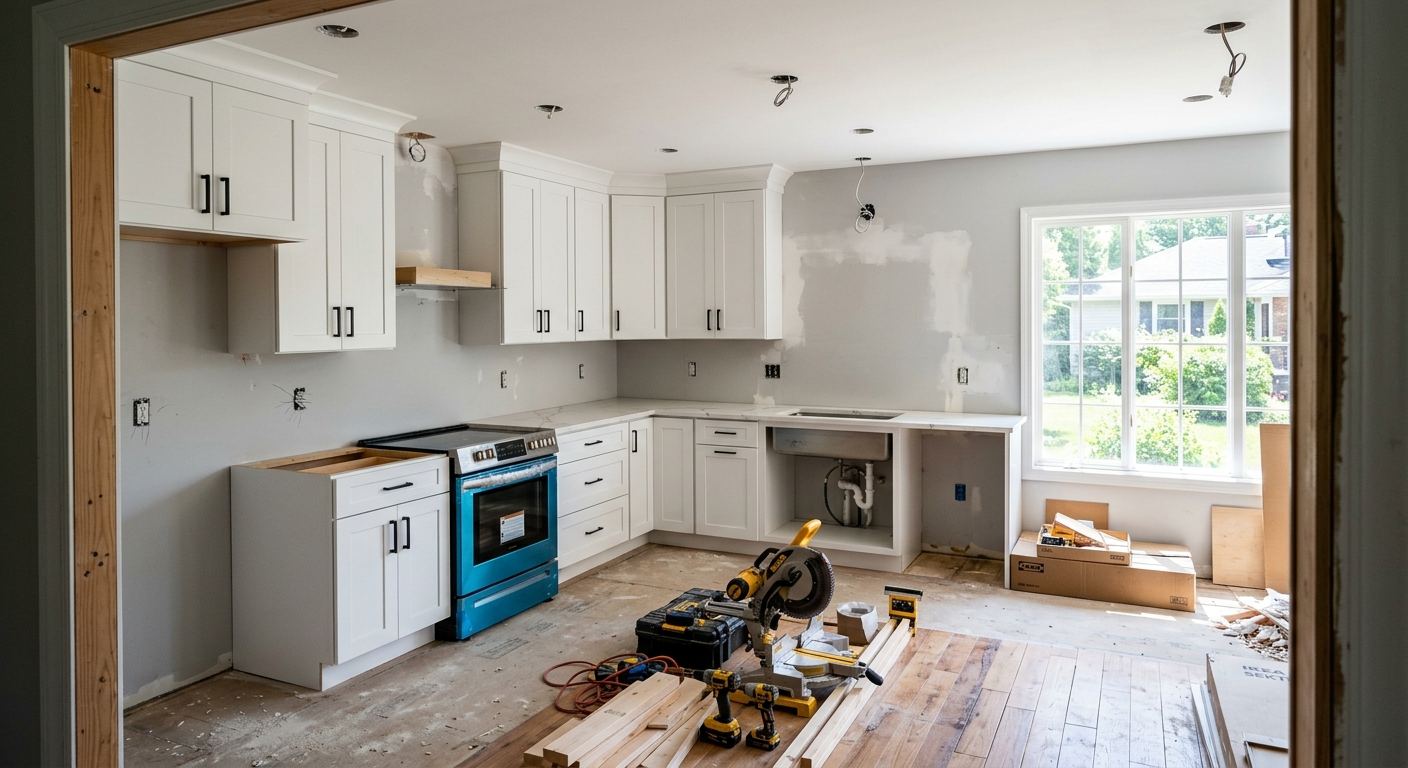
Kitchen renovation options and costs in North St.James Town
North St.James Town homeowners have a few clear paths when planning a kitchen renovation, and the right choice usually depends on whether you’re refreshing finishes or changing how the kitchen works. In a community of 18,615 people (Statistics Canada, 2021 Census), many households are balancing day-to-day affordability with the reality that kitchens drive buyer perception and resale confidence. In Toronto’s core, the typical expectation is that a “mid-range” update still looks intentional—clean lines, durable countertops, and modern lighting—because nearby housing stock often dates back to mid-century builds with smaller layouts and older plumbing runs.
In terms of cost, the Toronto market pushes budgets more than climate does. Toronto isn’t a “storm-kitchen” city, so labour productivity and material lead times dominate rather than weather-driven delays. That said, winter freeze-thaw and temperature swings can affect installation schedules for tile and stone work, and they can slow delivery windows when crews are coordinating multiple sites across the GTA. The bigger pricing differences come from neighbourhood demand: the St. James Town/Church–Carlton corridor sees steady trade activity because many condos and apartment-adjacent homes are renovated for resale or rental upgrades.
Budgeting is easiest when you think in renovation tiers. Below are realistic ranges for North St.James Town projects, from cosmetic-only upgrades to full custom millwork—then you can match your scope to the tier that fits both your lifestyle and your resale goals.
| Renovation Tier |
What's Included |
Typical Duration |
Price Range |
| Cosmetic refresh (paint, hardware, new appliances only) |
Cabinet paint or new hardware, new appliance package only, basic caulking, minor sink faucet swap, touch-up trim work |
3–7 days |
$5,000–$18,000 |
| Mid-range full renovation (new cabinets, counters, sink, tile) |
Semi-custom cabinetry, quartz or good laminate counters, sink + faucet, backsplash tile, updated lighting, floor tile/laminate refresh, standard plumbing hook-ups |
4–8 weeks |
$25,000–$60,000 |
| High-end full renovation (custom cabinets, stone counters, island) |
Fully custom millwork, premium quartz/stone counters, island with seating, upgraded appliance package, full-height or feature backsplash, improved electrical plan and recessed lighting |
8–14 weeks |
$70,000–$90,000 |
| Cabinet refacing only (new doors + drawer fronts, same boxes) |
Refaced door/drawer fronts, new hardware, matching end panels, minor alignment adjustments, optional cabinet colour change |
1–3 weeks |
$8,000–$35,000 |
| Countertop swap only (laminate to quartz or stone) |
Remove and replace existing top, new quartz or stone, undermount sink set (if applicable), simple backsplash edge finish, caulking and sealing |
3–10 days |
$3,000–$15,000 |
| Backsplash tile installation only |
Ceramic tile installation, waterproofing prep, cutting around outlets, grouting and sealing where needed |
3–7 days |
$2,000–$10,000 |
Prices are estimates only and vary by project scope, site access and material selection.
What affects the price of kitchen renovation in North St.James Town
In Toronto and across Ontario, two homeowners can receive quotes that differ by 30–50% for what sounds like the same job. The reason is that finish tier and structural scope are priced differently even when a contractor uses the same “base model.” In high-value economic pockets of the Toronto region, homeowners often choose quartz or stone counters and semi-custom cabinetry because buyers are more likely to recover that spend on resale—so you’ll see projects clustered toward the upper end of the budget bands. In more price-sensitive areas around the region, many households still upgrade to quartz but keep cabinetry in the stock/semi-custom range, aiming for better value-per-dollar while remaining marketable.
Local conditions in North St.James Town can nudge costs up or down. First, many homes and older buildings have walls that aren’t perfectly square—so a “straightforward” counter install may require more labour and additional materials for shimming and rework. Second, dated plumbing and venting can mean that what looks like a simple sink swap turns into extended drain or supply work, which pushes the job toward the higher end of the $25,000–$90,000 full-renovation band. Third, winter scheduling matters: tile and stone adhesives and grouts need stable temperature conditions, so crews may prioritize work windows that keep curing reliable.
Layout changes are the wild card regardless of finish. Removing a wall, adding an island, or moving a gas line or plumbing run can add work hours, licensed trade coordination, and sometimes permitting—so your quote variation is often driven by the “hidden” complexity more than the countertop choice.
| Price Factor |
Why It Matters |
Cost Impact |
| Cabinet tier — stock vs. semi-custom vs. fully custom millwork |
Higher tiers change build time, fit accuracy, material quality, and options like soft-close mechanisms and interior organizers |
Can swing budgets by $10,000–$35,000 |
| Countertop material — laminate vs. quartz vs. granite vs. stone |
Material cost and fabrication complexity vary widely; stone also affects edge profiles and installation labour |
Typically $3,000–$15,000 |
| Layout change — wall removal, island add, plumbing/gas move |
Structural and routing changes introduce demolition, patching, inspections, and trade coordination |
Often $5,000–$25,000 beyond a refresh |
| Appliance package tier — builder vs. mid-range vs. pro-grade |
Professional-grade units may require electrical readiness, ventilation adjustments, and higher hook-up expectations |
Roughly $2,000–$12,000 |
| Flooring — refinish existing vs. full replacement |
Demolition and subfloor correction are where costs rise; repairs to uneven framing can add labour |
Often $2,000–$10,000 |
| Backsplash — ceramic tile vs. marble vs. full-height slab |
Complex cuts, waterproofing prep, and heavier materials increase installation time and handling |
Typically $2,000–$10,000 |
| Electrical — new circuits for island, under-cabinet lighting |
Electrical work must be done by licensed professionals and may require additional panels/permit steps |
Commonly $1,500–$8,000 |
| Permit fees and licensed trade requirements |
Major plumbing/gas moves, load-bearing changes, and electrical upgrades can require inspections and paperwork |
Can add $500–$5,000 depending on scope |
Permits & regulations in Ontario
In Ontario, a lot of “face-lift” kitchen work can be done without permits—particularly cabinet and countertop swaps where you’re not changing plumbing routes, electrical circuits, or building structure. For example, replacing laminate with quartz or installing new cabinet doors on existing boxes generally doesn’t trigger a permit. Where permits and licensed trades come in is when you change life-safety systems or building elements: moving plumbing supply or drain lines, relocating a gas stove/range, and removing a load-bearing wall all typically require permits, inspections, and coordination with licensed professionals.
Here’s the practical way a North St.James Town homeowner can keep control of the process. Step 1: Ask the contractor (before signing) to list “permit-required” scopes in writing—electrical additions for an island, new circuits for under-cabinet lighting, plumbing reroutes, gas line relocation, and any structural wall removal. Step 2: Confirm the contractor’s responsibility in the contract, not just verbally. Step 3: Verify licences and coverage. For gas work, insist it’s performed by a licensed gas fitter (and request the contractor’s proof). For electrical, use a licensed electrician and ask for their licence details.
Also request proof of liability insurance and WSIB/WCB coverage (or clear written exemption documentation if applicable). Get these as certificates and keep them with your contract paperwork. Finally, ask what inspection sign-offs you’ll receive at the end—especially after gas, electrical, or plumbing work.
Cabinets, countertops and layout decisions in North St.James Town
When you renovate a kitchen in North St.James Town, three decisions shape both the final look and the total cost: (1) cabinet tier, (2) countertop material, and (3) whether you change the layout. Start with cabinets: stock is the fastest and cheapest because boxes are standard and lead times are predictable. Semi-custom is usually the best balance in Toronto for a kitchen that needs to look built for the space—more options for sizes, finishes, and organizers without fully custom millwork pricing. Custom cabinets look the most “integrated,” but the cost is real because you pay for bespoke sizing, higher craft time, and longer fabrication.
Countertops are the durability and maintenance decision. Laminate can work well for budget refreshes, but it’s more sensitive to heat and impact and typically doesn’t offer the same resale perception as stone. Quartz is popular in the Toronto market because it’s consistent, low-maintenance, and durable for everyday cooking. Granite/natural stone adds character and can be a strong upgrade for buyers who prefer premium aesthetics. Butcher block appeals for warmth and visible grain; it needs regular sealing and careful water management. Marble is beautiful, yet it’s more prone to staining and etching—many homeowners choose it for display-forward kitchens, then they protect it with sealing and disciplined cleaning.
Layout is where justification must be measurable. Adding an island can cost more because it requires electrical planning (often new circuits) and sometimes plumbing routing. If the island meaningfully improves storage and workflow, it’s worth it; if it only “looks nice,” you may spend toward the high-end of the $70,000–$90,000 band without proportional resale value for your particular layout. In older Toronto housing, small space constraints can also mean careful planning around traffic flow rather than expanding the footprint.
Concrete example: moving from a quartz to a stone countertop can raise your countertop line by several thousand dollars, but skipping an unnecessary layout change can keep your total project closer to the $25,000–$60,000 range while still delivering the buyer-friendly upgrade most people notice first.
| Option |
Durability |
Maintenance |
Best For |
Price Range |
| Stock cabinets (big-box) |
Good for standard dimensions; durability depends on construction quality and hardware |
Low; wipe-clean surfaces and standard adjustment |
Fast timelines and budget-conscious refreshes |
$8,000–$20,000 |
| Semi-custom cabinets (local dealer) |
Very strong for daily use; better fit options reduce long-term alignment issues |
Low; soft-close hardware holds up well with routine care |
Most North St.James Town renovations balancing cost and finish |
$15,000–$35,000 |
| Custom cabinets (local millwork shop) |
Highest fit and finish; tailored storage improves usability |
Low-to-moderate; premium finishes still need standard cleaning |
Complex layouts, heritage details, and top-tier resale presentation |
$30,000–$60,000 |
| Laminate countertop |
Decent daily durability; can chip at edges and wear where exposed to heat |
Low, but avoid prolonged heat and sharp impacts |
Budget-friendly upgrades with a modern look |
$3,000–$7,000 |
| Quartz engineered countertop |
Very durable and uniform; resists staining better than many natural stones |
Low; routine cleaning only, no sealing required |
Busy households and kitchens aimed at strong resale appeal |
$6,000–$15,000 |
| Granite / natural stone countertop |
Hard and resilient; performance depends on specific stone and finish |
Moderate; periodic sealing and careful cleaning |
Premium look with natural variation |
$7,000–$18,000 |
| Butcher block countertop |
Durable but can scratch; vulnerable to water pooling if not maintained |
Moderate; regular oiling and prompt drying |
Home-cook lifestyles and warm, traditional styling |
$4,000–$12,000 |
| Marble countertop |
Beautiful but softer than quartz/most stones; can show wear over time |
Moderate-to-high; sealing and stain/etch prevention |
Statement kitchens where aesthetics outweigh heavy wear |
$8,000–$20,000 |
How to choose a kitchen renovation contractor in North St.James Town
Choosing the right contractor matters in North St.James Town because kitchen renovations often involve several trades—carpentry, plumbing, electrical, tile, and sometimes gas—stacked on a tight urban schedule. Start by verifying Ontario licensing. Ask for proof that licensed trades are used for their scopes: a licensed electrician for any new circuits, and a licensed gas fitter for any gas-related modifications. Confirm contractor liability insurance (so you’re protected if damage occurs) and request WSIB/WCB coverage documentation for the workers they dispatch. Look for certificate dates and ensure the names on the insurance match the legal company doing the work.
Next, get 2–3 itemised written quotes. “Itemised” should mean a labour and materials breakdown, not just a single lump-sum number. Make sure the scope includes whether permits are pulled by the contractor, and whether demolition debris disposal and dust control are included. Confirm who supplies materials and when they’re ordered—countertops and custom cabinets often have lead times that affect the whole schedule. Ask for a workmanship warranty (how long, and what it covers) and separate product/manufacturer warranties for cabinets and countertops. Also ask whether warranties are transferable if you sell your home.
On payments, never accept a plan with large upfront deposits. In practice, I recommend no more than 10–15% up front, then progress payments tied to completed milestones; keep a holdback until punch-list completion. Finally, insist on a start date and a completion estimate in writing, including assumptions about access and lead times.
- Ask for Ontario licence details for any trade work they claim to do.
- Request liability insurance certificate and confirm coverage limits.
- Provide WSIB/WCB clearance or exemption documentation in writing.
- Get quotes broken into labour, materials, and fixtures with quantities.
- Confirm permit responsibility and which permits (if any) are required.
- Clarify disposal: demolition debris haul-away included or extra?
- Ask about dust protection and how they protect floors and stairwells.
- Ensure the quote lists allowances for cabinets, counters, and tile.
- Get countertop fabrication lead time and install date assumptions.
- Review warranty terms for workmanship and product coverage.
- Use a payment schedule tied to milestones; keep a holdback.
- Confirm start date, estimated completion, and change-order process.
Red flags in North St.James Town: a contractor won’t put permits/responsibilities in the contract; they ask for more than 20% upfront; quotes are not itemised (especially for cabinets/counters and electrical scope); no proof of insurance/WSIB/WCB is provided; or they avoid discussing warranty coverage details and exclusions.
Frequently asked questions — kitchen renovation in North St.James Town
Custom vs stock cabinets — is custom worth it?
In North St.James Town, custom cabinets are worth it when your kitchen has awkward dimensions, needs special storage (pantries, integrated appliance garages), or you want a very high-end, built-in look that “reads” well to buyers. If your layout is fairly standard, stock or semi-custom often gets you 80% of the visual upgrade at a far better cost. A typical cabinet tier shift can move your budget by tens of thousands, pushing you from mid-range full renovation pricing to high-end territory. If you’re targeting a project budget in the $25,000–$60,000 range, semi-custom is usually the sweet spot. If you’re closer to $70,000–$90,000 and planning an island with premium finishes, custom becomes more justifiable. (Statistics Canada, 2021 Census)
How do I choose a kitchen contractor in North St.James Town?
Start with verification: ask for Ontario licence details where licensed trades are involved, plus liability insurance and WSIB/WCB coverage documentation. Then require 2–3 itemised written quotes showing labour and materials, including allowances for cabinets, countertops, and tile. In Toronto, many cost surprises come from scope gaps—like who pulls permits, who disposes of demolition debris, and whether electrical upgrades (for island outlets or under-cabinet lighting) are included. Read the scope line by line and ask how change orders are priced. A good contractor will also provide a clear workmanship warranty and a realistic schedule that matches countertop/cabinet lead times. Finally, don’t choose based only on lowest price; choose based on completeness and accountability.
What order do kitchen renovation steps happen in?
For most North St.James Town renovations, the sequence is: (1) final measurements and ordering (cabinets/counters first because they have lead times), (2) demolition and site prep, (3) rough-ins for plumbing, electrical, and gas if included (with permits/inspections where required), (4) inspection sign-offs, (5) install cabinets, (6) install countertops and sinks, (7) tile backsplash and flooring finishes, (8) paint/trim adjustments, (9) appliance install and final hardware alignment, then (10) final walkthrough and punch-list. The schedule can tighten if you’re doing a countertop-only or backsplash-only job, which usually avoids structural rough-in work. In colder months, crews also manage curing times for tile, grout, and adhesives so the finishes bond properly.
Can I live at home during a kitchen renovation in North St.James Town?
Sometimes, but it depends on your scope and your household setup. Cosmetic refreshes and countertop swaps can often be done while you live at home, especially if the work area is contained. For a mid-range full renovation (commonly within the $25,000–$60,000 band), you may need partial displacement—at minimum, a temporary sink and safe access around demolition dust. High-end builds with islands and major layout changes often require more disruption because multiple trades work at once. If your project needs electrical and plumbing reroutes, expect longer “no-cook” periods. In Ontario, licensed trades are required for their scopes, so schedule coordination is essential. Discuss a practical plan with your contractor: daily work hours, where you’ll prepare food, and how they protect floors/stairways.
Should I renovate my kitchen before selling in North St.James Town?
Usually, you renovate before selling if the kitchen issues are visible and affect buyer confidence—damaged counters, outdated layouts, or worn cabinetry. But only do the level of upgrade that matches the rest of the home and the buyer segment. In the Toronto area, kitchens are a major decision driver, and buyers often expect durable counters (quartz is a common choice) and clean cabinet finishes. If your budget is closer to the mid-range $25,000–$60,000 band, focus on cabinets, countertops, and lighting rather than major plumbing/gas moves. If you’re considering a high-end overhaul in the $70,000–$90,000 range, confirm your home’s condition supports it—otherwise you risk overspending. A smart contractor will help you choose finishes likely to photograph well and perform day-to-day, not just look premium.
What's the most popular kitchen style in North St.James Town right now?
Right now in North St.James Town and the broader Toronto core, the most common “popular” direction is modern transitional: simple shaker-style or slab-front cabinetry in soft whites, warm greys, or natural wood tones, paired with quartz countertops and an understated backsplash. Buyers also respond well to practical layouts—clear walkways, better task lighting, and storage that makes older, tighter kitchens feel more functional. That’s why many projects land in the semi-custom range: homeowners want a clean, updated look without waiting for fully custom millwork. For countertop selection, quartz is frequently chosen because it’s low-maintenance for busy households and rentals, and it aligns with a mid-range renovation budget such as the $25,000–$60,000 band. (Statistics Canada, 2021 Census)