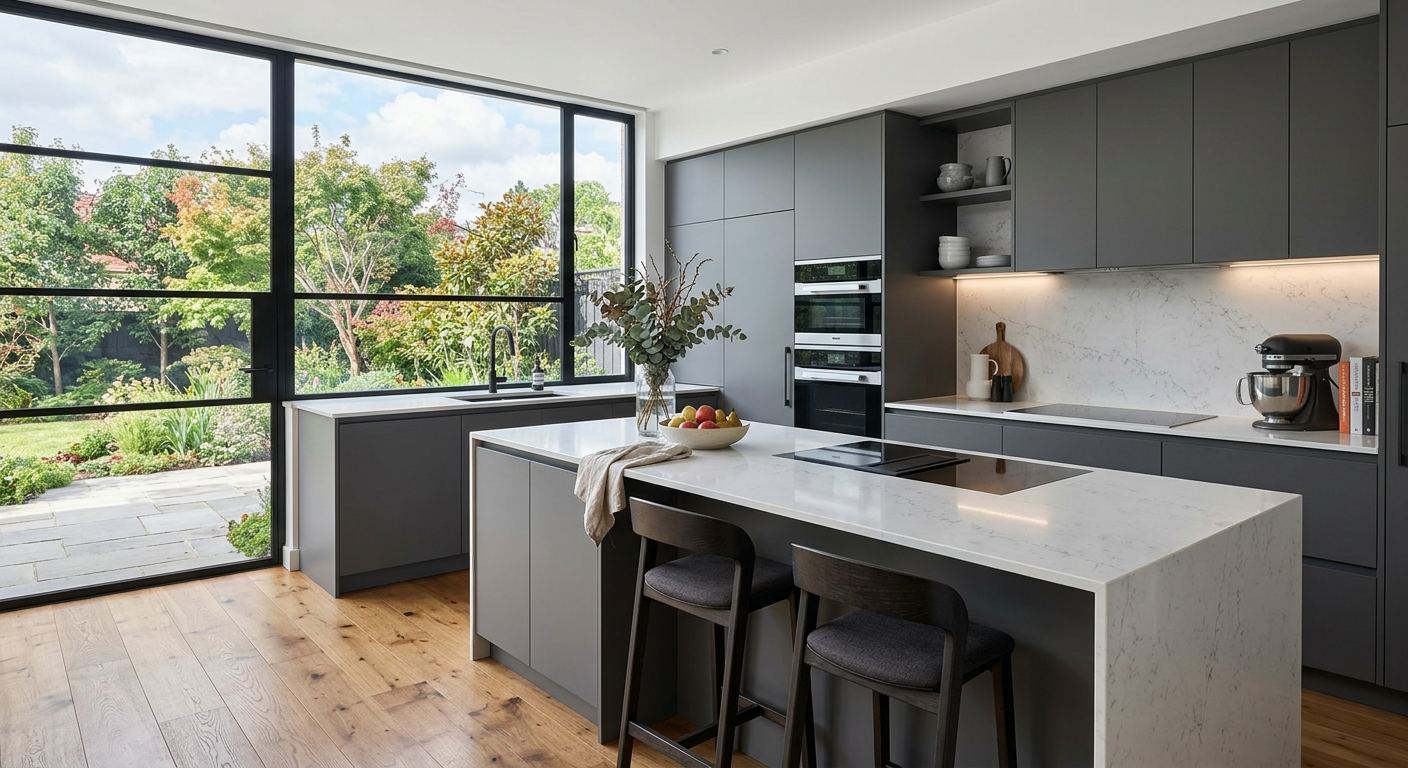
Kitchen renovation options and costs in Thorold
Thorold homeowners typically start their kitchen renovation planning by asking one question: “What will this cost here?” With a median household income of $82,000 (Statistics Canada, 2021 Census), many families in Thorold choose finishes that look premium but still make financial sense on resale. And because 69.3% of households own (Statistics Canada, 2021 Census), most projects are planned as long-stay upgrades rather than short-term flips—so cabinets, stone/quartz, and practical layout upgrades are common.
Across the Hamilton–Niagara Peninsula, kitchen budgets track more with local home values and buyer expectations than with climate. Even though southern Ontario sees freeze–thaw cycles and winter humidity swings, the cost drivers are usually materials and labour availability. Renovations in neighbourhoods like Port Robinson (and surrounding south Thorold pockets) are especially in demand because there’s a lot of pre-1981 housing stock (55.1% of homes) and many older kitchens are being reworked for modern storage and electrical needs. You’ll also see strong contractor demand during spring and early summer, which can affect scheduling and pricing.
For homeowners, that means similar scopes can land in different tiers. A typical mid-range full renovation (new cabinets, quartz counters, backsplash and minor updates) often sits in the mid-$30k to $60k range, while custom, island-heavy redesigns can push toward $90k+. Use the table below to compare realistic options before you request itemised quotes.
| Renovation Tier |
What's Included |
Typical Duration |
Price Range |
| Cosmetic refresh (paint, hardware, new appliances only) |
Cabinet paint/stain (if applicable), hardware, minor repairs, new appliances, basic trim/caulking; excludes cabinet replacement and countertop replacement |
3–7 days |
$6,000–$15,000 |
| Mid-range full renovation (new cabinets, counters, sink, tile) |
New semi-custom or quality stock cabinets, quartz counters, sink + faucet, backsplash tile, labour for install, disposal; may include minor layout tweaks |
3–5 weeks |
$35,000–$65,000 |
| High-end full renovation (custom cabinets, stone counters, island) |
Fully custom cabinetry, natural stone or premium slab, island build (base + electrical provisions), upgraded backsplash (often tile-to-ceiling or decorative), premium sink/faucet, more complex trimwork |
5–9 weeks |
$75,000–$95,000 |
| Cabinet refacing only (new doors + drawer fronts, same boxes) |
Refacing system, new doors/drawers, hardware, sanding/finish work where needed; excludes new counter and major plumbing changes |
1–2 weeks |
$8,000–$20,000 |
| Countertop swap only (laminate to quartz or stone) |
Remove and dispose existing countertop, template, install new quartz/stone, seam layout and polishing where applicable; excludes cabinet/base work |
5–10 business days |
$2,500–$8,500 |
| Backsplash tile installation only |
Tile supply allowance, installation, backer prep as required, grouting/sealing; excludes full-floor or full-wall demolition |
3–7 days |
$2,500–$9,500 |
Prices are estimates only and vary by project scope, site access and material selection.
What affects the price of kitchen renovation in Thorold
In Thorold and the broader Hamilton–Niagara Peninsula, it’s common to see two quotes for the “same” kitchen come in 30–50% apart. The reason isn’t climate; it’s the mix of finish tier, how much the layout changes, and how many trades are triggered by electrical, plumbing, or gas work. In higher-value pockets of the region, homeowners are more likely to choose quartz counters and semi-custom cabinetry because the quality gap is easier to recover at resale. In more budget-focused projects, laminate and stock cabinets dominate to protect the ROI, especially when buyers are mainly upgrading appliances and paint rather than moving plumbing or adding an island.
Concrete examples from Thorold: first, kitchens in older (pre-1981) homes often require more subfloor/underlayment prep for new flooring and tile—small details that can add labour time. Second, if you’re dealing with dated electrical routing, adding under-cabinet lighting or outlets for an island can increase cost more than homeowners expect because it requires licensed electrical work. Third, when we install quartz in a kitchen with limited clearances, templating and countertop delivery logistics can extend timelines and increase coordination labour.
As a pricing anchor, cabinet installation/refacing can run roughly $5,000–$25,000 depending on the tier, and full renovations typically land between $30,000 and $90,000 for the complete package. The most unpredictable part is layout change—wall removal, island adds, and plumbing/gas relocation can swing the budget even if you keep the finishes mid-range.
| Price Factor |
Why It Matters |
Cost Impact |
| Cabinet tier — stock vs. semi-custom vs. fully custom millwork |
Higher-end systems cost more per linear foot and often require more detailed measuring, custom sizing, and longer lead times |
Typically shifts budgets by $10,000–$25,000+ within full projects |
| Countertop material — laminate vs. quartz vs. granite vs. stone |
Material cost, thickness, edging, and install complexity vary widely between products |
Often adds or reduces $1,500–$8,000 or more |
| Layout change — wall removal, island add, plumbing/gas move |
Triggers structural review, more demo, and additional licensed trades; also changes labour time and waste |
Common swing: $5,000–$25,000 depending on scope |
| Appliance package tier — builder vs. mid-range vs. pro-grade |
Professional models cost more and may require different electrical/venting details |
Often shifts $2,000–$15,000+ |
| Flooring — refinish existing vs. full replacement |
Tile/wood removal and reinstallation can multiply labour and disposal costs |
Typically $1,500–$8,000+ depending on room size |
| Backsplash — ceramic tile vs. marble vs. full-height slab |
Higher-end stone increases material cost and demands more careful installation and sealing |
Usually $2,000–$10,000+ |
| Electrical — new circuits for island, under-cabinet lighting |
More outlets, GFCI needs, dedicated circuits, and lighting add licensed labour time |
Often $1,000–$6,000+ depending on changes |
| Permit fees and licensed trade requirements |
Certain work requires permits and inspection; costs include coordination and documentation time |
Typically a few hundred to several thousand dollars |
Permits & regulations in Ontario
In Ontario, many “swap-in” tasks are straightforward and don’t usually require permits—like replacing cabinets in the same footprint, swapping a countertop, or changing hardware and appliances. However, kitchen renovations become permit- and inspection-sensitive when you move plumbing supply/drain lines, relocate gas appliances (including changes around the stove), remove a load-bearing wall, or add new electrical circuits (for example, outlets and lighting on an island).
Here’s the practical divide for Thorold homeowners: typically no permit for cabinet and countertop swaps that don’t change the plumbing/gas/electrical locations. Typically requires permits when you: (1) reroute drain or water lines under the sink, (2) move a gas stove or alter venting for a gas range/hood, (3) remove or alter a load-bearing wall, (4) add or modify electrical circuits for new lighting/outlets, including under-cabinet lighting tied into code-compliant wiring.
To verify a contractor in step-by-step fashion, ask for: (1) their Ontario business registration details, (2) an up-to-date certificate of insurance (general liability), and (3) WSIB/WCB coverage proof for workers doing the job. For licensed trades, confirm: gas work must be done by a licensed gas fitter, and electrical work by a licensed electrician. Then request a copy of the clearance letter/permit documentation where applicable. Also insist that the contract clearly states who is responsible for permits—don’t rely on verbal assurances.
Cabinets, countertops and layout decisions in Thorold
When planning a Thorold kitchen renovation, the three decisions that move your budget and your satisfaction the most are: (1) cabinet tier, (2) countertop material, and (3) layout changes. The Hamilton–Niagara Peninsula market tends to reward kitchens that look “finished” and function well—buyers commonly expect brighter surfaces, good lighting, and durable counters. With 55.1% of homes built before 1981 (Statistics Canada, 2021 Census), many renovations also start from older framing and dated electrical locations, so layout and finish choices need to be coordinated early.
Cabinet tier: stock cabinets are fastest and cheapest, but semi-custom is the sweet spot for most move-up homeowners—especially if you’re trying to maximize storage in a narrower Thorold footprint. Custom is best when you need unusual wall-to-wall fit, integrated panel details, or high-end hardware layouts.
Countertops: laminate is the budget option but is less durable to everyday heat and can be more vulnerable to edge wear. Quartz is the most common “default upgrade” in this region because it’s low-maintenance and holds up to normal kitchen use, while granite/natural stone and marble are premium but require a more careful sealing/maintenance routine.
Layout: opening a wall for flow or adding an island can justify cost if it creates seating, improves work triangle efficiency, and unlocks better storage. But plumbing/gas relocation is expensive—so if you want quartz and new cabinets, keeping the plumbing and stove locations often delivers better value than moving them.
Dollar example: if relocating plumbing adds $8,000–$15,000 in total labour/trade time, you may be better off using that budget to upgrade from mid-range quartz to a nicer slab selection and invest in better cabinet interiors (pull-out shelves, pantries) instead of paying for a major reroute.
| Option |
Durability |
Maintenance |
Best For |
Price Range |
| Stock cabinets (big-box) |
Good for typical household use; limited custom sizing can create gaps or compromises |
Low maintenance; just keep doors/drawers adjusted over time |
Fast timelines and tighter budgets |
$5,000–$12,000 |
| Semi-custom cabinets (local dealer) |
Very durable with better door/drawer options and more flexibility in layouts |
Low maintenance; hinges and slides may need occasional tuning |
Most Thorold homeowners aiming for a modern look without going fully custom |
$12,000–$25,000 |
| Custom cabinets (local millwork shop) |
Highest durability and best fit; can be built around irregular spaces and specific storage needs |
Low maintenance, but higher-end finishes should be cleaned with manufacturer-recommended products |
Premium kitchens, unique wall dimensions, integrated hardware/panels |
$25,000–$45,000 |
| Laminate countertop |
Moderate; seams and edges can be more vulnerable to chips/heat if not handled carefully |
Wipe clean; avoid prolonged heat directly on the surface |
Budget-conscious renovations |
$1,500–$3,500 |
| Quartz engineered countertop |
High durability; resists staining and daily wear extremely well |
Low maintenance; clean with mild soap and water |
Most “best value” full renovations in the Hamilton–Niagara Peninsula |
$3,500–$7,500 |
| Granite / natural stone countertop |
Very durable; unique patterning; good resistance when sealed properly |
Periodic sealing recommended depending on stone type and use |
Premium look where homeowners are okay with extra care |
$5,000–$9,000 |
| Butcher block countertop |
Solid and warm; can show knife marks and needs protection around water and spills |
Oil and re-finish as needed; keep it properly sealed |
Families who want a casual, functional cooking surface |
$2,500–$6,500 |
| Marble countertop |
Premium and elegant; softer than quartz for everyday impacts and can etch if acidic substances spill |
Needs careful cleaning and sealing; more maintenance expectations |
Low-traffic display-style or homeowners committed to careful upkeep |
$6,000–$10,000 |
How to choose a kitchen renovation contractor in Thorold
Choosing the right contractor matters as much as material selection in Thorold, especially because older homes may need extra prep work (and because kitchens often trigger multiple trades). Start by verifying Ontario licensing where applicable: electrical work should be done by a licensed electrician, and gas work by a licensed gas fitter. For general renovation contractors, you should still request proof of liability insurance and workers’ compensation coverage (WSIB/WCB). How to check: ask for a certificate of insurance (ensure it’s current, with coverage amounts visible) and proof of WSIB/WCB account status; then confirm the licence/coverage details with the trade professionals listed on the project.
Next, get 2–3 itemised written quotes—not just a lump sum. You want a breakdown that shows labour vs materials, and clearly indicates what’s included for demolition, drywall patching, disposal, countertop templating, installation, and finish carpentry. Pay attention to scope items like: “Permit pull included?” “Are appliances excluded?” “Is plumbing rough-in included or only final connections?” and whether flooring adjustments and trim work are included. A proper workmanship warranty should be in writing, and you should know how long it lasts and whether it transfers if you sell the home.
For payment scheduling, avoid large deposits—never pay more than 10–15% upfront—and request a holdback until key milestones (and punch-list completion). Finally, get the start date and completion estimate in writing so you’re not left managing delays.
- Request itemised quote with line-by-line labour/materials costs
- Confirm who pulls permits and schedules inspections (in writing)
- Verify liability insurance certificate is current before work begins
- Request WSIB/WCB proof for the contractor and any subcontractors
- Confirm electrical and gas work is performed by licensed trades
- Check warranty length for workmanship and product/manufacturer coverage details
- Ask whether warranties are transferable if you move
- Confirm disposal and waste removal is included
- Review schedule: demolition date, countertop template date, install date
- Make sure quote includes patching/painting drywall around the work area
- Verify measurements and change-order process (how changes are priced)
- Use a milestone-based payment plan with a holdback
Red flags in Thorold: quotes that skip demolition/disposal details, “permit included” promises with no written scope, no proof of insurance/WSIB/WCB, unclear warranty terms (or refusing to put them in the contract), and a timeline that’s missing key dates like countertop templating and cabinet lead-time coordination.
Frequently asked questions — kitchen renovation in Thorold
Do I need a permit for a kitchen renovation in Ontario?
In Ontario, many kitchen renovations don’t need permits when you’re keeping plumbing and wiring locations the same. Typical “no-permit” work includes cabinet and countertop swaps that don’t move supply/drain lines, plus cosmetic upgrades like paint, hardware, and appliance replacement. Permits are usually triggered when you move plumbing supply or drain lines under the sink, relocate gas appliances (such as changing where the stove sits), remove a load-bearing wall, or add/modify electrical circuits—like new outlets and under-cabinet lighting for an island. In Thorold, with many pre-1981 homes, you’ll often see more electrical upgrades needed than expected, so confirm permit responsibility in the contract. Ask your contractor to explain what requires permits and provide documentation after inspections (if applicable).
What's the ROI on a kitchen renovation?
ROI varies based on how the renovation aligns with buyer expectations in your area. In Thorold and the broader Hamilton–Niagara Peninsula, kitchens that look durable and “move-in ready” tend to price better at resale, particularly when upgrades include new cabinets and durable counters (often quartz) rather than only cosmetic changes. A cosmetic refresh can improve enjoyment quickly, but it usually doesn’t push resale value as much as a full renovation. For budgeting, many homeowners plan within the $30,000–$90,000 band for full projects: mid-range full renovations commonly land around $35,000–$65,000 and often deliver the strongest balance of cost and buyer appeal. High-end custom renovations can exceed $90,000+ and may only fully pay back when your property and finish level match the local resale market. The biggest ROI comes from solid workmanship and functional layout improvements—not from overspending on premium materials alone.
How do I budget for a kitchen renovation?
A good budget in Thorold starts with your renovation tier, then separates “must-haves” from “nice-to-haves.” For many homeowners, a mid-range full renovation (new cabinets, quartz counters, backsplash, sink) fits the typical $35,000–$65,000 range. If you’re doing more complex changes—like structural modifications or a full island redesign—you may need to budget toward the upper band, where highly customized projects often reach $75,000–$95,000. Don’t forget secondary costs that commonly surprise people: demolition/disposal, drywall patching and paint, electrical upgrades for added outlets/lighting, and countertop templating coordination. Because Thorold has a lot of older housing stock (55.1% pre-1981), plan for some extra prep and repair work. Aim for itemised quotes so you can compare apples-to-apples and keep a contingency for site conditions.
Can I move my kitchen sink or stove?
Yes, you can move a kitchen sink or stove, but it’s usually one of the biggest cost drivers because it changes plumbing and sometimes gas work. Moving a sink typically requires rerouting supply and drain lines, which adds labour, materials, and the need to coordinate trades and inspections if required. Moving a stove can involve gas relocation (and possibly venting updates) by licensed professionals. In Ontario, permit needs are more likely when you change plumbing/gas locations, so confirm this during quote stage rather than after signing. From a practical standpoint in Thorold, many homeowners who are aiming for quartz counters and new cabinets keep plumbing and appliance locations to protect the budget and avoid schedule delays. If you do move them, make sure the plan includes electrical provisions, water line access, and a ventilation strategy that meets code and works with your layout.
What's the most cost-effective kitchen upgrade?
The most cost-effective upgrade usually depends on what your kitchen currently lacks, but for many Thorold homes the “best bang for the buck” is a countertop upgrade and an updated backsplash—because they visually transform the space without the full cost of a redesign. If your cabinets are in decent shape, a countertop swap (like laminate to quartz) can be a smart move because quartz is durable and low-maintenance. For many renovations, quartz countertop installs commonly fall around the $3,500–$7,500 range, while full renovations typically sit higher (for example, mid-range full projects often land in the $35,000–$65,000 range). Another cost-effective approach is cabinet refacing, which can refresh the look while keeping cabinet boxes. If you already know your layout needs improvements, though, the highest-value upgrade may be a functional update—adding better lighting, storage pull-outs, or adjusting workflow—rather than focusing only on surface finishes.
Custom vs stock cabinets — is custom worth it?
Custom cabinets are worth it when you need a tight fit, unique storage solutions, or a higher-end look that matches the rest of the renovation. In Thorold’s older homes (55.1% built before 1981), walls and corners aren’t always perfectly square, so custom or semi-custom often creates a cleaner, more “built-in” finish. Stock cabinets are typically the most budget-friendly and fastest route, but they can require compromises in sizing or lead to more visible gaps if your space is irregular. Semi-custom is usually the most popular middle ground: it offers better door/drawer options and flexibility while staying closer to the mid-range budget where many full renovations land ($35,000–$65,000). If your budget is closer to the lower end of the full renovation range, choose semi-custom or even refacing + quartz counters. If your goal is a premium, island-centric kitchen and your home’s resale profile supports it, custom becomes more justifiable.